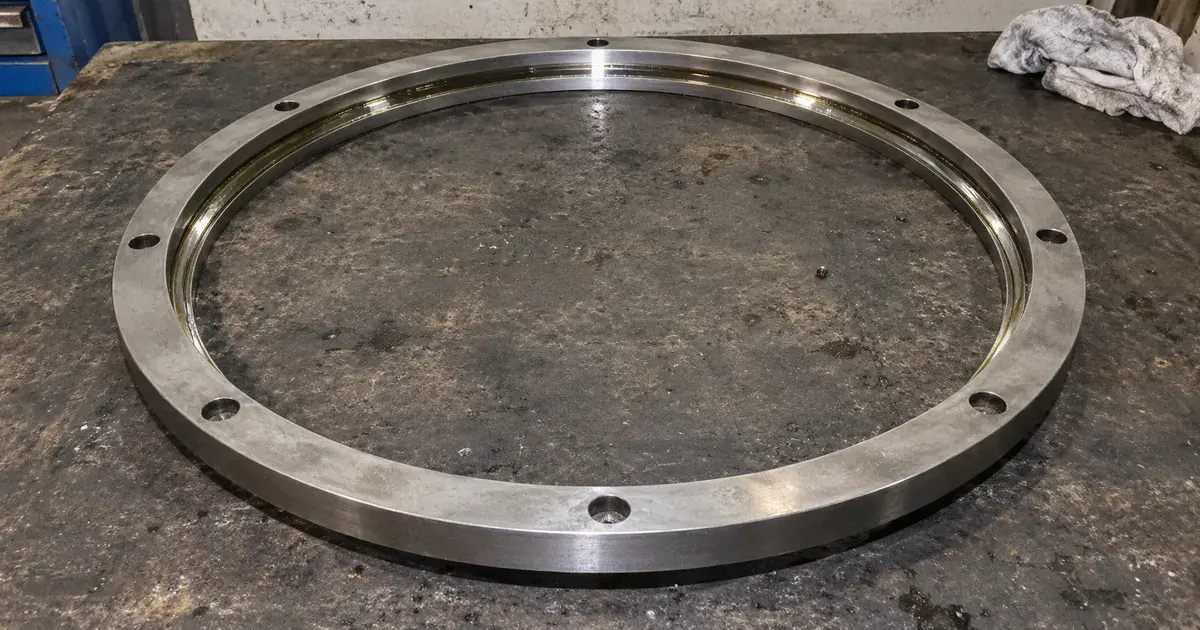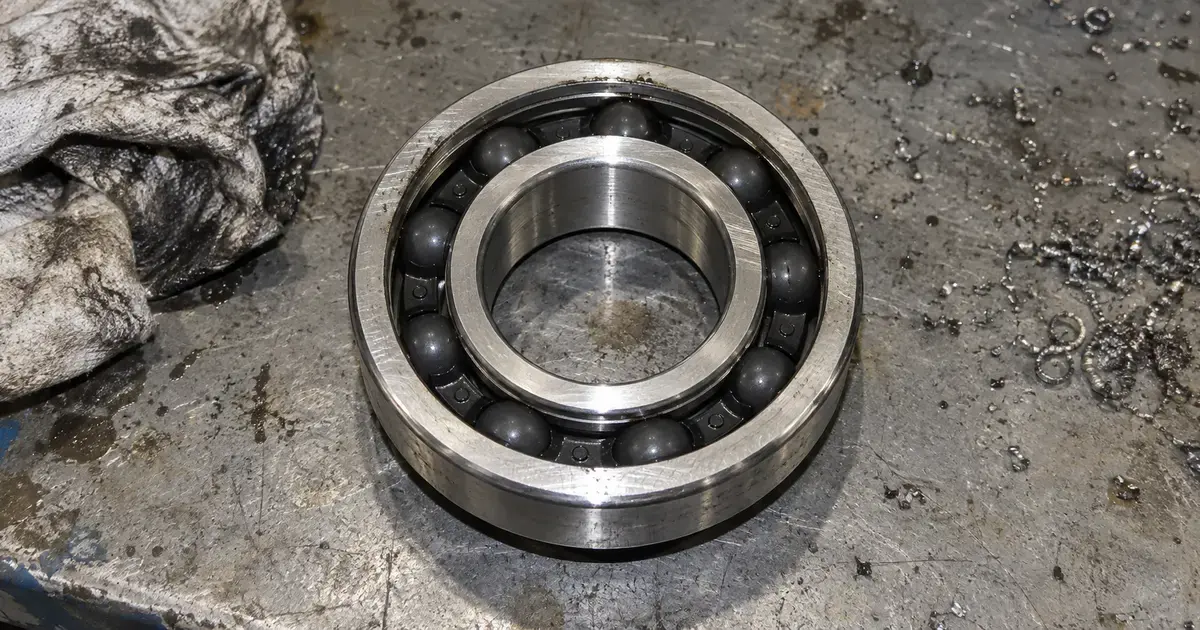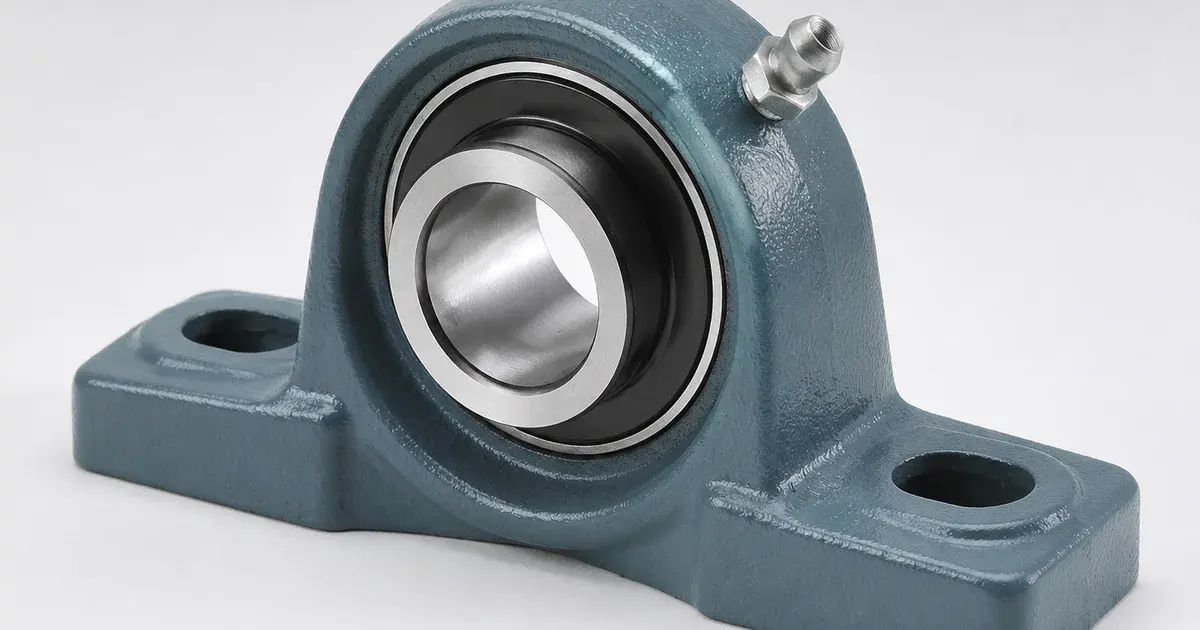
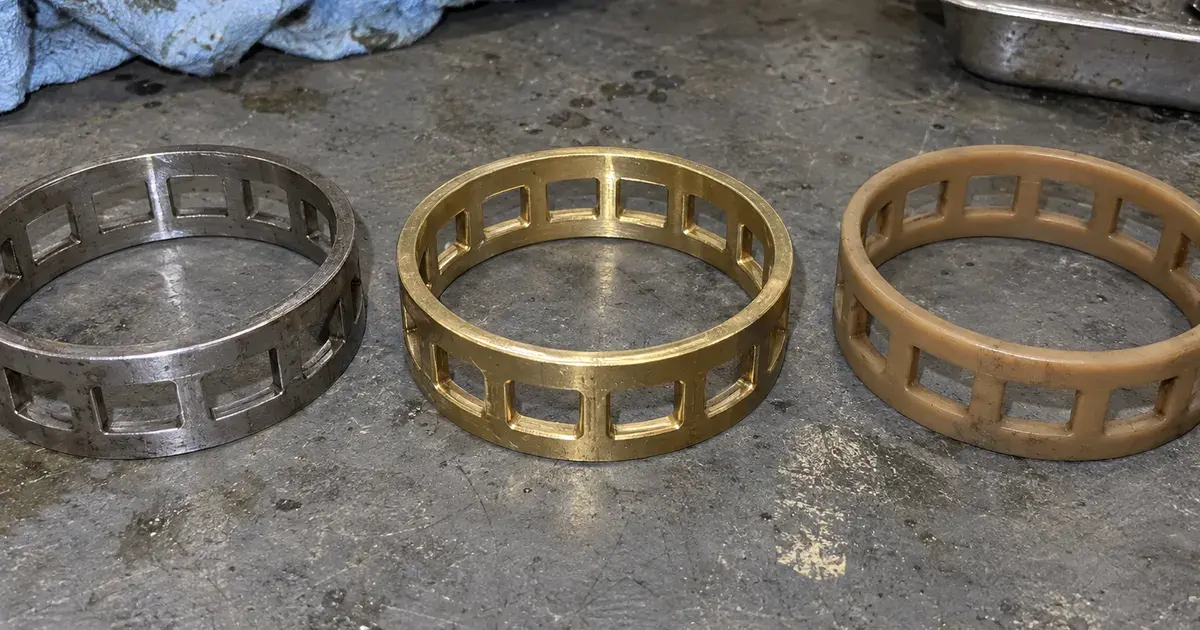
The cage carries none of the load. It still decides how fast the bearing can turn, how hot it can run, and what you are allowed to wash it with.
That combination makes it the most consequential part of a bearing that buyers routinely leave off the order. Cage information lives in the suffix. The suffix is where manufacturers stop following ISO and start writing house codes. And the limits get quoted as a single temperature number that, in one important case, does not exist. This guide covers what the cage does and what each material actually withstands. It then takes guidance as a second and separate decision, reads the codes across brands, checks what the catalogue says about removing the cage entirely, and ends on how cages fail. If you need the structure of a designation first, start with our guide to reading a bearing number.
Key Takeaways
- The cage separates and spaces the rolling elements, guides them through the unloaded arc, and holds separable bearings together as an assembly. ISO 5593:2023 is the vocabulary that defines the terms.
- Material sets the temperature ceiling. SKF gives steel cages up to 300 °C and brass up to 250 °C. Polyamide has no single figure: its permissible temperature is defined as the one that still yields at least 10 000 hours of cage ageing life in that lubricant.
- The lubricant ages a polymer cage, not just the heat. Glass fibre reinforced PA66 must not run above 70 °C in ammonia, or below −40 °C continuously, where it loses elasticity. PA46 buys 15 °C over PA66. PEEK shows no ageing to 200 °C but softens at 150 °C, which caps high-speed use.
- Guidance is a separate decision from material. A cage is centred by the rolling elements, or guided by a ring land. SKF specifies ring guidance on certain size and series combinations to limit contact stress between the rolling elements and the cage.
- The codes do not travel. A machined brass cage is
Mat SKF andFYat Koyo. Koyo splits material and guidance into two different positions of the designation, where SKF fuses them into one letter.- Removing the cage is a trade rather than an upgrade. On one verified SKF pair of identical size, the full complement bearing takes 17% more static load and gives up 70% of its limiting speed.
What Does a Bearing Cage Actually Do?
A cage does four things. It separates the rolling elements so they cannot rub against each other, and spaces them evenly around the raceway so the load shares out. It guides them through the arc where no load is applied. On separable bearings it also holds the whole assembly together for handling and mounting. Cage, retainer, and separator are three names for the same part. ISO 5593:2023, the rolling bearing vocabulary, is the standard that fixes the terminology, including forms such as the window cage, a one-piece cage whose pockets surround the rolling elements.
None of those four jobs is load transmission. NTN states the point directly in its general catalogue: cages maintain the rolling elements at a uniform pitch, and load is never applied directly to the cage (NTN, CAT. No. 2203).
What the cage does experience is a specific and awkward set of stresses. SKF lists frictional, impact, centrifugal and inertial forces, and adds that cages can be chemically influenced by certain organic solvents or coolants, lubricants, and lubricant additives (SKF). That list is the reason material choice dominates cage selection. A part that carries no load is not chosen for strength. It is chosen for how it behaves at temperature, in a particular chemistry, at speed.
What Are Bearing Cages Made Of?
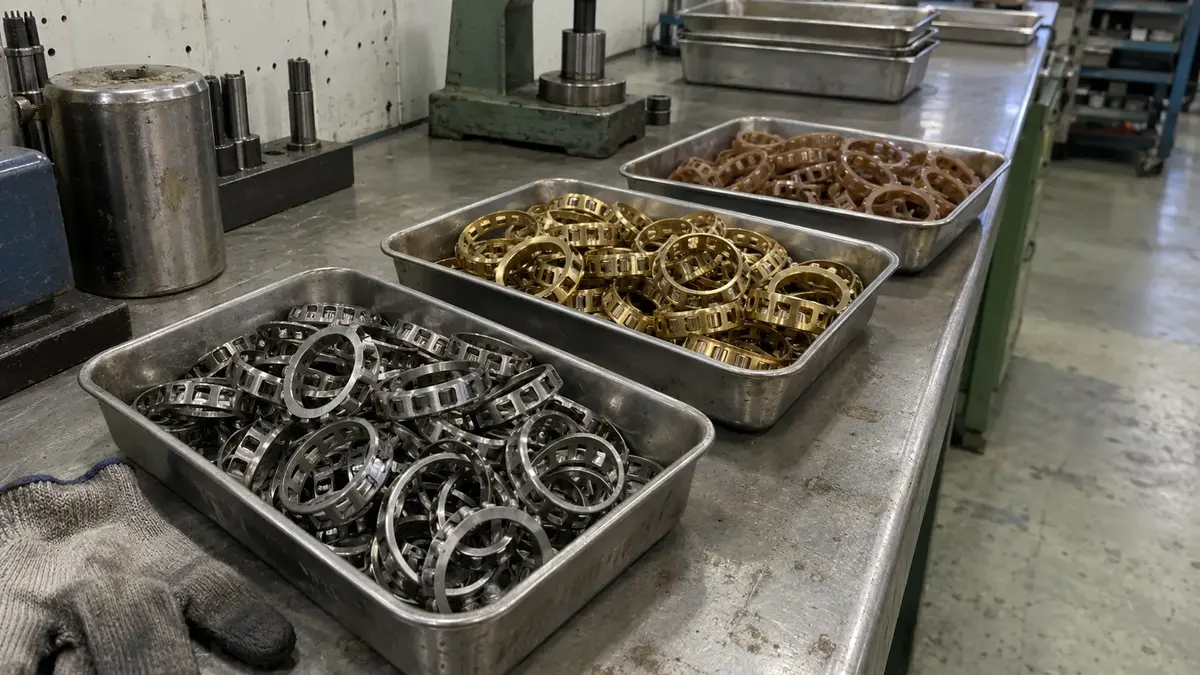
Four families cover nearly all of it: stamped sheet steel, machined steel or brass, injection moulded polyamide, and PEEK for high speed or aggressive chemistry. Their ceilings sit far apart. SKF gives steel cages an operating temperature up to 300 °C (570 °F) and brass cages up to 250 °C (480 °F) (SKF).
The steels are less interchangeable than they look. Stamped sheet steel cages are made of low carbon steel. They are light and have relatively high strength, and on some bearing types they can be surface treated to reduce friction and wear in critical conditions. Machined steel cages are normally made of non-alloyed structural steel. SKF notes that machined steel cages are unaffected by the mineral or synthetic oil-based lubricants normally used in rolling bearings, and by the organic solvents used to clean bearings. That last point matters if parts get washed between service intervals.
Brass behaves similarly on chemistry. Most brass cages are machined from cast or wrought brass and are unaffected by most common bearing lubricants, including synthetic oils and greases, and can be cleaned with organic solvents. Koyo's designation tables name the alloy more precisely for its own machined cages: high-tensile brass casting (Koyo).
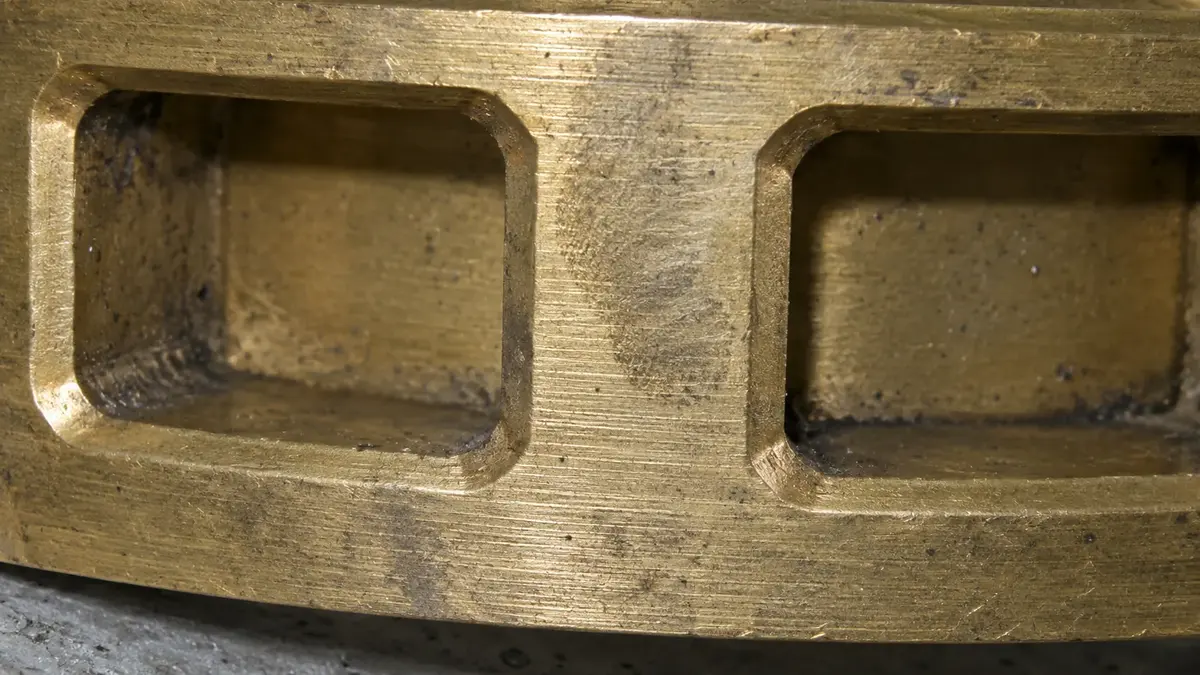
There is one exception worth carrying to the order desk, because it splits brass into two different answers. In applications such as refrigeration compressors that use ammonia, SKF specifies machined brass or steel cages, and rules out stamped sheet brass. Sheet and machined brass are not substitutes in that service even though both are brass.
| Material | Form | Ceiling | Chemistry notes | Typical use |
|---|---|---|---|---|
| Low carbon steel | Stamped sheet | 300 °C | Unaffected by normal bearing lubricants and cleaning solvents | General purpose, the default on most catalogue bearings |
| Non-alloyed structural steel | Machined | 300 °C | As above; some are surface treated for friction and wear | Larger sizes, higher duty |
| Brass | Stamped sheet | 250 °C | Not for ammonia service | Some small and medium sizes |
| Brass (cast or wrought) | Machined | 250 °C | Unaffected by most lubricants including synthetics; solvent cleanable | Heavy duty, high speed, shock loads |
| Glass fibre reinforced PA66 | Injection moulded | No single figure; ages | 70 °C ceiling in ammonia; −40 °C cold floor | Very common on small and medium bearings |
| Glass fibre reinforced PA46 | Injection moulded | PA66 + 15 °C | As PA66 | Standard on some CARB toroidal roller bearings |
| Glass fibre reinforced PEEK | Injection moulded | 200 °C, no ageing; 150 °C at high speed | High chemical and wear resistance | Hybrid and super-precision ball and cylindrical roller bearings |
| Phenol resin | Machined | Not published by Koyo | Lightweight, low inertia | High-speed precision, listed as Koyo code FT |
Ceilings and chemistry notes are SKF's; the phenol resin row is Koyo's designation table. For the ring and roller steels these cages sit inside, see our guide to rolling mill bearing materials.
Why Are Polyamide Cages Rated by Life Instead of Temperature?
A polymer cage does not fail at a threshold. It ages. The rate depends on temperature, on time, and on the medium it is exposed to, which in practice means the lubricant. So SKF does not publish a single number for polyamide. It publishes a permissible operating temperature defined as the temperature that provides a cage ageing life of at least 10 000 operating hours (SKF).
That definition is the answer to the question, and it has a different shape from the one most people expect. Ask "what temperature is nylon good to" and you are asking for a property of the plastic. The honest answer is a property of the plastic, the lubricant, and the service life you need, together.
PA66 is the most commonly used material for injection moulded cages, with or without glass fibres, because it combines strength and elasticity well. Its mechanical properties are temperature dependent and subject to ageing, and SKF classifies lubricants as aggressive or mild, with the permissible temperature moving accordingly. Whether a polyamide cage suits your application therefore depends on the operating conditions and the life requirement, not on a lookup value.
Two bounds are firm enough to memorise. Some media are more aggressive than the ones in SKF's lubricant table. Ammonia in refrigeration compressors is the named example, and there glass fibre reinforced PA66 should not be used above 70 °C (160 °F). At the other end, polyamide loses its elasticity when cold, so glass fibre reinforced PA66 should not be used where the continuous operating temperature is below −40 °C (−40 °F).
Two upgrades exist when PA66 runs out of room. Glass fibre reinforced PA46 has a permissible operating temperature 15 °C (25 °F) higher than PA66, and is the standard cage material for some small and medium CARB toroidal roller bearings. Glass fibre reinforced PEEK is the step beyond, suited to high speeds, chemical resistance, or high temperatures. PEEK shows no signs of ageing from temperature or oil additives up to 200 °C (390 °F). Its maximum for high-speed use is lower, at 150 °C (300 °F), because that is the softening temperature of the polymer. PEEK cages are commonly available on hybrid and super-precision ball and cylindrical roller bearings, which is where you meet them in our guide to ceramic and hybrid bearings.
Other manufacturers do publish single figures, and the two framings are compatible once you read them as different things. NTN rates its T2 polyamide cage at 120 °C peak and 100 °C continuous, which is a design limit for that specific cage in normal service. SKF's ageing-life definition tells you what happens either side of such a number in a given lubricant. Use the manufacturer's figure for the cage you are ordering, and use the ageing-life reasoning when the lubricant or the duty is unusual.
The practical consequence is that lubricant selection and cage selection are one decision, not two. If the grease changes, the cage's permissible temperature changes with it. Our guide to bearing lubrication covers the chemistry and additive side of that pairing.
Ball-Centred or Ring-Guided? How a Cage Is Located
Material is half of a cage specification. The other half is how the cage is located, and that is a genuinely separate decision. A cage is either centred by the rolling elements it holds, or guided by a land on the inner or outer ring. Which one you get follows from bearing size, series, speed, and how the bearing is assembled.
SKF gives the engineering reasons rather than leaving guidance as a catalogue quirk. Some bearing types need either split or snap-type cages, because they are assembled after the rings and rolling elements have been sub-assembled. Other types need roller-guided cages in order to be self-containing. And bearings of a certain combination of size and series need ring-guided cages, to limit contact stress between the rolling elements and the cage (SKF). Read in order, those three reasons say that the guidance is dictated by assembly method, self-containment, and contact stress, in that sequence, before anyone gets to express a preference.
A guided land introduces a sliding contact that did not exist on a ball-centred cage, and that contact needs lubricant. This is what SKF's S suffix marks: a lubrication groove in the guiding surface. If you see MAS or MBS on a designation, the groove is the difference.
Cages also get classified by how they are made rather than where they run. NTN sorts them into pressed, machined, and formed types (NTN, CAT. No. 2203). Koyo's designation tables carry a fourth: a pin type cage, coded FP in carbon steel, used on large roller bearings where pins pass through drilled rollers. Large ring-guided cages are common in the sizes covered by our guide to four-row cylindrical roller bearings.
One thing guidance is not is a precision specification. Cage type and tolerance class are independent axes, in the same way clearance class and tolerance class are; see ABEC ratings and ISO 492 tolerance classes for that distinction.
How Do You Read a Cage Suffix Across Brands?
The cage code encodes material and centring together, and no standard governs it. Each manufacturer writes its own, which is exactly why an interchange that maps suffixes letter by letter produces the right size with the wrong bearing.
SKF's deep groove ball bearing designation system is unusually explicit, because it names the centring in every cage entry (SKF):
| SKF code | Cage |
|---|---|
M | Machined brass, ball centred. A number after the M marks a different design or material grade, for example M2 |
MA(S) | Machined brass, outer ring centred. The S indicates a lubrication groove in the guiding surface |
MB(S) | Machined brass, inner ring centred. The S indicates a lubrication groove in the guiding surface |
TN9 | Glass fibre reinforced PA66, ball centred |
TN9/VG1561 | Glass fibre reinforced PA46, ball centred |
JEM | Stamped steel, ball centred. See the warning below |
M, MA, and MB are all machined brass. The letter that follows tells you where the cage is located, which is a real difference in friction, lubricant routing, and behaviour under acceleration. Treating them as one code because they share a material is a common ordering error.
JEM deserves its own paragraph, because it is a cage code that quietly changes two things that are not the cage. SKF documents it as "an aftermarket designation used on the package only. The bearing itself is marked according to the SKF designation system." It adds that the suffix "also indicates C3 internal clearance and GJN grease for bearings capped on both sides." A part number that looks like a cage variant is therefore also a clearance change. If you have ever had a JEM bearing run differently from the J you expected, that is why, and our guide to internal clearance classes covers what a jump to C3 does.
Now compare a second house. Koyo publishes its cage codes in a completely different alphabet, and structures them differently as well (Koyo):
| Koyo code | Cage | Family |
|---|---|---|
// | Steel sheet | Pressed |
YS | Stainless steel sheet | Pressed |
FT | Phenol resin | Machined |
FY | High-tensile brass casting | Machined |
FW | High-tensile brass casting, separable type | Machined |
NG, FG | Polyamide | Moulded |
FP | Carbon steel | Pin type |
PA | With outer ring guide cage | Guidance, ball bearings |
Q3 | With roller guide cage | Guidance, roller bearings |
V | Full complement, no cage | Construction |
The structural difference is the useful part. SKF fuses material and guidance into a single letter, so M and MA differ by guidance alone. Koyo separates them: the material sits in the cage material and type position, while PA and Q3 sit in a cage guide position elsewhere in the designation. A machined brass outer-ring-guided cage is one code at SKF and two at Koyo. That is not a translation problem a lookup table can solve. It is the strongest argument there is for mapping suffixes by function, which is the method in our guide to bearing cross reference charts.
The two houses do agree on one letter. V means full complement in both systems, which is why the bearing in the next section is called NCF 2224 V.
Caged or Cageless: What Does the Catalogue Actually Say?
Every general explanation of full complement bearings says they carry more load and run slower. That is true enough to be useless for specifying, because it does not say which load rating goes up or by how much the speed falls. SKF's own product data does, and the answer is more specific than the slogan.
Take two single row cylindrical roller bearings with identical boundary dimensions, 120 x 215 x 58 mm. One has a machined brass cage. One has no cage at all.
Caged NU 2224 ECM | Full complement NCF 2224 V | Change | |
|---|---|---|---|
| Cage | Machined brass | None | |
| Basic dynamic load rating C | 520 kN | 512 kN | −1.5% |
| Basic static load rating C₀ | 630 kN | 735 kN | +16.7% |
| Reference speed | 3 400 r/min | 1 400 r/min | −59% |
| Limiting speed | 5 600 r/min | 1 700 r/min | −70% |
Sources: SKF NU 2224 ECM and SKF NCF 2224 V, retrieved 2026-09-09.
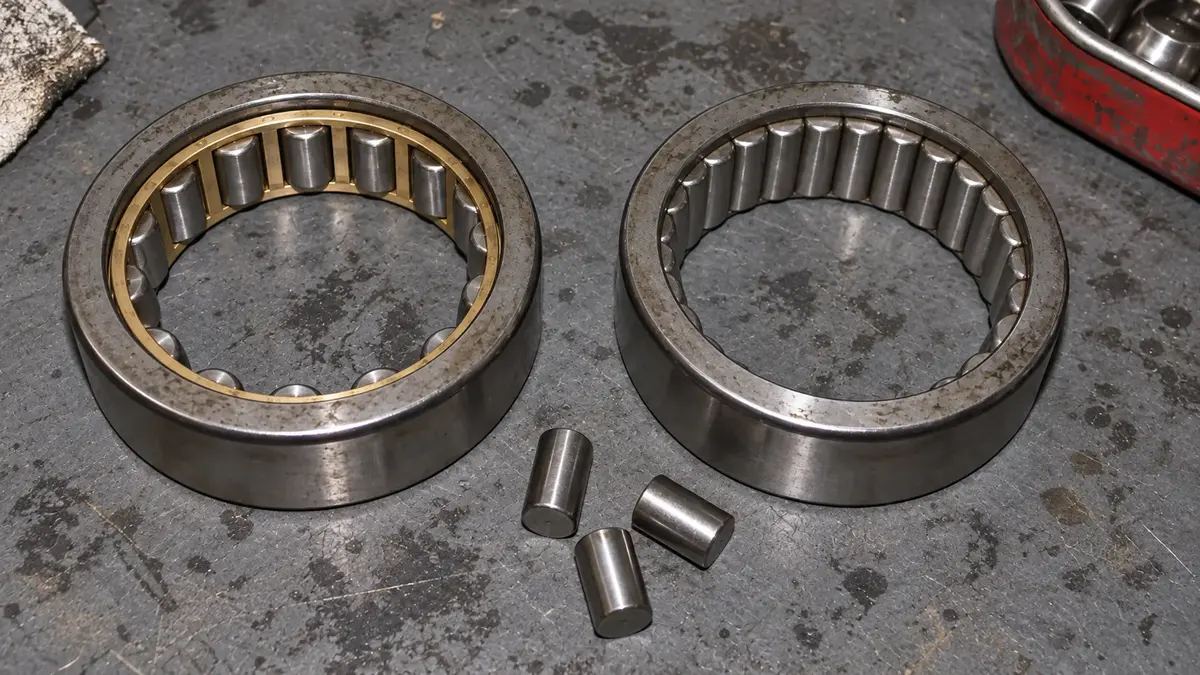
Two honest caveats belong with those numbers. The caged bearing carries SKF's EC increased-capacity internal design, so part of the small dynamic-rating gap reflects that design rather than the presence of a cage. And this is one size pair. The ratio moves across the range, so treat it as a verified data point rather than a general law and check your own size before you rely on it.
Read that way, the trade is clear. SKF describes full complement bearings as not equipped with a cage, incorporating a maximum number of rollers, and therefore suitable for very heavy radial loads at lower speeds (SKF). Where the capacity shows up is the static rating, which is the one that matters for heavy, slow, or oscillating duty. Our guide to dynamic and static load ratings covers why C and C₀ answer different questions.
The mechanism behind the speed penalty is roller skew. A cage holds each roller parallel to the bearing axis. With nothing performing that job, the rollers can skew, rub against each other, and generate heat, which is what sets the ceiling. The same trade appears in the needle bearing family, where it is often the primary selection decision; see caged and full complement needle roller bearings for that version. The equivalent choice between roller geometries is in tapered versus cylindrical roller bearings.
Manufacturers have been working the middle of this trade. SKF markets separable high-capacity cylindrical roller bearings that it says combine the high load carrying capacity of full complement bearings with the high speed capability of bearings with a cage. Treat that as SKF's claim for a specific product family rather than a general result.
How Do Bearing Cages Fail?
Cage damage is nearly always a symptom. NSK's troubleshooting entry for cage damage lists seven possible causes, and not one of them is an underspecified cage (NSK). The causes are poor mounting with bearing misalignment, poor handling, large moment load, shock and large vibration, excessive rotation speed with sudden acceleration and deceleration, poor lubrication, and temperature rise.
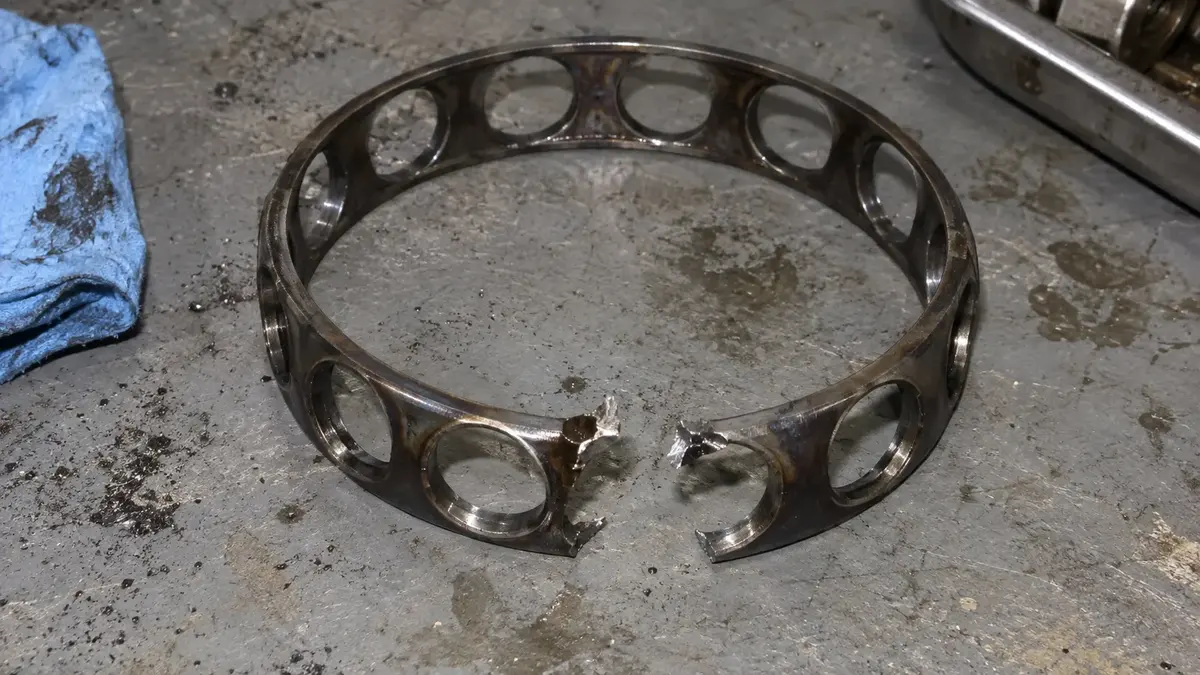
| Damage condition | What NSK attributes it to | NSK countermeasures |
|---|---|---|
| Cage deformation, fracture, wear | Poor mounting and misalignment; poor handling | Check the mounting method |
| Fracture of cage pillars | Shock and large vibration; large moment load | Reduce the vibration |
| Deformation of the side face | Poor handling; poor mounting | Check the mounting method |
| Wear of the pocket surface | Poor lubrication; excessive speed with sudden acceleration and deceleration | Change the lubrication method or lubricant; select a different cage type |
| Wear of the guide surface | Poor lubrication; temperature rise | Check temperature, rotation and load conditions |
Conditions and causes are NSK's; the pairing of individual conditions to the most closely associated causes is engineering summary, since NSK presents the two as lists.
That table has a diagnostic use beyond its rows. Wear of the guide surface can only occur on a cage that has a guide surface, which means a ring-guided cage. Finding it tells you something about the bearing's construction as well as its service history, and it points at lubricant supply to the guiding land rather than at the pockets. NSK illustrates cage damage on deep groove, angular contact, tapered roller, and cylindrical roller cages, so this is not one family's problem.
Polymer cages add a mode the table does not cover, and it follows directly from the ageing behaviour above. An aged polyamide cage becomes embrittled and can crack without any matching overload event. Say a cracked polymer cage comes out of a position with no shock history, no misalignment, and a load well inside rating. Look at the operating temperature and the lubricant before you look for a mechanical cause.
Note what is absent here: a percentage. Manufacturers publish cage damage as a qualitative mode, and any figure claiming a share of bearing failures caused by cages should be traced before use. The mode framework worth citing is the one in our guide to bearing failure analysis, with the heavy-industry case worked through in hot strip mill bearing failure analysis. Because misalignment heads NSK's cause list, spherical roller bearings and misalignment is often the more useful upstream fix. Cage noise usually arrives before cage damage does, and bearing noise diagnosis covers reading it.
How Do You Specify a Cage?
Work four inputs in order, and the material and guidance fall out of them. Default to the manufacturer's standard cage unless one of the four pushes you off it, because the standard cage is the one made in volume for that size.
Two things are worth saying about what this decision is not.
It is not a fix for something else. A cage change will not correct misalignment, restore a lubricant supply, or absorb a shock load the position should not be seeing. Since misalignment, poor lubrication, and vibration head NSK's cause list, changing the cage on a repeat failure without addressing those first buys a second failure with a different part number.
And it is usually not a redesign. Cage choice is normally a line on the order rather than a change to the housing or shaft. SKF offers its Quiet Running deep groove ball bearings with pressed steel or machined brass cages and states that they remain fully interchangeable with standard deep groove ball bearings. That interchangeability is what makes the cage a practical lever: you can change it without touching anything around it.
That puts the cage alongside two decisions this site covers separately. Internal clearance, sealing, and cage are the three specification levers you set on an otherwise standard bearing. They interact. Clearance and cage both respond to temperature, and seal drag is one of the things that raises it. See internal clearance classes and sealed versus shielded bearings for the other two.
If you are specifying a cage for a position now, send us the operating temperature, the lubricant, the speed, and the duty cycle. ANDE's engineering team will come back with a cage material and guidance recommendation, and confirm what is available in your size. That beats quoting the standard cage and leaving you to find out later.
Frequently Asked Questions
What is the cage in a bearing?
The cage separates the rolling elements so they cannot rub, spaces them evenly around the raceway, and guides them through the unloaded arc. On separable bearings it also holds the assembly together for handling and mounting. It carries no load. ISO 5593:2023 defines the terminology, including forms such as the window cage. Cage, retainer, and separator all name the same part.
What are bearing cages made of?
Stamped or machined steel, stamped or machined brass, injection moulded polyamide (PA66 or PA46), and glass fibre reinforced PEEK cover almost all production. SKF gives steel cages an operating ceiling of 300 °C and brass 250 °C. Koyo additionally lists machined phenol resin cages and carbon steel pin type cages in its designation tables.
What temperature can a polyamide cage take?
There is no single figure, and that is the accurate answer rather than an evasion. SKF defines the permissible operating temperature for glass fibre reinforced PA66 as the temperature giving a cage ageing life of at least 10 000 operating hours in the lubricant used. It therefore moves with lubricant aggressiveness. Two bounds are fixed: 70 °C in ammonia service, and a −40 °C floor for continuous operation, below which the material loses elasticity.
Can a bearing run without a cage?
Yes. Full complement bearings drop the cage and fit the maximum number of rolling elements. On SKF's 120 x 215 x 58 mm cylindrical roller pair, the full complement NCF 2224 V has a 16.7% higher static load rating than the caged NU 2224 ECM. Its limiting speed is 70% lower. The dynamic load rating is almost unchanged, so the trade is static capacity against speed.
What causes bearing cage failure?
NSK attributes cage damage to poor mounting with misalignment, poor handling, large moment load, shock and large vibration, excessive rotation speed with sudden acceleration and deceleration, poor lubrication, and temperature rise. Selecting a different cage type is one of its countermeasures, but it sits alongside checking the mounting method and the lubricant. Rule the upstream causes out before you reach for a stronger cage.
Does the cage suffix mean the same thing across manufacturers?
No, and the structure differs as well as the letters. A machined brass cage is M at SKF and FY at Koyo. SKF encodes guidance in the same letter, so M is ball centred and MA is outer ring centred. Koyo puts guidance in a separate position of the designation, as PA or Q3. Map cage codes by function, never letter for letter.
The Short Version
The cage carries none of the load and sets most of the envelope. Four points are worth keeping:
- Material fixes the temperature ceiling, and the two metals have published numbers while polyamide does not. Steel 300 °C, brass 250 °C, PEEK 200 °C with a 150 °C high-speed limit, and polyamide rated by ageing life in a specific lubricant.
- Guidance is a second decision. Ball centred, inner ring guided, and outer ring guided are different parts, with different friction, lubricant needs, and failure signatures. SKF chooses ring guidance to limit contact stress rather than as a preference.
- The code does not survive a letter-for-letter interchange. SKF fuses material and guidance into one letter; Koyo splits them across two positions.
JEMchanges the clearance as well as the cage. - Cage damage is a symptom. Misalignment, handling, shock, over-speed, lubrication, and temperature account for it. Look upstream before changing the part.
Send your operating temperature, lubricant, speed, and duty cycle to ANDE's engineering team for a cage material and guidance recommendation on the size you need.
About the Author
Jeff Li writes on bearing engineering and global sourcing for ANDE Bearing. He works directly with OEM and aftermarket buyers in automotive, heavy industry, and renewable energy. Connect on LinkedIn.