Why Rolling Mill Bearing Materials Determine Equipment Uptime
A rolling mill doesn't forgive weak bearings. When a hot strip mill or plate mill is running at full capacity, the forces acting on roll neck bearings are extraordinary — radial loads measured in hundreds of tons, operating temperatures exceeding 300°F, and relentless shock loading from billet entry. In this environment, the wrong bearing material doesn't just wear faster. It fails catastrophically, and unplanned downtime in a rolling mill can cost tens of thousands of dollars per hour.
This is precisely why rolling mill bearing materials are a strategic engineering decision, not a catalog selection. Standard industrial bearings are designed for steady loads and predictable conditions. Roll neck applications deliver the opposite: cyclical overloads, thermal gradients, and impact forces that strip away lubricant films and initiate fatigue cracks deep within the steel.
The engineering response to these demands follows two distinct metallurgical paths:
- Through-hardening — creating uniform hardness throughout the bearing cross-section
- Case-hardening — developing a hard outer surface over a tough, ductile core
The central challenge is balancing surface hardness (which resists contact fatigue) against core toughness (which absorbs shock without brittle fracture). Getting that balance right starts with understanding the industry's benchmark material — and knowing exactly where its limits lie.
The Industry Standard: High-Carbon Chromium Steel (100Cr6 / AISI 52100) for Rolling Mill Bearings
As established earlier, bearing material selection is a direct lever on mill uptime. For most rolling mill applications, the conversation starts — and often ends — with one alloy: AISI 52100, known internationally as 100Cr6. It's the benchmark against which every other steel mill bearing alloy gets measured, and for good reason.
Composition and Fatigue Strength
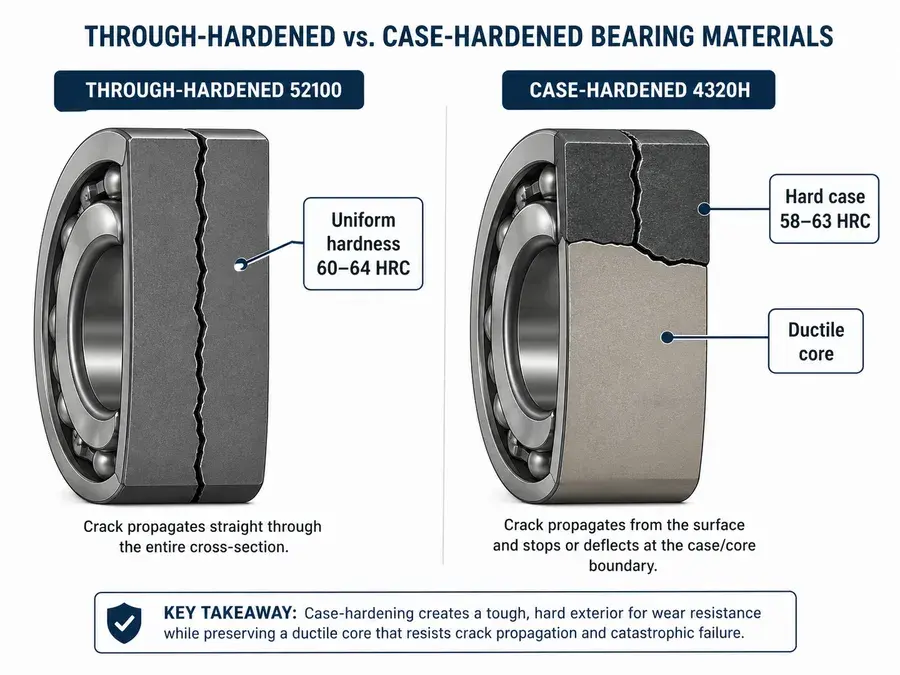
52100's chemistry is deceptively simple: approximately 1.0% carbon and 1.5% chromium, balanced with manganese and silicon. That high carbon content is the key driver. During heat treatment, carbon combines with chromium to form fine carbide particles distributed throughout the matrix, producing a hardness of 60–64 HRC through the entire cross-section. Through-hardening gives 52100 a uniformly hard structure capable of resisting the rolling contact fatigue that dominates bearing failure modes in cylindrical roller and backing roll applications.
Where Through-Hardened 52100 Excels
For cylindrical roller bearings supporting work rolls, and for backing bearings in cluster mills, 52100 delivers consistent performance under steady, high radial loads. Its predictable fatigue behavior and excellent dimensional stability make it a reliable choice where loads are continuous and well-distributed.
The Critical Limitation: Brittle Fracture Risk
However, through-hardening has a significant downside. A uniformly hard microstructure has limited capacity to absorb sudden impact energy. Under shock loads — common at the entry point of a billet mill or during a cobble event — through-hardened steel can fracture catastrophically rather than deform and absorb energy.
Specifying 'Extra Clean' 52100
When fatigue life must be maximized, specifying vacuum-degassed or extra-clean 52100 reduces non-metallic inclusions that act as crack initiation sites. In practice, this upgrade can meaningfully extend L10 bearing life in demanding temper mill applications.
This brittleness limitation is precisely why certain heavy-impact rolling positions demand a fundamentally different metallurgical approach — one built around case-hardened steel grades designed to absorb shock without shattering.
Case-Hardened Bearing Steel for Heavy Shock Loads: 4320H vs 52100
As covered in the previous section, through-hardened 52100 delivers excellent performance under steady, predictable loads. But rolling mill applications rarely stay predictable. Cobble events, sudden billet jams, and strip breaks create instantaneous shock loads that can reach several times the nominal operating force. In those moments, the very hardness that makes 52100 so effective becomes a liability.
The Mechanics of Carburizing: Hard Skin, Tough Core
Carburizing—the foundation of case-hardened industrial roller bearing steel grades—is a heat treatment process that diffuses carbon into the outer surface of a lower-carbon steel. The result is a bearing with two distinct zones working in concert: a hard, wear-resistant outer case (typically 58–63 HRC) and a relatively soft, ductile core beneath it.
That core is what changes everything under shock loading. A ductile core absorbs and redistributes impact energy rather than allowing a crack to propagate straight through the race. Through-hardened steels like 52100 are uniform throughout, meaning an initiated surface crack can travel directly to the bore or outer diameter, causing catastrophic shattering. Case-hardened steel effectively stops that crack at the boundary between the hard case and the tough core.

In applications subject to heavy shock loads and misalignment, case-hardened steel components can extend service life significantly compared to their through-hardened equivalents. This improvement is attributed to the material's superior fracture toughness and its ability to resist crack propagation from surface defects like spalls.
Key Grades: 17CrNiMo7-6 and SAE 4320H
Two grades dominate this application space:
- SAE 4320H — A nickel-chromium-molybdenum alloy that carburizes predictably and produces excellent core toughness. Common in North American mill specifications.
- 17CrNiMo7-6 — The European standard equivalent, widely used in heavy-duty gearbox and large-bore bearing applications. It offers slightly higher alloy content, improving hardenability in thick sections.
Both grades are engineered specifically for applications where impact resistance outweighs the need for maximum surface fatigue life.
Why Four-Row Tapered Roller Bearings Demand Case-Hardening
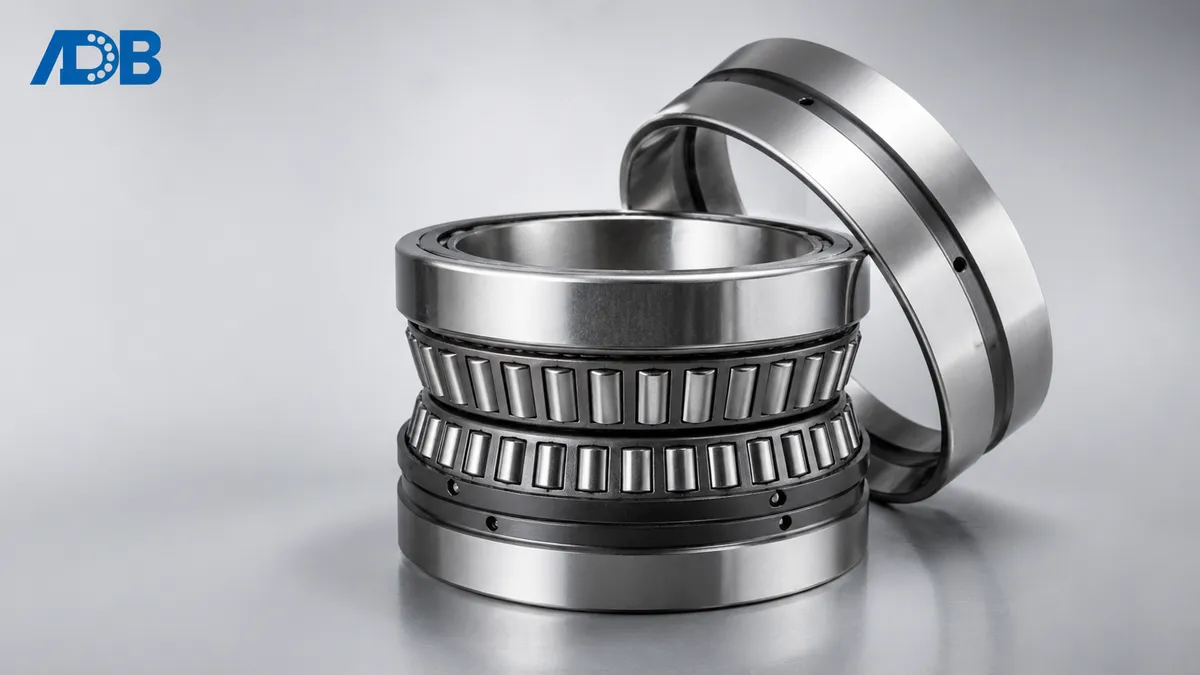
Four-row tapered roller bearings in work roll and backup roll positions experience the harshest combined loading in any mill stand—radial forces, axial thrust, and shock events, all simultaneously. In practice, most OEM specifications for these bearing types require case-hardened races precisely because through-hardened variants cannot reliably survive the crack propagation risk under repeated shock cycles.
The grade selection, however, is only part of the story. Equally critical is what holds the rollers in position under those same violent conditions—which brings the cage material into focus.
Four-Row Tapered Roller Bearing Material and Specialized Cage Components
While the previous sections focused on the steel used for rings and rolling elements, the cage is equally critical — and it's where many mill bearings silently fail first. Understanding what steel is used for rolling mill bearings is only part of the picture; the cage material determines how long that bearing survives in real operating conditions.
Why Steel Cages Fall Short in Mill Environments
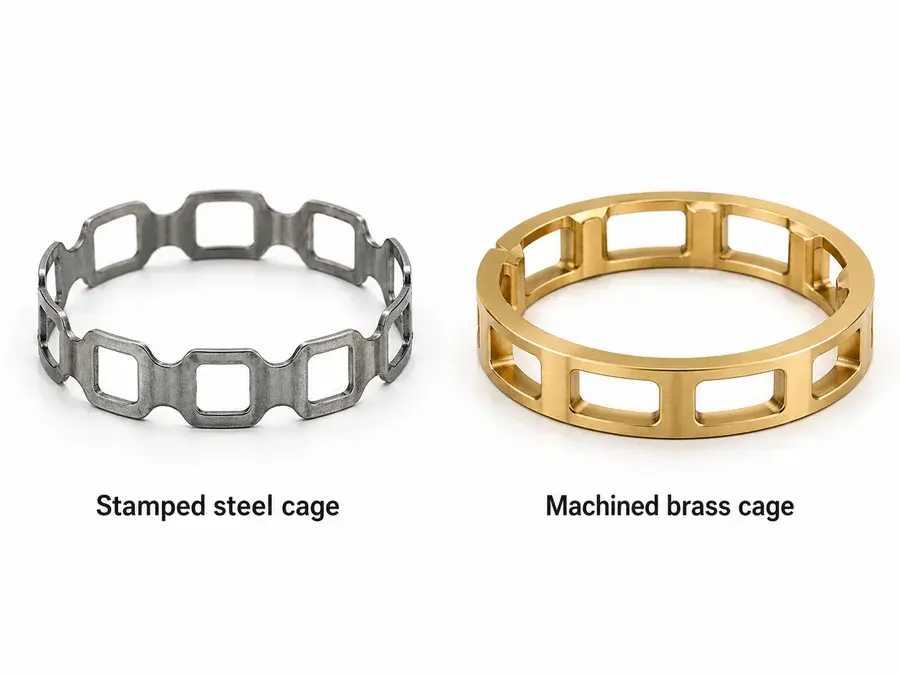
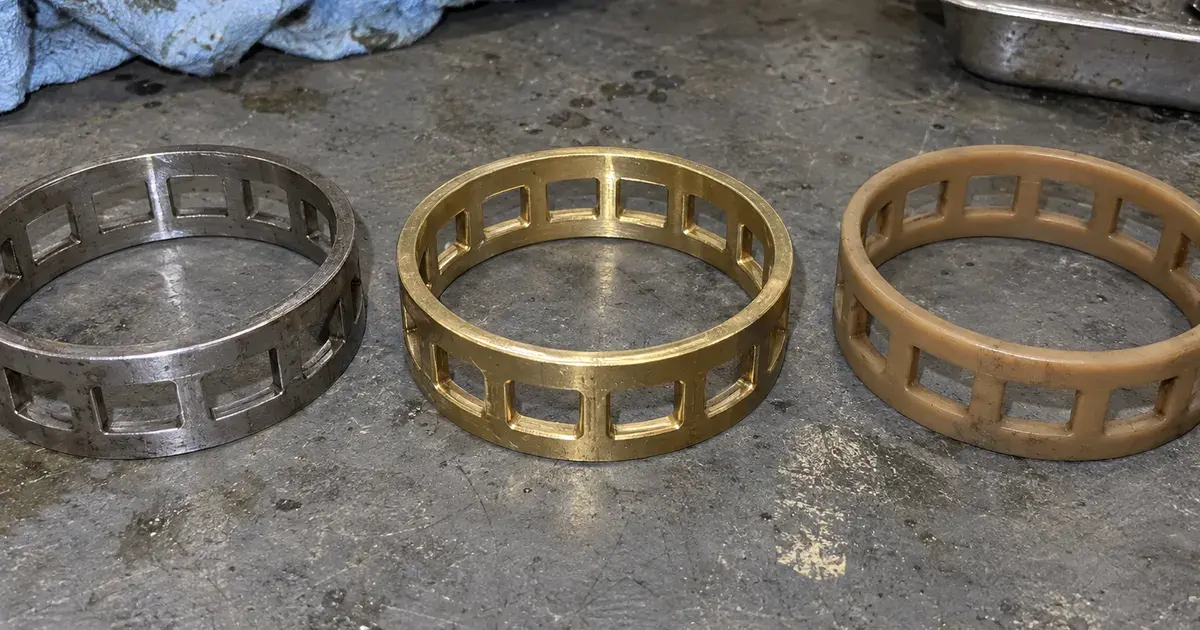
Stamped or pressed steel cages are cost-effective, but they struggle in high-vibration rolling mill environments. Rapid acceleration and deceleration cycles — common during coil changes, speed transitions, and threading operations — generate impact forces that steel cages simply absorb poorly. The result is fatigue cracking, roller skewing, and accelerated wear at the cage pockets.
The Case for Machined Brass Cages (M/MA Suffix)
Machined brass cages, identified by the M or MA bearing suffix, are the preferred solution for demanding mill applications. Brass offers two key advantages:
- Self-lubrication: Brass has a naturally low coefficient of friction against steel, reducing heat generation at the roller-cage interface even when lubrication films thin out temporarily.
- Vibration damping: Brass absorbs energy during shock loading, cushioning rollers during sudden load reversals that would fracture a steel cage.

In practice, brass-caged four-row tapered rollers outlast steel-caged equivalents significantly in reversing mill stands.
High-Speed Cold Mill Alternatives
For high-speed cold rolling mills, where operating temperatures and speeds exceed brass's practical limits, polyamide (PA66) or fiber-reinforced polymer cages offer superior performance. These materials are lighter, generate less friction, and tolerate the high-RPM conditions common in tandem cold mills.
The right cage choice depends heavily on mill position and load type — a natural lead-in to the position-by-position material selection guide that follows.
What Steel Is Used for Rolling Mill Bearings? A Selection Guide by Mill Position
Not every position in a rolling mill places the same demands on its bearings. Back-up rolls, work rolls, thrust positions, and Sendzimir mills each create a distinct load signature — and matching the right material to each position is where theoretical knowledge meets practical engineering judgment.

Back-Up Roll Bearings: Through-Hardened Cylindrical Rollers
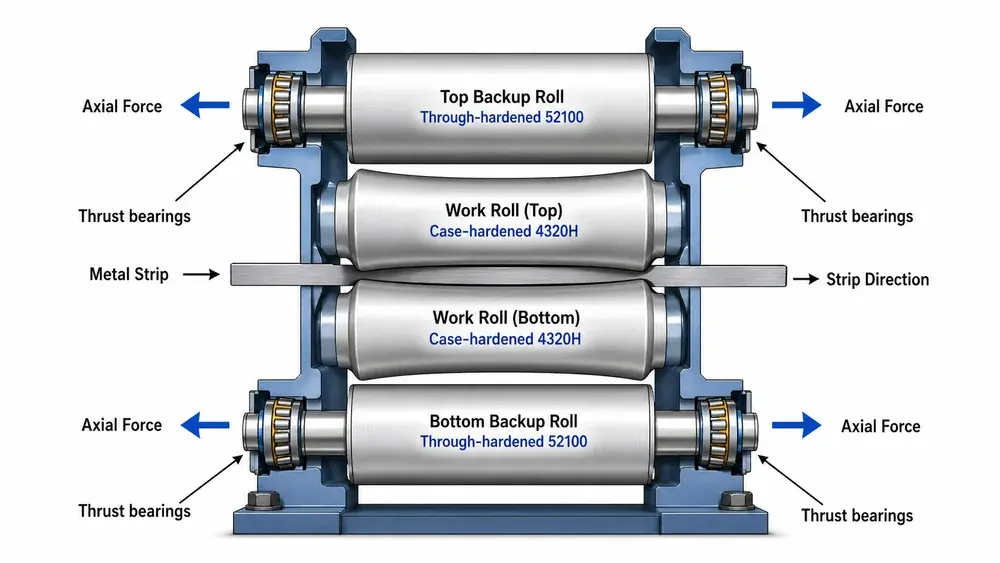
Back-up rolls carry enormous, sustained radial loads under relatively stable conditions. Through-hardened 52100 steel is the standard choice here because the load is predictable, distributed across a large contact area, and rarely involves sudden shock impulses. The uniform hardness through the entire cross-section provides the compressive strength needed to resist subsurface fatigue over millions of load cycles — exactly the failure mode that dominates in high-load, steady-state rolling applications.
Work Roll Bearings: Case-Hardened Four-Row Tapered Rollers
Work rolls are a different story entirely. These bearings absorb both radial and axial forces while enduring strip-change impacts and abrupt load reversals. Four-row tapered roller bearing material at this position must be able to absorb shock without fracturing — which is why case-hardened 4320H consistently outperforms through-hardened alternatives here. The tough, ductile core absorbs impact energy while the hardened case resists surface fatigue and wear from contaminated lubrication environments.
Thrust Bearings: Managing Axial Load in Mill Stands
Thrust bearings in tandem mill stands must handle axial forces generated by strip tension and roll-force imbalances. Angular contact ball bearings and spherical roller thrust bearings made from 52100 are common, though the selection depends heavily on whether the axial load is unidirectional or reversing. Reversing loads typically demand materials with higher toughness ratings.
Sendzimir Mill (Z-Mill) Bearings: Precision Through-Hardening
Sendzimir mills use small-diameter work rolls supported by a cluster arrangement, demanding exceptional dimensional stability under high contact stress. Through-hardened bearing steel — ground to extremely tight tolerances — is non-negotiable here. Any material inconsistency translates directly into strip thickness variation, making metallurgical uniformity as critical as hardness itself.
Material Selection by Mill Position — Quick Reference
| Mill Position | Bearing Type | Recommended Material | Key Reason |
|---|---|---|---|
| Backup Roll | Four-row cylindrical roller | Through-hardened 52100 | Steady high radial load, no shock |
| Work Roll | Four-row tapered roller | Case-hardened 4320H / 17CrNiMo7-6 | Shock loads, combined radial + axial |
| Thrust Position | Angular contact ball / tapered roller thrust | Through-hardened 52100 | Axial-only, predictable loading |
| Sendzimir Mill | Backing bearing | Through-hardened 52100 (extra clean) | Extreme dimensional precision required |
Each position tells you something important about what your bearing steel needs to do first. And when conventional steel reaches its limits, alternative materials — ceramics, specialized coatings, and corrosion-resistant alloys — open up new possibilities worth understanding.
ANDE Bearing manufactures four-row tapered roller bearings, four-row cylindrical roller bearings, and backing bearings for each of these mill positions — with full material traceability documentation including hardness verification, heat-lot records, and dimensional inspection reports to support your incoming quality requirements.
Alternative Materials in Rolling Bearing Construction: Ceramics, Coatings, and Corrosion-Resistant Alloys
Standard bearing steels like 52100 and the case-hardened grades covered earlier handle the majority of rolling mill demands — but certain environments push beyond what carbon-chromium metallurgy can reliably deliver. When the application demands corrosion resistance, magnetic neutrality, or radically reduced friction, alternative materials and surface treatments enter the conversation.
Austenitic Stainless Steel for Corrosive Cooling Environments
In rolling mill positions where water-based coolants and chemical scale inhibitors create aggressive corrosive conditions, AISI 316 austenitic stainless steel offers a defensible alternative. Its elevated molybdenum content (2–3%) provides meaningful resistance to chloride pitting — a failure mode that undermines standard bearing steels quickly in wet mill environments. The trade-off is real, however: 316 offers lower hardness than 52100, making it unsuitable where contact stress is the dominant concern. It works best in lightly loaded, high-corrosion positions.
Ceramic Hybrid Bearings: Reduced Friction, Extended Speed Limits
Silicon nitride (Si₃N₄) ceramic rolling elements paired with steel rings represent the most significant alternative material development in precision bearing design. Ceramic's lower density reduces centrifugal loading at high speeds, while its electrical non-conductivity prevents current-induced fluting damage — a genuine concern in electrically active mill environments. In practice, hybrid ceramic bearings also run cooler, extending lubricant life in demanding cycles.
Protective Coatings: A Practical, Cost-Effective Layer
For operations not ready to commit to ceramic or stainless alternatives, black oxide and phosphate coatings applied to standard steel bearings add meaningful corrosion and mild wear resistance at relatively low cost. These coatings improve lubricant retention during initial run-in, reducing early-stage surface fatigue.
Amagnetic Steels for Specialized Applications
Where electromagnetic interference or magnetic particle accumulation poses operational risk — certain specialty rolling applications — amagnetic bearing steels eliminate ferrous attraction entirely, protecting both bearing integrity and product quality.
Selecting the right material isn't simply a metallurgical decision — it's a systems decision that weighs load profile, environment, speed, and total cost of ownership together. The sections above have mapped the full spectrum from cage materials and position-specific steel grades through to these advanced alternatives. The strategic takeaway is straightforward: match material capability to actual operating conditions, revisit those conditions when the mill changes, and treat bearing material selection as an ongoing engineering discipline rather than a one-time specification choice.
Key Takeaways
- Default to 52100 for steady-load positions — backup rolls and Sendzimir mills run best on through-hardened high-carbon chromium steel where loads are predictable and shock is minimal.
- Switch to case-hardened 4320H or 17CrNiMo7-6 for work rolls — any position with shock loads, combined radial/axial forces, or cobble risk needs the hard-case/ductile-core structure that only carburized steel provides.
- Cage material matters as much as ring material — specify machined brass (M/MA suffix) for reversing mills and high-vibration stands; use polyamide cages for high-speed cold rolling mills.
- When corrosion is the primary threat, don't over-engineer — consider AISI 316 stainless or protective coatings for wet environments before upgrading the entire bearing to exotic materials.
- Match material to mill position, not to catalog availability — use the selection guide above to align bearing steel grade, cage type, and coating to the actual load signature at each roll position.
Need help selecting the right bearing material for your specific mill configuration? ANDE Bearing's engineering team provides free technical consultation for rolling mill bearing selection, material grade verification, and application optimization — contact us for a quotation within 24 hours.