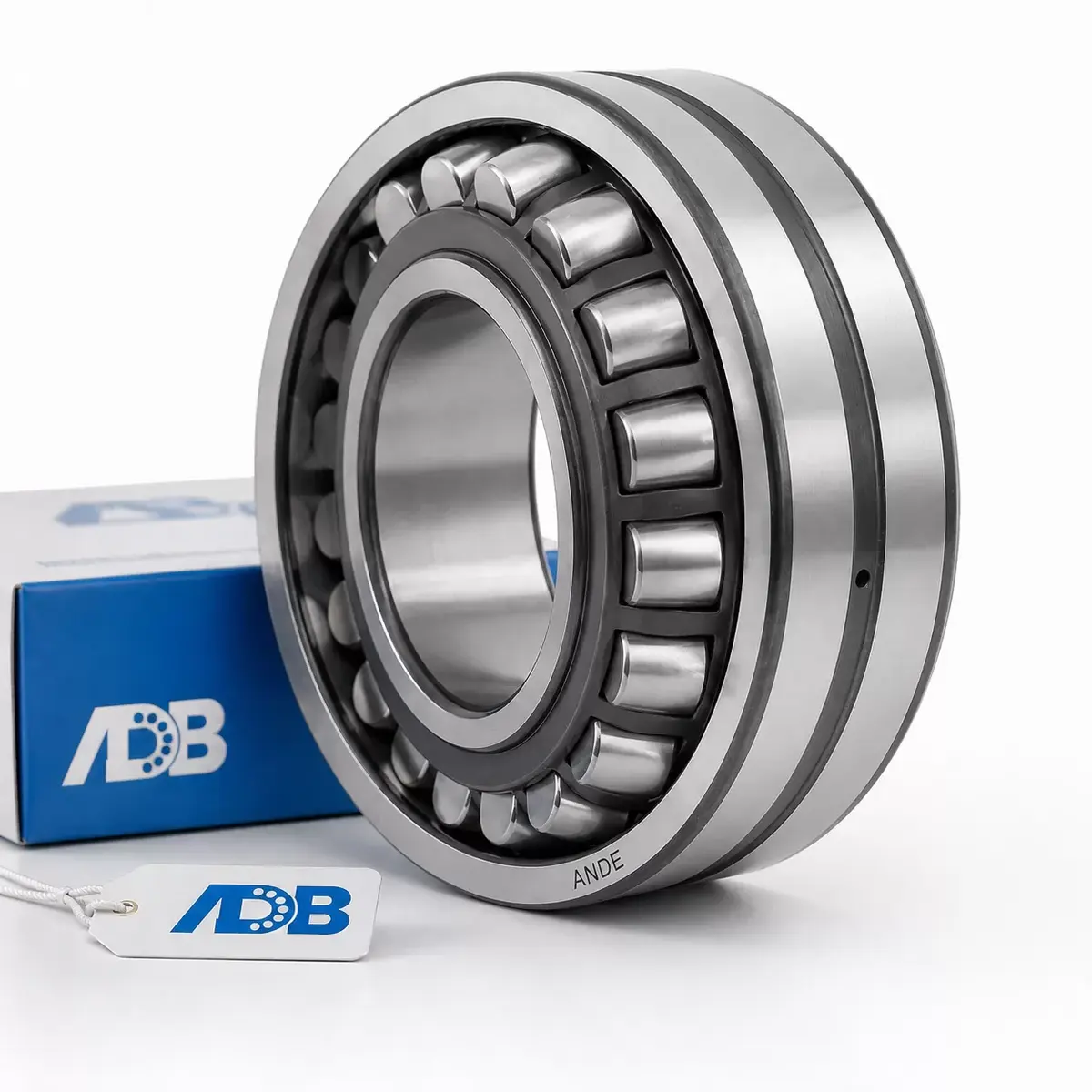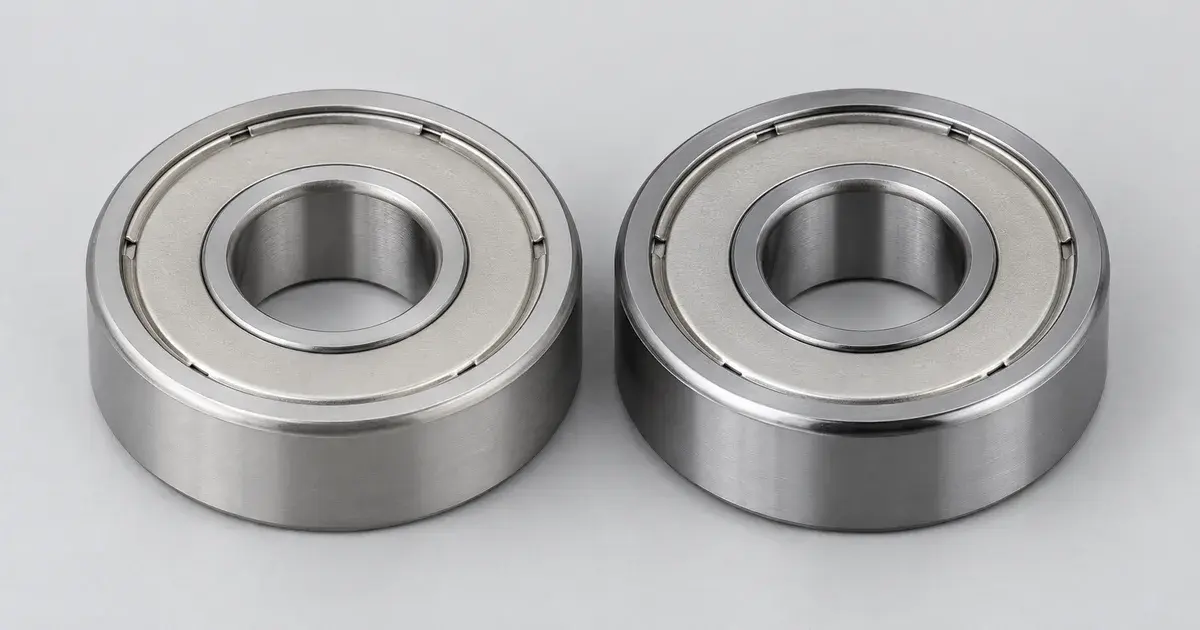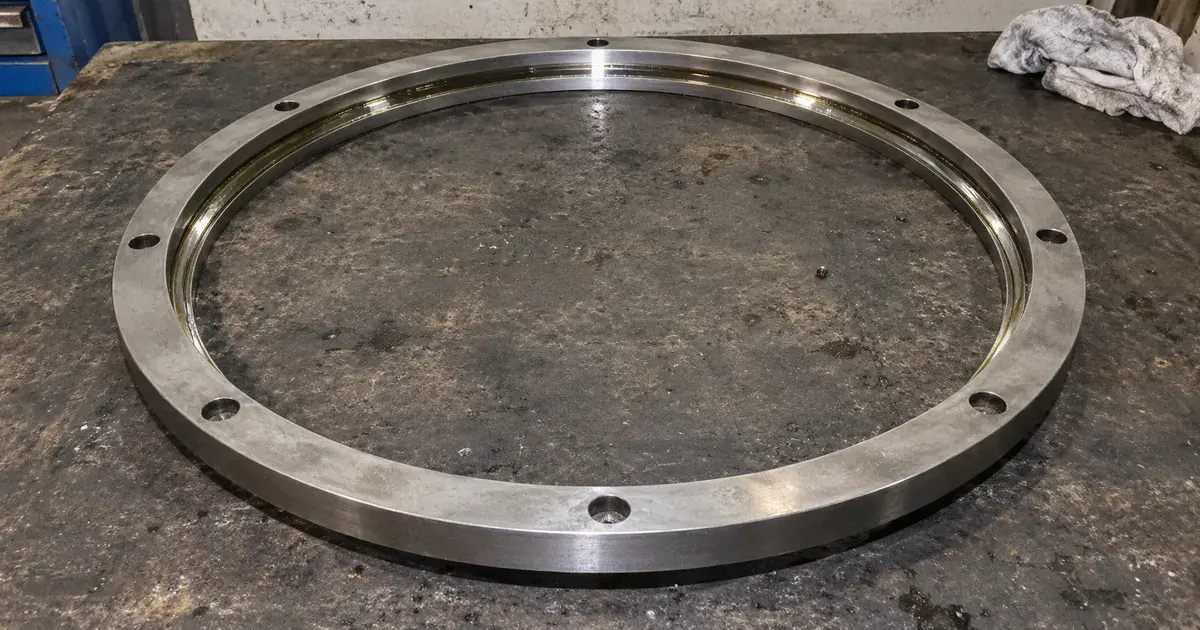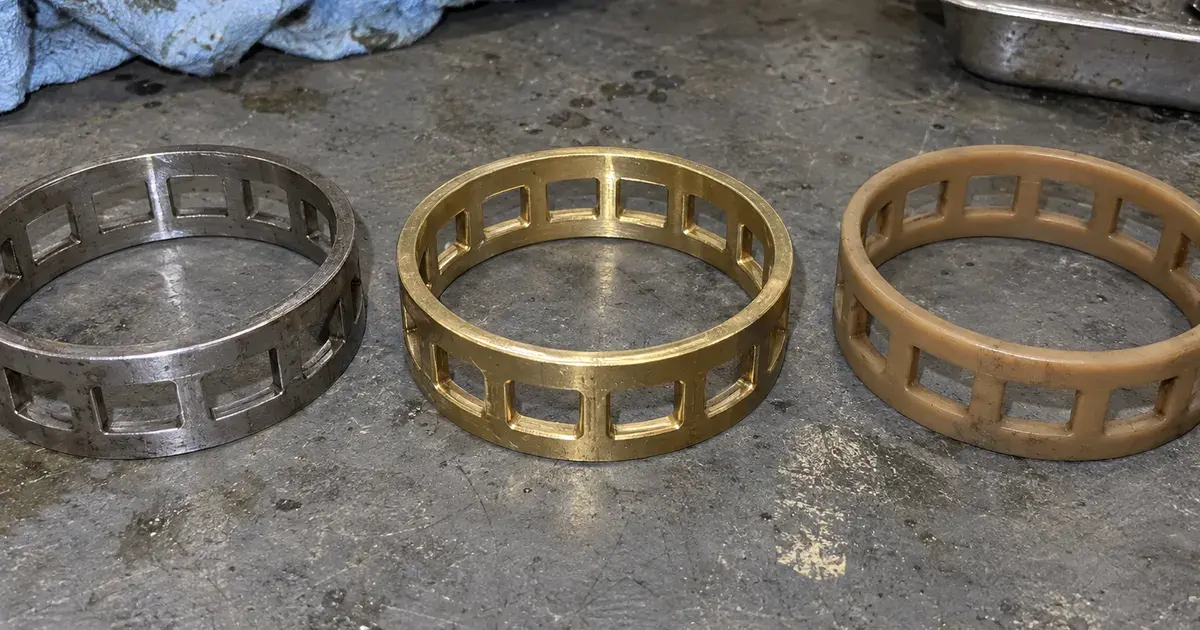
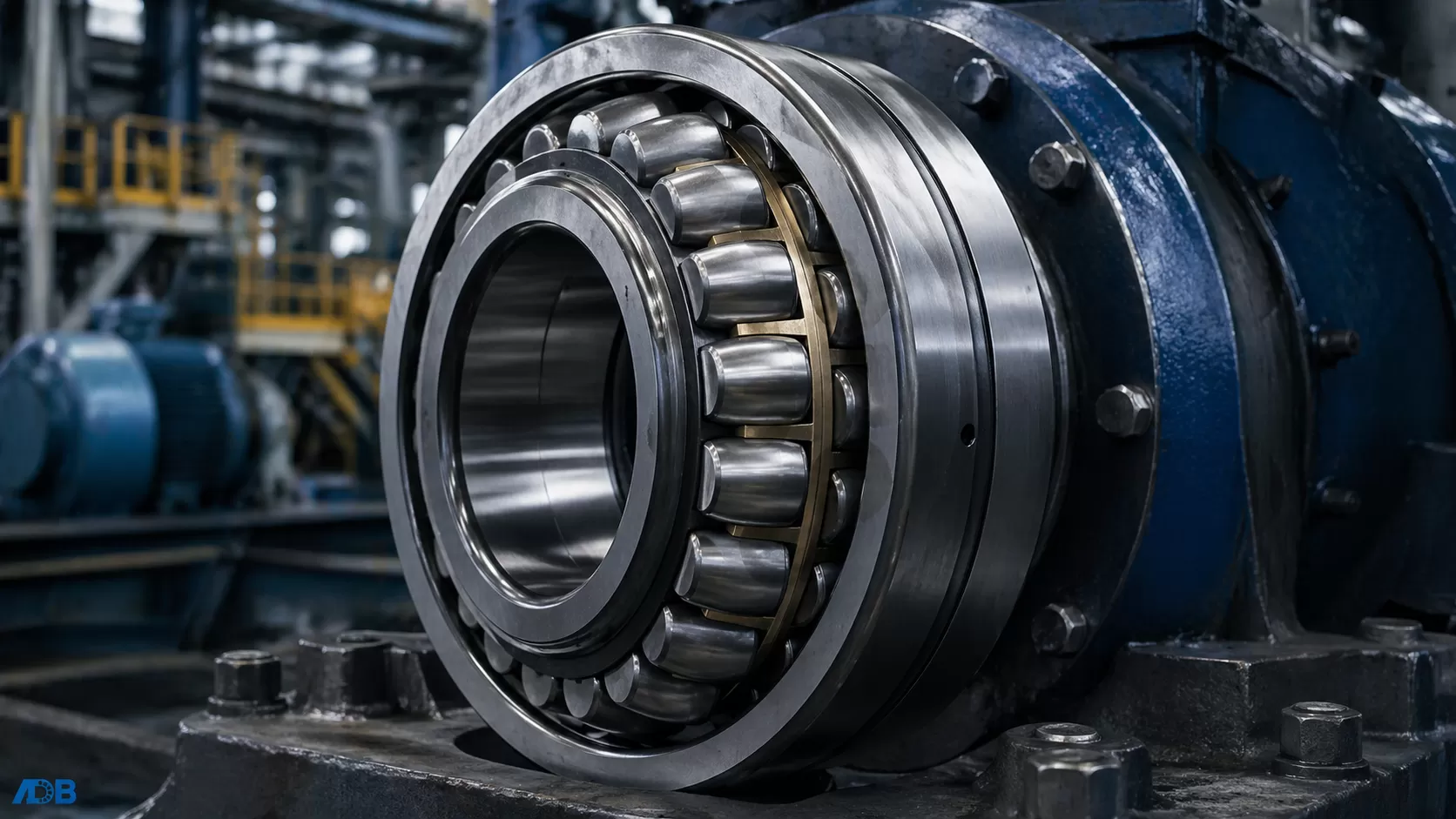
A spherical roller bearing (SRB) is a self-aligning roller bearing that carries heavy radial and axial loads while accommodating angular misalignment between the inner and outer rings. Manufacturer engineering catalogs (SKF, Schaeffler, NSK, Timken) typically rate this self-aligning capability at up to 1.5° to 2.5° depending on series and clearance class. Always confirm the value against the specific datasheet for the bearing you are specifying. When shaft deflection, thermal expansion, or mounting imperfections rule out rigid bearing arrangements, SRBs are the standard answer.
Key Takeaways
- Spherical roller bearings absorb angular shaft deflection and housing misalignment without the edge loading that destroys cylindrical or tapered roller bearings.
- Bearing rating life uses the L10 method defined in ISO 281:2007. In well-maintained industrial service, L10 typically lands between 20,000 and 100,000+ hours, depending on load, speed, and contamination.
- SRBs dominate crushers, vibrating screens, continuous casters, and wind turbine main shafts, where high radial loads coincide with shaft flex.
- Lubrication and sealing are the two variables that most influence SRB service life in harsh environments. Most premature failures trace to one of those two causes.
- Misalignment-related bearing failure is almost always preventable through correct bearing selection, fit, and maintenance.
Why Is Misalignment Unavoidable in Heavy Industry?
Every rotating machine carries some misalignment. In textbook conditions, it's negligible. In heavy industry, it isn't. ISO 15243 classifies bearing damage into six failure modes by appearance, and misalignment beyond the bearing's design tolerance shows up in several of them: surface-initiated fatigue (5.1.3) where edge loading concentrates stress, abrasive and adhesive wear (5.2), and fatigue fracture (5.6.3) where a ring sees high cyclic stress (ISO 15243:2017). Note that the standard classifies appearance rather than cause, a distinction the bearing failure guide covers along with the diagnostic path from pattern to root cause.
Crusher main shafts flex under impact loads. Conveyor pulleys deflect across long spans. Continuous caster segments shift as thermal gradients cycle through the strand. In each case, the bearing must absorb angular displacement that a standard cylindrical or tapered roller bearing cannot tolerate without edge loading, premature fatigue, and eventual failure.
The consequences are predictable and expensive:
- Edge loading concentrates stress on a narrow band of the raceway, accelerating spalling.
- Increased operating temperature from uneven load distribution degrades the lubricant faster.
- Seal damage from shaft angular movement opens the bearing to contamination ingress.
- Unplanned downtime. A single crusher bearing failure can halt the production line until the bearing arrangement is replaced and re-aligned.
Standard roller bearings are designed for near-perfect alignment. When the real world doesn't cooperate, the bearing pays the price.
How Do Spherical Roller Bearings Handle Misalignment?
The defining feature of a spherical roller bearing is its concave outer ring raceway. The barrel-shaped rollers run against this spherical surface, which lets the inner ring tilt relative to the outer ring without creating edge stress on the rollers or raceways. Manufacturer engineering catalogs typically rate the permissible self-alignment angle in the 1.5° to 2.5° range, with exact values published per series.
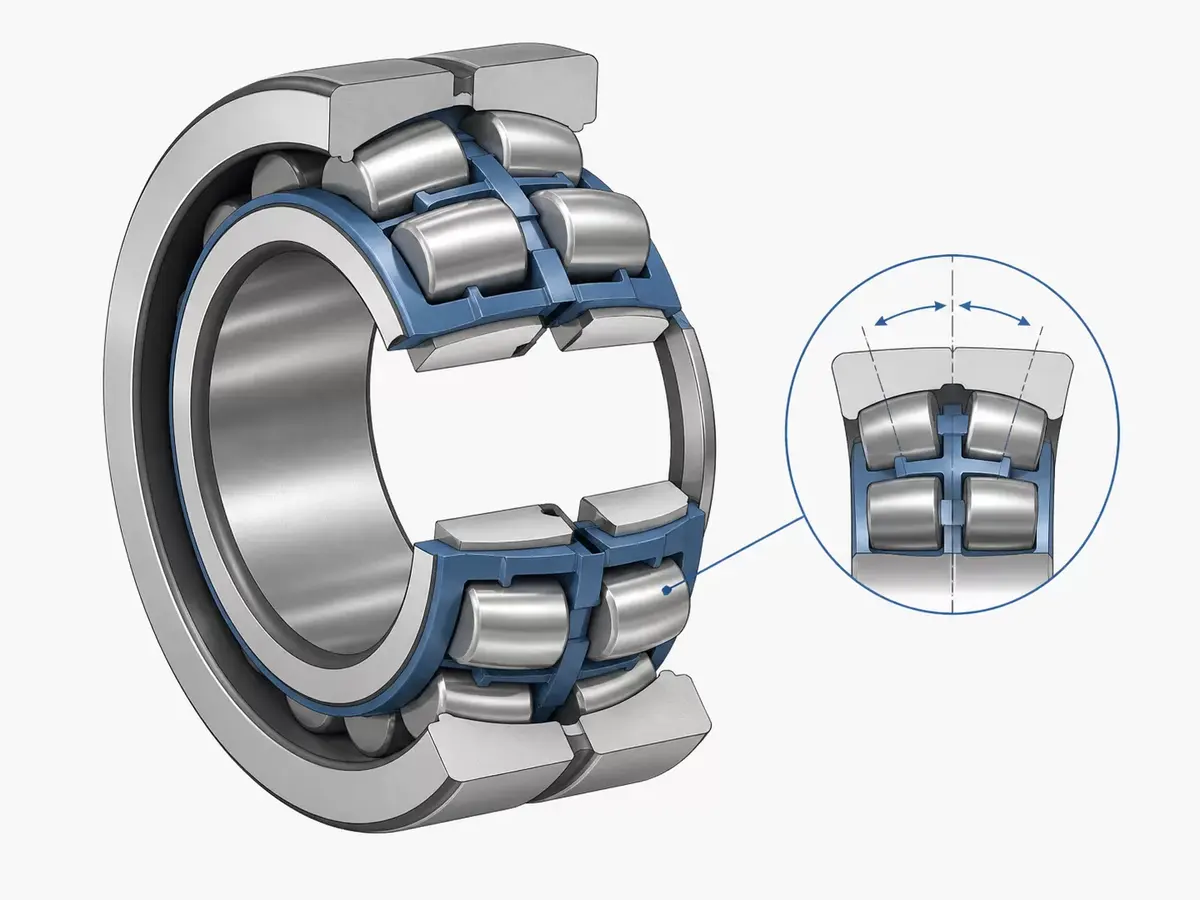
This geometry gives SRBs three capabilities that rigid bearings lack.
1. Self-Alignment Under Load
SRBs accommodate angular misalignment continuously under full load, without the edge loading that destroys cylindrical roller bearings in the same conditions. This isn't a static tolerance. The bearing adjusts dynamically as shaft deflection changes during operation.
For a crusher main shaft that deflects differently under varying feed loads, or a conveyor pulley that bows under belt tension, this self-aligning capability is the difference between a bearing that lasts its rated life and one that fails in months.
2. High Combined Load Capacity
Spherical roller bearings carry both heavy radial loads and moderate axial loads simultaneously. The ANDE spherical roller bearing range covers the 22200, 22300, 23000, 23100, 23200, 24000, and 24100 series across a wide range of bore sizes used in industrial equipment.
This combined load capacity eliminates the need for separate thrust bearings in many applications, which simplifies the bearing arrangement and reduces failure points.
3. Tolerance for Mounting Imperfections
In practice, perfect alignment between a bearing housing and shaft is difficult and expensive to achieve, especially in field installations, large-frame equipment, or split-housing arrangements. SRBs compensate for initial mounting errors that would immediately compromise a rigid bearing.
How does an SRB compare to cylindrical and tapered roller bearings?
| Bearing type | Misalignment tolerance | Radial load | Axial load | Speed | Best for |
|---|---|---|---|---|---|
| Spherical roller (SRB) | High (typically up to 1.5°–2.5°) | High | Moderate, both directions | Moderate | Crushers, screens, conveyors, wind turbine main shafts |
| Cylindrical roller (CRB) | Very low (typically <0.05°) | Very high | None to low (depends on flange config) | High | Rolling mill rolls, gearboxes, electric motors |
| Tapered roller (TRB) | Low (typically <0.1°) | High | High, one direction per row | Moderate to high | Wheel hubs, pinion shafts, work-roll positions |
Misalignment values are illustrative ranges drawn from manufacturer catalogs and vary by series, internal clearance class, and operating load. Always confirm against the specific bearing datasheet before selection.
Where Are Spherical Roller Bearings Used?
SRBs are not universal. They are the right answer for specific operating conditions. Across the bearing inquiries we field for crusher and mill OEMs, four application clusters account for the majority of SRB demand.
Mining and Minerals Processing
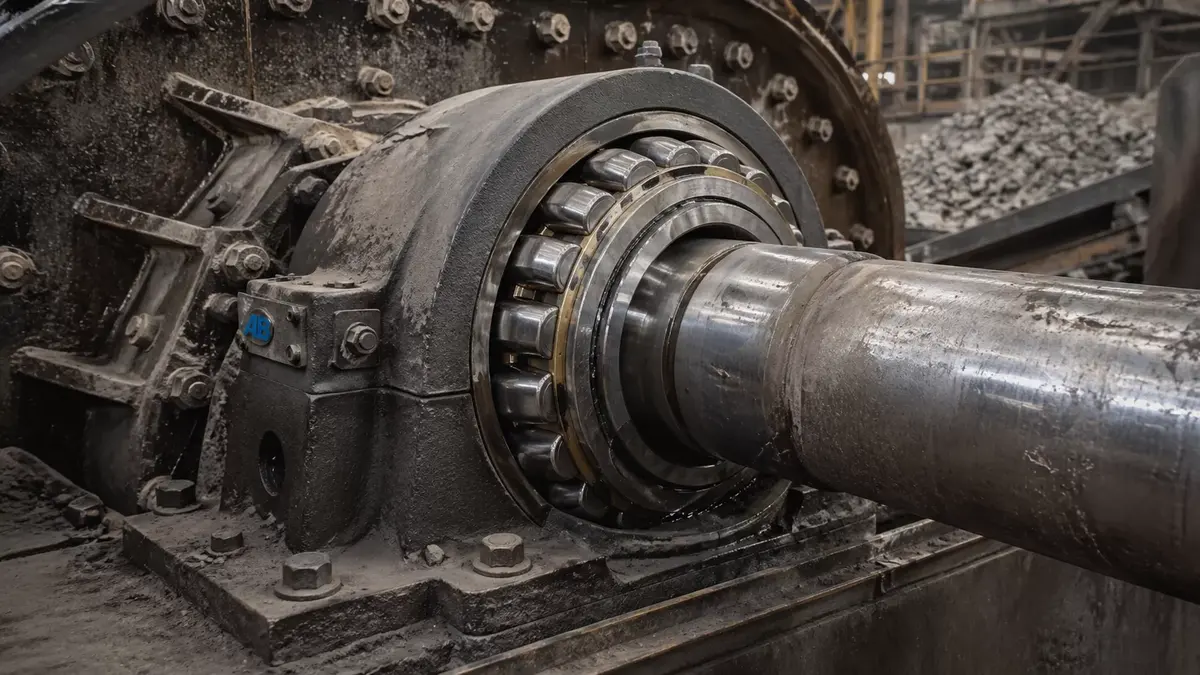
Cone crushers, jaw crushers, vibrating screens, and ball mills generate high radial loads combined with shaft deflection and severe contamination. SRBs are the standard bearing type for these machines. Enhanced sealing options (contact seals or labyrinth seals) protect against the fine particulate and moisture that destroy bearings in mineral processing environments.
Steel and Rolling Mills
In continuous casters, spherical roller bearings support segment rolls under thermal cycling and misalignment from strand movement. In auxiliary drives, gearboxes, and roller tables, SRBs handle the combined loads and alignment tolerances that come with large, thermally active equipment.
For roll neck positions specifically, four-row designs (cylindrical or tapered) are standard. SRBs dominate the supporting equipment around the mill rather than the roll necks themselves. See our rolling mill bearings guide for a complete overview, or read our bearing failure analysis for case studies.
Energy and Power Generation
Wind turbine main shaft bearings are one of the highest-profile SRB applications. The main shaft deflects under variable wind loads, and the bearing must accommodate that deflection across millions of cycles. The IEC 61400-1 wind turbine design standard frames structural integrity over the planned design lifetime, with industry practice typically targeting 20 years of service (IEC 61400-1:2019). SRBs are also standard in large pumps, compressors, and generator bearings where alignment cannot be guaranteed over time.
Conveyor Systems
Long-span conveyor pulleys in mining, port handling, and bulk material transport deflect under belt tension. Head and tail pulley bearings must tolerate this deflection while carrying heavy radial loads. SRBs in pillow block or flange bearing housings are the default solution.
How Do You Maximize Spherical Roller Bearing Service Life?
An SRB that's correctly selected and properly maintained will reach or exceed its calculated rating life under ISO 281. Most premature failures trace back to one of two causes: lubrication or contamination. SKF's cause split for bearings that do fail puts roughly one third on lubrication and one sixth on contamination (SKF).
Lubrication
SRBs require adequate lubricant film thickness to prevent metal-to-metal contact between rollers and raceways. In practice, this means:
- Grease selection matched to operating temperature and speed. High-viscosity base oil for slow, heavy-load applications, lower viscosity for higher speeds.
- Re-lubrication intervals based on actual operating conditions, not generic schedules. Bearings in high-temperature or contaminated environments need shorter intervals.
- Avoid over-greasing. Excess grease raises internal temperature and can damage seals. Follow the manufacturer's fill quantity recommendations.
Sealing and Contamination Control
In mining, steel, and outdoor applications, contamination is the primary life-limiting factor. Effective sealing strategies include:
- Sealed SRB variants with integrated contact seals for moderate contamination.
- External labyrinth seals or taconite seals for severe environments such as crushers and vibrating screens.
- Housing design that prevents water pooling and directs contaminants away from the seal interface.
Mounting and Fit
Proper interference fit between the inner ring and shaft prevents creep (relative rotation) that damages both the bearing and the shaft seat. For SRBs:
- Use the manufacturer's recommended shaft tolerance (typically j5 to m6 for normal loads).
- Heat the inner ring uniformly for installation. Never use a torch on one side.
- Verify alignment after mounting. Even though SRBs tolerate misalignment, starting closer to zero extends life.
Frequently Asked Questions
Q: What is a spherical roller bearing used for? A: Spherical roller bearings are used in heavy industrial equipment where high radial loads combine with shaft misalignment or deflection. Common applications include crushers, vibrating screens, conveyor pulleys, continuous casters, wind turbines, and large pumps. Their self-aligning design accommodates angular misalignment typically in the 1.5° to 2.5° range under full load, with exact values published per series in the manufacturer's catalog.
Q: How does a spherical roller bearing handle misalignment? A: The outer ring raceway of an SRB is ground to a spherical (concave) profile. Barrel-shaped rollers run against this surface, which lets the inner ring assembly tilt relative to the outer ring without creating edge stress on the rollers or raceways. This self-alignment happens dynamically during operation, not just at installation.
Q: How long do spherical roller bearings last? A: Service life depends on load, speed, lubrication, and contamination levels. Under proper conditions, SRBs routinely achieve their L10 rating life as calculated under ISO 281. In well-maintained industrial service, that translates to roughly 20,000 to 100,000+ hours of operation. Premature failure is almost always caused by inadequate lubrication, contamination ingress, or incorrect mounting fit.
Q: Can spherical roller bearings replace cylindrical roller bearings? A: In applications with significant misalignment or shaft deflection, yes. SRBs are often the better choice. However, cylindrical roller bearings have higher radial load capacity per unit size and support higher speeds. If alignment is well-controlled and loads are purely radial, cylindrical roller bearings may be more efficient. The decision depends on the specific load profile and operating conditions.
When Should You Specify a Spherical Roller Bearing?
Use this short decision check before defaulting to a cylindrical or tapered alternative:
- Does the shaft deflect, thermally grow, or sit in a split housing? If yes, the bearing must self-align. SRBs are the safe default.
- Is the load primarily radial with moderate two-direction axial component? SRBs absorb both. If the axial load is heavy and unidirectional, evaluate a tapered roller bearing instead.
- Is the operating environment dirty or wet? Specify a sealed SRB variant or external taconite seal. Contamination is the dominant failure trigger in heavy industry.
- Is alignment well controlled and the load purely radial at high speed? A cylindrical roller bearing may give higher load capacity per unit size and support higher speeds.
When the first three answers are yes, the SRB selection is rarely wrong. The remaining variables, lubrication, sealing, and correct fit, sit on the maintenance and installation side rather than the bearing itself.
Need spherical roller bearings for your application? Request a quote from ANDE Bearing and share the bore size, load profile, and operating environment. Response within 24 hours.