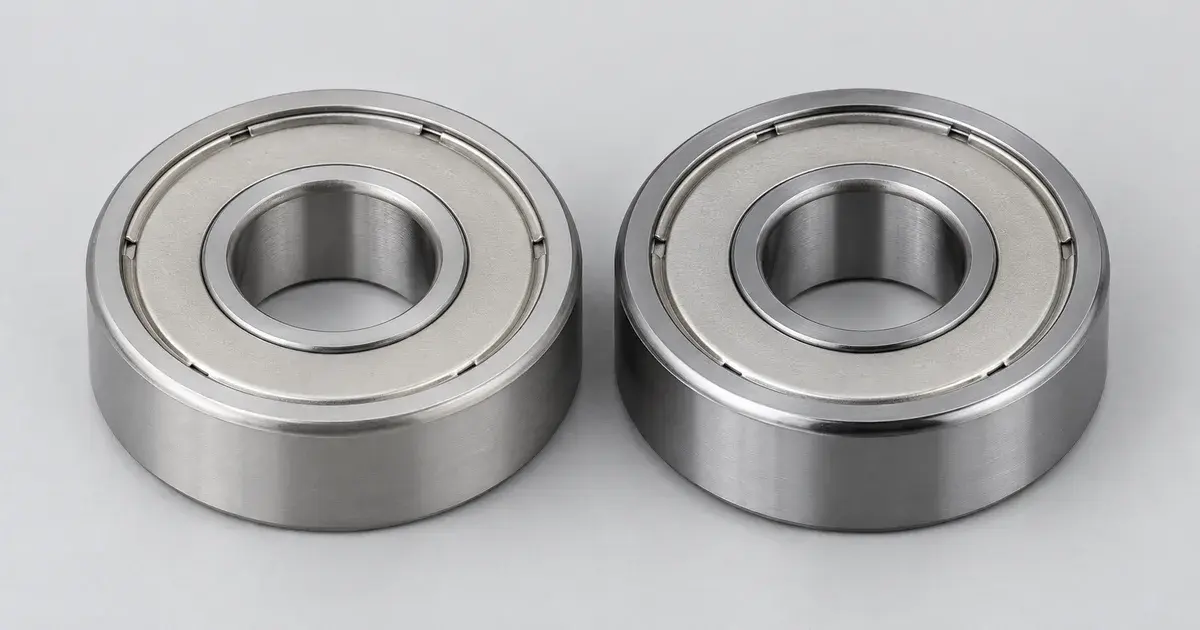
ABEC 5 bearings command 49.7% of ABEC-rated bearing market revenue — yet most engineers over-specify by at least one class, burning budget on tolerances their application can't exploit (Future Market Insights). The confusion is understandable: "higher number equals better bearing" sounds logical until you realize ABEC measures only dimensional tolerance — not noise, not speed limits, not material quality, not service life.
This guide explains what the ABEC scale actually defines, lays out the full tolerance chart in indexable numbers, maps ABEC to ISO/DIN/JIS equivalents, and gives you a decision framework for choosing the minimum adequate class. No over-specification, no guesswork.
Key Takeaways
- ABEC (Annular Bearing Engineering Committee) defines 5 tolerance classes — 1, 3, 5, 7, 9 — governing bore diameter, outer diameter, width, and runout deviations per ANSI/ABMA Standard 20.
- ABEC 1 bore tolerance is 0 to −8 µm; ABEC 9 tightens to 0 to −2.5 µm (bore 0.6–10 mm) (Engineers Edge, ABMA Std 20).
- Industry estimates suggest ~90% of industrial applications need only ABEC 1 or 3 (Axis Bearing). Higher classes cost 5–10× more and only matter above ~10,000 rpm or in vibration-sensitive equipment.
- ABEC does NOT measure noise, vibration, lubrication quality, ball grade, radial play, surface finish, load capacity, or speed limits.
What Does ABEC Stand For?
ABEC stands for Annular Bearing Engineering Committee, a technical committee within ABMA (American Bearing Manufacturers Association) that publishes ANSI/ABMA Standard 20 — the North American specification for radial ball bearing dimensional tolerances (ABMA). The standard defines five precision classes: ABEC 1, 3, 5, 7, and 9, where higher numbers indicate tighter tolerances.
The odd-number scale isn't arbitrary. It maps approximately to the ISO tolerance classes: ABEC 1 ≈ ISO Normal, ABEC 3 ≈ ISO class 6, ABEC 5 ≈ ISO class 5, ABEC 7 ≈ ISO class 4, ABEC 9 ≈ ISO class 2. The P0, P6, P5, P4 and P2 codes that catalogues print alongside those classes are the DIN 620 lineage, not ISO designations. The two systems converged over decades and are treated as equivalent for engineering purposes, though minor numerical differences exist in edge cases. ISO also defines a class 6X, between Normal and class 6, that has no ABEC counterpart.
One family sits outside Standard 20 entirely. Inch-design thin section bearings are toleranced under ANSI/ABMA Standard 26.2, in classes written ABEC 1F, 3F, 5F and 7F, because their large, deliberately flexible rings only become round once mounted. Miniature and instrument sizes are covered separately in miniature bearings.
What does the standard actually specify? Four geometric parameters:
- Bore diameter tolerance — how far the inner ring bore may deviate from nominal
- Outer diameter tolerance — how far the outer ring OD may deviate
- Width tolerance — how far ring width may deviate
- Radial runout — maximum eccentricity when the ring rotates
The current edition is ANSI/ABMA 20-2025 (approved September 2025), replacing the 2011 version. Tolerance values haven't changed — the revision aligned symbols and definitions to current ISO nomenclature and redrew figures for readability.
What ABEC does not define matters just as much. The standard says nothing about ball grade, cage quality, surface roughness, lubrication type, noise levels, radial internal clearance, material hardness, heat treatment, or speed ratings. Our bearing internal clearance guide explains why clearance must be selected separately. Two bearings can both be ABEC 5 yet perform very differently because of these uncontrolled variables.
What Are the ABEC Tolerance Values?
In 2024, the global bearing market reached USD 58.6 billion, projected to grow to USD 143.6 billion by 2034 at a 9% CAGR (GM Insights). The table below shows the actual tolerance numbers engineers need — bore deviation for the most common size range.
Inner ring bore tolerance (bore 10–18 mm) per ANSI/ABMA Standard 20:
| ABEC Class | ISO 492 class (DIN 620 code) | Bore Tolerance (µm) | Radial Runout, Inner (µm) |
|---|---|---|---|
| ABEC 1 | Normal (P0) | 0 to −8 | 10 |
| ABEC 3 | 6 (P6) | 0 to −7 | 6 |
| ABEC 5 | 5 (P5) | 0 to −5 | 4 |
| ABEC 7 | 4 (P4) | 0 to −4 | 2.5 |
| ABEC 9 | 2 (P2) | 0 to −2.5 | 1.5 |
Note: OD tolerances are looked up separately by the bearing's outer diameter range — not by bore size. A bearing with bore 10–18 mm can have an OD of 26–50+ mm, each falling into a different OD tolerance band. See ANSI/ABMA 20 for the full outer ring tables.
Bore diameter tolerance for smaller bores (bore 0.6–10 mm):
| ABEC Class | Bore Tolerance (µm) | Max Radial Runout, Inner (µm) |
|---|---|---|
| ABEC 1 | 0 to −8 | 10 |
| ABEC 3 | 0 to −7 | 6 |
| ABEC 5 | 0 to −5 | 4 |
| ABEC 7 | 0 to −4 | 2.5 |
| ABEC 9 | 0 to −2.5 | 1.5 |
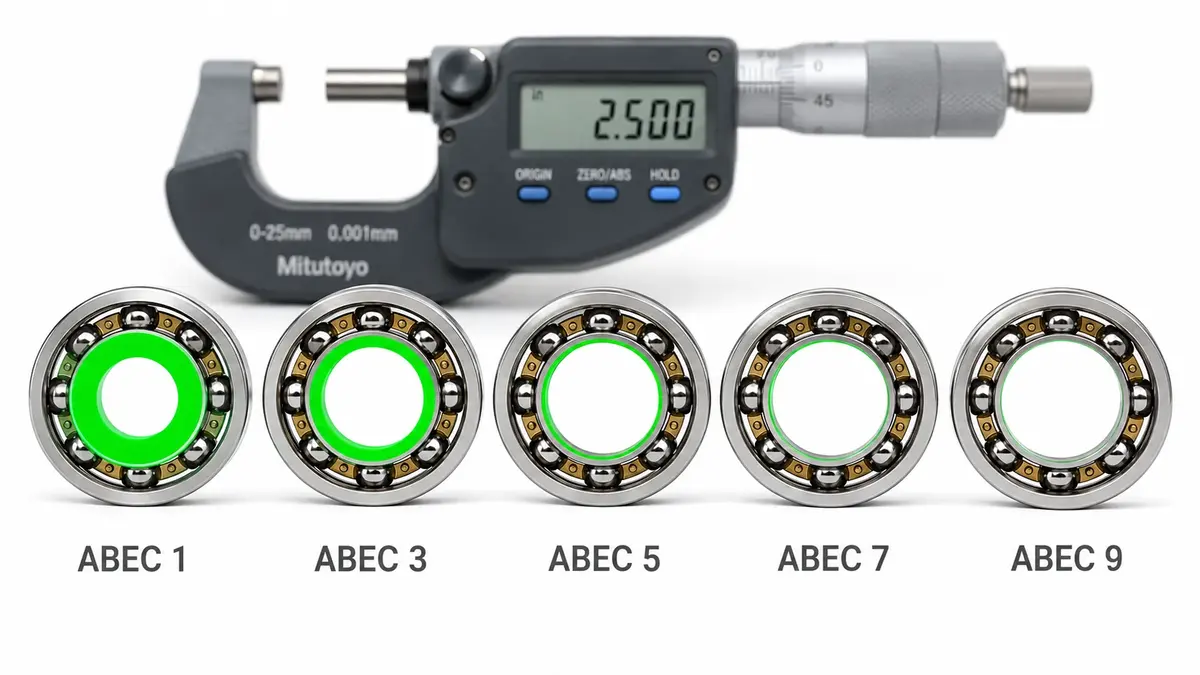
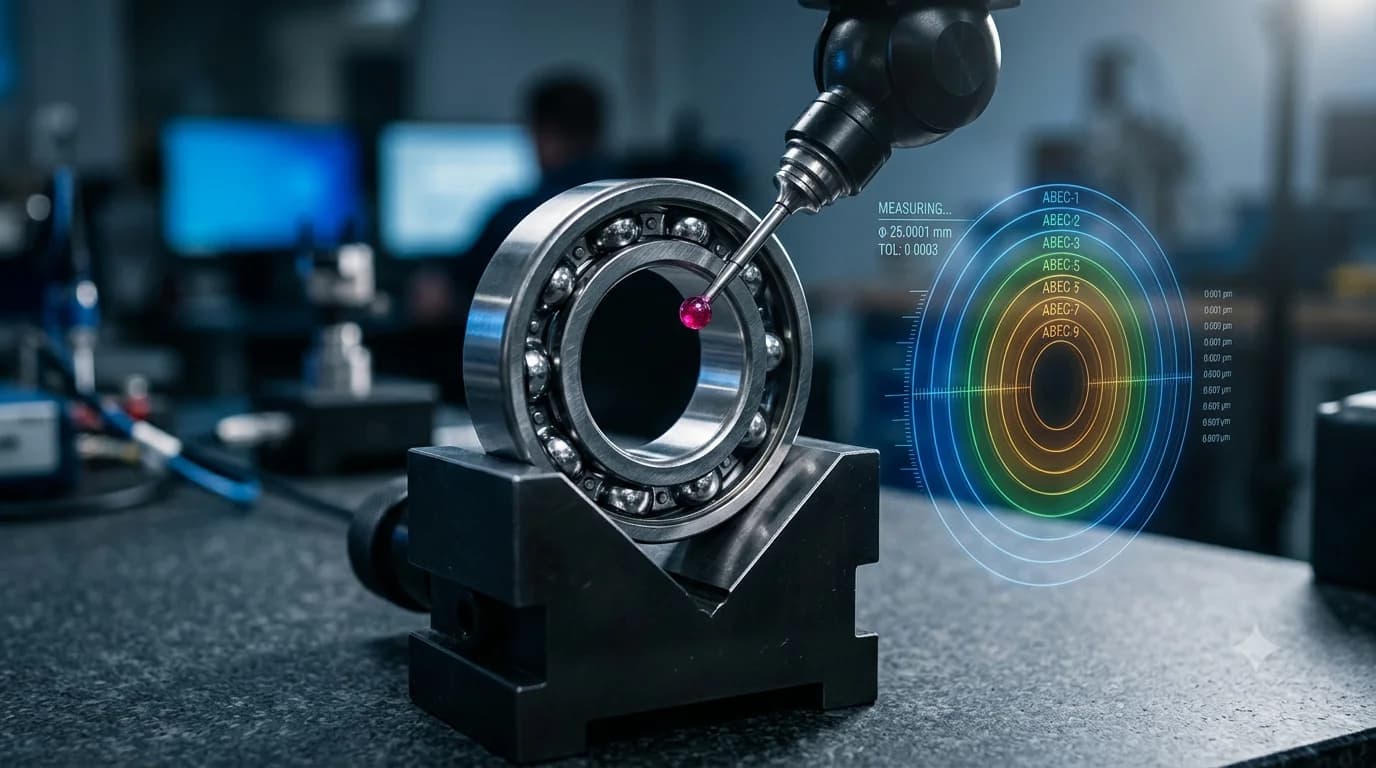
To put ABEC 9 in perspective: 2.5 micrometers is roughly 40× thinner than a human hair. Achieving that consistency across a production run requires multiple grinding passes, temperature-controlled environments, and individual CMM inspection — which is why costs escalate so steeply at higher classes.
For engineers working in imperial units: 8 µm ≈ 0.000315 in, and 2.5 µm ≈ 0.000098 in. The tolerance chart above applies to metric-series bearings; inch-series bearings follow ABMA Standard 19 with equivalent precision grades.
ABEC to ISO Equivalents — How International Standards Map
ABEC 1 corresponds to the ISO Normal class, and the equivalence continues through all five classes with approximately matching tolerance values (ISO 492:2023). The standards originated separately — ABEC in the United States in the mid-20th century, ISO in Europe — but converged over decades. Today they're treated as equivalent for practical sourcing and specification purposes, though minor numerical differences remain in certain bore ranges.
| ABEC (USA) | ISO 492 class | DIN 620 code | JIS B 1514 (Japan) | Common Name |
|---|---|---|---|---|
| ABEC 1 | Normal | P0 | Class 0 | Normal / Standard |
| — | 6X | 6X | Class 6X | No ABEC equivalent |
| ABEC 3 | 6 | P6 | Class 6 | Moderate precision |
| ABEC 5 | 5 | P5 | Class 5 | High precision |
| ABEC 7 | 4 | P4 | Class 4 | Very high precision |
| ABEC 9 | 2 | P2 | Class 2 | Ultra precision |
Read the two middle columns as separate systems. ISO 492 designates its classes Normal, 6X, 6, 5, 4 and 2; the P-prefixed codes belong to the DIN 620 lineage and survive as manufacturer suffixes, which is why a catalogue can print P5 and an inspection report "class 5" for the same bearing. DIN 620's current edition names the same six classes ISO does (JTEKT / Koyo). Calling P5 an "ISO class" is common shorthand and technically wrong.
Notice too that the numbering runs in opposite directions. ABEC uses ascending numbers for higher precision (1 → 9), while ISO and DIN both descend (Normal → 2). This catches people off guard: class 6 is lower precision than class 5. The convention exists because Normal is the baseline tolerance class, with the numbered classes historically denoting departures from that baseline. The 6X class, tighter than Normal but looser than 6, applies to metric tapered roller bearings and has no ABEC counterpart.
Some catalogues also list a P3. That is a manufacturer special class, not a rung on the ISO ladder: it combines class 4 dimensional accuracy with class 2 running accuracy, so it cannot be placed between two ISO classes at all.
When sourcing bearings internationally, simply convert using this table. A Japanese supplier quoting "JIS Class 5" delivers the same tolerances as an American supplier quoting "ABEC 5." Chinese manufacturers typically stamp both designations on certificates — look for either "P5" or "ABEC 5" on inspection reports.
Why do four separate standards exist for the same tolerance values? Historical momentum. ABMA governed the U.S. market, DIN governed Germany, JIS governed Japan, and ISO became the international harmonization layer. Technical content converged by the 1990s. The labels persist because catalogs, purchase orders, and QC documentation built over decades still reference the regional designations.
What Does Each ABEC Class Mean? (1 Through 9)
In 2025, the ABEC 7 and ABEC 9 precision bearing segment alone reached approximately USD 980 million, forecast to grow to USD 1.32 billion by 2031 at a 4.4% CAGR (Global Info Research). But the bulk of volume still sits at lower classes. Here's what each actually means in practice:
ABEC 1 (ISO Normal) — Standard Precision
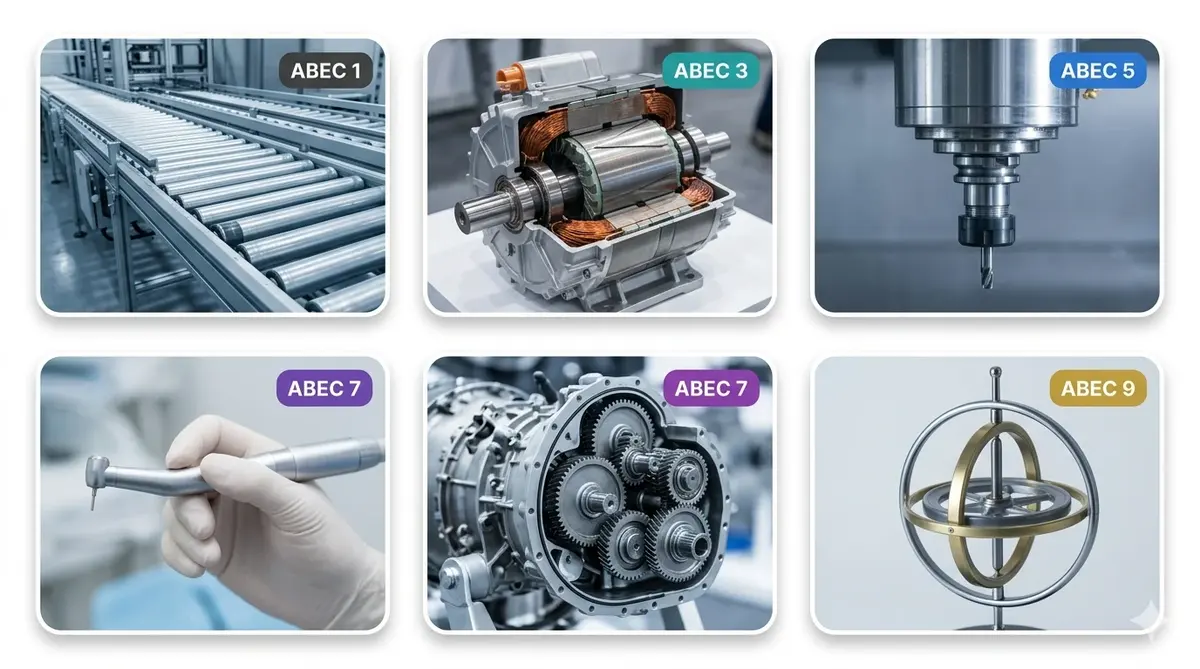
Bore tolerance: 0 to −8 µm. This is the default class for general industrial use. Pumps, conveyor idlers, electric motor auxiliaries, agricultural equipment, household appliances — roughly 90% of industrial bearing applications run ABEC 1 (Axis Bearing). If nobody specified a precision class on the purchase order, you got ABEC 1.
ABEC 3 (ISO class 6) — Moderate Precision
Bore tolerance: 0 to −7 µm. A modest step up. Used in medium-duty electric motors, gearbox input shafts, power tools, and mid-range pumps. The cost premium over ABEC 1 is typically 20–40%, making it an easy upgrade when moderate vibration reduction matters.
ABEC 5 (ISO class 5) — High Precision
Bore tolerance: 0 to −5 µm. This is where the market concentrates: ABEC 5 bearings account for 49.7% of ABEC-rated bearing market revenue (Future Market Insights). Applications: CNC machine spindles, medical imaging equipment, higher-speed electric motors, aerospace accessories, and precision instruments. The sweet spot between cost and performance for demanding applications.
ABEC 7 (ISO class 4) — Very High Precision
Bore tolerance: 0 to −4 µm. Machine tool main spindles, dental handpieces (>300,000 rpm), high-frequency motor spindles, precision grinding spindles, and radar antenna drives. At this level, manufacturers match individual balls by diameter and roundness — standard production sorting isn't adequate.
ABEC 9 (ISO class 2) — Ultra Precision
Bore tolerance: 0 to −2.5 µm. Gyroscopes, inertial navigation systems, coordinate measuring machines, and applications exceeding 100,000 rpm. These bearings are individually serialized and often sold with inspection certificates showing measured (not just class) values.
The takeaway? Don't default to ABEC 5 just because it's the most popular class. It dominates market revenue because high-value industries (automotive at 42.5% of the market, aerospace, medical) concentrate there. But by unit volume, ABEC 1 dwarfs everything else.
Does a Higher ABEC Rating Always Mean a Better Bearing?
No. ABEC 1 serves approximately 90% of industrial applications adequately because most machines don't operate at speeds or precision levels that demand tighter dimensional tolerances (Axis Bearing). A higher ABEC class is not a quality endorsement — it's a tolerance band specification.
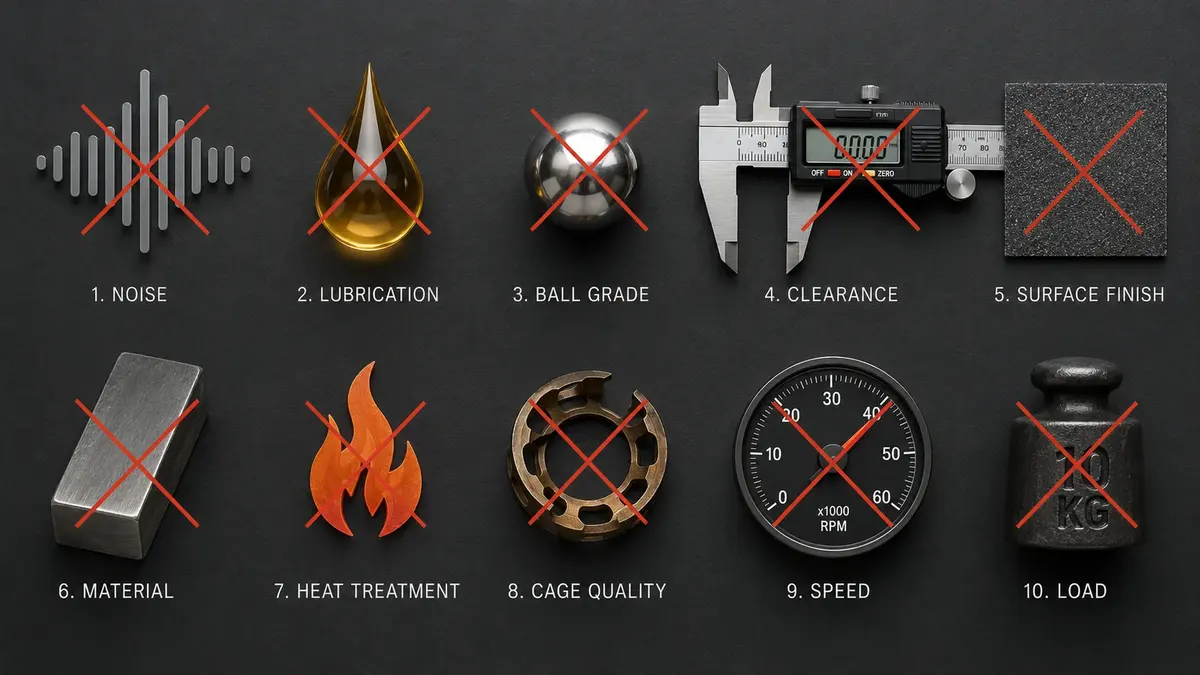
Here's what the ABEC scale explicitly does NOT measure or control:
- Noise and vibration levels — no decibel or acceleration requirement
- Lubrication quality — grease type, fill amount, relubrication intervals
- Ball grade — sphericity, surface roughness, diameter variation of rolling elements
- Radial internal clearance — fit between inner ring, balls, and outer ring
- Surface finish — raceway roughness (Ra) beyond what tolerance implies
- Material composition — 52100 chrome steel vs stainless vs ceramic hybrid (see rolling mill bearing materials for material comparisons)
- Heat treatment — through-hardness, case depth, residual stress
- Cage quality — material, pocket clearance, balance
- Speed ratings — thermal or mechanical speed limits
- Load capacity — dynamic (C) or static (C₀) ratings per ISO 281
A well-lubricated, properly fitted ABEC 1 bearing from a quality manufacturer will outlast a dry, misaligned ABEC 7 bearing in the same application. For more on what ball bearings are actually used for across industries, see our dedicated guide. The skateboard industry illustrates this clearly: wheel speeds rarely exceed 1,800 rpm, where even ABEC 1 tolerances are irrelevant — yet "ABEC 9 bearings" command premium prices based on marketing, not engineering necessity.
Our finding: When reviewing bearing failure reports across our customer base, over-specification of ABEC class correlated with higher failure rates in contaminated environments — likely because procurement teams spent budget on tolerance instead of sealing or lubrication upgrades that would have addressed the actual failure mode.
The correct engineering question isn't "what's the highest ABEC I can afford?" It's "what's the lowest ABEC class that meets my speed, runout, and vibration requirements?"
How Much Do Higher ABEC Bearings Cost?
ABEC 7 and ABEC 9 bearings cost 5–10× more than ABEC 1 equivalents of the same bore size and series (Axis Bearing). Precision classes drive disproportionate value growth within the broader bearing market.
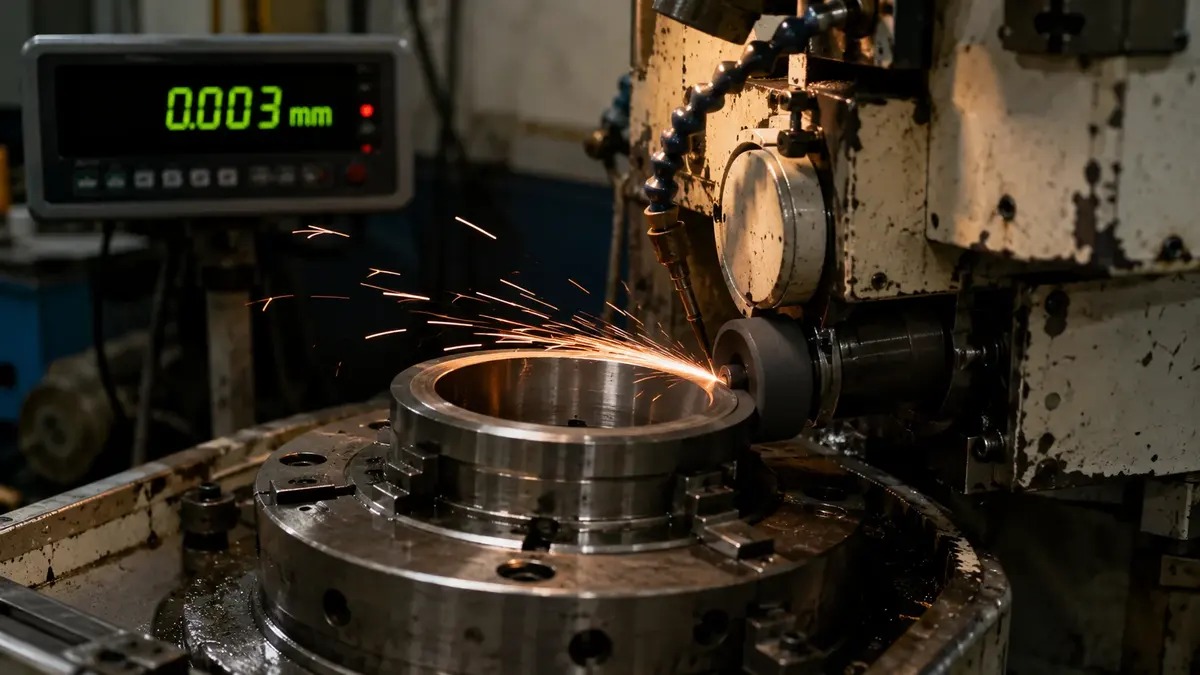
Why does cost escalate so steeply? Each class demands additional manufacturing steps:
- ABEC 1 → ABEC 3: Standard grinding with one additional pass. Batch inspection by sampling. Cost premium: ~20–40%.
- ABEC 3 → ABEC 5: Superfinishing added to raceways. Temperature-controlled grinding. 100% dimensional check rather than sampling. Premium: ~2–3× over ABEC 1.
- ABEC 5 → ABEC 7: Multiple superfinish passes. Individual ball matching by size group (within 0.5 µm). CMM inspection per ring. Premium: ~4–6× over ABEC 1.
- ABEC 7 → ABEC 9: Individual serialization. Matched-set assembly. Climate-controlled finishing rooms. 100% roundness measurement. Premium: ~7–10× over ABEC 1.
From our production floor: Moving from ABEC 5 to ABEC 7 doesn't just add one grinding pass — it changes the entire material flow. Rings enter a temperature-stabilized cell (±0.5°C), dwell for thermal equilibrium, then undergo multi-point CMM gauging. The equipment isn't the big cost; it's the throughput penalty. Our ABEC 7 line runs at roughly 1/4 the pieces-per-hour of the ABEC 5 line for the same bearing size.
The economic implication is clear: specifying ABEC 5 when ABEC 3 suffices doubles your bearing cost for zero performance gain. For a machine with 20 bearing positions, that's a meaningful line-item difference.
Which ABEC Rating Do I Need? A Selection Framework
The automotive sector accounts for 42.5% of ABEC-rated bearing market revenue, yet most automotive bearings are ABEC 3 — not ABEC 5 or 7 (Future Market Insights). The selection process starts with your application's actual requirements, not with a catalog default.
ABEC selection decision matrix:
| Your Application Needs | Recommended ABEC | Rationale |
|---|---|---|
| Speed < 3,000 rpm, standard load, general industry | ABEC 1 | Tolerances irrelevant at this speed range; cost savings go elsewhere |
| Speed 3,000–10,000 rpm, moderate vibration acceptable | ABEC 3 | Marginal improvement over ABEC 1 at small cost premium |
| Speed 10,000–30,000 rpm, low vibration required | ABEC 5 | Sweet spot for CNC spindles, precision motors, medical |
| Speed 30,000–80,000 rpm, minimal runout required | ABEC 7 | Machine tool spindles, dental handpieces, high-speed grinding |
| Speed > 80,000 rpm, instrument-grade precision | ABEC 9 | Gyroscopes, turbomolecular pumps, inertial navigation |
Application-to-class mapping:
| Industry | Application | Typical ABEC | Why |
|---|---|---|---|
| General manufacturing | Conveyor rollers, pumps, fans | 1 | Low speed, cost-driven |
| Automotive | Alternators, water pumps, A/C | 1–3 | Moderate speed, high volume |
| Electric motors (industrial) | Frame sizes 56–315 | 3–5 | Speed-dependent |
| Machine tools | Milling/turning spindles | 5–7 | Precision and surface finish |
| Medical devices | Imaging, surgical tools | 5–7 | Vibration and noise critical |
| Aerospace | Turbine accessories, instruments | 5–7 | Reliability at temperature |
| Semiconductor | Wafer handling, vacuum spindles | 7–9 | Ultra-clean, ultra-precise |
| Defense / navigation | Gyroscopes, IMU | 9 | Maximum geometric accuracy |
Before specifying a class higher than ABEC 3, ask these four questions:
- Does my operating speed actually demand tighter tolerances? Below 3,000 rpm, you can't measure the difference between ABEC 1 and ABEC 5 in the assembled machine.
- Is my mounting precision adequate? An ABEC 7 bearing pressed into a housing bored to IT7 (±12 µm) tolerance has its precision wasted by the housing.
- What's actually causing my vibration or noise problem? Usually it's imbalance, misalignment, or contamination — not bearing tolerance. Our guide to bearing noise covers how noise is measured and which vibration group to specify instead.
- Am I willing to control the environment? Higher ABEC classes are sensitive to contamination, misalignment, and thermal distortion that ABEC 1 bearings shrug off.
For most readers of this guide — engineers specifying bearings for general industrial or automotive applications — ABEC 1 or 3 delivers the performance you need at the right cost. Move to ABEC 5+ only when your speed, vibration, or noise requirements genuinely demand it.
Which ABEC Class Does My Industry Use?
Ball bearings hold 46.3% of the overall ABEC-rated bearing market (Future Market Insights), and ABEC applies specifically to ball bearings. Here's how the major bearing-consuming industries actually use the scale:
CNC Machine Tools: Main spindles typically require ABEC 7 (P4) for direct-drive configurations running 12,000–24,000 rpm. Support bearings and axis drive bearings often use ABEC 5. Belt-driven spindles under 8,000 rpm can work with ABEC 5.
Electric Vehicles: Traction motor bearings generally need ABEC 3 to ABEC 5, depending on motor speed (typically 12,000–18,000 rpm). The push toward 25,000+ rpm motors in next-generation EVs is driving demand toward ABEC 5 as the new baseline. See our automobile ball bearings guide for EV-specific selection criteria.
Medical Equipment: MRI and CT scanner bearings require ABEC 5–7 for vibration isolation. Surgical handpieces (dental, orthopedic) operating above 50,000 rpm need ABEC 7. Diagnostic centrifuges use ABEC 5.
Aerospace: Turbine engine accessories (fuel pumps, oil pumps, generators) standardize on ABEC 5 to ABEC 7. Flight control actuators use ABEC 3–5 depending on criticality. Inertial measurement units demand ABEC 9.
For roller bearings — tapered, cylindrical, and spherical types — the ABEC designation doesn't apply. The same ANSI/ABMA Standard 20 defines parallel RBEC (Roller Bearing Engineers Committee) classes for cylindrical and spherical roller bearings, and ISO 492 covers all radial types under its Normal-to-2 class ladder. See our guide to different kinds of bearings for more on roller bearing types.
Frequently Asked Questions
What does ABEC stand for in bearings?
ABEC stands for Annular Bearing Engineering Committee, a technical division of ABMA (American Bearing Manufacturers Association). The committee publishes ANSI/ABMA Standard 20, which defines five precision tolerance classes — ABEC 1, 3, 5, 7, and 9 — for ball bearing dimensional accuracy. The current edition is ANSI/ABMA 20-2025. Each class specifies permissible deviations in bore diameter, outer diameter, width, and radial runout.
Is ABEC 7 better than ABEC 5?
ABEC 7 has tighter tolerances than ABEC 5 — bore deviation of 0 to −4 µm vs 0 to −5 µm (bore 10–18 mm) — but "better" depends entirely on your application. ABEC 7 costs 2–3× more than ABEC 5 and only provides measurable benefit above approximately 10,000 rpm or in applications with strict vibration limits. For CNC spindles under 15,000 rpm, ABEC 5 is typically adequate. For grinding spindles above 20,000 rpm, ABEC 7 justifies its premium.
What is the ISO equivalent of ABEC 5?
ABEC 5 corresponds to ISO 492 class 5. The P5 code that catalogues print is the DIN 620 equivalent, not an ISO designation; JIS B 1514 calls the same grade Class 5. All three designations specify approximately equivalent tolerance values for bore, OD, width, and runout limits. When sourcing internationally, these designations are treated as interchangeable on engineering drawings and purchase specifications.
Does ABEC rating affect bearing speed?
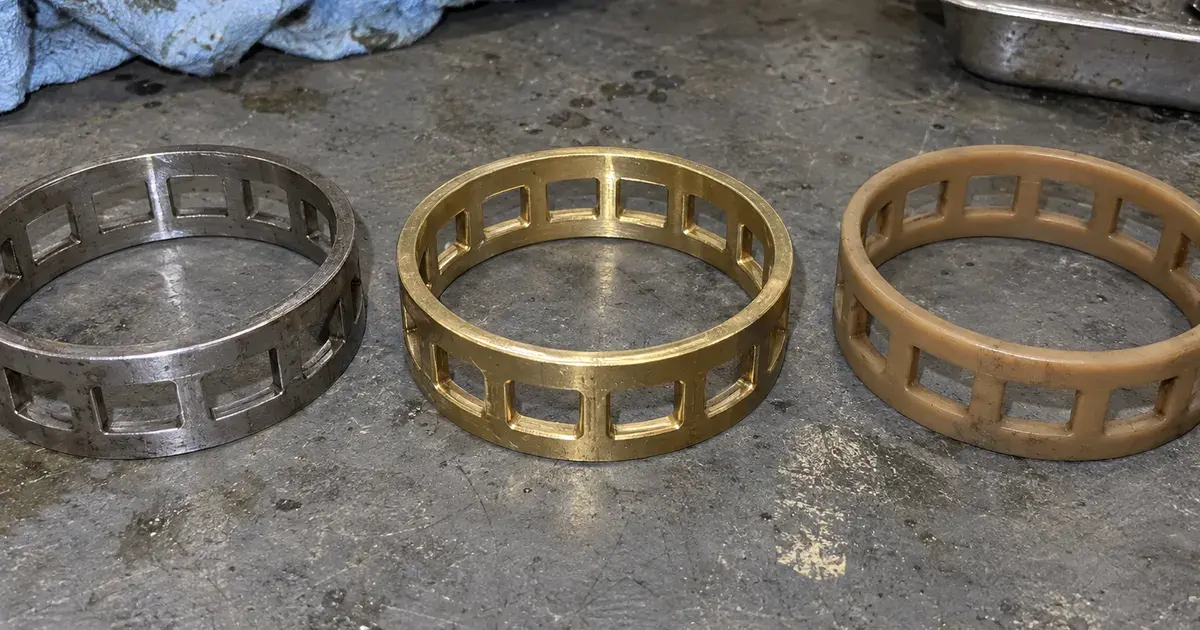
Indirectly, yes. Tighter dimensional tolerances reduce geometric imperfections that generate vibration and heat at high rotational speeds. But ABEC does not define speed limits. A bearing's maximum speed depends on lubrication method (grease vs oil mist vs air-oil), cage material (polyamide vs brass vs PEEK), internal clearance, and ball material (steel vs ceramic). A ceramic hybrid bearing at ABEC 5 can outrun an all-steel ABEC 9 bearing because material properties dominate at extreme speeds.
Are Chinese-manufactured bearings ABEC rated?
Yes. Chinese bearing manufacturers produce to the same ANSI/ABMA and ISO standards as American, European, and Japanese suppliers. The ABEC rating isn't geographically restricted — it's a tolerance specification any manufacturer can meet if their grinding, finishing, and inspection equipment supports the required precision. The differentiator between manufacturers isn't the standard they claim — it's their process capability (Cpk values), measurement system accuracy, and quality consistency across production lots. Ask for SPC data and third-party audit reports when evaluating any supplier, regardless of origin. For context on the major bearing manufacturers — including how China's makers fit into the global market — see our ranked guide.
Conclusion
ABEC ratings are a dimensional tolerance specification — nothing more, nothing less. They define how close a ball bearing's physical dimensions must be to their nominal values. They don't define quality, durability, speed capability, noise levels, or suitability for any particular application.
The practical decision rules:
- For 90% of industrial applications (pumps, motors, conveyors under 3,000 rpm): ABEC 1 or 3
- For precision applications (CNC spindles, medical, EV motors at 10,000–30,000 rpm): ABEC 5
- For high-speed precision (machine tool spindles, dental handpieces above 30,000 rpm): ABEC 7
- For instrument-grade (gyroscopes, navigation, >80,000 rpm): ABEC 9
Specify the lowest class that meets your actual speed and vibration requirements. Spend the savings on better sealing, lubrication, or mounting precision — factors that ABEC can't measure but that determine real-world bearing life.
Need precision bearings across ABEC 1–9? Contact ANDE Bearings for specifications, volume pricing, and SPC data on any standard or custom configuration. Or explore our full ball bearing product catalog to find the right series for your application.