A bearing number is a compact spec sheet. Read 6205 correctly and you already know it is a deep groove ball bearing with a 25 mm bore, a 52 mm outside diameter, and a 15 mm width. The system that makes this possible is standardized internationally under ISO 15, which is exactly why the same number describes the same bearing whether SKF, NSK, FAG, or ANDE made it.
The trouble starts with the suffixes. The basic number is portable across brands, but the letters after it are not. Codes like 2RS, ZZ, DDU, and C3 follow house conventions rather than a single standard. Get the suffix wrong and you order a bearing that fits the shaft but fails in the application. This guide decodes a full designation character by character, covers every common suffix, and gives you a cross-brand table so you can translate one manufacturer's code into another's. If you're comparing bearing families first, start with our guide to different kinds of bearings.
Key Takeaways
- A designation reads in three blocks: an optional prefix, the basic designation (type digit + dimension series + bore code), and suffixes (seals, clearance, cage, precision).
- The last two digits of the basic number encode the bore: 00/01/02/03 = 10/12/15/17 mm, then codes 04 to 96 are multiplied by 5 (ISO 15). So 05 → 25 mm.
- The first digit is the bearing type.
6= single-row deep groove ball, the most widely produced type in general machinery.- The basic number is standardized (ISO 15), but suffixes are brand-specific. SKF
2RS1, NSKDDU, NTNLLU, and FAG2RSRall mean the same double contact seal.- Internal clearance runs C2 < CN (Normal) < C3 < C4 < C5 per ISO 5753-1. A bigger number means more radial play, not lower quality.
What Do the Numbers on a Bearing Mean?
Every rolling bearing designation splits into three blocks: an optional prefix, the basic designation, and one or more suffixes. SKF documents that structure in its designation system (SKF). The prefix (often absent) flags a bearing component or a special variant. The basic designation carries type and size. The suffixes describe everything else.
The basic designation itself is three fields packed together:
[ type digit ][ dimension series ][ bore code ]
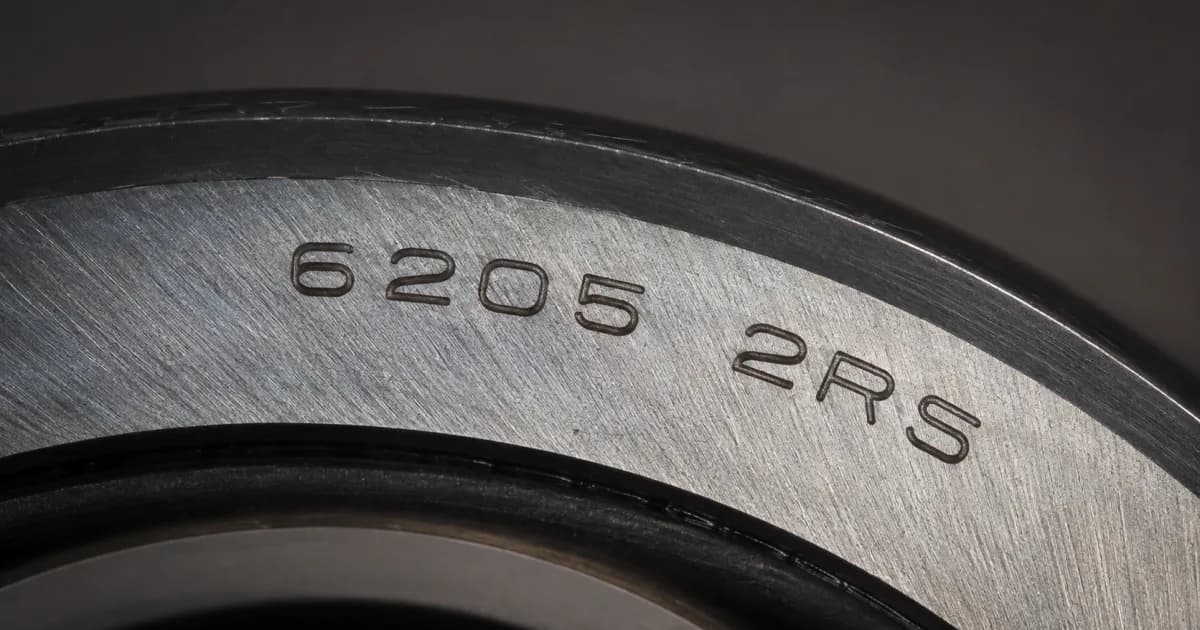
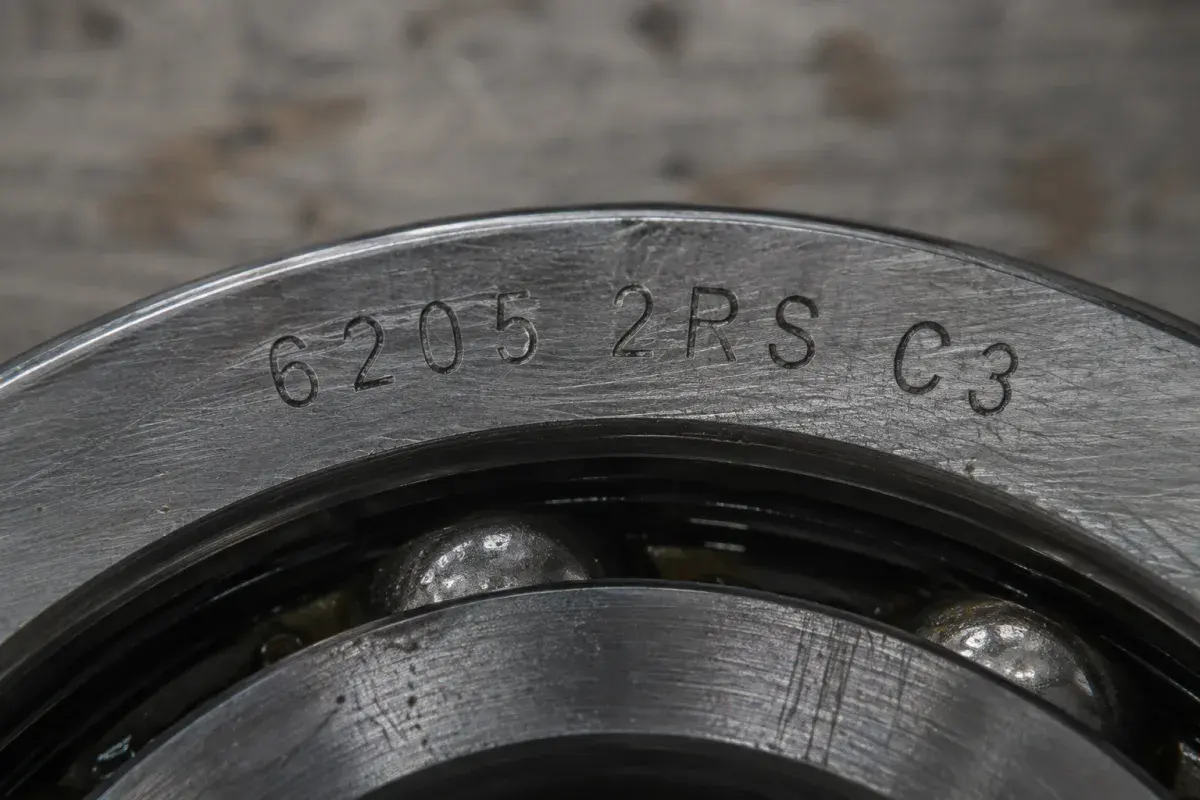
Take 6205. The 6 is the type, the 2 is the dimension series, and 05 is the bore code. Three numbers tell you what the bearing is and how big it is. The diagram below dissects the full string, suffixes included.
Why does this matter beyond trivia? Because the number is verifiable. If a bearing is stamped 6205 but your caliper reads a 30 mm bore, either the marking is counterfeit, the bearing is non-standard, or you're measuring the wrong surface. The designation and the physical part must agree.
How Do You Read the Bearing Size? (The Bore Code)
The last two digits of the basic designation encode the bore diameter, and the rule has one shortcut and four exceptions. Codes 00, 01, 02, and 03 mean 10, 12, 15, and 17 mm; every code from 04 to 96 is simply multiplied by 5 to give the bore in millimeters, per ISO 15. Koyo/JTEKT states it directly: bore numbers in the 04 to 96 range give the bore "by multiplying their bore diameter number by five" (Koyo/JTEKT).
So 6205 has a bore of 05 × 5 = 25 mm. A 6208 is 40 mm. A 6220 is 100 mm. Learn the four exceptions and the ×5 rule, and you can size most metric bearings in your head.
There are edge cases. Bores below 10 mm and non-standard bores use a slash: /0.6 means a 0.6 mm bore, and large bores are stated outright, so /500 is a 500 mm bore. Those are rare in general-purpose bearings but common in specials. If a bearing has no legible markings at all, the bore code won't help and you'll have to measure. Our step-by-step guide to measuring a bearing covers that path, then sends you back here to confirm the number.
What Does the First Digit Mean? (Bearing Type)
The first digit, or a letter prefix, identifies the bearing type. 6 is by far the most common because it denotes the single-row deep groove ball bearing, which every major catalogue lists across the widest bore range of any type (SKF). When you see a number starting with 6, you're almost certainly looking at the workhorse of the industry.
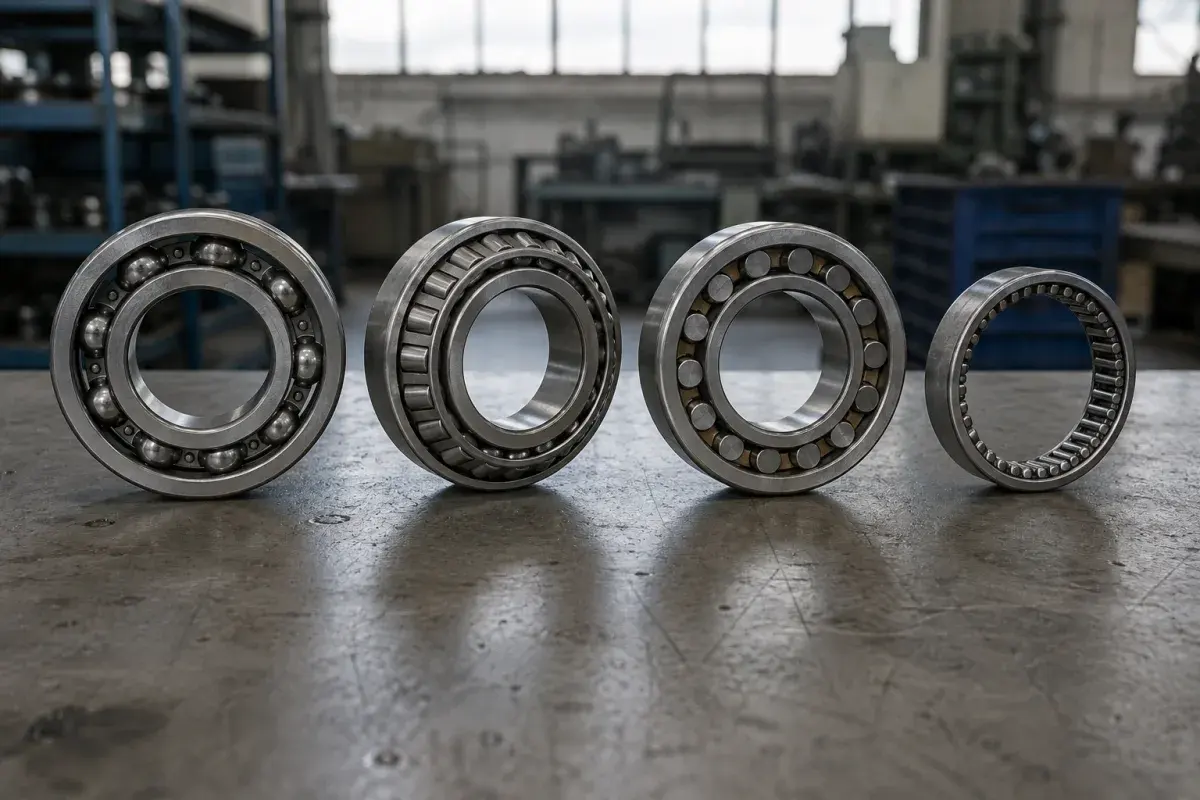
Left to right: single-row deep groove ball, tapered roller, cylindrical roller, and needle roller bearings. Each type carries a different leading digit or letter prefix.
Here's the full type map. Note that roller types often use letter prefixes instead of a leading digit.
| Digit / prefix | Bearing type |
|---|---|
1 | Self-aligning ball bearing |
2 | Spherical roller bearing (also self-aligning family) |
3 | Tapered roller bearing |
4 | Double-row deep groove ball bearing |
5 | Thrust ball bearing |
6 | Single-row deep groove ball bearing (most common) |
7 | Single-row angular contact ball bearing |
8 | Cylindrical roller thrust bearing |
N, NU, NJ, NUP, NF | Cylindrical roller bearing (letter = flange configuration); NN/NNU double-row |
NA, NKI | Needle roller bearing |
QJ | Four-point-contact ball bearing |
One trap to avoid: there is no modern standard type "0" for self-aligning ball bearings. The self-aligning ball type is 1. (A historical leading zero once flagged double-row angular contact bearings and is normally dropped.) If you decode a leading digit, match it against the table above rather than assuming a "0" family exists.
Each type has its own selection logic. If your number starts with 7, see our guide to the angular contact bearing; a 3 points to a tapered roller bearing; an NA prefix is a needle roller bearing; and a 5 is a thrust bearing.
What Do the Middle Digits Mean? (Dimension Series)
The digits between the type and the bore code are the dimension series, and they answer a question the bore alone can't: how big and how strong is the bearing around that bore? The dimension series combines a width (or height) series with a diameter series, and for a fixed bore, a higher diameter-series number means a larger outside diameter and higher load capacity (Koyo/JTEKT).
The clearest way to see it is to hold the bore constant and change the series. Compare 6205 and 6305:
| Designation | Type | Series | Bore | Outside diameter | Width |
|---|---|---|---|---|---|
| 6205 | 6 (deep groove ball) | 2 | 25 mm | 52 mm | 15 mm |
| 6305 | 6 (deep groove ball) | 3 | 25 mm | 62 mm | 17 mm |
Same 25 mm shaft, two different bearings. The 6305 is physically bigger and carries more load because the diameter series jumped from 2 to 3. The light-to-heavy diameter-series progression runs 8, 9, 0, 1, 2, 3, 4, from thinnest and lightest-duty to largest and heaviest.
Why 6205 shows only one series digit: the dimension series is technically two digits, width series then diameter series. But for the most common bearings the width-series digit is
0or1, and it's conventionally suppressed in the printed number. That's why6205looks like it has a single series digit when it really encodes "width series 0, diameter series 2." When you see a bearing like62/22or a four-digit series on a spherical roller bearing, the width digit has reappeared because it's no longer the default.
This is the field engineers most often skip, and it's the one that decides whether a "same bore" substitute actually fits the housing. The bore can match perfectly while the OD is 10 mm too large for the seat in the mounting. If the bearing sits in a bolted housing rather than a machined bore, our guide to flange bearings covers how the mount itself constrains the OD.
What Do the Suffixes Mean? (Seals, Clearance, Cage)
Everything after the basic number is a suffix, and suffixes describe the features that determine how the bearing behaves: seals, internal clearance, cage material, and precision. Unlike the basic number, suffixes are where manufacturers diverge, so this is the block that causes the most ordering errors. Four categories cover the vast majority of what you'll encounter.
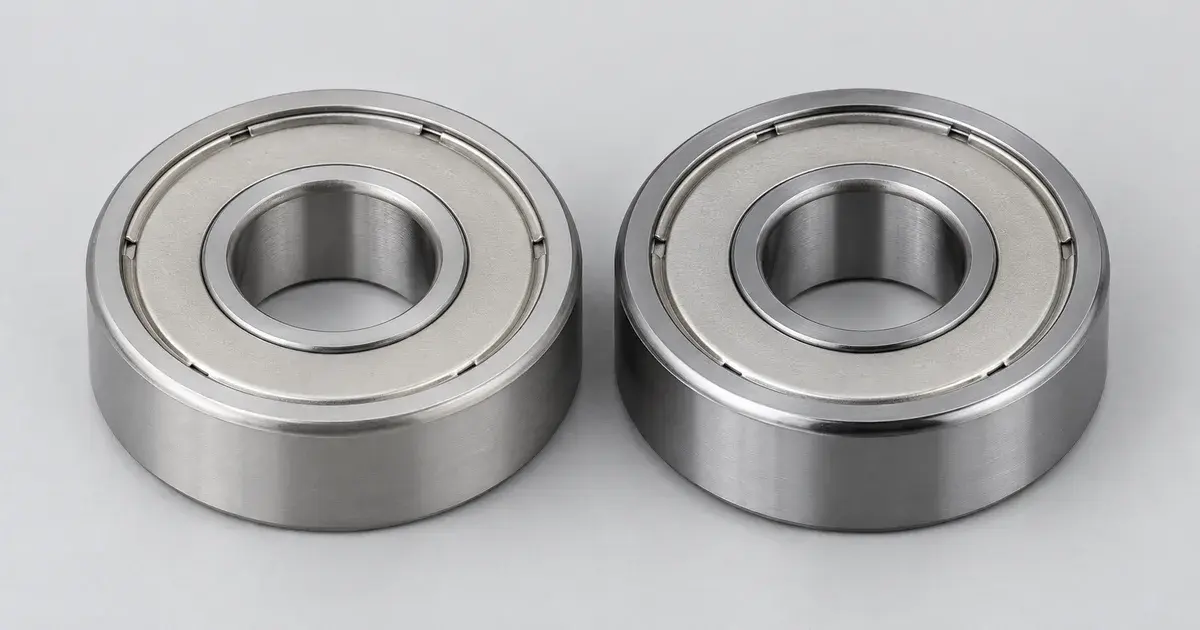
Seals and shields. These control contamination and lubricant retention. A 2RS (two contact rubber seals) trades speed for sealing; a ZZ or 2Z (two metal shields) keeps speed but only blocks coarse debris; a 2RZ is a low-friction non-contact seal. For the full trade-off between them, see our comparison of sealed vs shielded bearings.
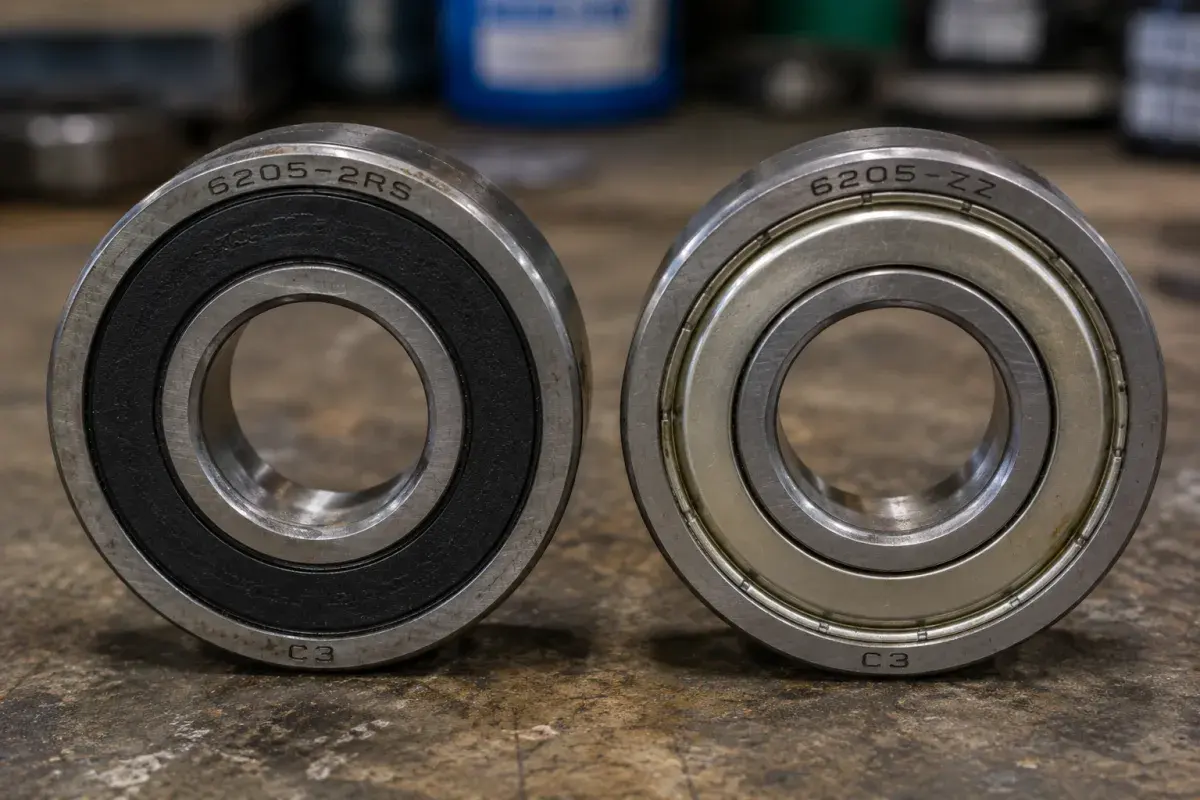
Internal clearance. This is the radial play inside the bearing before mounting, governed by ISO 5753-1. The scale runs from tight to loose. A higher number reflects a deliberate choice for thermal expansion or interference fits, not lower quality. For the actual micrometre values per class and how the fit and operating heat consume them, see our guide to bearing internal clearance.
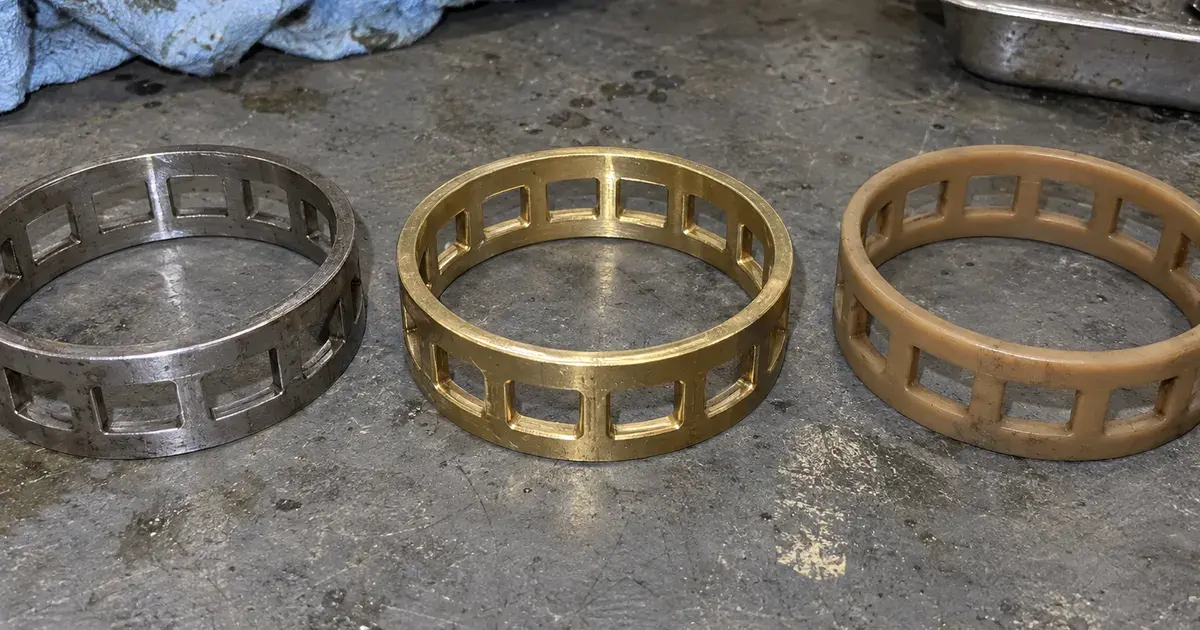
Cage (retainer). M is machined brass, J or Y is pressed steel, and TN, TNH, or TVH denote molded polyamide (nylon 6,6, often glass-reinforced). Cage choice affects speed, temperature limits, and shock tolerance. The letter also encodes where the cage sits, so SKF's M, MA and MB are all machined brass but centred differently; for the material limits and that distinction, see our guide to bearing cages.
Precision. The tolerance class follows ISO 492, which designates the classes Normal, 6, 5, 4 and 2. The P-prefixed codes catalogues print are the DIN 620 equivalents, and they map cleanly onto the ABEC scale most North American buyers know, which is defined separately under ANSI/ABMA Standard 20.
| ISO 492 class (DIN 620 code) | ABEC |
|---|---|
| Normal (P0) | ABEC 1 |
| 6 (P6) | ABEC 3 |
| 5 (P5) | ABEC 5 |
| 4 (P4) | ABEC 7 |
| 2 (P2) | ABEC 9 |
For the practical difference between these grades, and when you actually need P5 or better, see our guide to the ABEC bearing rating.
Are Bearing Numbers the Same Across Brands?
The basic number is largely universal, but the suffixes are not, and that split is the single biggest source of cross-brand ordering mistakes. Because ISO 15 fixes the boundary dimensions, a 6205 is 25 × 52 × 15 mm whether it comes from SKF, NSK, FAG, or ANDE. That's precisely what lets you cross-reference brands by the basic number. But each manufacturer writes its own seal, cage, and clearance codes, so 6205-2RS1 (SKF) and 6205DDU (NSK) are the same bearing with different labels.
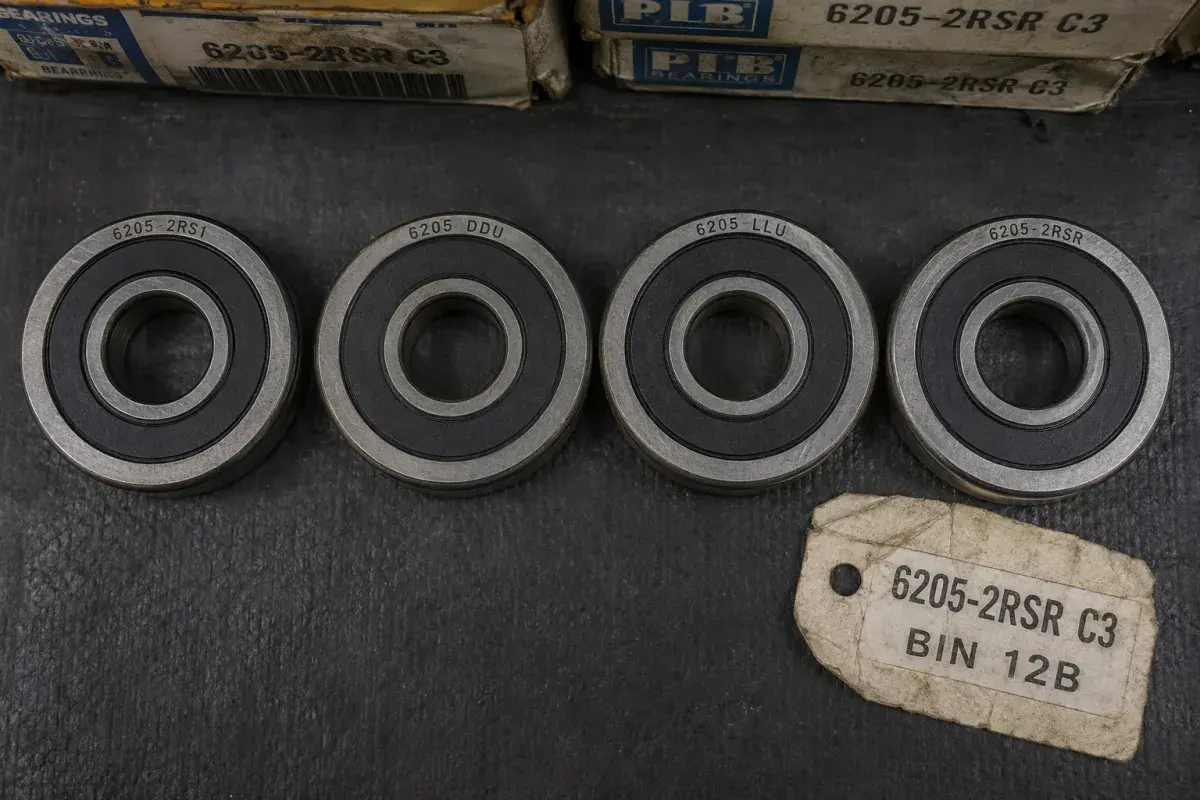
Same bearing, four labels: SKF 2RS1, NSK DDU, NTN LLU, and FAG 2RSR all describe an identical double contact seal.
One code family doesn't vary: clearance codes (C2 to C5) read the same across all four brands because they trace back to ISO 5753 rather than to any house style. Seals are the wild card, and one seal code is rarely one seal. SKF alone publishes seven for deep groove ball bearings, two of which use a different elastomer. Our bearing cross reference guide carries the full suffix matrix, those compound differences, and a five-step workflow for verifying an interchange before you order.
From our order desk: the failure mode we see most often is the right size with the wrong seal, not the wrong size. A buyer replacing an NSK
6205VV(non-contact seal) orders an SKF6205-2RS1(contact seal), the drag goes up, the bearing runs hotter, and a "same part" swap quietly loses a few hundred rpm of headroom. When you cross-reference, match the seal function, not the letters.
Standardization also has a darker side worth naming. Because the designation system is open, a counterfeiter can stamp a correct-looking number on a substandard ring. Global trade in counterfeit goods was valued at roughly 467 billion USD in 2021, about 2.3% of total global imports. Automotive parts are among the categories that same report flags as a growing danger (OECD / EUIPO). A correct number on the ring is necessary but not sufficient; provenance still matters. The World Bearing Association offers a Check app for a quick initial screen, and says identifying counterfeits with certainty is done with the help of the premium brand manufacturers. Contact the manufacturer and the authorities before raising it with your distributor or supplier, because sharing a suspicion with them first can lead to evidence being destroyed. If you're sourcing internationally, our guide on how to procure Chinese bearings from overseas covers supplier qualification.
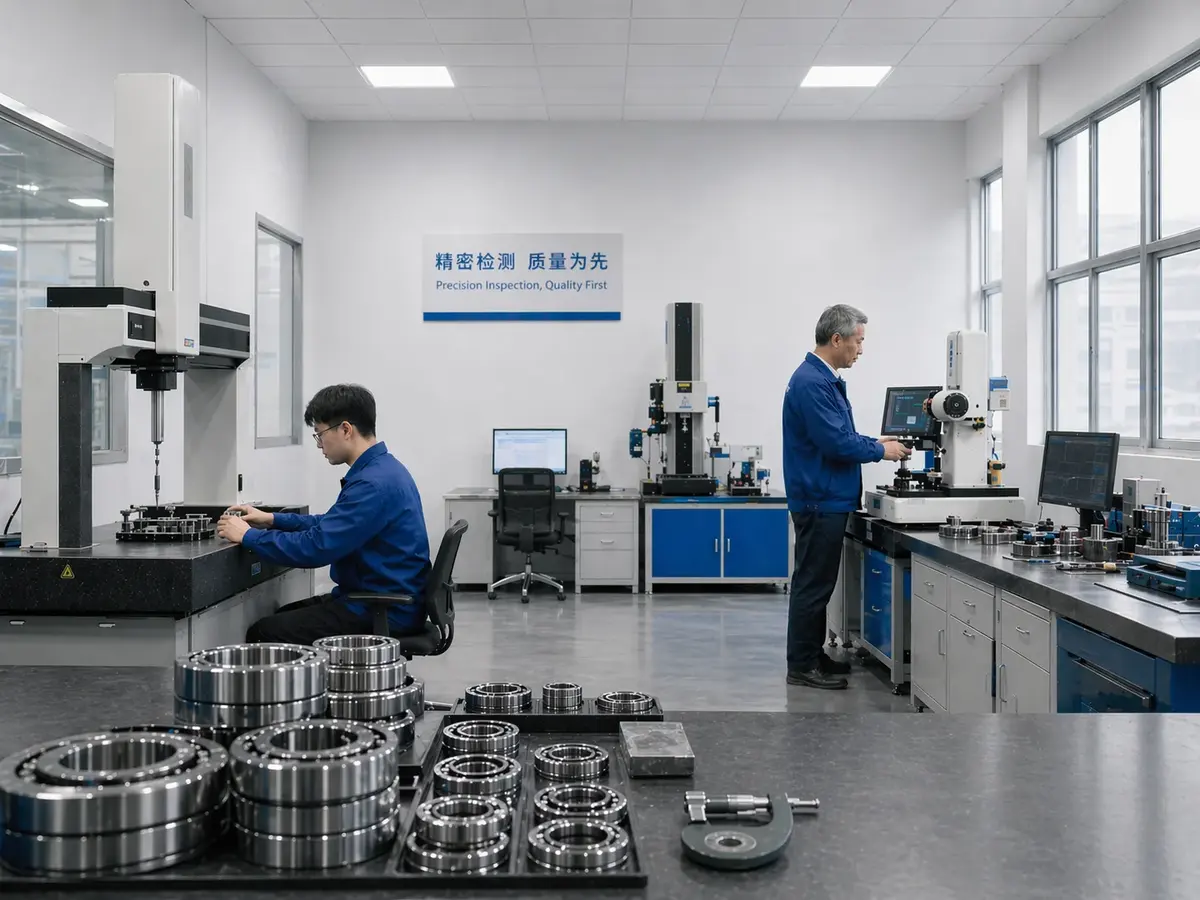
The number and the physical part must agree. In-house QC measures bore, OD, and runout against the designation before a batch ships.
How Do You Read Tapered, Cylindrical, and Inch-Series Numbers?
Not every bearing follows the tidy 6205 pattern. Tapered, cylindrical, and inch-series bearings each use their own conventions, and inch-series is the one that trips up engineers raised on metric. Metric tapered roller bearings follow ISO 355 with its own series designations, and cylindrical roller bearings use letter prefixes for flange configuration. Inch-series tapered bearings abandon the numeric size system entirely for a two-part cone-and-cup scheme (Timken).
Cylindrical roller bearings carry a letter prefix that tells you which ring has flanges, and therefore how much axial location the bearing provides. NU has no flanges on the inner ring, NJ has one, NUP has a flange plus a loose rib ring, and N has flanges only on the inner ring. The rest of the number (dimension series, bore code) behaves like the metric ball-bearing system.
Inch-series tapered bearings are the real departure. Instead of encoding the bore in the number, they use a matched pair: a cone (inner ring with rollers) and a cup (outer ring), each with its own part number. A classic set is cone LM12749 running in cup LM12711. The two are sold and specified separately, and mixing cones and cups across sets is a mounting error. This ANSI/ABMA convention is why a Timken inch tapered number tells you nothing about the bore until you look it up. For the metric side of the tapered world, our comparison of tapered vs cylindrical roller bearings covers where each fits.
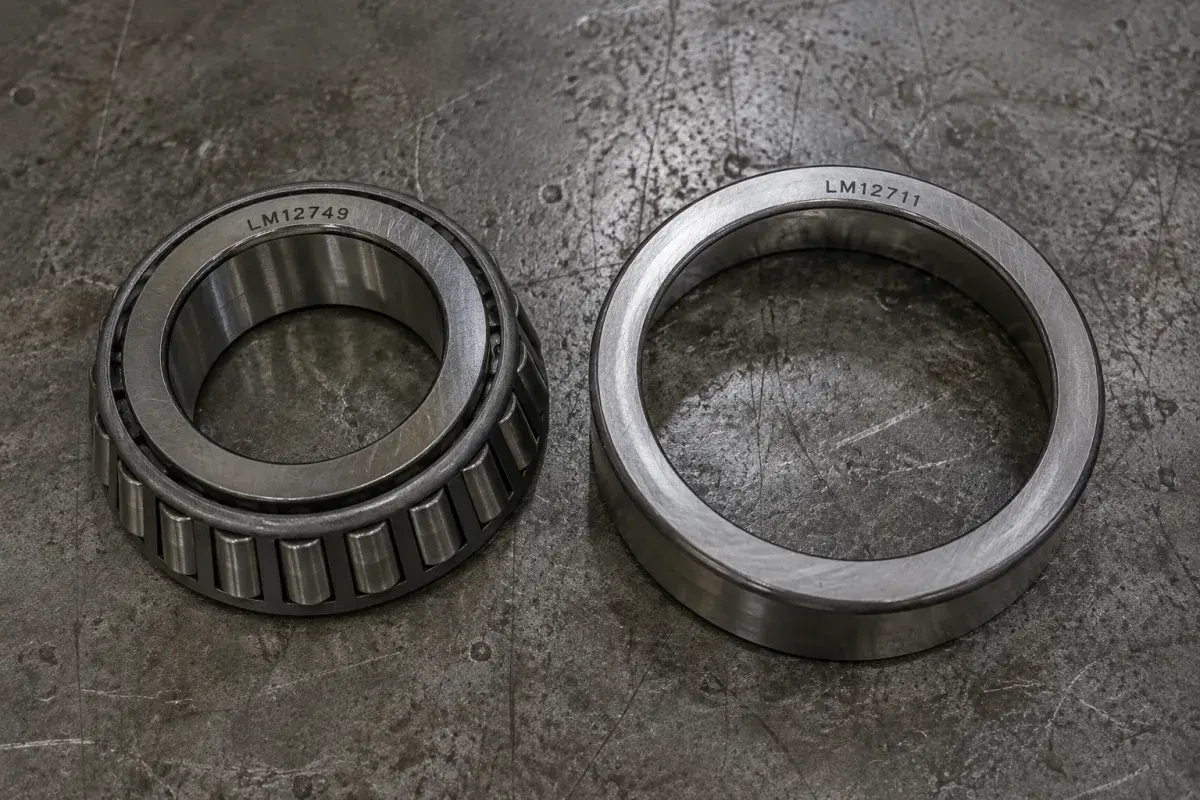
An inch-series set ships as two separately numbered parts, cone LM12749 and cup LM12711, that must be kept together.
Worked Example: Decode 6205-2RS C3 From Start to Finish
Put the whole method together and a designation reads like a sentence. Walk 6205-2RS C3 left to right: 6 = single-row deep groove ball; 2 = dimension series (52 mm OD, 15 mm width for this bore); 05 = bore code, 05 × 5 = 25 mm; 2RS = two contact rubber seals; C3 = internal clearance greater than Normal. The result is a sealed 25 × 52 × 15 mm deep groove ball bearing with extra clearance, per the ISO 15 and ISO 5753-1 systems.
Now prove the method generalizes with a bearing that doesn't start with 6. Take NU 2210 E:
NU— cylindrical roller bearing, no inner-ring flanges (floating axial arrangement)22— dimension series (width series 2, diameter series 2)10— bore code, 10 × 5 = 50 mm boreE— reinforced internal design (higher load capacity)
Same three-block logic: type, then size, then features. Once you internalize that pattern, the only thing you look up is the exact OD and width from a dimension table — and even those you can often estimate from the series. Can you read your own bearing now? Pull one off the shelf and try the string on it.
Frequently Asked Questions
Q: What does 6205 mean on a bearing?
The 6 means a single-row deep groove ball bearing, the 2 is the dimension series that sets the outside diameter and width, and 05 is the bore code. Multiply 05 by 5 to get a 25 mm bore. The full bearing measures 25 × 52 × 15 mm under the ISO 15 boundary-dimension system.
Q: What do the last two digits of a bearing number mean?
They encode the bore diameter. Codes 00, 01, 02, and 03 mean 10, 12, 15, and 17 mm respectively. For every code from 04 to 96, multiply by 5 to get the bore in millimeters, per ISO 15. So a code of 08 is a 40 mm bore, and 20 is a 100 mm bore.
Q: What does 2RS (or ZZ or C3) mean on a bearing?
2RS means two contact rubber seals, one on each side. ZZ (or 2Z) means two metal shields. C3 is an internal clearance group greater than Normal, defined by ISO 5753 — chosen for thermal expansion or interference fits, not a sign of lower quality.
Q: How do I find a bearing's size from its number?
Decode the bore code (last two digits) for the bore, then read the type and dimension series to look up the outside diameter and width in a dimension table. If the markings are unreadable, measure the bore, OD, and width directly — our guide to measuring a bearing shows how, then cross-check against the number.
Q: Are bearing numbers the same across brands?
The basic number is standardized by ISO 15, so a 6205 is 25 × 52 × 15 mm from any maker — SKF, NSK, FAG, or ANDE. The suffixes are not standardized. A double contact seal is 2RS1 at SKF, DDU at NSK, and LLU at NTN. Match the suffix by function, not by letters.
Q: What does the letter prefix like NU or NJ mean?
Letter prefixes identify roller bearing types and flange configuration. NU, NJ, NUP, and N are all cylindrical roller bearings that differ in which ring carries flanges, which sets how much axial load and location the bearing provides. NA and NKI denote needle roller bearings.
Conclusion
A bearing number is a spec sheet compressed into a handful of characters, and reading it comes down to three blocks:
- Type first. The leading digit or letter tells you what the bearing is —
6for deep groove ball,3for tapered,N-family for cylindrical. - Size next. The dimension series sets the OD and width; the last two digits give the bore (00 to 03 are fixed, 04 to 96 multiply by 5).
- Features last. Suffixes carry seals, clearance, cage, and precision — and they're the brand-specific trap. Cross-reference by function.
Get those three right and you can identify, verify, and substitute bearings across manufacturers with confidence. The basic number travels; the suffixes need translation.
Need to cross-reference a legacy SKF, FAG, or NSK number to an equivalent part? Send the full designation to ANDE Bearing's engineering team and we'll confirm the interchange, dimensions, and the right suffix for your application. You can also browse our deep groove ball bearings to start from the size you need. If your markings are gone entirely, work backward from the physical part with our guide to measuring a bearing.
About the Author
Jeff Li writes on bearing engineering and global sourcing for ANDE Bearing. He works directly with OEM and aftermarket buyers in automotive, heavy industry, and renewable energy. Connect on LinkedIn.