A needle roller bearing carries 2 to 8 times the load per unit mass of other bearing types at the same bore, and fits into half the outside diameter and one-fifth the mass of a comparable deep groove ball bearing (NTN). No other rolling bearing packs that much capacity into that little radial space.
The catch is that "needle roller bearing" covers at least four structurally different products, and picking the wrong one is the most common specification error in this family. A drawn cup in a soft aluminium housing, a full-complement assembly at 8,000 rpm, or a caged assembly on an unhardened shaft will each fail early — not because the load rating was wrong, but because the construction didn't match the application. This guide covers what they are, the four families, how to read the designations, and how to choose. If you're comparing bearing families more broadly, start with our guide to different kinds of bearings.
Key Takeaways
- Needle rollers run a length-to-diameter ratio between 1:3 and 1:10, giving line contact in a minimal radial envelope. They are radial-load-only bearings.
- Four families in rising order of section height: cage assembly → drawn cup → machined ring without inner ring → machined ring with inner ring. Section height and housing independence trade against each other.
- Caged designs run faster with less friction; full-complement designs carry more load but are speed-limited. Full complement suits high-load, low-speed, and oscillating duty (NTN, Table 1.1).
- Any design without an inner ring needs the shaft hardened to 58–64 HRC and ground to Ra 0.2 μm and IT5, or the catalog load rating no longer applies.
- Needle bearings tolerate only 1/2000 misalignment — the same slenderness that gives them capacity makes them intolerant of angular error (NTN 2203E, Table 3).
What Is a Needle Roller Bearing?
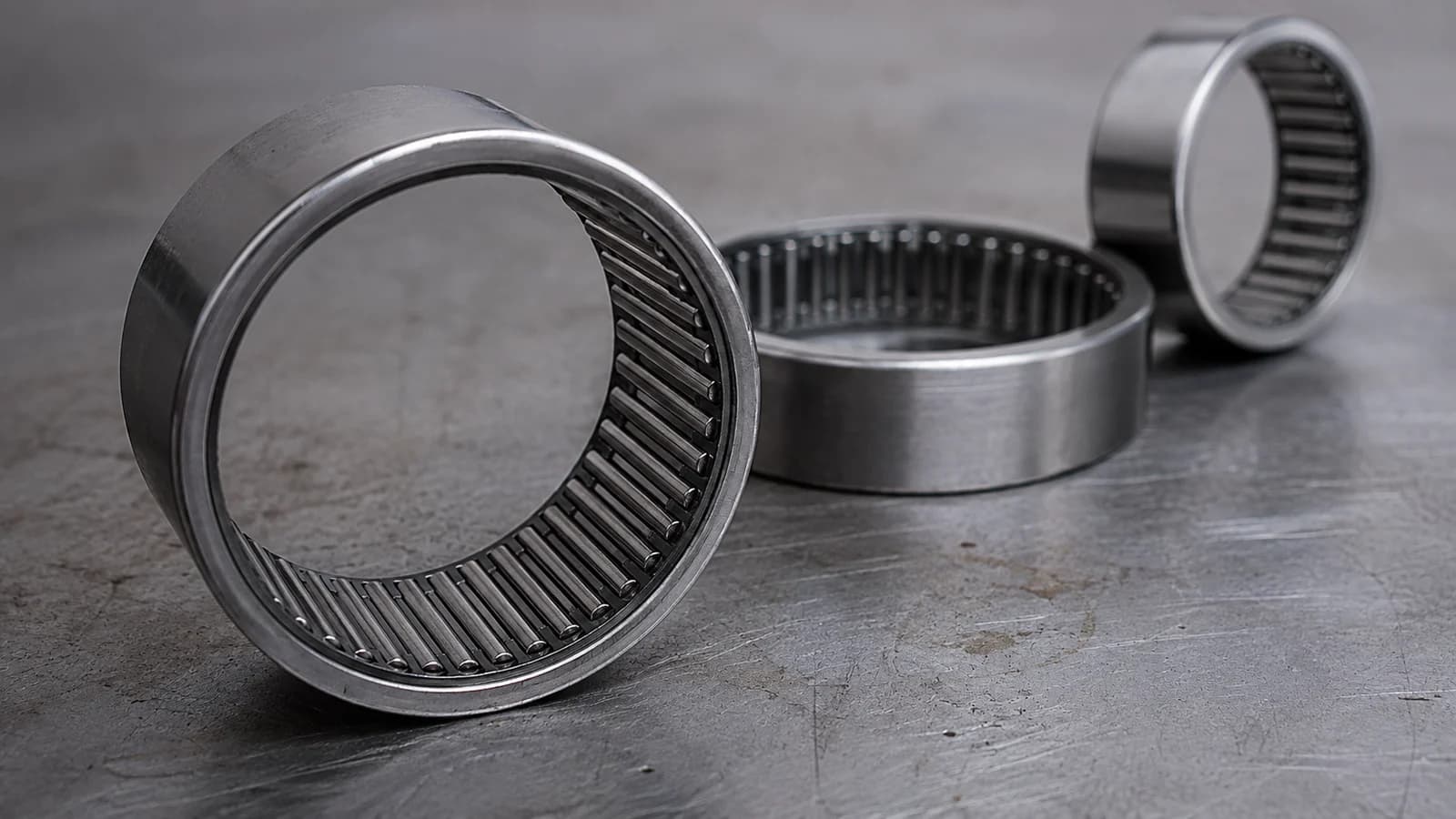
A needle roller bearing is a rolling-element bearing using long, slender cylindrical rollers whose length is three to ten times their diameter, per ISO 5593, with the roller diameter itself usually no greater than 5 mm. That slenderness is the entire point: it produces line contact with the raceway while keeping the radial cross-section barely thicker than the roller — which is how these bearings reach 2 to 8 times the load capacity per unit mass of other types at equal bore (NTN).
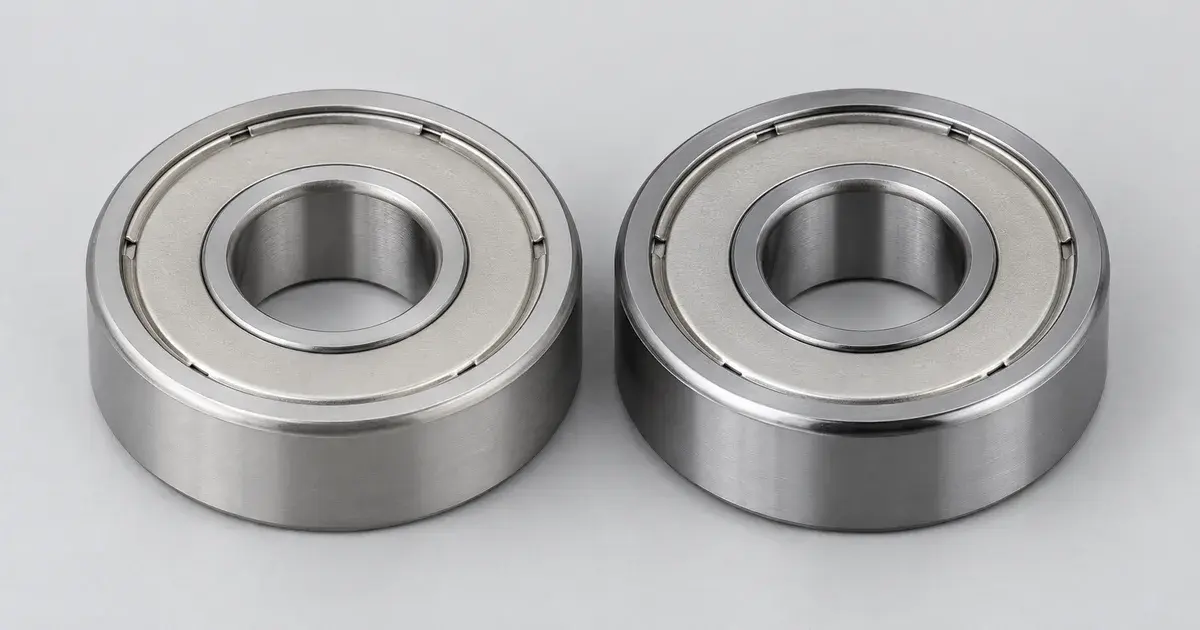
Compare it to a deep groove ball bearing at the same bore. The ball bearing makes point contact, so its load is concentrated on a tiny elliptical patch and the rings need substantial wall thickness to spread it. Needle rollers spread the same load along a line, which lets the whole assembly shrink radially.
Three consequences follow, and all three matter when specifying:
- Radial loads only. Needle bearings carry essentially no axial load. Schaeffler is explicit that drawn cup needle roller bearings and needle roller and cage assemblies may be subjected to radial load only. Axial location has to come from snap rings, shoulders, or adjacent structure.
- High rigidity. Under equal basic load rating, needle bearings deflect less than ball bearings, because load per unit contact area is lower (NTN, §1.2).
- Low inertia. Less rotating mass makes them well suited to reciprocating and oscillating positions like connecting rods and piston pins.
The property nobody markets: needle bearings are unusually good at oscillating motion, where the shaft rocks rather than rotates. But NTN adds a design condition most engineers never see — the oscillation angle must be large enough that each roller's travel overlaps the position of its neighbour. If the swing is too small, rollers keep working the same tiny patch of raceway, lubricant gets pushed out and isn't replenished, and life falls sharply. Because needle bearings pack the most rollers into a row, they reach that overlap at the smallest swing angle of any bearing type — which is exactly why they dominate rocker arms and connecting rods. Specify the oscillation angle, not just the load.
What Are the Four Types of Needle Roller Bearings?
Needle roller bearings divide into four structural families: cage assemblies, drawn cup, machined ring without an inner ring, and machined ring with an inner ring. They differ by which raceways the bearing supplies and which ones you must manufacture — and NTN identifies the drawn cup as having the smallest section height of any type with an outer ring (NTN, CAT. No. 2300E). That single distinction drives cost, section height, and housing requirements.
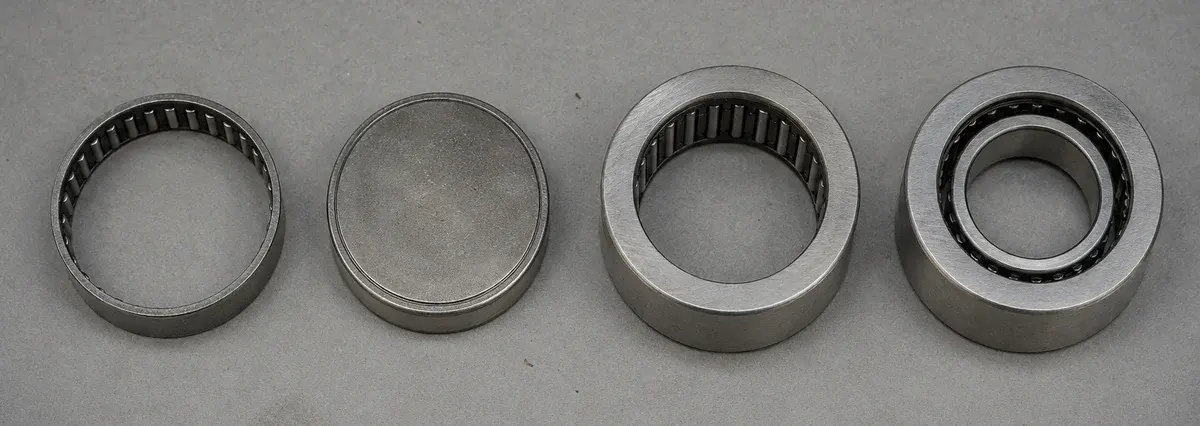
| Family | Typical series | Supplies | You must provide | Section height |
|---|---|---|---|---|
| Needle roller and cage assembly | K, KBK, PK | Rollers + cage only | Hardened shaft and housing raceway | Lowest |
| Drawn cup | HK (open), BK (closed), HN/HV (full complement) | Thin pressed outer cup | Hardened shaft (or add an inner ring) | Very low |
| Machined ring, no inner ring | NK, RNA 48/49/59/69 | Thick ground outer ring | Hardened shaft | Moderate |
| Machined ring with inner ring | NA 48/49/59/69, NK+IR | Both rings | Nothing — self-contained | Highest |
Needle roller and cage assemblies
Just rollers held in a cage. No rings at all. Section height equals roughly the roller diameter, which is as compact as rolling bearings get. Both the shaft and the housing bore become raceways, so both need hardening and grinding. Used where space is absolutely critical and volumes justify the machining — engine connecting rods, piston pins (KBK), crank pins (PK).
Drawn cup needle roller bearings
An outer ring formed by precision deep-drawing of thin steel sheet, then surface-hardened by carburizing. NTN describes this as the smallest section height of any needle bearing with an outer ring (NTN, Drawn cup needle roller bearings, CAT. No. 2300E). Open-end (HK) and closed-end (BK) versions exist, the closed end capping the shaft end.
Because the cup is thin, it takes its final geometry from the housing. Schaeffler puts it plainly: the bearings only adopt their precise geometry once they have a tight fit (Schaeffler). NTN goes further — because deformation during heat treatment is unavoidable, measuring a drawn cup's accuracy before press-fitting is meaningless; it's checked inside a ring gauge of at least 20 mm wall thickness.
Two consequences for the designer. Drawn cups need a rigid steel or cast-iron housing with a good bore, and NSK explicitly advises avoiding split housings for them (NSK, Needle Roller Bearings, §4.1.2). They also carry a hard ceiling: NSK specifies a maximum permissible load Pmax per size that dynamic loads must not exceed, with static load permitted only up to 1.3 × Pmax. Press-fit installation does provide axial retention without snap rings, which simplifies the housing.
Machined ring needle roller bearings
A thick-walled outer ring, through-hardened and ground to final geometry before installation. It holds its own accuracy regardless of the housing, so these work in aluminium, magnesium, thin-walled, or split housings where a drawn cup would deform. NSK notes that solid bearings can sustain high shock loads and continuous loads and tolerate double-cut split housings, precisely where drawn cups can't (NSK, §4.1.2).
Available with an inner ring (NA, NK+IR) or without (NK, RNA). Adding the inner ring makes the bearing fully self-contained — no shaft hardening required.
Thrust and combined types
Two extensions worth knowing, since they solve the axial-load limitation:
- Thrust needle roller bearings (AXK series, plus washers) take axial load in one direction with a very thin axial profile. Common in automotive transmissions and planetary gear sets.
- Combined bearings carry radial and axial load in one unit: NKX (needle + thrust ball), NKXR (needle + thrust cylindrical roller), ARN and AXN (needle + double-direction thrust for high axial loads).
There are also one-way clutch bearings (HF series) — a drawn cup that transmits torque in one direction only, used for indexing and backstopping — and dedicated rocker arm bearings (RAB) for engine valvetrains.
Caged or Full Complement: Which Should You Choose?
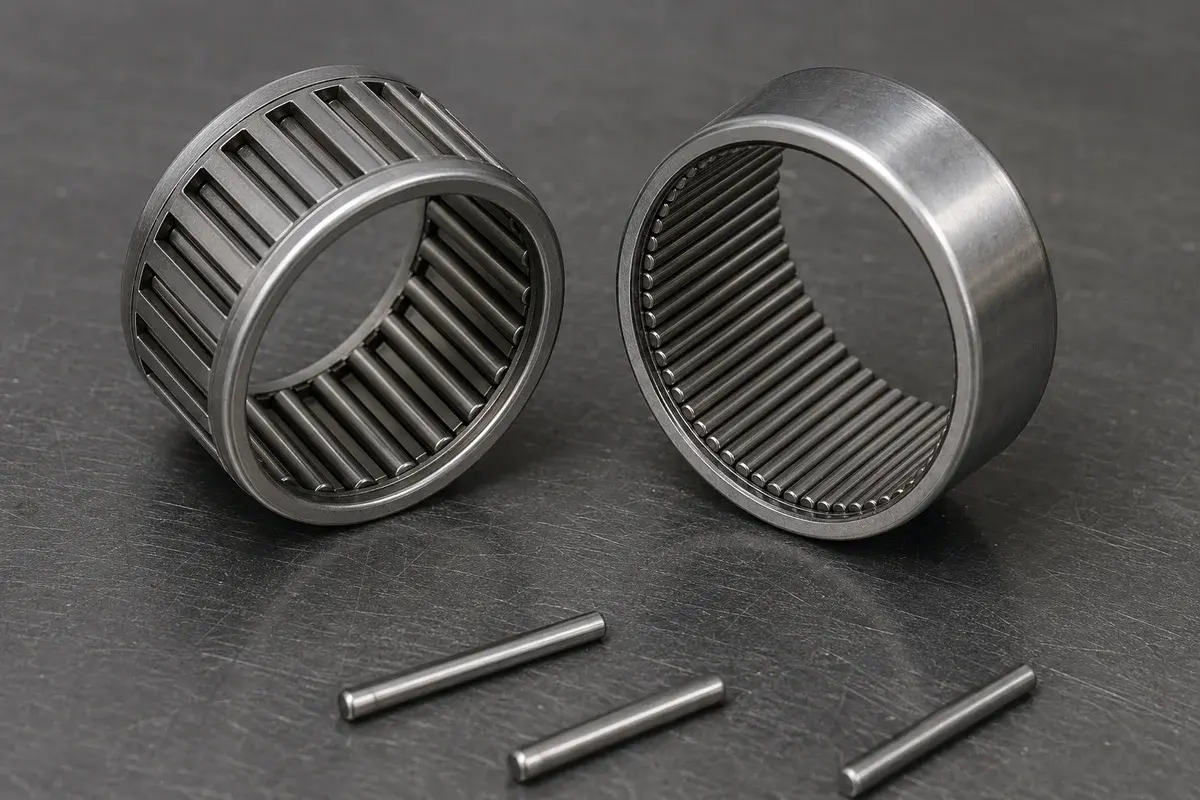
Choose caged for speed, full complement for load. NTN's comparison is unambiguous: caged assemblies show low roller skew, small friction, low temperature rise and high permissible speed, while full-complement designs invert all four in exchange for capacity that "can be increased" (NTN, Needle Roller Bearing Handbook, Table 1.1). Full complement removes the cage and fills the space with more rollers; caged designs space them out. The same trade is quantified on catalogue data for cylindrical rollers in our guide to bearing cages, where dropping the cage buys static capacity and costs most of the limiting speed.
| Property | Caged | Full complement |
|---|---|---|
| Roller skew | Low incidence | High incidence |
| Friction coefficient | Small | Large |
| Temperature rise | Low | High |
| Permissible speed | High | Low |
| Load capacity | Lower | Can be increased |
Source: NTN Needle Roller Bearing Handbook, Table 1.1.
The mechanism behind the speed limit is roller skew. A cage guides each roller parallel to the shaft axis; without one, nothing holds the rollers square, so they can skew, rub against each other, and generate heat. NTN's guidance is that full-complement bearings suit high-load, low-speed, and oscillating applications, while caged designs cover general rotating duty.
A practical rule: if the position rotates continuously at any real speed, choose caged. If it oscillates, indexes, or turns slowly under heavy load — a press linkage, a hydraulic cylinder pin, an agricultural drive — full complement earns its capacity.
How Much Load Can a Needle Roller Bearing Carry?
Rated life follows the ISO 281 relationship L₁₀ = (C/P)ᵖ, with the roller-bearing exponent p = 10/3 rather than the 3 used for ball bearings, and the static rating C₀ᵣ corresponds to a limiting contact stress of 4,000 MPa for roller bearings (NTN, Needle Roller Bearing Handbook, §4). Basic dynamic rating C is the load giving one million revolutions of rated life. Our guide to dynamic versus static load ratings covers how to apply both.
Two constraints specific to needle bearings deserve more attention than they usually get.
There is a minimum load, not just a maximum
Schaeffler specifies a minimum radial load of P > C₀ᵣ/60 for drawn cup needle roller bearings, to prevent the rollers sliding instead of rolling. Under-loaded needle bearings smear rather than fatigue.
In most installations the weight of supported parts and external forces already exceed this. But it bites in two situations: a lightly loaded idler or guide roller, and a bearing sized generously "for safety." Oversizing a needle bearing can cause the failure you were trying to avoid.
The load rating assumes a raceway you may have to build
For any bearing without an inner ring, the published C value assumes the shaft raceway meets specification. Fall short and every manufacturer applies a derating factor — NTN as a₂×a₃, NSK and Schaeffler as a hardness factor fH, with Schaeffler adding a separate static factor fH0.
| Requirement | Specification | Source |
|---|---|---|
| Surface hardness | 58–64 HRC (Schaeffler: ≥670 HV) | NTN 2203E; Schaeffler |
| Surface roughness Ra | 0.2 μm ≤φ80 · 0.3 μm φ81–120 · 0.4 μm >φ120 | NTN 2203E, Table 1 |
| Dimensional accuracy | IT5 (IT4 for high running accuracy) | NTN 2203E, Table 1 |
| Roundness / cylindricity | IT3 (IT2) | NTN 2203E, Table 1 |
| Allowable misalignment | 1/2000 radial; 1/10 000 thrust | NTN 2203E, Table 3 |
From our inspection floor: when customer-supplied shafts fail incoming inspection as raceways, low surface hardness is rarely the reason. The recurring findings are a hardened layer too shallow for the roller diameter, and grinding chatter that measures within the Ra ceiling but fails roundness. Both pass a spot hardness check and a roughness gauge, and neither survives service. If the drawing doesn't call out case depth and roundness, inspection can't catch either.
If the shaft can't be brought to that spec — aluminium, magnesium, non-heat-treatable alloys, low volumes, or grinding capability you don't have — specify an inner ring (IR or LR) or a machined bearing with one. The section height goes up; the process risk goes away.
How Do You Read Needle Bearing Designations?
Designations encode construction, not just size, so the series code tells you most of what you need before you open a dimension table. Boundary dimensions and tolerances for radial needle roller and cage assemblies are governed by ISO 3030:2022, now in its 4th edition. Using NTN's needle bearing catalogue as the reference — equivalent series exist across SKF/INA, NSK, Koyo, and IKO:
| Code | Construction |
|---|---|
| K | Needle roller and cage assembly (no rings) |
| HK | Drawn cup, open end, caged |
| BK | Drawn cup, closed end, caged |
| HN / HV / BV | Drawn cup, full complement |
| HF | Drawn cup one-way clutch |
| NK | Machined ring, no inner ring |
| NK+IR | Machined ring assembled with an inner ring |
| RNA 48/49/59/69 | Machined ring, no inner ring, dimension series |
| NA 48/49/59/69 | Machined ring with inner ring, dimension series |
| NAO / RNAO | Machined ring, separable |
| AXK | Thrust needle roller and cage assembly |
| NKX / NKXR / ARN / AXN | Combined radial + axial |
| IR / LR | Inner rings (IR precision machined, LR ground, looser tolerance) |
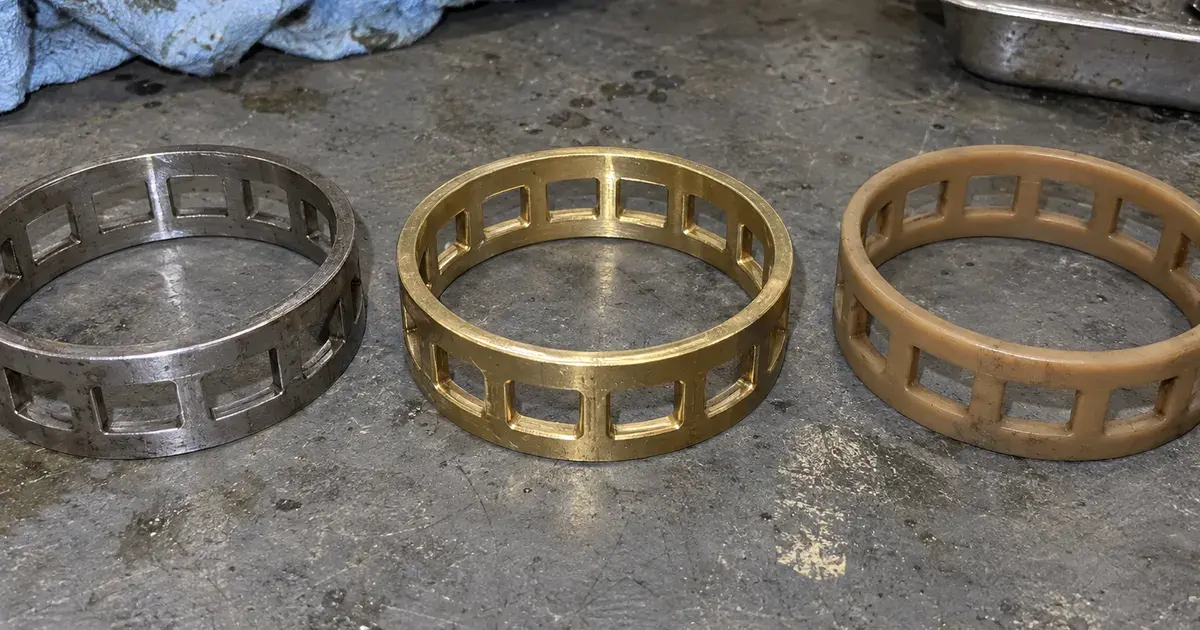
The letter pairs matter most. NA versus RNA and NK versus NK+IR differ only by the inner ring, which is the single decision that determines whether you must harden the shaft. Common suffixes: ZW double row, LL / L seals, T2 polyamide cage (temperature-limited to 120 °C peak, 100 °C continuous), S adjustable clearance.
On standards: ISO 3030:2022 replaced the now-withdrawn 2011 edition and added geometrical product specifications plus an informative annex on shaft and housing raceway tolerances. Machined-ring tolerances follow ISO 492, and drawn cup dimensions commonly reference DIN 618. If a drawing or purchase order cites ISO 3030, cite it with the year — two prior editions are withdrawn.
Full boundary dimensions and tolerances live in the manufacturer's dimension tables. If you're working from a bearing already in service with no legible markings, our guide to measuring a bearing covers identification from physical dimensions.
Where Are Needle Roller Bearings Used?
Automotive is the dominant application. Market Research Future puts the automotive segment at over 50% of the global market, and Technavio projects the automotive needle bearing segment growing at a 7% CAGR through 2030 with Asia-Pacific contributing 49.2% of that growth (Market Research Future; Technavio). Transmissions alone use them in planetary gear sets, shafts, and synchronizer hubs, where radial space between concentric shafts is the binding constraint.
| Sector | Typical positions | Why needle bearings |
|---|---|---|
| Automotive powertrain | Transmission planetary sets, connecting rods, piston pins, rocker arms, universal joints, steering columns | Radial space between concentric shafts; oscillating duty |
| Compressors & pumps | Connecting rods, eccentric drives, swash plates | High load in small envelope; reciprocating motion |
| Textile & printing | Roller journals, cylinder supports, guide rollers | Many bearing positions, compact and low cost |
| Power tools | Gear reductions, hammer mechanisms, spindles | Small radial envelope, shock tolerance |
| Agricultural & construction | Drive shafts, linkages, cylinder pins | Full-complement capacity at low speed and oscillating motion |
| Robotics | Precision reducers, collaborative joints | Low section height with high rigidity |
A note on market figures
Published needle bearing market estimates disagree wildly. For essentially the same period, Maximize Market Research reports $3.21 B (2025), MarkWide $3.8 B (2026), Research and Markets $5.51 B (2026), and Market Research Future $8.63 B (2025) — with CAGRs from 4.82% to 9.2%. That's a 2.7× spread between the lowest and highest figure for the same market. It reflects different scope definitions (automotive-only versus all needle types, factory-gate versus distributor value), not genuine disagreement about demand.
Treat any single figure with caution. The directional consensus across all of them is more reliable than any one number: automotive is the largest segment, Asia-Pacific is the largest region, and electrification is reshaping requirements rather than shrinking demand. Electric drivetrains remove the engine-oil splash environment that used to lubricate transmission needle bearings, which pushes the design problem toward grease-limited operation and cage materials rather than eliminating the bearings.
Needle Roller vs Cylindrical Roller vs Ball Bearings
Needle bearings win on radial section height, reaching comparable capacity at half the outside diameter and one-fifth the mass of a deep groove ball bearing (NTN); cylindrical rollers win on outright capacity; ball bearings win on speed and axial load. Schaeffler's guidance is that where the design envelope is restricted radially, needle roller and cage assemblies and drawn cup bearings are the appropriate choice, because line contact delivers high radial capacity at low section height (Schaeffler).
| Needle roller | Cylindrical roller | Deep groove ball | |
|---|---|---|---|
| Contact | Line (slender roller) | Line (roller) | Point |
| Radial section height | Minimum | Moderate | Moderate |
| Radial capacity | High for its size | Highest | Lower |
| Axial capacity | Essentially none | None (N, NU types) | Moderate |
| Speed | Low to moderate | Moderate to high | Highest |
| Misalignment tolerance | Very low (1/2000) | Low | Moderate |
| Rigidity at equal rating | High | High | Lower |
Schaeffler names high-performance vehicle gearboxes as the canonical radially-constrained case. Choose accordingly:
- Radial space is the constraint → needle roller. Nothing else is this thin.
- Maximum radial capacity, space available → cylindrical roller.
- High speed, or any meaningful axial load → ball bearing, or add a thrust element alongside the needle bearing.
- Combined radial and axial load in one unit → combined needle types (NKX, NKXR, ARN, AXN).
- Significant misalignment or shaft deflection → spherical roller bearings, which handle up to about 2° — roughly 70 times the needle bearing limit.
How to Select a Needle Roller Bearing
Work through six checks in order — load direction, shaft, housing, cage type, speed, lubrication. Each answer eliminates options, which is faster than starting from a dimension table. NTN lists the same inputs as prerequisites for selection: load magnitude and direction, speed and which ring rotates, required life, and ambient temperature (NTN, Needle Roller Bearing Handbook, §3).
Step 1 — Confirm the load is purely radial
If there's any sustained axial load, a plain needle bearing is wrong. Either add a thrust needle bearing (AXK) alongside it, or specify a combined type. Check that axial location is handled by snap rings, shoulders, or adjacent structure.
Step 2 — Decide whether the shaft can be a raceway
Can it reach 58–64 HRC, Ra 0.2 μm, IT5, with adequate case depth? If yes, a cage assembly or a bearing without an inner ring gives minimum section height. If no, specify an inner ring — and accept the added wall thickness.
Step 3 — Assess the housing
Rigid steel or cast iron with a well-toleranced bore permits a drawn cup. Aluminium, magnesium, thin-walled, or split housings require a machined ring, whose thick outer ring holds geometry independently. This is the single most common misapplication in the family: a drawn cup in a housing that can't support it.
Step 4 — Choose caged or full complement
Continuous rotation at moderate or high speed → caged. Oscillating, indexing, or slow-speed heavy load → full complement.
Step 5 — Check speed, load range, and clearance
Verify permissible speed for the size, then confirm the load sits above C₀ᵣ/60 and below the rated capacity — and for drawn cups, below Pmax. Where shaft deflection or mounting error is significant, NSK advises selecting a larger radial clearance (C3 or greater) so the bearing doesn't lose internal clearance in service.
Step 6 — Specify lubrication
Low section height means very little grease reservoir volume. Plan a relubrication interval rather than assuming lifetime fill, or specify a sealed variant (LL/L suffix) with factory grease. For oil, provide a lubrication hole and position it in the non-loaded region. Our guide to bearing lubrication covers interval derating with temperature.
Need help matching a needle bearing to your envelope? Contact ANDE Bearing's engineering team, or browse our needle roller bearings — drawn cup, machined ring, and cage-and-roller configurations from 5–150 mm bore, dynamic capacity to 300 kN, ISO 492 class 5 precision standard and class 4 on request (DIN 620 codes P5 and P4), manufactured to ISO 3030 and ISO 492.
Frequently Asked Questions
Q: What is a needle roller bearing used for?
Needle roller bearings support high radial loads where radial space is limited. The largest use is automotive powertrain — transmission planetary sets, connecting rods, piston pins, rocker arms, and universal joints. They're also standard in compressors, textile and printing machinery, power tools, and agricultural linkages.
Q: Can needle roller bearings take axial load?
No. They're pure radial bearings and carry essentially no axial load, so axial location must come from snap rings, shoulders, or adjacent structure. For combined loads, use a thrust needle bearing (AXK) alongside, or a combined type such as NKX, NKXR, ARN, or AXN.
Q: What's the difference between drawn cup and machined needle roller bearings?
Drawn cups have a deep-drawn thin outer ring that only reaches its precise geometry once press-fitted, so they need a rigid steel or cast-iron bore and should avoid split housings (NSK) — cheapest in volume, smallest section height of any type with an outer ring (NTN). Machined rings are thick-walled and ground, holding accuracy independently, which suits aluminium, thin-walled, or split housings and sustains higher shock loads.
Q: Do needle roller bearings need a hardened shaft?
Only designs without an inner ring — cage assemblies, HK/BK drawn cups, NK and RNA series. Those need the shaft at 58–64 HRC, Ra 0.2 μm, IT5, with adequate case depth, or the catalog load rating no longer applies. Specify an inner ring (IR/LR) or an NA/NK+IR bearing to avoid shaft hardening entirely.
Q: How much load can a needle roller bearing handle compared to a ball bearing?
At the same bore, needle bearings carry 2 to 8 times the load per unit mass, and reach comparable capacity at roughly half the outside diameter and one-fifth the mass of a deep groove ball bearing (NTN). The trade is lower speed capability and effectively no axial load capacity.
Q: What's the difference between NA and RNA needle bearings?
The inner ring. RNA series are machined-ring bearings without an inner ring, so the shaft becomes the raceway and must be hardened and ground. NA series are the same outer ring assembled with an IR inner ring, making them self-contained at the cost of greater section height. The same distinction applies to NK versus NK+IR.
Conclusion
Needle roller bearings solve one problem better than anything else: high radial load in almost no radial space. Everything else about them — the shaft hardening, the housing requirements, the misalignment sensitivity, the lack of axial capacity — is the price of that geometry.
Selection reduces to four questions:
- Is the load purely radial? If not, use a combined or thrust type alongside.
- Can the shaft be hardened and ground? If not, specify an inner ring.
- Is the housing rigid steel? If not, use a machined ring, not a drawn cup.
- Does it rotate or oscillate? Rotating means caged; oscillating or slow heavy load means full complement.
Get those right and the load rating in the table is the one you'll actually get. Get the housing or shaft wrong and no amount of rated capacity will save the bearing.
For sizing help or a drawing review, contact ANDE Bearing. If it turns out radial space isn't your binding constraint after all, our comparison of tapered and cylindrical roller bearings covers the higher-capacity alternatives.