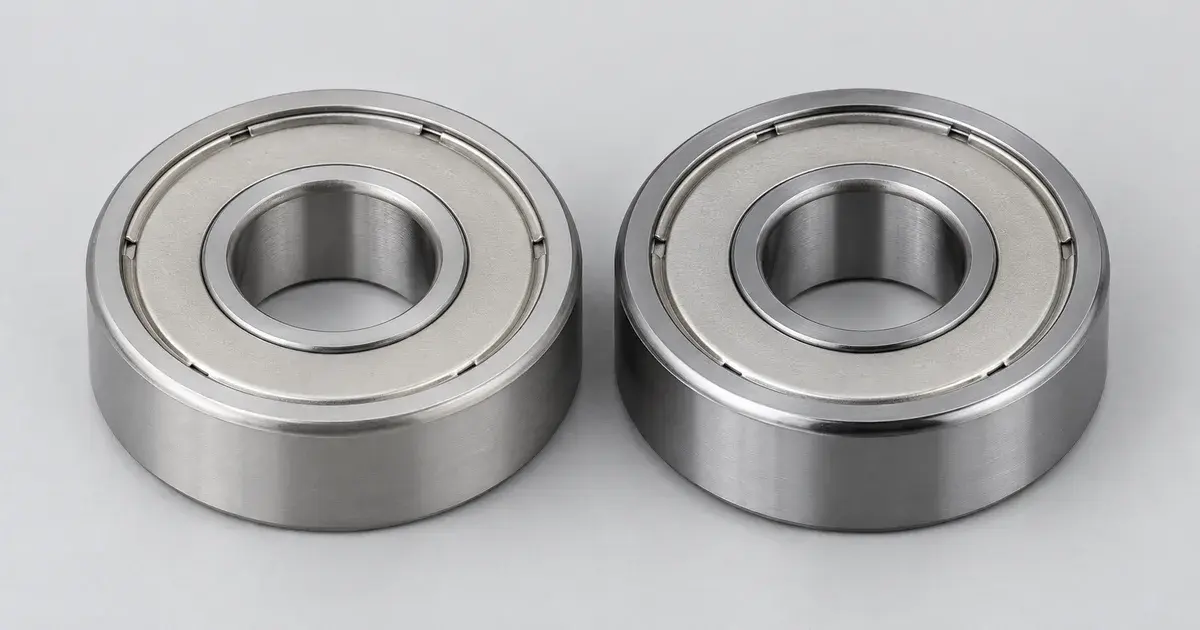
A 6210 C3 bearing leaves the factory with 18 to 36 micrometers of radial play. Mount it on a press fit and run it warm, and most of that play is gone before the machine reaches steady temperature. That gap between the clearance you order and the clearance the bearing actually runs with is the whole reason internal clearance classes exist, and it is where most selection mistakes happen.
Radial internal clearance (RIC) is the total radial distance one ring can move relative to the other before mounting, under no load. ISO 5753-1 grades it into groups from tight to loose. This guide gives the actual micrometer values for a common bore, shows how interference fit and operating temperature consume them, works one example end to end, and turns the result into a rule for picking a class. If you need to decode the C3 suffix on a ring first, start with our guide to reading a bearing number.
Key Takeaways
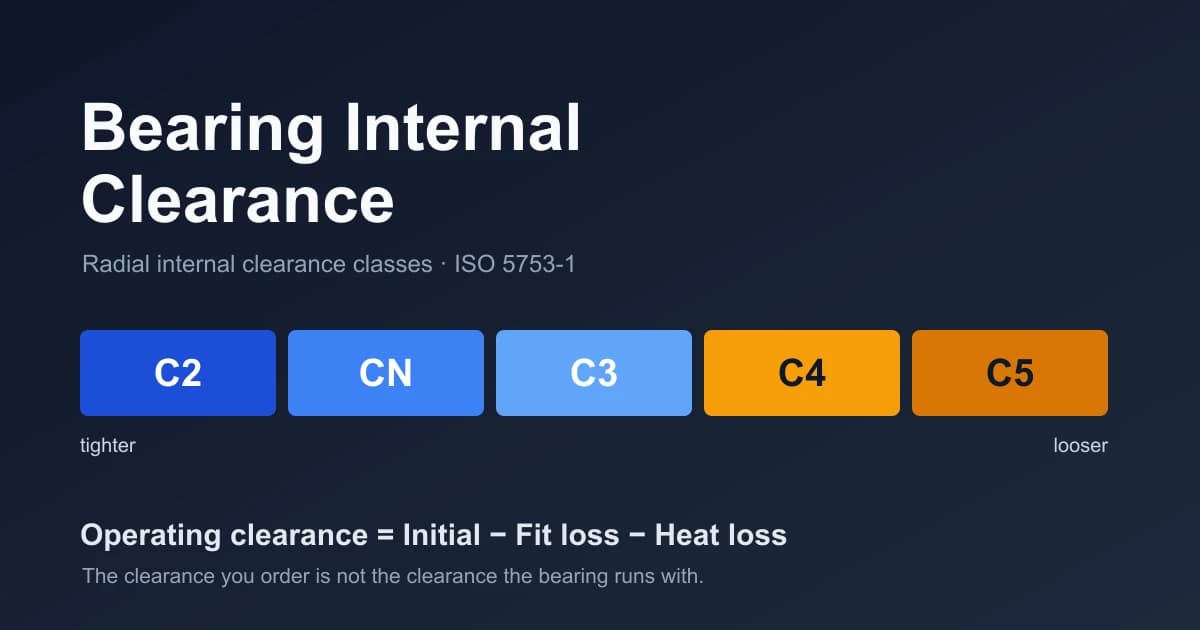
- Radial internal clearance is graded C2 < CN (Normal) < C3 < C4 < C5 by ISO 5753-1. The same groups are defined identically in DIN 620-4, so the labels travel across standards.
- CN is the default and carries no suffix. A code appears only for a non-Normal group, such as
6210 C3. A higher clearance group means more factory play, not lower quality.- Operating clearance is smaller than what you order. Interference fit consumes roughly 70 to 90% of the ring interference, and an inner ring running hotter than the outer shrinks the gap further. The identity is Δe = Δ0 − δf − δt.
- Aim for slightly positive operating clearance. Fatigue life peaks at a slightly negative value, but designers stay just above zero because negative clearance drives preload, heat, and seizure.
- Pick the class from the fit and the temperature, not from habit. Press fits and hot running push you looser (C3, C4, or CM); light fits and low-noise duty pull you tighter (C2).
What Is Radial Internal Clearance?
Radial internal clearance is the total distance one ring can move radially relative to the other before the bearing is mounted, with no load applied. ISO 5753-1 sorts that play into groups running from C2 (tight) through CN, C3, C4, to C5 (loose), with a rarely used C1 tighter than C2. CN sits in the middle and is the value you get if you order a bearing with no clearance suffix at all.
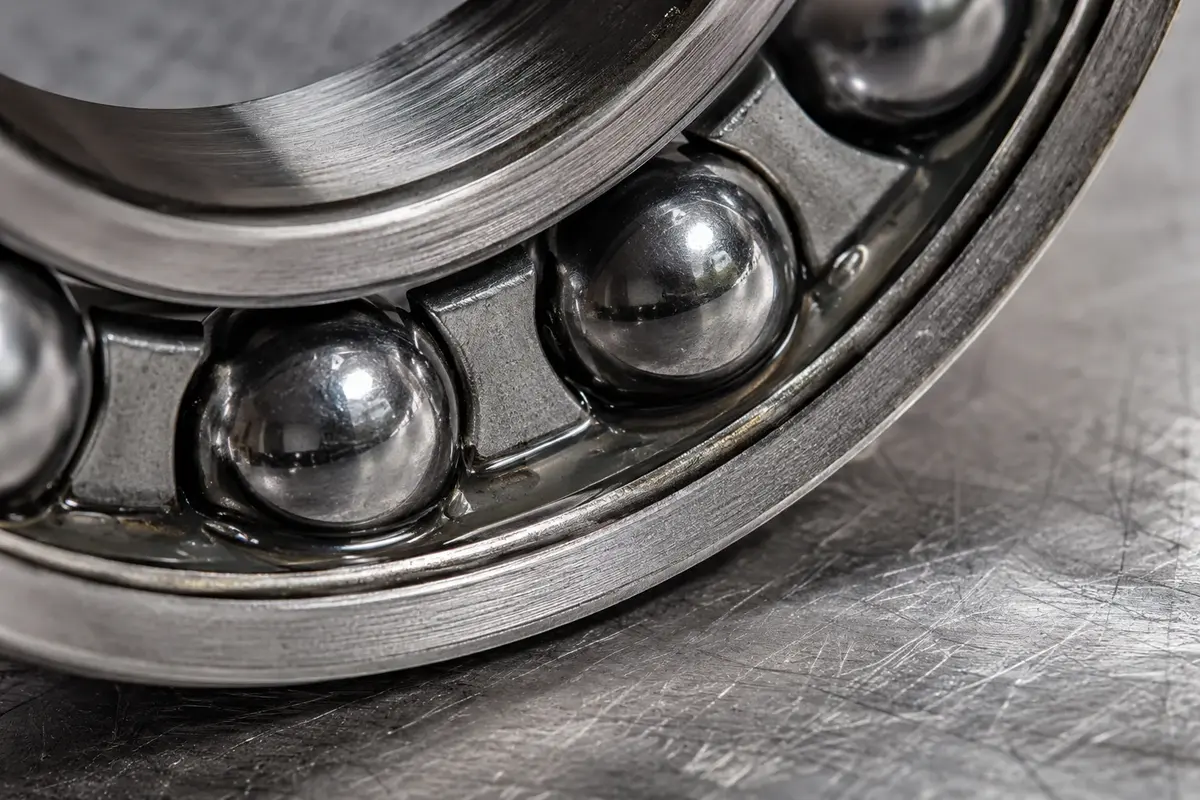
Two points trip people up. First, CN is not printed on the ring. The designation carries a clearance code only when the group is something other than Normal, so 6210 is a CN bearing and 6210 C3 is the looser variant of the same part. This matches the suffix logic in our bearing number guide. Clearance is one of the few codes that is identical across SKF, NSK, NTN, and FAG, because it traces to ISO rather than to a house style. Second, this whole scale is about radial play. Angular-contact and tapered roller bearings are governed by axial internal clearance, defined for four-point-contact types in ISO 5753-2, and are set as adjusted or preloaded pairs rather than by choosing a radial group.
That portability makes clearance the easiest layer of an interchange to check, and the house-coded seal and cage suffixes the hardest; our guide to a bearing cross reference works through all three layers.
One special code is worth naming now. CM is a narrowed clearance range aimed at electric-motor bearings, where the fits and temperatures are well characterized and a tighter, more consistent operating clearance keeps the motor quiet. It behaves like a factory-tuned band between CN and C3 for that one application.
The C2 to C5 Clearance Chart (µm for a 50 mm Bore)
Clearance groups are ranges, not single numbers, and the ranges overlap. For a 6210 deep groove ball bearing (50 mm bore, 90 mm outside diameter), the ISO 5753-1 radial internal clearance bands are the values below, reproduced in the NTN engineering catalogue (NTN Catalog 2203, Table 8.8). Because a C3 bearing near the bottom of its band overlaps a CN bearing near the top of its band, "C3 is looser than CN" is only true group-to-group, not part-to-part.
The bands scale with bore size, so always read the row for your actual bore. The table below gives the 50 mm bore alongside the next size band up so you can see the drift.
| Bore range | C2 | CN (Normal) | C3 | C4 | C5 |
|---|---|---|---|---|---|
| over 40 to 50 mm (e.g. 6210) | 1 to 11 | 6 to 23 | 18 to 36 | 30 to 51 | 45 to 73 |
| over 50 to 65 mm | 1 to 15 | 8 to 28 | 23 to 43 | 38 to 61 | 55 to 90 |
Values in µm, radial internal clearance per ISO 5753-1 (NTN Catalog 2203, Table 8.8).
Clearance Class Is Not the Same as Tolerance Class
Internal clearance and precision are two independent specifications governed by two different standards, and conflating them is the most common misunderstanding on this topic. Internal clearance (C2 to C5, defined by ISO 5753-1) describes how far the rings can move relative to each other. Precision, or tolerance class (P0, P6, P5, and the ABEC scale, defined by ISO 492 and ANSI/ABMA 20), describes how tightly the bore, outside diameter, width, and running accuracy are held.
A C3 bearing tells you nothing about its ABEC grade. The two codes sit on separate axes and can be combined freely. A designation such as
6205 C3 P5specifies a bearing with greater-than-Normal radial clearance and high running accuracy at the same time. Ordering C3 when you actually needed P5 precision, or paying for P5 when the application only needed a clearance change, both come from treating one scale as if it implied the other.
If you need to confirm which clearance a used or unmarked bearing actually has, residual clearance can be checked with a feeler gauge on the mounted bearing. Our guide to measuring a bearing covers that path. For the practical difference between the precision grades, and when you genuinely need P5 or better, see our guide to the ABEC bearing rating.
Why Operating Clearance Is Smaller Than What You Order
The clearance that governs how a bearing performs is not the value in the catalogue. It is the operating (effective) clearance, the play left once the bearing is mounted and has reached its running temperature. Both mounting and heat reduce it, and the relationship is a simple subtraction (NTN Catalog 2203, Eq. 8.1):
Δe = Δ0 − δf − δt
Here Δ0 is the initial clearance from the catalogue, δf is the loss from the interference fit, and δt is the loss from the temperature difference between the rings. This gives three distinct states: initial clearance before mounting, residual clearance after the fit is applied, and operating clearance once the bearing warms up under load. NSK describes the same progression from initial to residual to effective clearance.
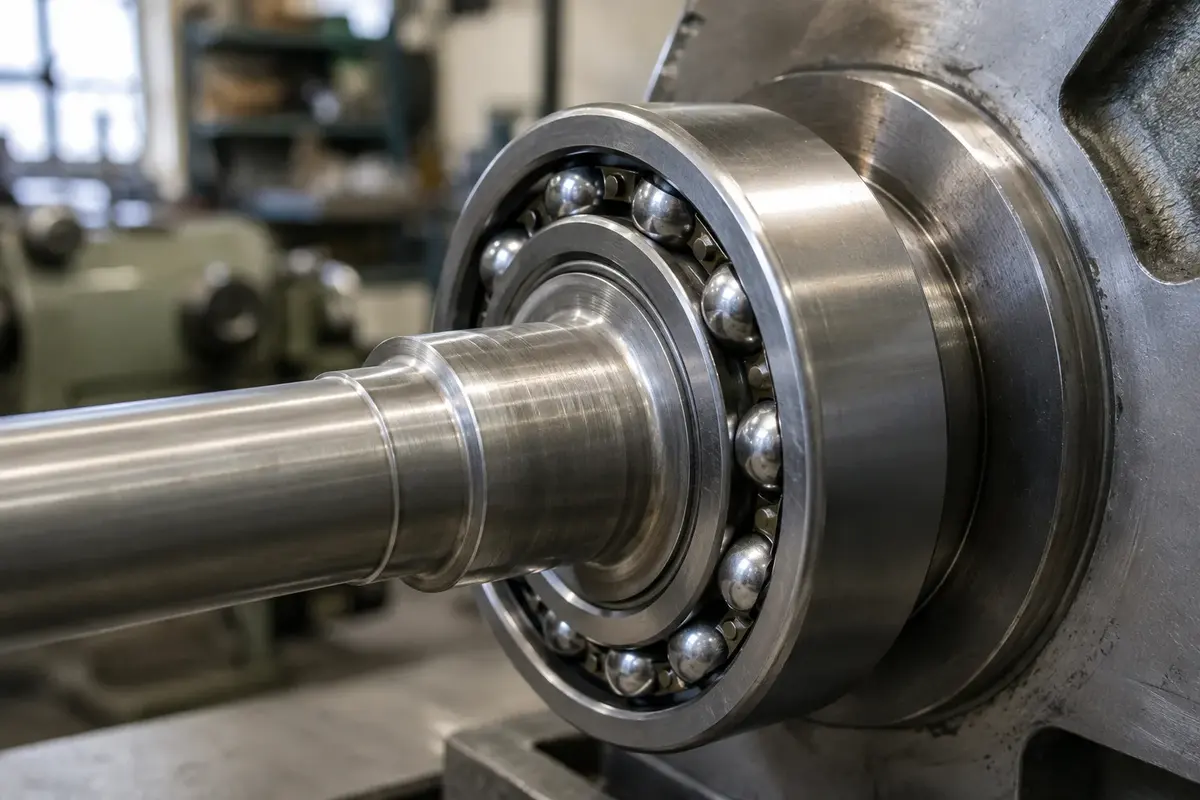
Fit loss (δf). Pressing a ring onto a shaft or into a housing expands or compresses it, and that swallows clearance. NTN gives the loss as roughly 70 to 90% of the effective interference (NTN Eq. 8.2), which is the precise form of the "about 80%" rule of thumb that circulates without a source. A tighter fit buys more location and less creep, but it spends radial clearance to do it.
Heat loss (δt). In most machines the inner ring runs hotter than the outer ring, typically by 5 to 10 °C, because it is closer to the heat source and worse at shedding heat. The inner ring therefore expands more than the outer, and the gap closes. SKF gives the reduction as δt = 0.012 × ΔT × dm, where ΔT is the ring-to-ring temperature difference in °C and dm is the mean bearing diameter, (d + D) / 2, in millimeters. The hotter the duty, the more this term matters, which is also why lubrication choice and operating temperature feed directly into clearance selection. Our guide to bearing lubrication covers the film and temperature side of that.
Worked Example: From a CN Order to Operating Clearance
Put real numbers on the identity and the reason clearance classes exist becomes obvious. Take a 6210 on a CN clearance, mounted with an interference fit on the shaft and running with a 10 °C inner-to-outer ring gradient. The mean diameter dm is (50 + 90) / 2 = 70 mm. The arithmetic below uses an illustrative effective interference of 15 µm; the fit factor and the temperature formula are from the catalogues.
Δ0  (CN, mid-band)              = 15 µm
δf  (interference-fit loss)     = 0.80 × 15  ≈ 12 µm      (0.70 to 0.90 × effective interference)
δt  (10 °C gradient loss)       = 0.012 × 10 × 70 ≈ 8.4 µm (dm = (50 + 90) / 2 = 70 mm)

Δe  = Δ0 − δf − δt = 15 − 12 − 8.4 ≈ −5.4 µm     → NEGATIVE: the bearing is preloaded
A negative result means the rolling elements are squeezed before any external load arrives. Even at the top of the CN band (23 µm) the operating clearance barely clears zero, and at the bottom (6 µm) it is heavily negative. On this fit and this temperature, CN is the wrong choice. The waterfall below shows where the clearance goes.
Now run the identical fit and temperature on a C3 bearing:
Δ0  (C3, mid-band)              = 27 µm
Δe  = 27 − 12 − 8.4 ≈ +6.6 µm                    → slightly positive: on target
Same shaft, same heat, opposite outcome. This is why "just use CN" fails on a press-fit, hot-running application, and why "always upgrade to C3" is equally wrong on a light fit at moderate temperature, where C3 would leave too much operating clearance. The class has to match the fit and the heat, which is exactly the selection logic in the next two sections.
Too Loose or Too Tight: What Clearance Does to Life
Operating clearance has an optimum, and both sides of it cost you. The relationship between operating clearance and bearing life is the reason the whole exercise matters.
Too much clearance widens the unloaded zone, so fewer rolling elements share the load at any instant. That raises vibration and noise and reduces fatigue life, which is why clearance is one of the levers in our guide to bearing noise. Too little clearance, or a negative value, preloads the rolling elements before any external load arrives, which spikes contact stress, generates heat, and in the worst case leads to thermal runaway and seizure. Fatigue life is theoretically longest at a slightly negative operating clearance. Designers still target a small positive value, because holding a negative clearance across real fit and temperature scatter is risky, as the worked example showed.
The load-zone effect connects directly to how a bearing is rated. A wider unloaded arc means the working load rides on fewer elements, which is the practical reason the operating clearance feeds into the fatigue-life picture we cover in dynamic load vs static load. When clearance is wrong and the failure shows up in the field, it typically reads as raceway damage and abnormal heat. Our bearing failure analysis places those symptoms in the full ISO 15243 taxonomy, while our hot strip mill bearing failure analysis shows them in a field case.
How to Choose a Clearance Class
Start from the target: a slightly positive operating clearance once the bearing is mounted and hot. Then work backwards from the fit and the temperature to the factory class that lands you there. The decision flow below captures the common cases.
A negative clearance is not always a defect. When it is deliberate and controlled, a small negative value is called preload, and it is exactly what angular-contact and tapered roller bearings use to stiffen a shaft and remove play. Those types are set by axial preload rather than by picking a radial group, which is why our guides to the angular contact bearing and to tapered vs cylindrical roller bearings treat preload as a mounting adjustment, not a catalogue suffix.
Finally, the group names carry across standards, so a spec written to one system translates cleanly to another.
| ISO 5753-1 | ANSI/ABMA 20 | DIN 620-4 | JIS B 1520 |
|---|---|---|---|
| C2 | Group 2 | C2 | C2 |
| CN (Normal) | Normal | CN | CN |
| C3 | Group 3 | C3 | C3 |
| C4 | Group 4 | C4 | C4 |
| C5 | Group 5 | C5 | C5 |
The radial internal clearance groups are defined identically in ISO 5753-1 and DIN 620-4; the North American values live in ANSI/ABMA 20.
Frequently Asked Questions
Q: What is internal clearance in a bearing?
Internal clearance is the total distance one ring can move relative to the other. Radial internal clearance is that movement measured radially, before mounting and under no load. ISO 5753-1 grades it into groups running C2 < CN (Normal) < C3 < C4 < C5, from tight to loose.
Q: What is the difference between C3 and Normal (CN) clearance?
C3 is a looser radial clearance group than CN. For a 6210 (50 mm bore), CN spans 6 to 23 µm and C3 spans 18 to 36 µm per ISO 5753-1, so the bands overlap. C3 is chosen when an interference fit or operating heat would otherwise close the gap too far, not because it is a higher-quality bearing.
Q: Is C3 clearance always better than CN?
No. On a light fit at moderate temperature, C3 leaves too much operating clearance, which widens the unloaded zone and raises noise and vibration while trimming fatigue life. C3 helps only when fit and heat consume enough clearance to justify starting looser. Match the class to the application, not to a habit of always upgrading.
Q: What does C4 clearance mean and when do you need it?
C4 is a clearance group looser than C3. For a 6210 it spans 30 to 51 µm per ISO 5753-1. You need it when the operating conditions eat a large amount of clearance, such as very high temperature, a large inner-to-outer ring temperature difference, or a heavy interference fit, so a normal or C3 start would end up negative.
Q: How do interference fit and operating temperature reduce clearance?
Both subtract from the initial value: Δe = Δ0 − δf − δt. The interference fit consumes roughly 70 to 90% of the effective ring interference (δf), and the ring-to-ring temperature difference consumes δt = 0.012 × ΔT × dm, where dm is the mean bearing diameter. The operating clearance the bearing actually runs with is always smaller than the catalogue value.
Conclusion
Internal clearance is a small number that decides whether a bearing runs quietly to its rated life or overheats and seizes. The discipline comes down to a few points:
- The value you order, C2 through C5 per ISO 5753-1, is the initial clearance. The operating clearance is smaller after the fit and the heat take their share.
- Pick the class from the fit and the temperature, using Δe = Δ0 − δf − δt to check where you land. Aim for slightly positive.
- CN is the default. Move to C3, C4, or CM for press fits and hot running, and to C2 only for light fits where low noise or precise positioning dominates.
- Clearance class and precision class are separate specs. A C3 bearing can be any ABEC grade.
If you are specifying a bearing for a defined shaft and housing fit, speed, and temperature and want the class checked against a residual-clearance calculation before the order goes out, send the application data to ANDE Bearing's engineering team and we will return the recommended group and the expected operating clearance. You can also start from the size you need in our deep groove ball bearings.
About the Author
Jeff Li writes on bearing engineering and global sourcing for ANDE Bearing. He works directly with OEM and aftermarket buyers in automotive, heavy industry, and renewable energy. Connect on LinkedIn.