Order an industrial deep groove ball bearing in its hybrid ceramic version and three numbers in the catalogue change. One of them appears in every sales conversation. The other two rarely appear at all, and the larger of the two moves against you.
This guide is written for engineers specifying a bearing to an envelope, not for the sports market that dominates the search results for this term. It covers what the two ceramic constructions are and which standards govern each part. It then covers what the load and speed ratings do when you switch rolling element material, and the duty profiles where the correct answer is still steel.
Key Takeaways
- "Ceramic bearing" covers two products. A hybrid has steel rings with silicon nitride rolling elements. A full ceramic bearing has ceramic rings as well, and it behaves nothing like the hybrid.
- ISO rates hybrids, not full ceramic bearings. ISO 20056-1:2017 and ISO 20056-2:2017 cover dynamic and static load ratings for bearings with steel rings and silicon nitride rolling elements. No standard in ISO's rolling bearings catalogue rates an all-ceramic bearing.
- The hybrid trade is a little load for real speed. Across three SKF designation pairs the hybrid gives up 3.9% to 5.5% of C, keeps C₀ identical, and gains 19% to 27% of limiting speed.
- The number nobody publishes is the fatigue load limit. In those same pairs it falls about 27%, and it is a direct input to the ISO 281 life calculation in exactly the light, fast duty where hybrids get specified.
- A hybrid is not a high temperature bearing. SKF heat stabilizes hybrid deep groove rings to at least 120 °C, and NBR seals stop at 100 °C. The 800 °C figure quoted for silicon nitride belongs to the material, not to the bearing.
What Counts as a Ceramic Bearing?
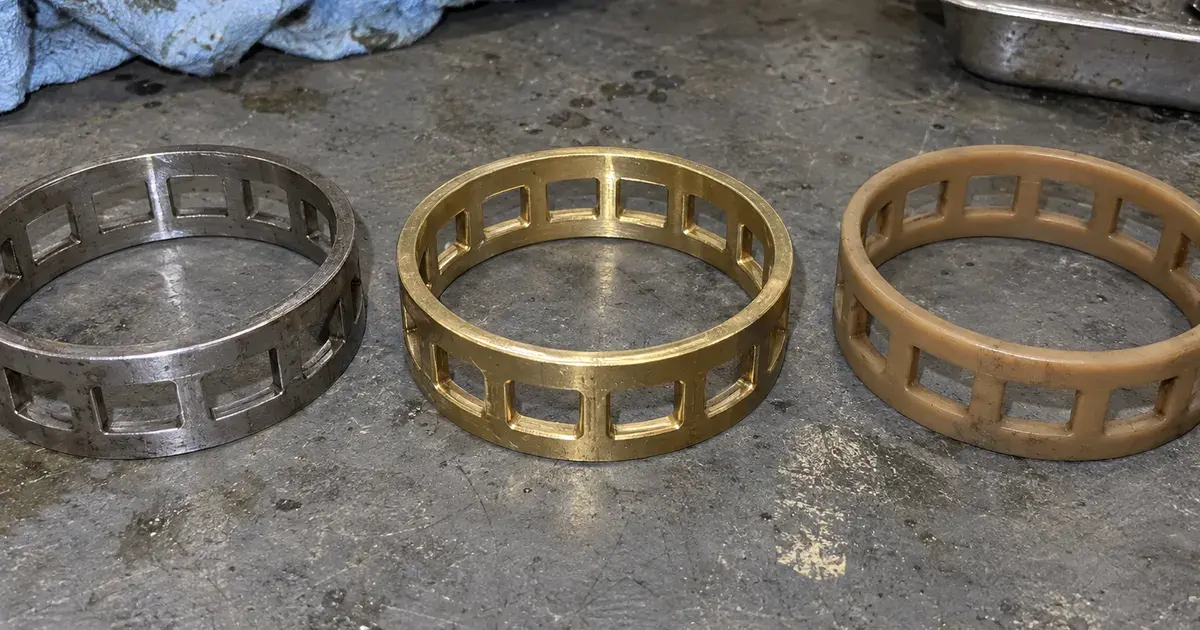
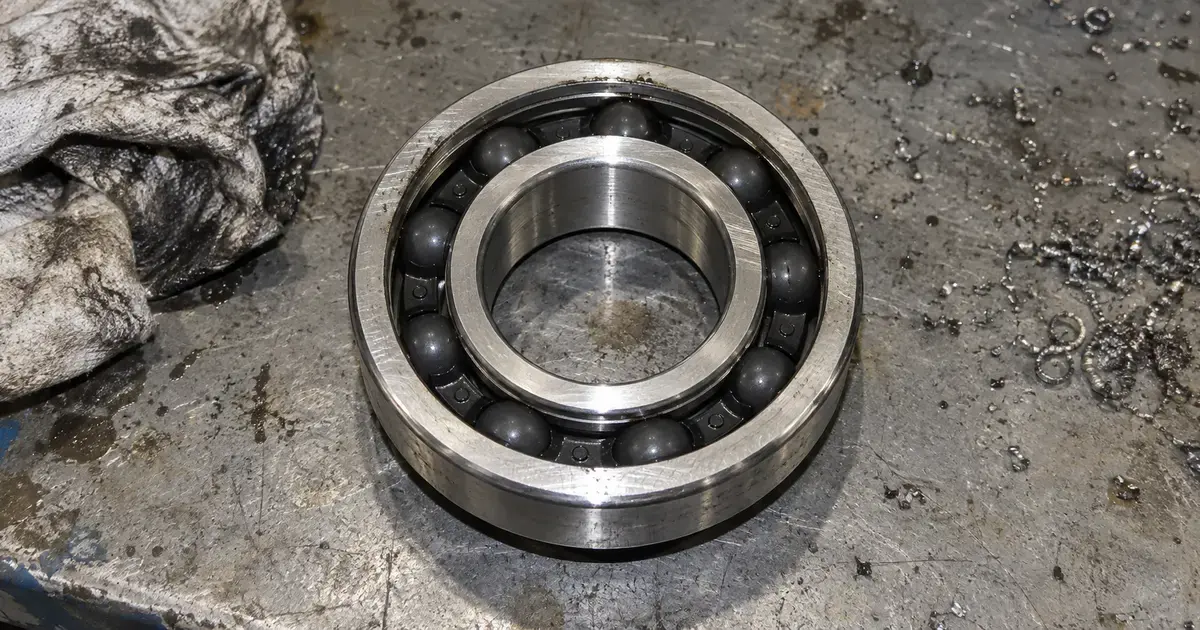
Two different products share the name, and the difference is which parts are ceramic. A hybrid bearing has rings of bearing steel with rolling elements of silicon nitride. A full ceramic bearing has ceramic rings too, usually with a polymer cage.
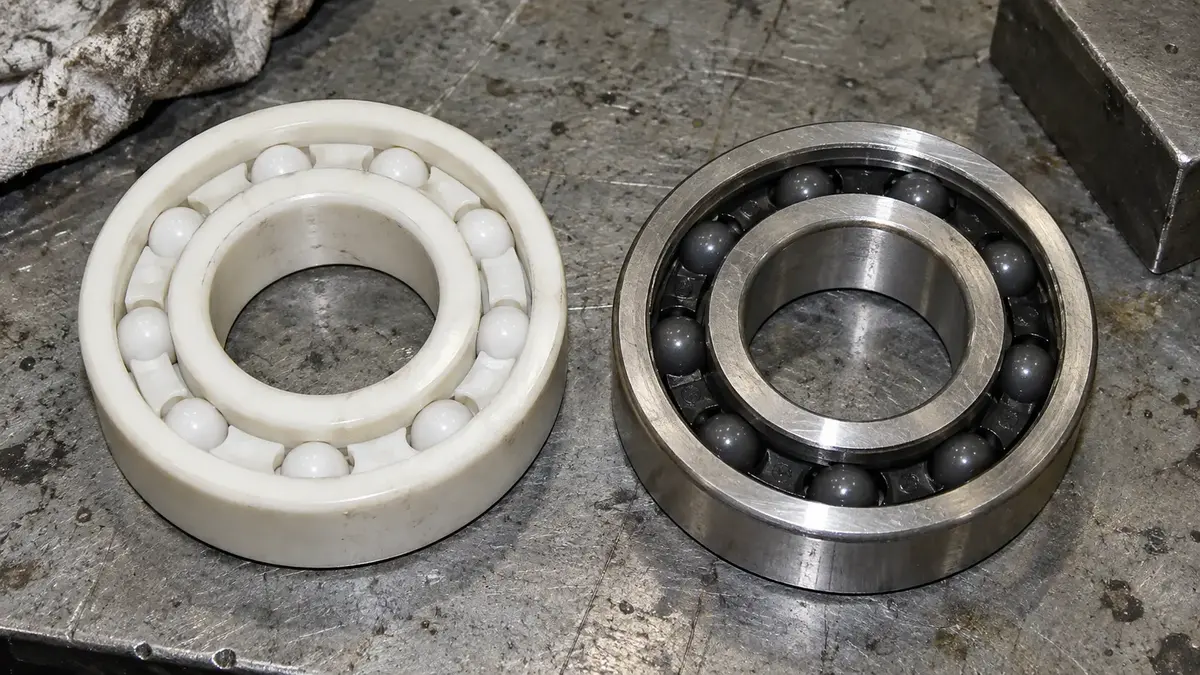
That distinction decides almost everything downstream. In a hybrid, the steel rings carry over the load capacity, dimensional stability and shock tolerance of a design with decades of field history, and only the rolling element material changes. In a full ceramic bearing every load path runs through a brittle material, so the speed limit, the load limit and the failure mode all change together.
Silicon nitride is the only ceramic that any rolling bearing standard covers for rolling elements. Zirconia, alumina and silicon carbide appear in full ceramic ring sets and in vendor literature, but not in the standards below. When a quotation says "ceramic," the first question is which of the two products it is, and the second is which ceramic.
For where both sit among the wider bearing families, see our overview of the main bearing types and what each one is for.
Which Standards Actually Govern a Ceramic Bearing?
Four standards cover the ceramic parts, two cover hybrid load ratings, and none of them covers an all-ceramic bearing's rating. That gap is the single most useful fact in this article, because it decides how much weight a published rating deserves.
The chain starts with the material and ends with the load rating.
ISO 26602:2017 sets the material. It specifies preprocessed silicon nitride for rolling bearing balls and rollers and divides it into three classes. Its Table 1 publishes ranges rather than single values, which is worth knowing before you quote a property figure from a data sheet.
| Property | Minimum | Maximum |
|---|---|---|
| Density (g/cm³) | 3.0 | 3.6 |
| Elastic modulus (GPa) | 270 | 330 |
| Poisson's ratio | 0.23 | 0.29 |
| Thermal expansion (× 10⁻⁶/°C, room temperature to 500 °C) | 2.0 | 3.7 |
Physical and mechanical properties of preprocessed silicon nitride, per Table 1 of ISO 26602:2017.
ISO 3290-2:2014 then covers the finished ball, and its clause 6 requires the material to conform to ISO 26602. ISO 12297-2:2018 does the equivalent job for ceramic cylindrical rollers, and ISO 19843:2018 specifies how to determine a finished ceramic ball's strength by notched ball test, for diameters from 3 mm to 50 mm.
Load ratings sit at the end of the chain, and this is where the scope narrows. ISO 20056-1 covers dynamic load ratings for bearings with rings "made of contemporary, commonly used, high quality hardened bearing steel" and rolling elements of silicon nitride, with ISO 20056-2 handling static ratings. Steel rings are part of the scope, not an example inside it.
So a full ceramic bearing has no ISO load rating method. Ratings are still published for them, and they may well be sound, but they rest on the supplier's own model rather than on a standard you can look up and check. That is a procurement fact, not an argument against the product.
If you need the surrounding designation logic, our guide to reading a bearing number covers the prefix, series and suffix structure that hybrid suffixes attach to.
Does a Hybrid Carry Less Load Than Steel?
Slightly less dynamic capacity, the same static capacity, and materially less fatigue limit. The mechanism is stiffness rather than weakness.
ISO 20056-1 explains it in its own introduction. Because silicon nitride has a higher modulus of elasticity than bearing steel, a hybrid has "a noticeably smaller contact ellipse at the same load," which in theory reduces the dynamic load carrying capacity. The standard uses 300,000 MPa for the ceramic rolling element against ISO 281's 207,000 MPa for bearing steel.
The standard then argues the other way. The smaller ellipse and the ceramic against steel material pairing produce "noticeably lower surface shear stress in the rolling contact," which raises load carrying ability. ISO 20056-1 compensates by raising the rating factor bm to 1.8 for every hybrid ball bearing type in its Table 1. ISO 281:2007 gives 1.3 for radial and angular contact ball bearings. The stated result is that the formulae "give the same dynamic load ratings as defined per ISO 281" for a bearing of identical internal geometry with steel rolling elements.
Published catalogue values do not quite match that intent. Three SKF deep groove designations, each available in an all-steel and a hybrid version of the same size, tell a consistent story.
| Designation | C | C₀ | Fatigue load limit | Reference speed | Limiting speed |
|---|---|---|---|---|---|
| 6206 | 4,564 lbf | 2,518 lbf | 107 lbf | 24,000 r/min | 15,000 r/min |
| 6206/HC5C3 | 4,384 lbf | 2,518 lbf | 78 lbf | 28,000 r/min | 18,000 r/min |
| 6208 | 7,306 lbf | 4,271 lbf | 180 lbf | 18,000 r/min | 11,000 r/min |
| 6208/HC5C3 | 6,902 lbf | 4,271 lbf | 132 lbf | 22,000 r/min | 14,000 r/min |
| 6212 | 12,432 lbf | 8,093 lbf | 344 lbf | 13,000 r/min | 8,000 r/min |
| 6212/HC5C3 | 11,847 lbf | 8,093 lbf | 252 lbf | 15,000 r/min | 9,500 r/min |
SKF product data as published, in imperial units. The 6206 and 6212 rows come from the corresponding SKF product pages.
The dynamic load rating falls 3.9%, 5.5% and 4.7% across the three pairs. The basic static load rating C₀ is identical in all three, which makes sense: a static rating is a permanent deformation limit at the raceway, and the raceway has not changed.
Hold both facts at once when you specify. The standard's method is calibrated to reach parity with steel, and the maker's published table for these three sizes sits a few percent below it. Neither is an error, and the difference is small enough that it will rarely decide a selection on its own. What decides selections is the third column.
For the difference between the two ratings themselves, see our guide to dynamic versus static load ratings, and for how combined loading enters the calculation, axial versus radial load.
The Fatigue Load Limit Is the Hidden Cost
The hybrid's fatigue load limit falls roughly five to seven times harder than its dynamic load rating, and it is the input that matters most in the duty hybrids are usually bought for.
The fatigue load limit is the load below which fatigue does not initiate in a well lubricated, clean bearing. ISO 281 writes it as Cu; SKF publishes it as Pu in the product tables. It is not a rating you compare directly against your load. It feeds the life modification factor, which ISO 281 derives from the viscosity ratio, a contamination factor, and the ratio of the fatigue load limit to the equivalent bearing load.
Across the three pairs above, that number drops by 27.1%, 26.7% and 26.7%.
That consistency across three sizes suggests a deliberate factor in the rating method rather than a quirk of one part. It also cuts against the way hybrids are usually sold. The pitch is speed, and speed is what a hybrid delivers. Speed duty is normally light duty, and light duty is precisely where the fatigue load limit dominates the life calculation.
Direction is all this article claims. The size of the effect depends on your equivalent load, your viscosity ratio and your contamination class. So run your own case in the manufacturer's selection tool with both parts and compare the modified rating life. Do not accept a life multiplier from a brochure, and do not assume the hybrid wins on life just because it wins on speed.
Our guide to why bearings fail covers the fatigue and contamination mechanisms this factor is trying to model.
How Much Speed Does Ceramic Actually Buy?
Between 19% and 27% on limiting speed for the same designation, and 15% to 22% on reference speed. The reason is mass rather than hardness.
Silicon nitride's density range in ISO 26602 is 3.0 to 3.6 g/cm³, against roughly 7.8 for bearing steel. Lighter balls generate less centrifugal load against the outer raceway at speed, and less heat in the contact. Schaeffler quotes up to 20% higher speed for its hybrids, with lower operating temperature, which lands inside the range those SKF pairs show.
Two speed numbers matter and they are not interchangeable. SKF publishes a reference speed, which is a thermal reference point, and a limiting speed, which is a mechanical limit that should not be exceeded unless the bearing and the application are adapted for it. Quoting one as the other is the most common speed error on this topic.
One constraint travels with the speed benefit and is easy to miss. SKF recommends oil lubrication for hybrids with a ring centred cage, designation suffix ML, and caps the grease lubricated case at an ndm value of 250,000 mm/min. If your arrangement is grease lubricated and that cap sits below the speed you were buying the hybrid for, the extra capability is not reachable.
Precision class interacts with all of this. Our guide to ABEC and ISO precision classes covers why tolerance grade and speed capability are related but not the same thing. Our miniature bearing guide covers the small bore end, where hybrids appear most often.
Temperature, Corrosion, and the 800 °C Myth
In a hybrid, the ceramic never sets the temperature limit. The rings, the cage, the seal and the grease do, and the order of those is where most people are surprised.
SKF heat stabilizes hybrid bearing rings to at least 120 °C for basic design hybrid deep groove ball bearings. Hybrid cylindrical roller bearings and XL hybrid deep groove bearings get 150 °C, and rings stabilized to 300 °C are available on request. Steel, brass and PEEK cages run at the same temperatures as those rings. Seals then cut in lower. NBR runs from −40 to +100 °C and tolerates 120 °C briefly; FKM runs from −30 to +200 °C and tolerates 230 °C briefly. Temperature peaks sit at the seal lip.
The 800 °C number that circulates on this topic is a property of bearing grade silicon nitride, and it applies to a bearing only when the rings are ceramic too. Specifying a hybrid for a hot application on the strength of the ceramic's capability is a recurring and expensive mistake. The same logic applies to corrosion. Steel rings still corrode, so a hybrid in a wet or chemically aggressive environment needs the same sealing or stainless decision an all-steel bearing would.
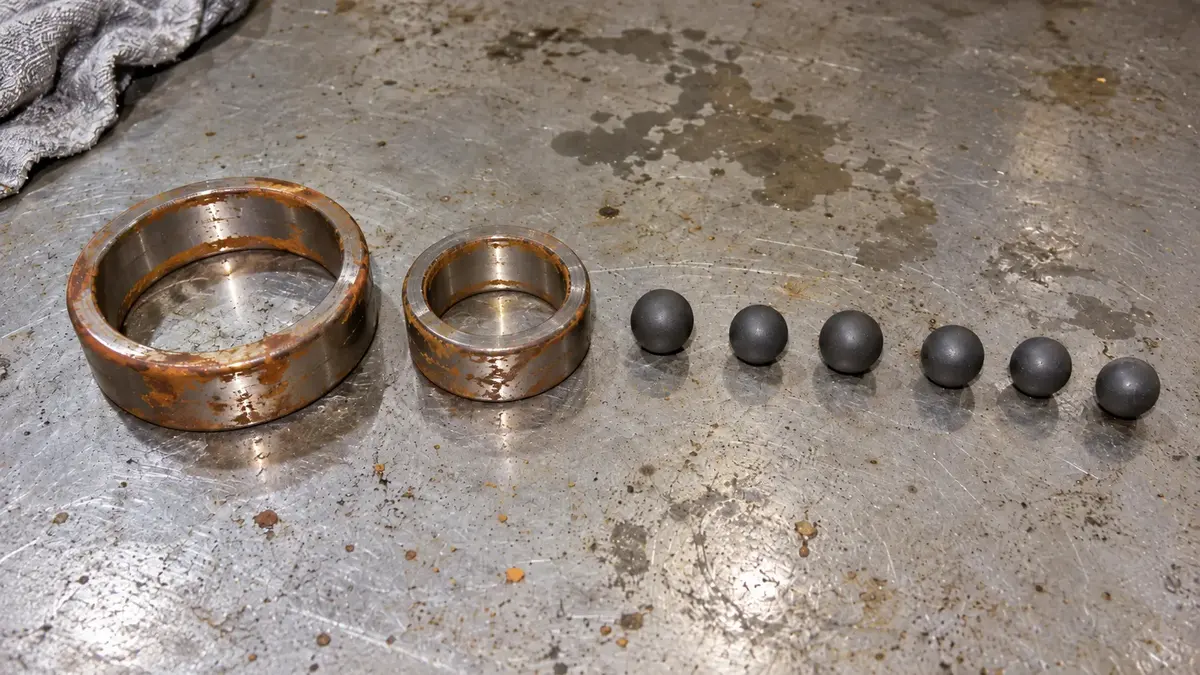
Full ceramic bearings are the answer in those environments, and they carry their own penalties. SMB Bearings, a specialist supplier, puts a full ceramic bearing's maximum speed at 20% to 25% of the all-steel equivalent. It puts maximum load at around 65% to 75% of what a steel bearing supports, because of the risk of sudden failure by cracking. Treat that as one supplier's position rather than a standard, and note that it points the opposite way to the marketing claim that ceramic means fast.
Seal selection often decides these cases. Our comparison of sealed versus shielded bearings covers the temperature and contamination trade, and our lubrication guide covers grease limits.
Electrical Insulation, and What a Hybrid Does Not Fix
Silicon nitride rolling elements break the current path through the rolling contact, which is why hybrids appear in inverter driven motors. The circuit does not disappear, and the grounding question does not go away with it.
Variable frequency drives impose high frequency common mode voltage on the motor shaft. When it discharges through the lubricant film it machines the raceway, producing micro-pitting, frosting and the axial fluting pattern that follows. SKF replicates the failure in lab studies and documents the progression to noise and vibration complaints and premature failure. Schaeffler positions its hybrids for exactly this duty across electric motors, rail vehicles, wind generators and machine tools.
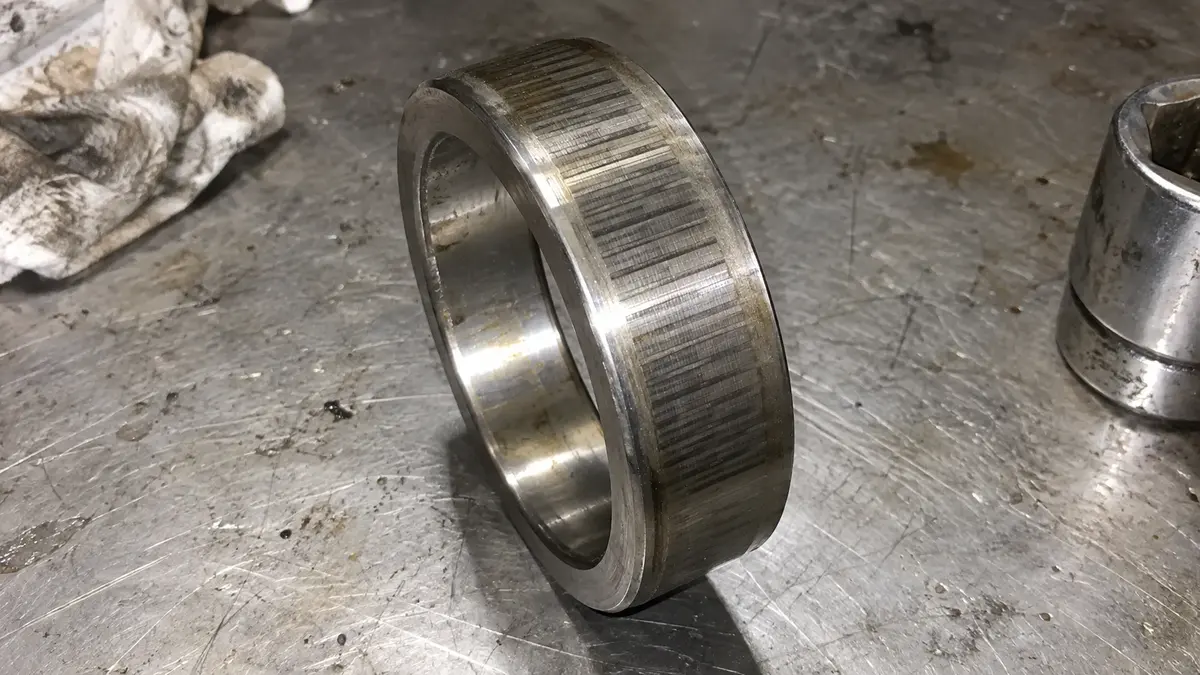
A hybrid raises the resistance of that path by orders of magnitude. SKF Evolution reports DC resistance in the gigaohm range for hybrid bearings in electrical machinery, along with more than four times the grease life at very high speed. Resistance is not immunity, and a hybrid is one of three answers rather than the only one. A coated outer ring insulates without changing the rolling element material, and a shaft grounding ring diverts the current instead of blocking it. Price all three against the failure you are trying to prevent.
Electric vehicle traction motors are where this shows up most often now, and we cover that case in detail in our automotive ball bearing guide. The failure mode itself sits alongside the other electrical damage patterns in our bearing failure guide.
Is a Hybrid a Drop-In Replacement?
Dimensionally yes, functionally no. The boundary dimensions match the steel bearing, and the clearance, the minimum load and the lubrication regime all change.
Clearance is the one that catches people. SKF's hybrid suffix C3P denotes a displaced clearance range: the upper half of C3 plus the lower half of C4. That is not a rounding convenience. Silicon nitride's coefficient of thermal expansion is 2.0 to 3.7 × 10⁻⁶/°C per ISO 26602, against roughly 12 for bearing steel. The ball set therefore grows far less than the rings as the bearing warms, so the operating clearance a steel bearing would have reached is not the one the hybrid reaches. Our guide to radial internal clearance classes covers what those classes mean before temperature.
Minimum load matters more, not less. SKF publishes a minimum radial load formula for both hybrid deep groove and hybrid cylindrical roller bearings. For quiet, high speed running it also applies an axial preload with spring washers to paired hybrid deep groove arrangements. Lighter balls need a load to keep rolling rather than skidding.
The axial ceiling is explicit. For pure axial load, SKF limits a hybrid deep groove bearing to 0.5 C₀. That falls to 0.25 C₀ for small bearings of 12 mm bore or less and for the light diameter series 8, 9, 0 and 1. Exceeding it costs service life.
Shock loading works against the hybrid in a way that is easy to get backwards. The steel rings tolerate impact better than ceramic rings would. But SMB Bearings notes that under a sudden impact the much harder ceramic balls indent the steel raceways, leading to rapid wear and early failure. Hard balls in a softer raceway is a different failure path from a brittle ring.
Dry running is not a hybrid capability. A full ceramic bearing can run unlubricated. A hybrid copes with marginal lubrication because of the ceramic balls, and abrades its steel rings much faster if run dry unless speeds stay low.
The suffixes themselves are worth reading before you order. In SKF's system:
| Suffix | Meaning |
|---|---|
| HC5 | Rolling elements made of silicon nitride |
| S0 | Rings heat stabilized for operating temperatures up to 150 °C |
| C3P | Displaced clearance: upper half of C3 plus lower half of C4 |
| F1 | Grease fill of 10% to 15% of the free space in the bearing |
| VC444 | Rings made of high nitrogen steel |
| VA970 | Special design deep groove bearing for wind turbine generators |
Additional suffixes used with SKF hybrid ceramic bearings, on top of the standard deep groove and cylindrical roller designation systems.
When Is Ceramic the Wrong Answer?
Whenever the problem it solves is not the problem you have. Three duty profiles buy something real from a ceramic rolling element; the rest pay a premium and accept a lower fatigue load limit for it.
| Your constraint | Specify | Why |
|---|---|---|
| Inverter driven motor, stray shaft current | Hybrid, coated ring, or shaft grounding | Ceramic breaks the path through the rolling contact; price it against the two alternatives |
| Light load, very high speed, above the steel bearing's limit | Hybrid, with the grease ndm cap checked first | Lower centrifugal load and a higher published limiting speed |
| Submerged in acid, alkali or seawater; dry running; non-magnetic required | Full ceramic, accepting no ISO load rating and a large speed derate | Steel rings cannot survive the medium |
| Heavy or shock load, moderate speed, ordinary environment | Steel, with the right clearance class and seal | The hybrid gives up fatigue load limit and returns nothing you need |
| High continuous temperature | Check ring stabilization and seal grade before changing material | The hybrid's ceiling is its rings and seals, not its balls |
The pattern is that ceramic is a rolling element decision, not a quality upgrade. A bearing that verifiably meets its standard performs to that standard, and the useful question is never which material sounds more advanced. It is which number in your calculation changes when you switch, and whether that number is the one limiting your application.
Material selection in heavy service follows the same logic. Our guide to rolling mill bearing materials works through the steel grades and where a ceramic hybrid earns its place in mill duty.
Frequently Asked Questions
Do hybrid ceramic bearings carry less load than steel?
Slightly less dynamic capacity, the same static capacity, and noticeably less fatigue load limit. For SKF's 6208 against 6208/HC5C3, the basic dynamic load rating falls from 7,306 to 6,902 lbf and the fatigue load limit drops from 180 to 132 lbf. The basic static load rating stays at 4,271 lbf. ISO 20056-1's method is calibrated to give the same dynamic rating as ISO 281 for identical geometry, so expect small differences between a standard's intent and a catalogue's value.
What temperature can a hybrid ceramic bearing run at?
The rings and the seals decide, not the ceramic. SKF stabilizes basic hybrid deep groove rings to at least 120 °C and hybrid cylindrical roller rings to 150 °C, with 300 °C available on request. An NBR seal stops at 100 °C and an FKM seal at 200 °C. The 800 °C figure quoted for silicon nitride is a material property, and it applies to a bearing only if the rings are ceramic as well.
Are hybrid ceramic bearings electrically insulating?
They interrupt the current path through the rolling contact rather than eliminating every path. SKF Evolution reports DC resistance in the gigaohm range for hybrids in electrical machinery. Treat a hybrid as one of three options alongside a coated outer ring and a shaft grounding ring, and choose on the basis of the discharge you measured rather than the category.
Can I drop a hybrid into the same envelope as a steel bearing?
The boundary dimensions match, so it fits. The specification around it changes in four places. SKF ships these with the displaced C3P clearance range, because silicon nitride expands far less than steel. It also publishes a minimum radial load, often expects an axial preload in paired arrangements, and caps pure axial load at 0.5 C₀, or 0.25 C₀ for small and light series bearings. Check all four before treating the swap as like for like.
Which ISO standards cover ceramic bearings?
ISO 26602 covers the silicon nitride material, ISO 3290-2 the finished balls, ISO 12297-2 the ceramic cylindrical rollers, and ISO 19843 the strength test for finished ceramic balls. Load ratings come from ISO 20056-1 for dynamic and ISO 20056-2 for static, and both are scoped to hybrid bearings with steel rings. No standard in ISO's rolling bearings catalogue rates an all-ceramic bearing.
Conclusion
Specifying around ceramic comes down to five reads:
- Identify which of the two products you are being quoted. Steel rings with ceramic balls behave like a steel bearing with a different rolling element. Ceramic rings are a different component class.
- Check whether a published rating has a standard behind it. ISO 20056-1 and 20056-2 cover hybrids. For a full ceramic bearing, the rating is the supplier's own.
- Read the fatigue load limit, not just C. It falls about 27% on the pairs above, and it is the parameter that governs life in light, fast duty.
- Treat temperature as a ring and seal question. The ceramic's capability is not the bearing's rating, and the seal is usually the first limit you hit.
- Decide on the duty cycle, not the material's reputation. Speed, stray current, or an aggressive medium are real reasons. A general wish for a better bearing is not.
ANDE manufactures steel rolling bearings, and for two of the five cases in the table above that is the correct answer rather than a fallback. That means deep groove ball bearings with the clearance class matched to your operating temperature, angular contact ball bearings where preload and combined load decide, and cylindrical roller bearings where the load is heavy and the speed moderate. We do not supply full ceramic bearings, and where your medium or your temperature requires them we will say so. Send your load, speed, temperature and any electrical duty to our engineering team and we will size the bearing to the standard that governs it.
About the Author
Jeff Li writes on bearing engineering and global sourcing for ANDE Bearing. He works directly with OEM and aftermarket buyers in automotive, heavy industry, and renewable energy. Connect on LinkedIn.