Poor lubrication is the single largest cause of premature bearing failure. In 2019, SKF's bearing damage analysis attributed 36% of premature failures to lubrication — more than fatigue, mounting, or contamination (SKF/STLE). Add the 14% blamed on contamination — the thing lubricant is meant to keep out — and half of all premature failures trace back to the oil film.
That's a striking figure for something that often comes down to a $5 tube of grease and the discipline to use it correctly. This guide covers the decisions that actually move bearing life: grease or oil, how much, how often, and the film physics that decide whether your bearing reaches its rated life at all. If you're still choosing a bearing type for the application, start there — this assumes you have a bearing and need to lubricate it well.
Key Takeaways
- Lubrication causes 36% of premature bearing failures — the largest single category in SKF's four-part split (SKF/STLE, 2019).
- About 80–90% of rolling bearings run on grease; switch to oil when speed, temperature, or heat removal exceed what grease can handle (NSK/NTN).
- Fill the bearing's free space ½–⅔ at low speed, only ⅓–½ above 50% of limiting speed — overfilling causes churning heat (NSK).
- Halve the relubrication interval for every +15 °C above 70 °C (NSK).
- Bearing life depends on the film ratio λ: aim for λ > 1 so the oil film separates the surfaces.
Why Does Bearing Lubrication Matter So Much?
In 2019, SKF's failure analysis split premature bearing failures into four causes: lubrication 36%, fatigue 34%, mounting/handling 16%, and contamination 14% (SKF/STLE). Lubrication leads the list — and it's the cause you control every day, not one designed in at the factory.
The lubricant does three jobs at once. It builds a film that separates the rolling elements from the raceway so metal never touches metal. It carries frictional heat out of the contact. And it forms a barrier that helps exclude moisture and particles. When any of those breaks down, the failure clock starts.
You'll also see "80% of bearing failures are lubrication-related" quoted widely. That number isn't wrong, but it answers a different question — it lumps together every failure with any lubrication link, across all causes, not the tightly scoped premature failure study above. When a source won't say which scope it used, treat the figure with caution. We anchor to the SKF 36% split because its methodology is defined.
The 36% lubrication share is corroborated by SKF's own inspection dataset, which reports the same figure from its Bearing Analysis Reporting Tool (SKF Evolution). That dataset distributes the remaining causes differently, putting contamination at 23% and classic fatigue at just 2%, because it counts inspected bearings rather than the premature-failure population above. The bearing failure guide reconciles the competing splits and explains which denominator each one uses.
According to SKF's 2019 damage analysis, lubrication (36%) and contamination (14%) together account for half of all premature bearing failures — the two categories a correct lubricant choice and clean handling directly prevent (SKF/STLE). No other pair of causes is as controllable at the maintenance level.
The cost math is simple. Bearings rarely reach their calculated L₁₀ fatigue life — most are pulled early by a preventable cause. Getting the lubricant right is the cheapest reliability upgrade on the machine.
Grease vs Oil: Which Bearing Lubricant Should You Use?
Roughly 80–90% of rolling bearings are grease-lubricated (NSK). Grease is easier to retain, simpler to seal, and needs less maintenance hardware. You move to oil when speed, temperature, or the need to carry heat away exceed what grease can do.
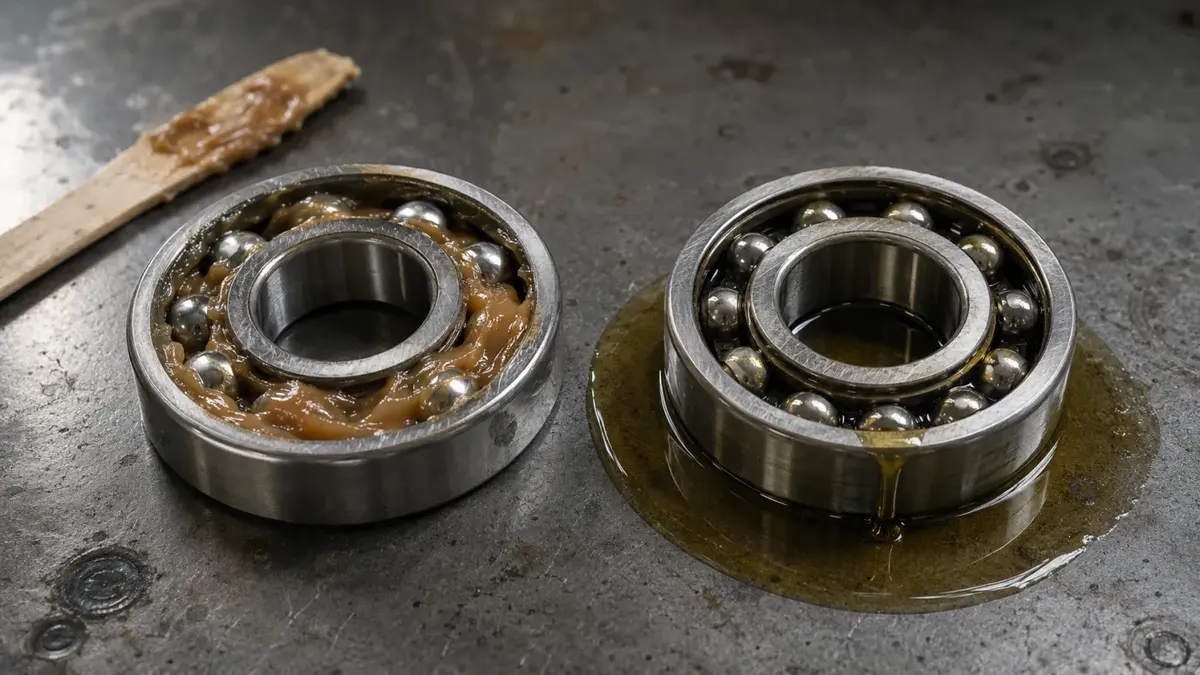
Grease is oil held in a thickener sponge. NSK gives its makeup as base oil 70–95%, thickener about 5–30%, plus a few percent additives (NSK). The base oil does the lubricating; the thickener (lithium, polyurea, calcium sulfonate) holds it in place and releases it slowly. That retention is why grease dominates: it stays put, resists leaking, and doubles as a contaminant barrier.
Oil wins where grease can't keep up. It removes heat far better because it can circulate and be cooled, it handles higher speeds, and it can be filtered and monitored continuously. The trade is cost and complexity — seals, sumps, pumps, and more maintenance touchpoints.
When should you actually switch? Grease covers most industrial bearings, but reach for oil when the speed factor (n·dm) climbs past grease's comfortable ceiling, when ambient heat is high enough to cook grease quickly, when the bearing shares a gearbox oil bath, or when you need to flush debris and heat continuously. NSK reports grease serves the great majority of rolling bearings, with oil reserved for the high-speed and high-temperature minority (NSK).
| Factor | Choose grease | Choose oil |
|---|---|---|
| Speed (n·dm) | Low to moderate | High — beyond grease's speed ceiling |
| Temperature | Ambient to moderate | High, or where heat must be removed |
| Heat removal | Not required | Circulating oil carries heat out |
| Contamination barrier | Built-in (grease blocks ingress) | Needs good seals + filtration |
| Maintenance access | Minimal — pack or regrease | Sump, filter, and oil changes |
| Typical service run | ~1–3 years between regreasing | 3–7+ years with clean, filtered oil |
When to choose oil over grease
Pick oil when the bearing runs above grease's speed limit, sits in an already-hot machine, or is coupled to gears that need oil anyway. Circulating or oil-jet systems also let you filter and cool — the reason high-speed spindles and many rolling mill bearings run on oil rather than grease.
What Are the Bearing Lubrication Methods?
There are two grease methods and roughly a dozen oil methods, and each maps to a speed band. Grease is either packed for life or replenished through a fitting; oil scales from a simple bath up to circulating and oil-jet systems that serve the highest speeds (NSK).
Grease methods are the default for most machines. A sealed, pack-for-life bearing needs no maintenance route. A relubricatable bearing takes fresh grease through a fitting on a schedule. Where access is hard or intervals are short, a single-point automatic lubricator meters small doses continuously — which shifts maintenance from reactive to preventive, the mindset Noria advocates (Machinery Lubrication).
Oil methods scale with speed and heat load. An oil bath or splash system suits moderate speeds. Ring and wick feeds lift oil to the contact. Above that, oil mist, circulating oil, and oil-jet systems handle the fastest bearings by delivering a metered, cooled, filtered supply straight into the rolling contact.
The selection principle is to match the method to the speed factor and heat load — not to habit. A conveyor idler is happy with a lifetime grease pack. A machine-tool spindle at high n·dm needs oil mist or a jet. Using bath oil where a jet belongs starves the contact; running a jet where grease would do just adds cost and leak paths.
Single-point and automatic lubrication
Automatic lubricators earn their keep where manual regreasing is missed or over-done. A metered dose every few hours keeps a fresh, correct volume in the bearing and closes the window for contamination that a manual grease-gun visit opens (Machinery Lubrication).
How Much Grease Does a Bearing Need?
Fill the bearing's free space ½ to ⅔ at speeds up to 50% of the limiting speed, and only ⅓ to ½ above that (NSK). More isn't safer. Overpacking is one of the most common self-inflicted failures on the shop floor.
Why does less grease help at speed? A bearing running fast has to churn whatever grease sits in its path. Churning generates heat, and heat both thins the base oil and ages the thickener. NSK's guidance is explicit: fill more at low speed for reserve lubrication, fill less at high speed to avoid overheating (NSK). The housing cavity is filled separately — typically 30–50% for grease-packed housings, less at higher speeds.
According to NSK's lubrication guidance, packing a high-speed bearing beyond about half its free space causes the grease to churn and overheat, degrading both the grease and the bearing — the opposite of the "more is better" instinct many technicians bring to a grease gun (NSK).
For an initial charge, a common field rule of thumb estimates grease quantity from bearing size — on the order of grease (g) ≈ 0.005 × outer diameter (mm) × width (mm). Treat that as a directional starting point only: for anything critical, use the bearing maker's published relubrication quantity (SKF, NSK, and NTN all give a bore-and-width formula in their catalogs). The fill-percentage rule above is the reliable anchor; the gram estimate just gets you in the right zip code.
How Often Should You Relubricate a Bearing?
Relubrication intervals fall sharply with heat. As a rule of thumb, halve the interval for every +15 °C above 70 °C (NSK). A bearing that's fine on a yearly regrease at 70 °C may need it four times a year at 100 °C.
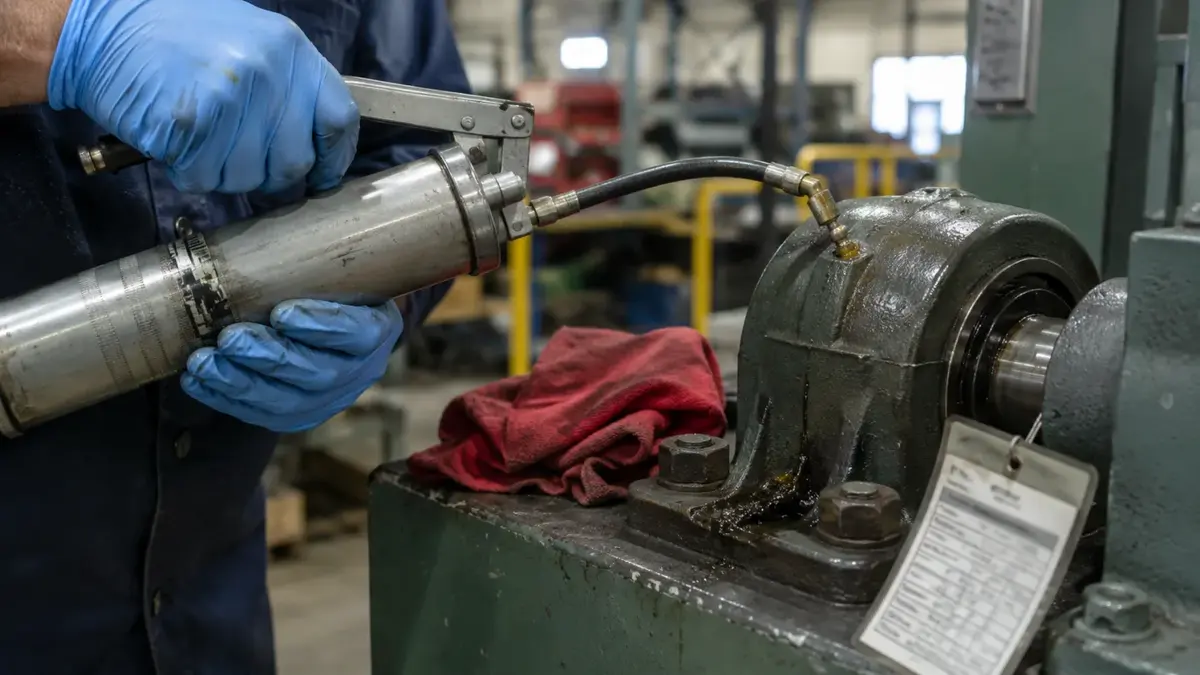
Speed, load, temperature, contamination, and even shaft orientation all pull the interval around. Temperature dominates because it drives base-oil oxidation. Mineral oils begin oxidizing meaningfully once they get hot, and every rise accelerates the reaction — which is exactly why the interval halves step by step as temperature climbs.
Oil systems follow the same logic. NTN guidance puts an oil-bath change interval near one year at around 50 °C, dropping to roughly every three months at 70–100 °C (NTN, via Bearing-News). Same principle, different lubricant: heat shortens service life on a steep curve.
Calendar-based schedules are a starting point, not the goal. The best programs move to condition-based relubrication — trending bearing temperature and, on critical machines, using ultrasonic feedback to add grease only when the bearing asks for it. That closes the two-sided failure risk: too little grease starves the film, too much churns and overheats. In heavy industry, the interval also has to account for the contamination and heat that hot strip mill bearings face, which pull intervals far shorter than a clean indoor motor.
What Is the Lubrication Regime — and Why Does It Decide Bearing Life?
Bearing life hinges on whether the oil film fully separates the surfaces. Tribology captures this with the film ratio λ (lambda) and viscosity ratio κ (kappa): surfaces are fully separated when the film is roughly three times the combined surface roughness (λ > 3), partly separated in mixed lubrication (1 < λ < 3), and in damaging metal-to-metal contact below λ = 1. This is the concept most general bearing guides skip — and it's the one that explains why bearings fail.
Think of it as three regimes. In boundary lubrication (λ < 1), asperities touch, friction and wear are high, and additives are the only protection. In mixed lubrication (1 < λ < 3), the film carries most of the load but peaks still touch occasionally. In full-film (elastohydrodynamic) lubrication (λ > 3), a continuous film separates the surfaces and rolling-contact fatigue — not wear — sets the life.
The practical control knob is base-oil viscosity. ISO 281 folds this into bearing life through the viscosity ratio κ, the ratio of actual to required base-oil viscosity at operating temperature. The standard treats κ = 1 as the usable lower bound and caps the benefit at κ = 4, and it applies a contamination factor so that clean oil multiplies calculated life while dirty oil slashes it (ISO 281:2007). Too thin an oil (from heat or the wrong grade) drops you toward boundary contact; too thick wastes energy and runs hot.
How to pick base-oil viscosity
You choose viscosity from the bearing's mean diameter and speed to land κ (and λ) safely above 1 at the real operating temperature — not room temperature. Slow, heavily loaded bearings need thicker oil to build a film; fast bearings need thinner oil to avoid churning heat. This is exactly where bearing material and hardness choices and lubricant selection meet: both are aimed at surviving the contact stress.
How Do Contamination and Water Destroy Lubrication?
Water at just 100–400 ppm measurably cuts rolling-bearing fatigue life, and at 100–300 ppm it can roughly halve it versus dry lubricant (Cantley, ASLE Transactions, vol. 20, no. 3). That's why contamination and lubrication are the two seal-preventable failure categories in SKF's split.
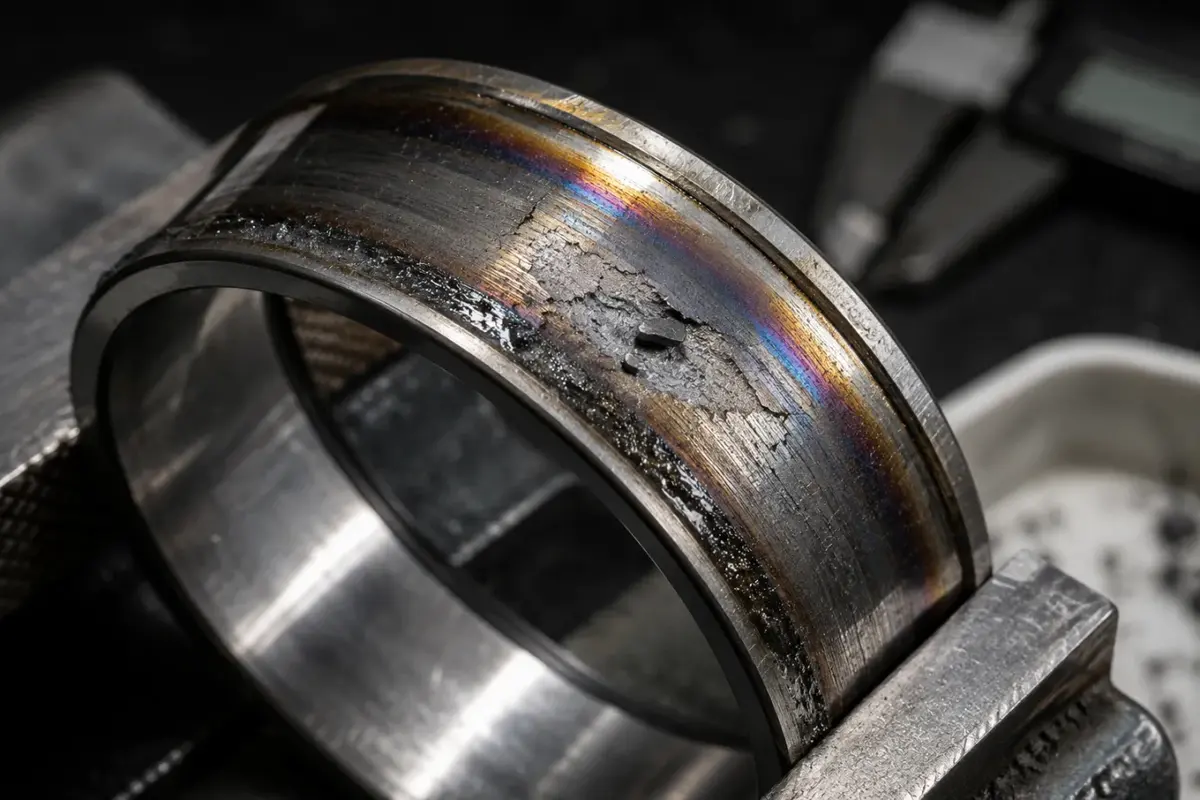
Solid particles and water attack by different routes. Hard particles get rolled into the raceway, leaving dents whose raised edges concentrate stress and seed surface-origin spalling. Water corrodes the steel and promotes hydrogen embrittlement, cracking the surface from within. Both defeat the film the lubricant worked to build — no viscosity choice survives a raceway full of grit.
In 1977, Cantley tested tapered roller bearings at 25, 100, and 400 ppm water and found a strong inverse relationship between water content and fatigue life, with life falling by about half at 100–300 ppm (Cantley, ASLE Transactions). Keeping water and particles out is not housekeeping — it's a first-order life factor, which is where the closure choice comes in. See sealed vs shielded bearings for how each barrier performs.
Grease incompatibility is a quieter contaminant. Mixing greases with incompatible thickeners — lithium with polyurea, for instance — can collapse the mix into oil and soap that no longer lubricates. When you switch grease types, purge the old charge rather than topping up over it.
| Old ↓ / New → | Lithium | Lithium complex | Polyurea | Calcium sulfonate |
|---|---|---|---|---|
| Lithium | ✓ | ✓ | ✗ | ✗ |
| Lithium complex | ✓ | ✓ | ✗ | ~ |
| Polyurea | ✗ | ✗ | ✓ | ~ |
| Calcium sulfonate | ✗ | ~ | ~ | ✓ |
✓ generally compatible · ~ test before mixing · ✗ generally incompatible. Directional guide only — confirm with the grease manufacturer's compatibility chart for the specific products.
From the plant floor: In rolling mills and steel plants, the real lubrication enemy isn't just dust — it's water and mill scale driven in under high load. ANDE's roll-neck and spherical roller bearings for heavy industry are specified with sealing and relubrication assumptions built around that ingress, which generic lubrication guides never account for.
How to Lubricate a Bearing Correctly (Step-by-Step)
Correct relubrication is a short, disciplined procedure — Noria frames it as clean, compatible, correct-quantity, and recorded (Machinery Lubrication). Most failures here come from skipping one of those steps, not from lack of grease.
- Wipe the fitting clean. Any grit on the grease nipple gets injected straight into the bearing.
- Confirm the right grease. Match the specified thickener and base-oil viscosity; never top up an incompatible grease.
- Purge the old charge where the design allows, so fresh grease fully replaces aged grease.
- Add the calculated quantity — the fill-percentage or catalog amount, not "until it comes out."
- Run briefly to distribute and let any slight excess purge, then wipe it away.
- Log it — date, amount, and grease — so the interval can be tuned against real temperature.
The five mistakes that undo all of this are predictable: over-greasing, using the wrong or an incompatible grease, injecting through a dirty fitting, relubricating on the calendar while ignoring temperature, and never recording what was done. Ask yourself before every grease-gun pull: right grease, right amount, clean fitting? On critical machines, condition monitoring — temperature trending and ultrasonic-guided greasing — replaces guesswork with a signal that tells you exactly when the bearing needs lubricant.
For application-specific lubrication, sealing, and relubrication schedules on heavy-industrial and rolling-mill bearings, contact ANDE Bearing — we specify closure, clearance, and grease together for the operating conditions, not from a generic chart.
Frequently Asked Questions
Q: Which lasts longer, grease or oil lubrication?
Oil systems generally support longer service and higher speed because oil can be filtered, cooled, and continuously replenished — grease-lubricated bearings typically run 1–3 years between regreasing, oil systems 3–7+ years with clean oil. Grease wins on simplicity, sealing, and low maintenance for the roughly 80–90% of bearings that don't need oil (NSK).
Q: Can you over-grease a bearing?
Yes — over-greasing is a named failure mode. Filling more than about half the free space at speed makes the grease churn, which raises temperature and degrades both grease and bearing. NSK recommends ⅓–½ fill above 50% of limiting speed and ½–⅔ below it (NSK). More grease is not more protection.
Q: How often should you relubricate a bearing?
It depends mostly on speed and temperature. A useful rule: halve the interval for every +15 °C above 70 °C (NSK). Oil-bath systems change roughly yearly at ~50 °C but every ~3 months at 70–100 °C (NTN). Confirm against the bearing maker's interval chart.
Q: Can you mix two different greases?
Only if the thickeners and base oils are compatible. Incompatible mixes — lithium with polyurea is the classic example — can break down into oil and soap that no longer lubricates. When changing grease types, purge the old charge instead of topping up, and check the manufacturer's compatibility chart first.
Q: Is lubrication really the top cause of bearing failure?
Lubrication is the largest single category of premature failure at 36%, ahead of fatigue (34%), mounting (16%), and contamination (14%) (SKF/STLE). The broader "80% lubrication-related" figure uses a different, looser scope, so treat it with caution — the 36% split has defined methodology.
Conclusion
Bearing lubrication is the cheapest reliability lever on any rotating machine, and the data backs that up. A few decisions carry most of the outcome:
- It's the #1 controllable failure cause — 36% of premature failures, half when you add contamination (SKF/STLE).
- Grease covers 80–90% of bearings; oil wins on speed and heat. Match the lubricant and method to the speed factor, not to habit.
- Get the film ratio λ above 1 by choosing base-oil viscosity for the real operating temperature — that's what delivers rated life.
- Don't over-grease, and keep water and particles out — both quietly halve life.
Lubrication doesn't stand alone. Closure, clearance, material, and lubricant are one decision. If you're still selecting the bearing type or a thrust bearing arrangement for the job, settle that first, then specify the lubrication around the real operating conditions. For engineering support on heavy-industrial and rolling-mill applications, contact ANDE Bearing.