Contamination (14%) and poor lubrication (36%) together account for half of all premature bearing failures (SKF/STLE, 2019). The difference between a $0.50 metal shield and a $0.80 rubber seal determines whether a bearing lasts six months or two-plus years on a dusty conveyor. Yet the choice isn't "sealed is always better." Sealed bearings sacrifice approximately 40% of their maximum permissible speed for that protection.
This guide compares sealed and shielded bearings with quantified engineering data: RPM reduction factors, temperature limits by seal material, friction coefficients, and a decision matrix by application. If you're still deciding which type of bearing your application needs, start there — this post assumes you've already landed on a deep-groove ball bearing and need to choose the closure.
Key Takeaways
- Shielded (ZZ) bearings run at full catalog speed (no friction penalty from non-contact shields) and allow easy relubrication through the 0.1–0.3 mm gap. They suit clean, high-speed environments.
- Sealed (2RS) bearings impose a ~40% speed reduction across all lubricant types but extend service life up to 4× in contaminated environments (SMB Bearings, 2025).
- Standard NBR seals fail above 100°C; upgrade to FKM/Viton for applications up to 200°C (SKF, 2025).
- SKF's four-category failure breakdown: lubrication 36%, fatigue 34%, mounting 16%, contamination 14% — the two seal-preventable categories sum to half of all premature failures (SKF/STLE, 2019).
What Is the Difference Between Sealed and Shielded Bearings?
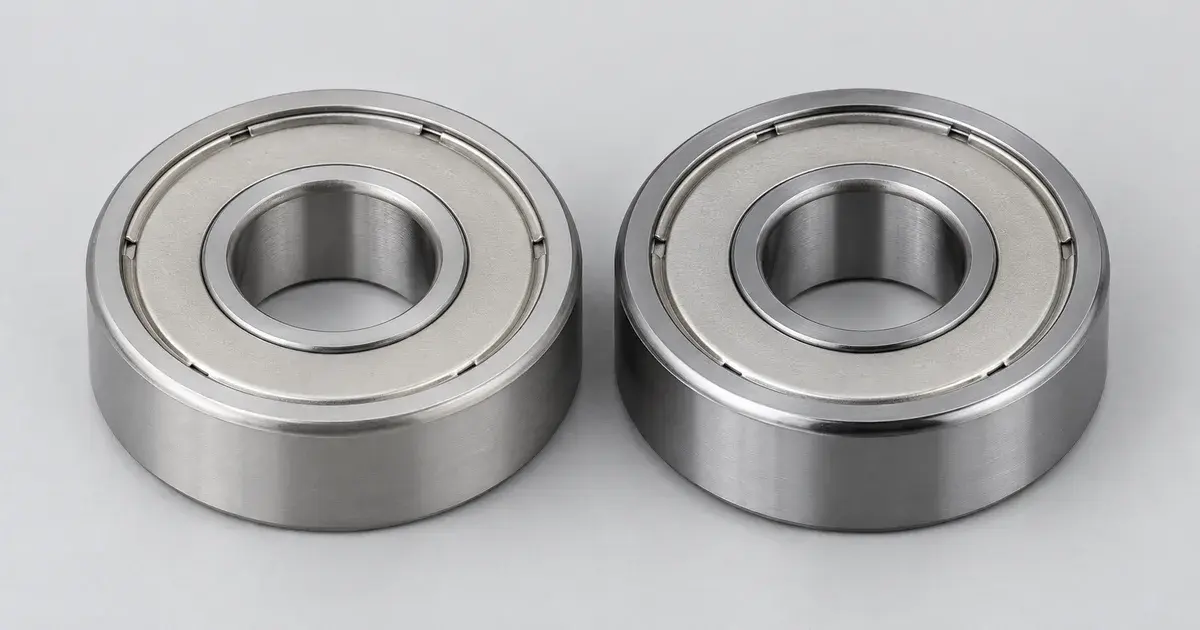
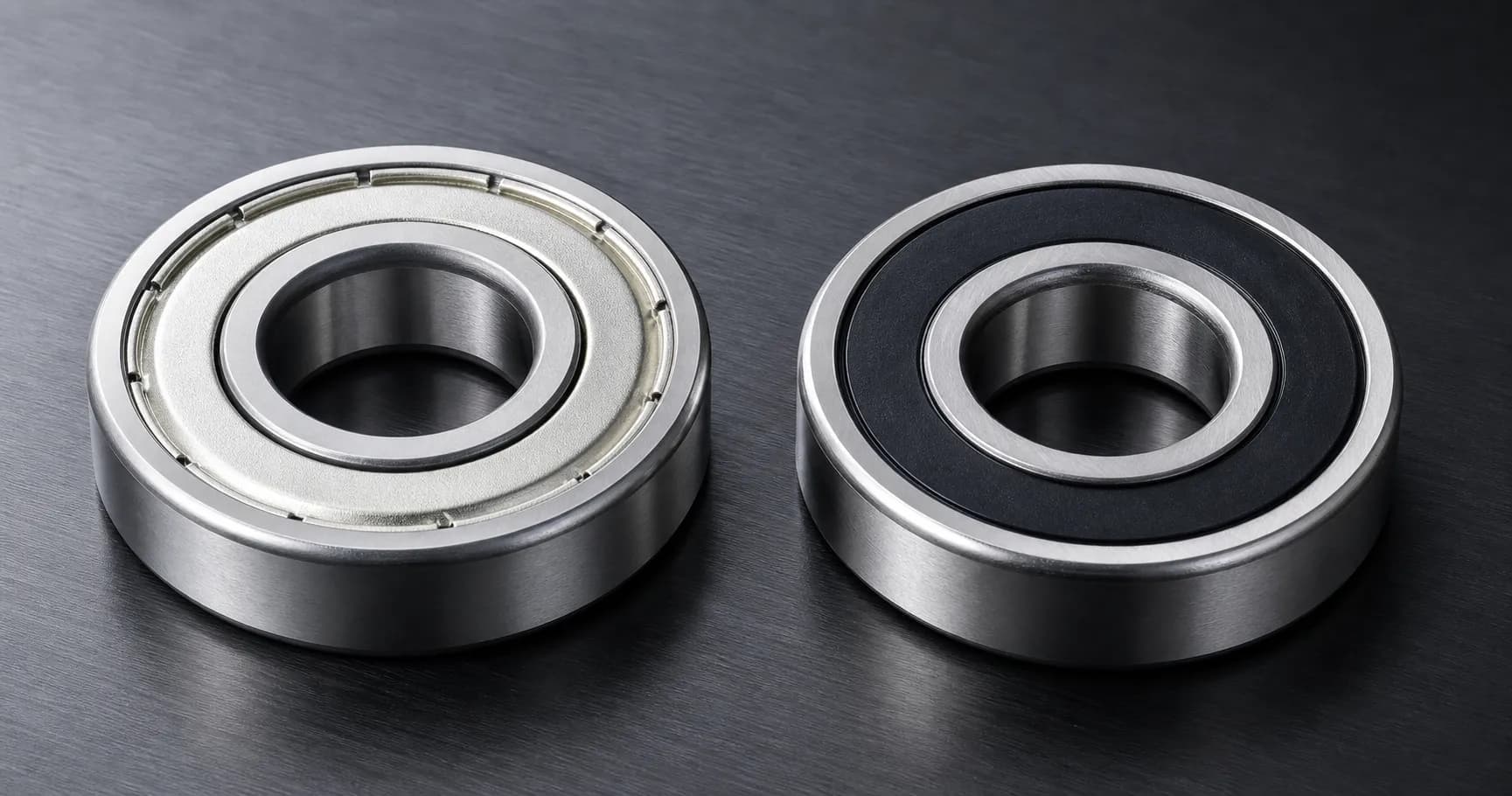
A shield (designated ZZ or 2Z) is a pressed-steel disc that snaps into a groove in the outer ring, leaving a 0.1–0.3 mm radial gap between the shield's inner edge and the inner ring. A seal (designated 2RS, 2RSR, LLU, or DDU depending on manufacturer) is a rubber or synthetic lip that contacts the inner ring, or rides on it with near-zero clearance, forming an almost airtight barrier.
That one structural difference, gap versus contact, cascades into every performance trade-off between the two configurations.
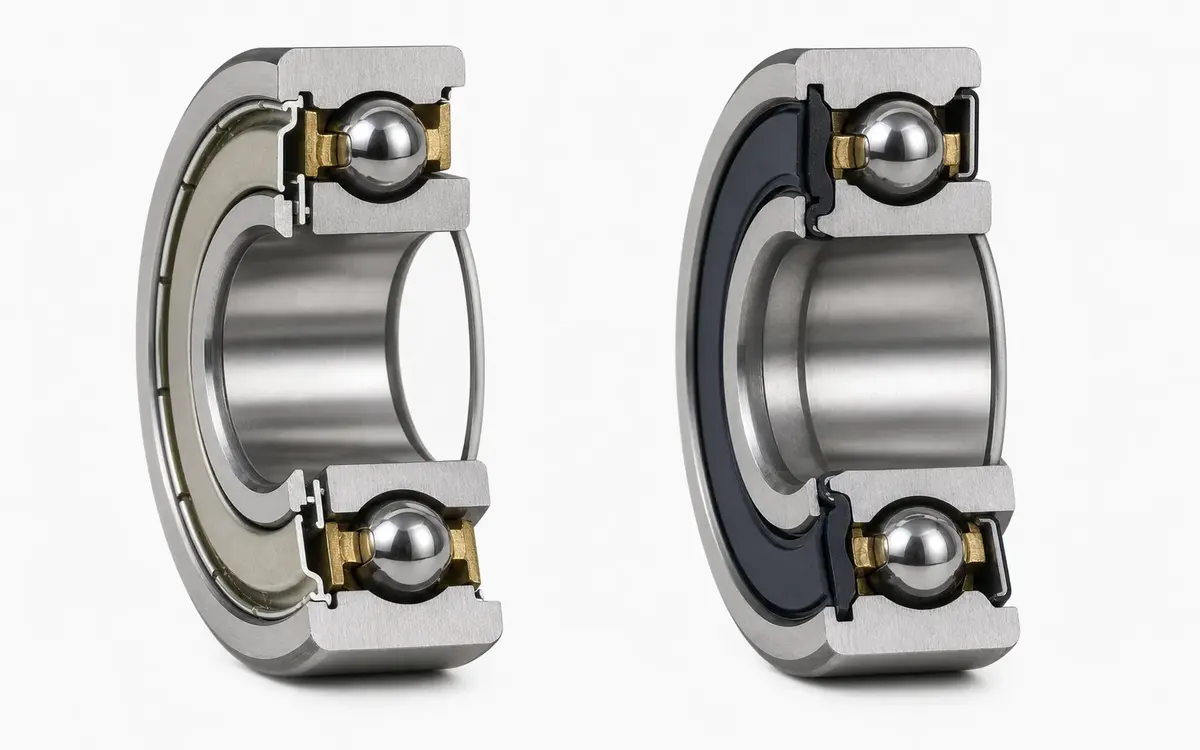
| Feature | Shielded (ZZ / 2Z) | Sealed (2RS / 2RSR) |
|---|---|---|
| Material | Pressed steel (SPCC) | Rubber lip (NBR, HNBR, or FKM) on steel reinforcement |
| Contact | Non-contact (radial gap) | Contact or low-clearance labyrinth |
| Contamination barrier | Blocks large particles; fine dust passes through | Blocks particles, moisture, and most liquids |
| Friction added | Near zero | Measurable (seal lip drag) |
| Speed penalty | None (non-contact, no friction added) | ~40% reduction across all lubricants |
| Relubrication | Yes, grease gun through the gap | Designed as "lubricated for life" |
| Typical designation | 6205-ZZ, 6305-2Z | 6205-2RS, 6305-2RSR |
The naming conventions vary by manufacturer. SKF uses "2RS1" and "2Z". NSK uses "DDU" (contact seal) and "ZZ" (shield). NTN uses "LLU" and "ZZ". FAG/Schaeffler uses "2RSR" and "2Z". Regardless of suffix, the physics is the same: metal disc with a gap, or rubber lip with contact. Translating one house's suffix into another's is its own job, and our guide to a bearing cross reference covers matching by function rather than by letter.
How Much Slower Are Sealed Bearings?
In 2025, SMB Bearings published speed reduction factors showing that contact seals reduce the maximum permissible speed by approximately 40%, while non-contact shields (ZZ) impose no speed reduction at all — because the shield doesn't touch the rotating ring (SMB Bearings). The root cause of the sealed-bearing penalty is friction heat: a rubber lip sliding against a rotating inner ring generates enough thermal energy to degrade both the seal material and the grease behind it.
The speed ceiling comes from lip sliding velocity. Machine Design reports that contact seal lips shouldn't exceed 8–10 m/s sliding speed before heat generation damages the seal (Machine Design). As an example: a 6205 bearing has an inner-ring seal land of approximately 32 mm diameter — applying V = π·d·n/60, the 8–10 m/s limit corresponds to roughly 4,800–6,000 RPM before the seal itself becomes the life-limiting factor.
Here's what that means in practice. The table below applies SMB's reduction factors to a typical 6205 catalog limiting speed (~14,000 RPM with grease, open configuration) as an illustrative example:
| Configuration | Speed factor (inner ring rotating) | Estimated 6205 limiting speed |
|---|---|---|
| Open (no closure) | 1.0 (reference) | ~14,000 RPM (grease) |
| Shielded ZZ | 1.0 (non-contact — no friction penalty) | ~14,000 RPM |
| Sealed 2RS (any lubricant) | 0.6 | ~8,400 RPM |
If your application needs every RPM the catalog offers, shields win. If your application runs well below the limiting speed (say, a conveyor at 1,200 RPM), the 40% penalty is irrelevant and seals cost you nothing in performance.
What Temperature Can Sealed Bearings Withstand?
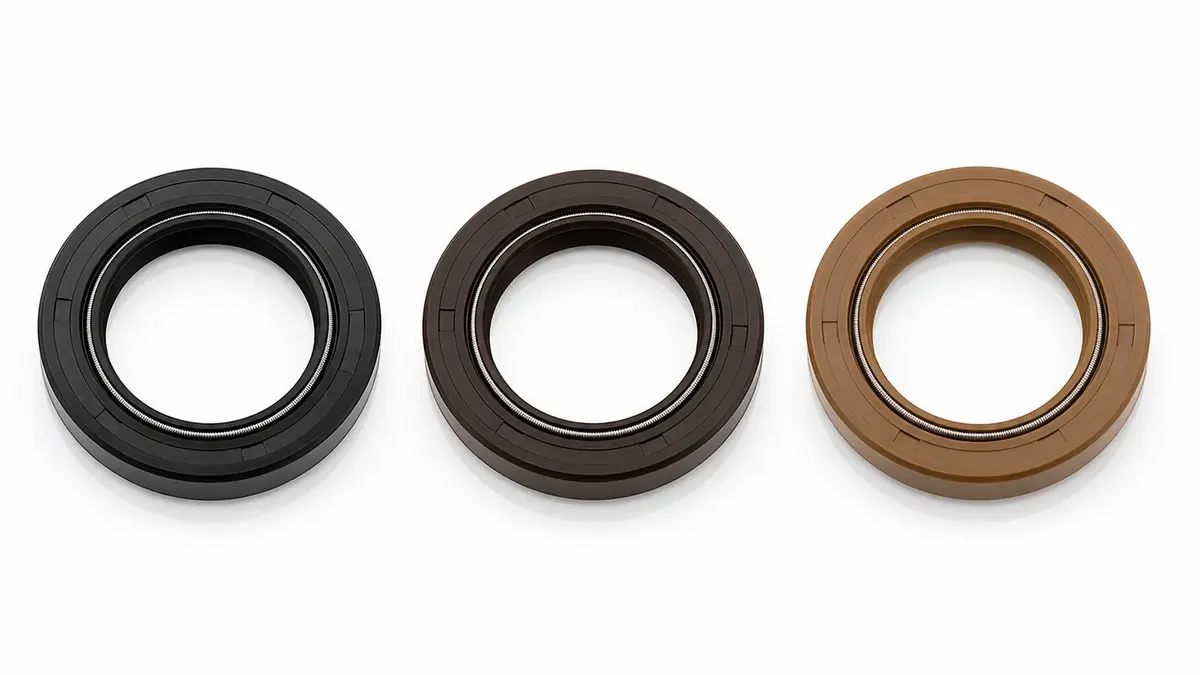
In 2025, SKF published seal material specifications showing that standard NBR (nitrile) seals operate from −40°C to +100°C, with brief exposure tolerance to 120°C. For higher temperatures, HNBR extends to 150°C, and FKM/Viton reaches 200°C with brief spikes to 230°C (SKF). Metal shields, by contrast, have no material temperature limit; only the grease determines the thermal ceiling.
This distinction matters because the seal is usually the first component to fail in a high-temperature application. NBR rubber hardens above 100°C, loses elasticity, cracks, and stops sealing. At that point, your "sealed" bearing becomes an open bearing with a chunk of degraded rubber inside it.
| Seal material | Min temp | Max continuous | Brief exposure | Common application |
|---|---|---|---|---|
| NBR (nitrile) | −40°C | +100°C | +120°C | General-purpose, indoor |
| HNBR (hydrogenated nitrile) | −40°C | +150°C | +170°C | Automotive, moderate heat |
| FKM / Viton | −20°C | +200°C | +230°C | Ovens, kilns, engine bay |
| Metal shield (SPCC steel) | −60°C | +250°C+ | Grease-limited | High-temp fans, dryers |
The practical takeaway: if your operating temperature stays below 80°C, standard NBR seals are fine and cheapest. Between 80–130°C, specify HNBR. Above 130°C, either use FKM seals (expensive) or switch to shielded bearings with high-temperature grease — often the more economical choice.
How Much Longer Do Sealed Bearings Last?
In contaminated environments, sealed bearings routinely outlast shielded equivalents by a factor of 4× or more. A common pattern in dusty material-handling plants: shielded conveyor bearings fail at 6-month intervals while sealed replacements run 2+ years with no other system changes. The mechanism is straightforward: fine abrasive particles enter through the shield's 0.1–0.3 mm radial gap, embed in the grease, and abrade the raceways until spalling begins.
This isn't surprising when you look at bearing failure statistics. In 2019, SKF's bearing damage analysis reported that premature bearing failures divide into four root causes: lubrication 36%, fatigue 34%, mounting/handling 16%, and contamination 14% (SKF/STLE). Contamination alone accounts for 14%, but contamination also accelerates lubrication degradation. Adding those two categories gives 50% of premature failures attributable to what enters the bearing or what dries out inside it. For the grease-fill percentages, relubrication intervals, and film-ratio data behind that 36%, see our bearing lubrication guide.
A seal addresses both mechanisms simultaneously: it keeps contaminants out AND keeps lubricant in. A shield only partially addresses the first and does nothing for the second.
Water is especially destructive. Cantley (1977) tested tapered roller bearings with 25, 100, and 400 ppm water contamination and found a strong inverse correlation between water content and fatigue life. At 100–300 ppm, life dropped by roughly half compared to dry lubricant (Cantley, "The Effect of Water in Lubricant on Bearing Fatigue Life," ASLE Transactions, vol. 20, no. 3, 1977). Shields offer no protection against water ingress; seals do.
But longevity isn't automatic. A sealed bearing's lubricant is finite — factory-filled at typically 25–35% of internal cavity volume per standard manufacturer practice. Once that grease degrades (from heat, oxidation, or time), the sealed bearing can't be easily relubricated without removing the seal. In clean, well-maintained environments where you reliably regrease on schedule, shielded bearings can match or exceed sealed bearing life because the lubricant is always fresh.
Friction and Power Loss: Does the Seal Cost Energy?
The base friction coefficient for a deep groove ball bearing is μ = 0.0010–0.0015 (Koyo/JTEKT, Bearing Engineering Data, Section 8) — already far lower than the μ = 0.05–0.20 range of a plain bushing. That figure applies to the rolling elements and raceway without any closure. Adding a metal shield increases friction negligibly (the shield doesn't contact anything). Adding a rubber contact seal increases friction measurably — typically adding μ = 0.001–0.003 on top of the base value, depending on seal lip preload, speed, and lubrication.
Does that matter? It depends on the application:
- Electric motors and spindles. Every watt of friction converts to heat inside the housing. At 10,000 RPM on a 6205 bearing, seal friction can add 5–15 watts of parasitic loss. That heat raises operating temperature, degrades grease faster, and shortens life. Shields (or open bearings with external sealing) are standard.
- Conveyor idler rolls. Running at 600 RPM with a 20 mm bore, seal friction adds under 1 watt. Irrelevant. Protection matters more than power loss.
- Skateboard wheels and hobby applications. Enthusiasts obsess over "free spin" time but real-world rolling resistance is dominated by wheel deformation, not bearing friction. Doesn't matter.
The energy cost of a contact seal is real but small. It only becomes the design-limiting factor in high-speed or precision applications where thermal management is already challenging.
Maintenance: Can Sealed Bearings Be Regreased?
Shielded bearings accept fresh grease through the radial gap without disassembly. You can run a grease gun at the zerk fitting and new lubricant pushes through the shield gap into the bearing cavity. This makes them standard in applications with scheduled maintenance programs — industrial motors, pumps, gearboxes, and anything with a lubrication route.
Sealed bearings are designed as "lubricated for life." The factory fills them with grease (typically 25–35% of internal volume) and the seal retains it. No gap exists for a grease gun to push through.
Can you regrease them anyway? Yes — by prying out one seal with a thin blade, packing fresh grease, and reseating the seal. But this introduces three risks:
- Contamination entry during the open period.
- Seal damage from prying (bent lip = compromised seal)
- Overfilling: too much grease increases internal temperature and accelerates degradation
For most applications, the correct approach is: run sealed bearings until end-of-life, then replace them. The total cost of a new bearing is often less than the labor cost of regreasing it.
When doesn't "lubricated for life" actually mean lifetime? When the grease has a shorter service life than the bearing itself. Standard lithium grease in a sealed bearing at 70°C might last 20,000–30,000 operating hours. If your machine runs 8,000 hours/year, that's 2.5–3.7 years. If the bearing's calculated L₁₀ fatigue life is 10 years, the grease fails first — and you either replace the bearing early or plan for a regrease cycle.
When to Choose Sealed vs Shielded: Decision Matrix
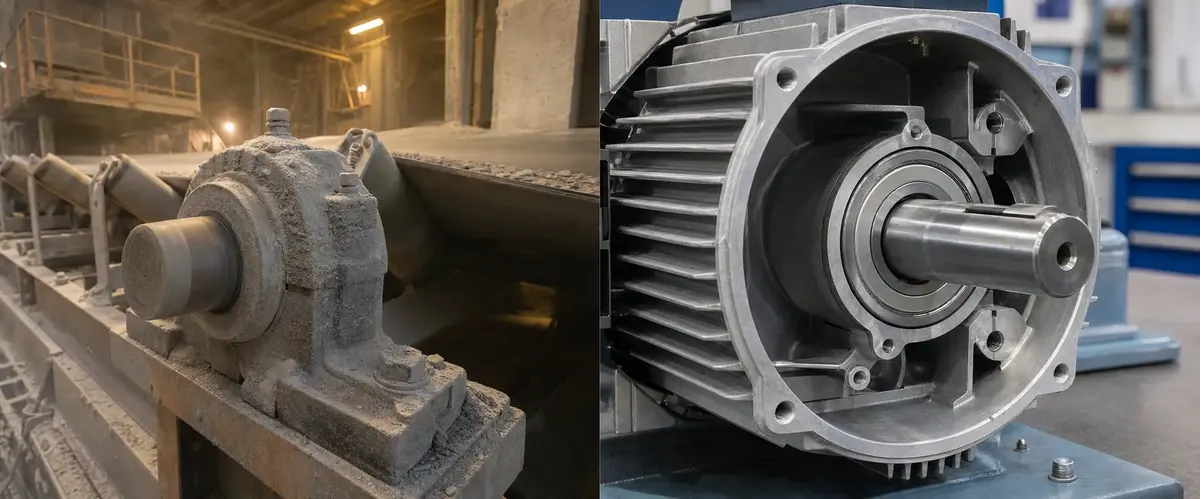
The selection rule is straightforward. Match the bearing closure to the environment, not to a generic "better/worse" hierarchy. A sealed bearing in a cleanroom wastes money on protection it doesn't need while paying a speed and friction penalty. A shielded bearing on an outdoor conveyor will fail from contamination within months.
| Environment | Recommended | Why |
|---|---|---|
| Clean, dry, indoor (electric motors, HVAC fans, office equipment) | Shielded (ZZ) | No contamination threat; full speed available; easy relubrication |
| Moderate dust (warehouse conveyors, packaging machines) | Sealed (2RS) | Dust particles too fine for shields; 4× life improvement documented |
| Heavy contamination (mining, cement, aggregate, food processing) | Sealed (2RS) with FKM or specialized seals | Maximum contamination protection; specify food-grade FKM for FDA compliance |
| High moisture / washdown (pumps, outdoor equipment, marine) | Sealed (2RS) | Shields offer no water protection; seal prevents ingress that halves bearing life |
| High temperature (>100°C) (ovens, dryers, kilns) | Shielded (ZZ) + high-temp grease, OR sealed with FKM | NBR seals fail above 100°C; shield + Polyurea grease is often cheaper than FKM seals |
| High speed (>70% catalog limit) (spindles, turbines, dental handpieces) | Shielded (ZZ) or open + labyrinth | Seal friction generates too much heat; external sealing preferred |
| Infrequent maintenance (remote equipment, solar trackers, inaccessible positions) | Sealed (2RS) | No relubrication access; seal retains grease for the bearing's useful life |
From our catalog: ANDE's 6205-2RS uses an NBR seal rated for continuous duty to 100°C and a C3 clearance option for applications where thermal expansion would preload a standard-clearance sealed bearing. The C3 variant adds approximately 8–12% to the price versus CN clearance.
Frequently Asked Questions
Q: Can sealed bearings be regreased?
Yes, but it's not recommended as routine maintenance. Pry out one seal, pack grease to 25–35% fill, and reseat. The risk is contamination entry and seal damage during the procedure. For most applications, replace the bearing instead — a new 6205-2RS costs less than the labor time for careful regreasing.
Q: Are shielded bearings waterproof?
No. The 0.1–0.3 mm radial gap between shield and inner ring allows water ingress. In 1977, Cantley demonstrated that free water in lubricant can reduce bearing fatigue life by approximately 50% (Cantley, ASLE Transactions). For wet environments, specify sealed (2RS) or use shielded bearings inside a separately sealed housing.
Q: Do sealed bearings last longer than shielded?
In contaminated environments, yes — field improvements of 4× or more are commonly reported. In clean environments with regular relubrication, shielded bearings match or exceed sealed bearing life because their grease supply is renewable rather than finite.
Q: What's the difference between 2RS and ZZ bearing designations?
ZZ (or 2Z) indicates two metal shields — non-contact steel discs with a radial gap. 2RS (or 2RSR, DDU, LLU) indicates two rubber contact seals. The letters after the designation vary by manufacturer (SKF, NSK, NTN, FAG) but the physics is identical within each category. The closure suffix is separate from the ABEC precision grade — a 6205-2RS can be ABEC 1 or ABEC 5; the seal doesn't change the tolerance class.
Q: Should I use sealed or shielded bearings in food processing?
Sealed — specifically with FKM (Viton) seals that comply with FDA 21 CFR 177.2600 for food contact. The seal prevents both contaminant ingress into the bearing and lubricant leakage onto the product. Shielded bearings in food environments risk grease migration through the gap and contamination of the process line.
Conclusion
The sealed-vs-shielded decision reduces to one question: is your operating environment clean enough for a 0.1–0.3 mm gap?
- If dust, moisture, or process fluids are present — seal it (2RS). Accept the 40% speed reduction and finite grease life in exchange for up to 4× longer service.
- If the environment is clean, speed matters, and you have a maintenance program — shield it (ZZ). Full catalog speed, near-zero friction penalty, renewable lubrication.
- If temperature exceeds 100°C — either upgrade to FKM seals or use shields with high-temperature grease. Run the cost comparison; shields + special grease often win on price.
Don't over-seal clean applications. Don't under-protect dirty ones. Match the closure to the environment. If you're unsure what conditions your ball bearing application actually exposes the bearing to, characterize it before specifying.
For application engineering support selecting sealed or shielded bearings for your specific conditions, contact ANDE Bearing — we supply both configurations across the full deep-groove ball bearing range (6000–6300 series) with NBR, HNBR, and FKM seal options.