
Products
Ball Bearings
Deep groove, angular contact, self-aligning, thrust, and four-point contact ball bearings for high-speed and precision applications.
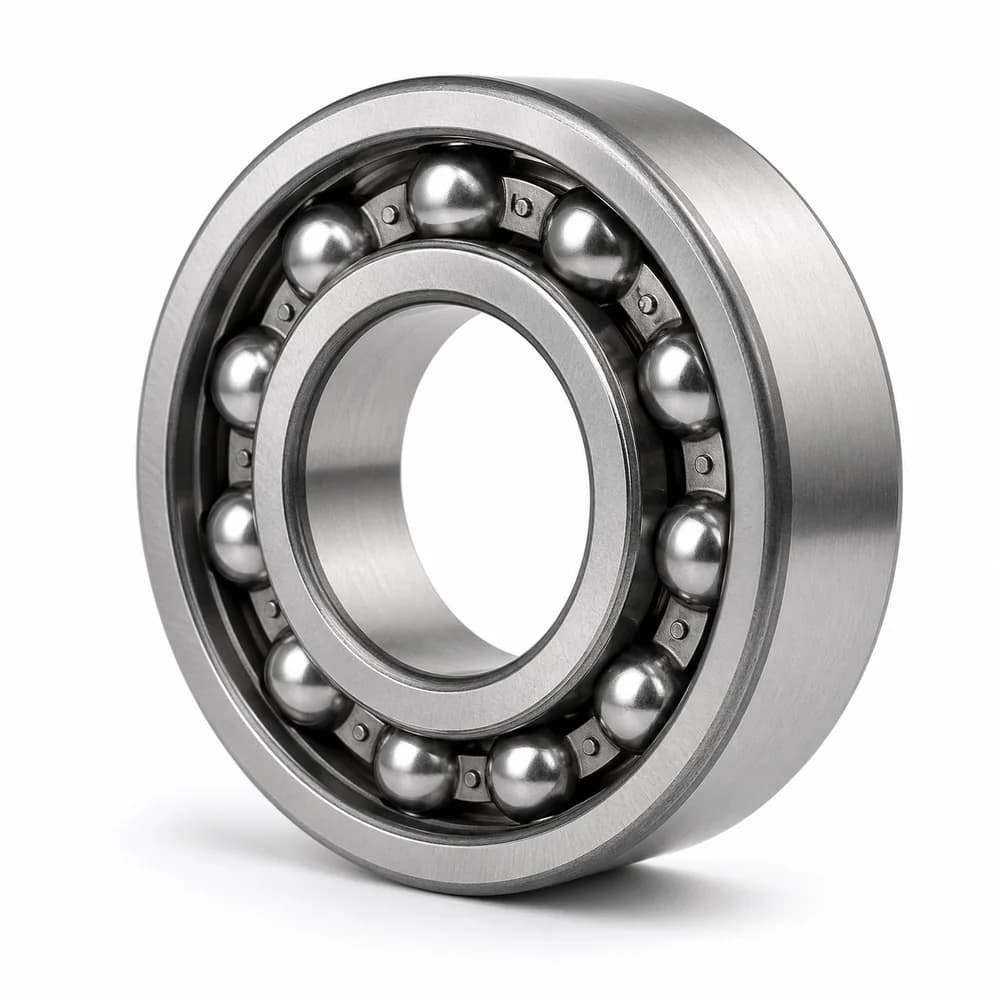
Deep Groove Ball Bearing
Versatile bearing type suitable for high-speed applications with radial and axial loads in both directions.
- Bore Diameter
- 10 mm - 200 mm (standard range)
- Dynamic Load Rating
- 1.5 kN - 380 kN
- Precision Class
- P5 standard, P4/P2 on request
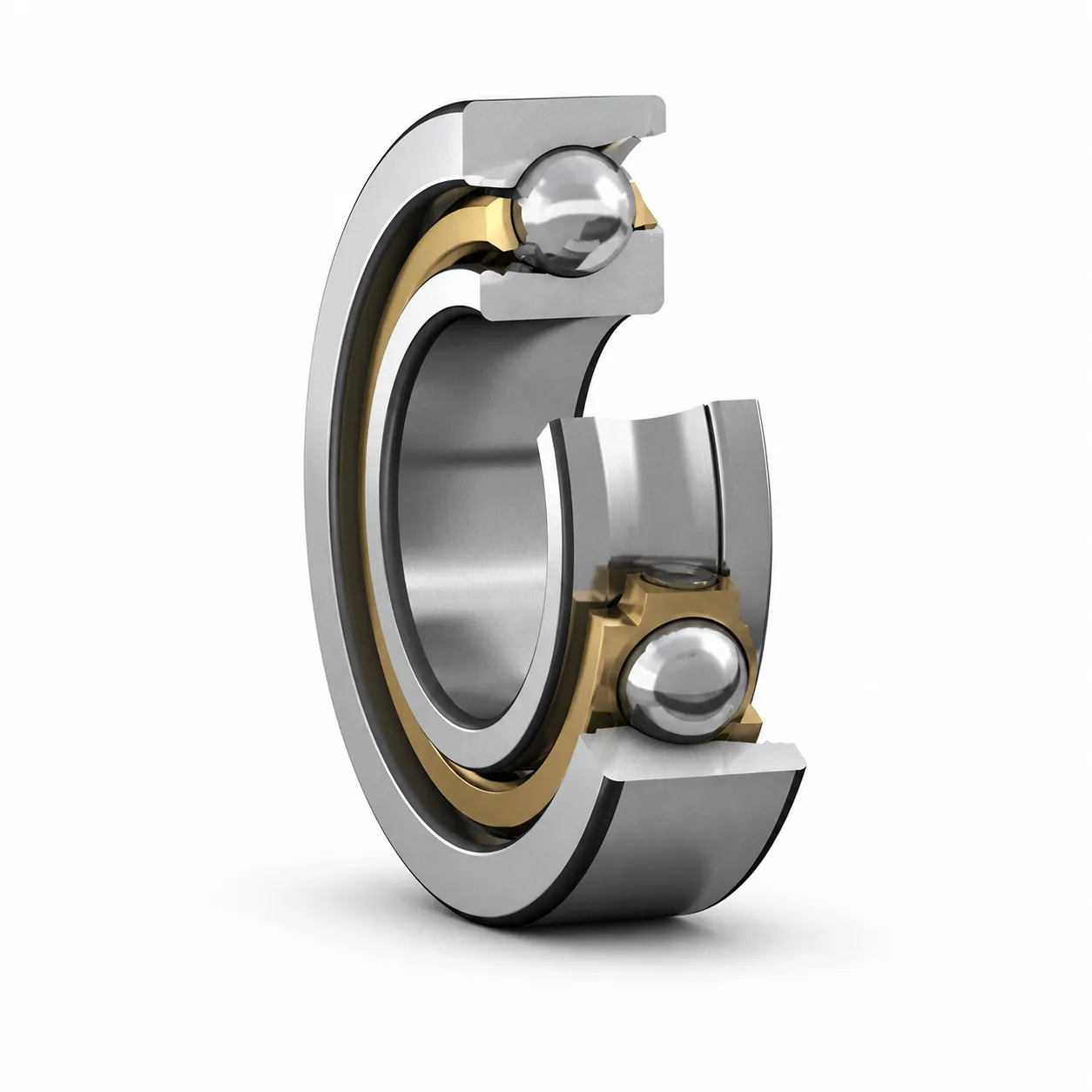
Angular Contact Ball Bearing
Designed for combined loads where high axial forces must be transferred in addition to radial forces, featuring a defined contact angle for optimal load distribution.
- Bore Diameter
- 10 mm - 200 mm (standard range)
- Dynamic Load Rating
- 3 kN - 400 kN
- Precision Class
- P5 standard, P4/P2 on request
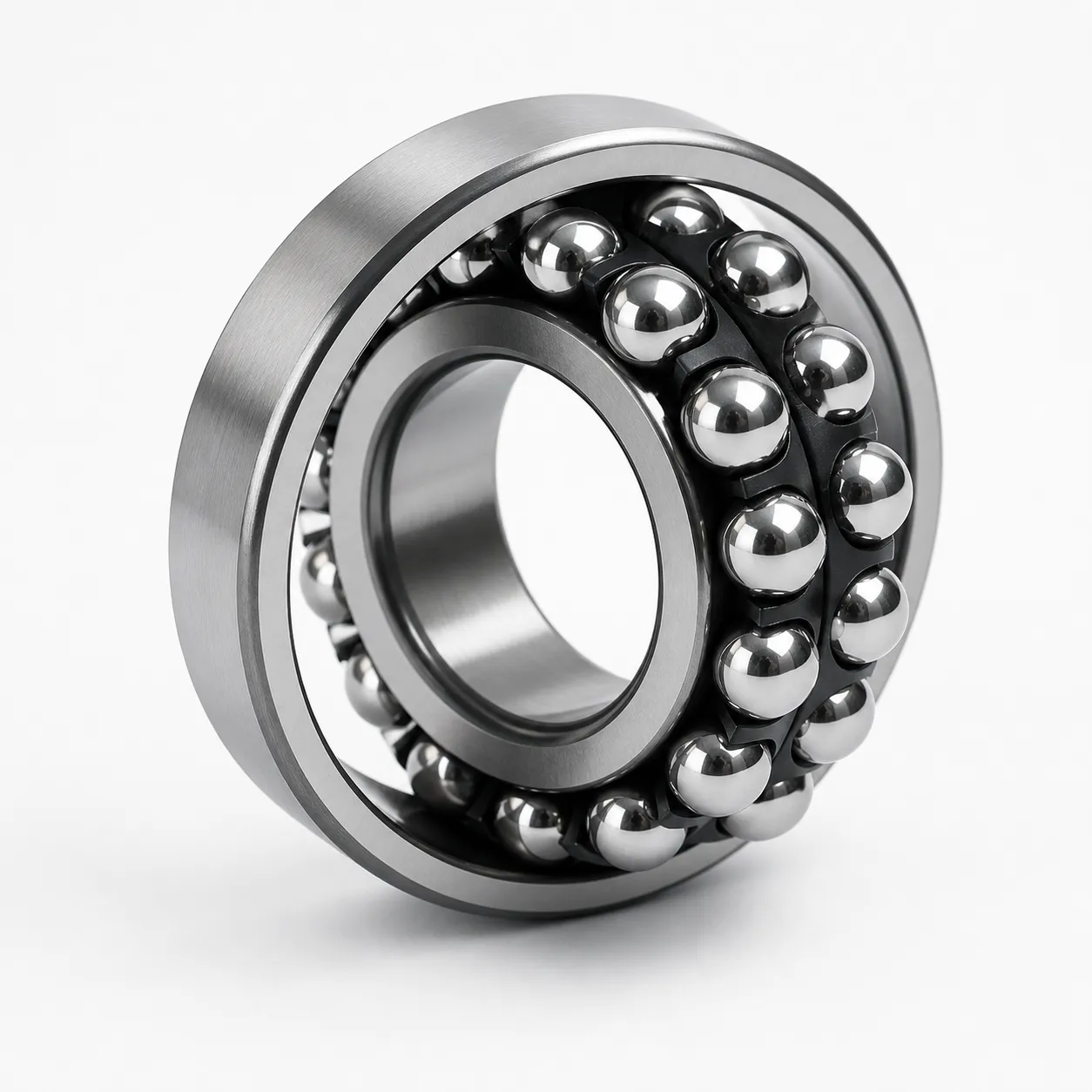
Self-Aligning Ball Bearing
Double-row ball bearings with a spherical outer ring raceway that allows self-alignment, ideal for applications with shaft misalignment or deflection.
- Bore Diameter
- 10 mm - 100 mm (standard range)
- Dynamic Load Rating
- 2 kN - 120 kN
- Precision Class
- P5 standard, P6 on request
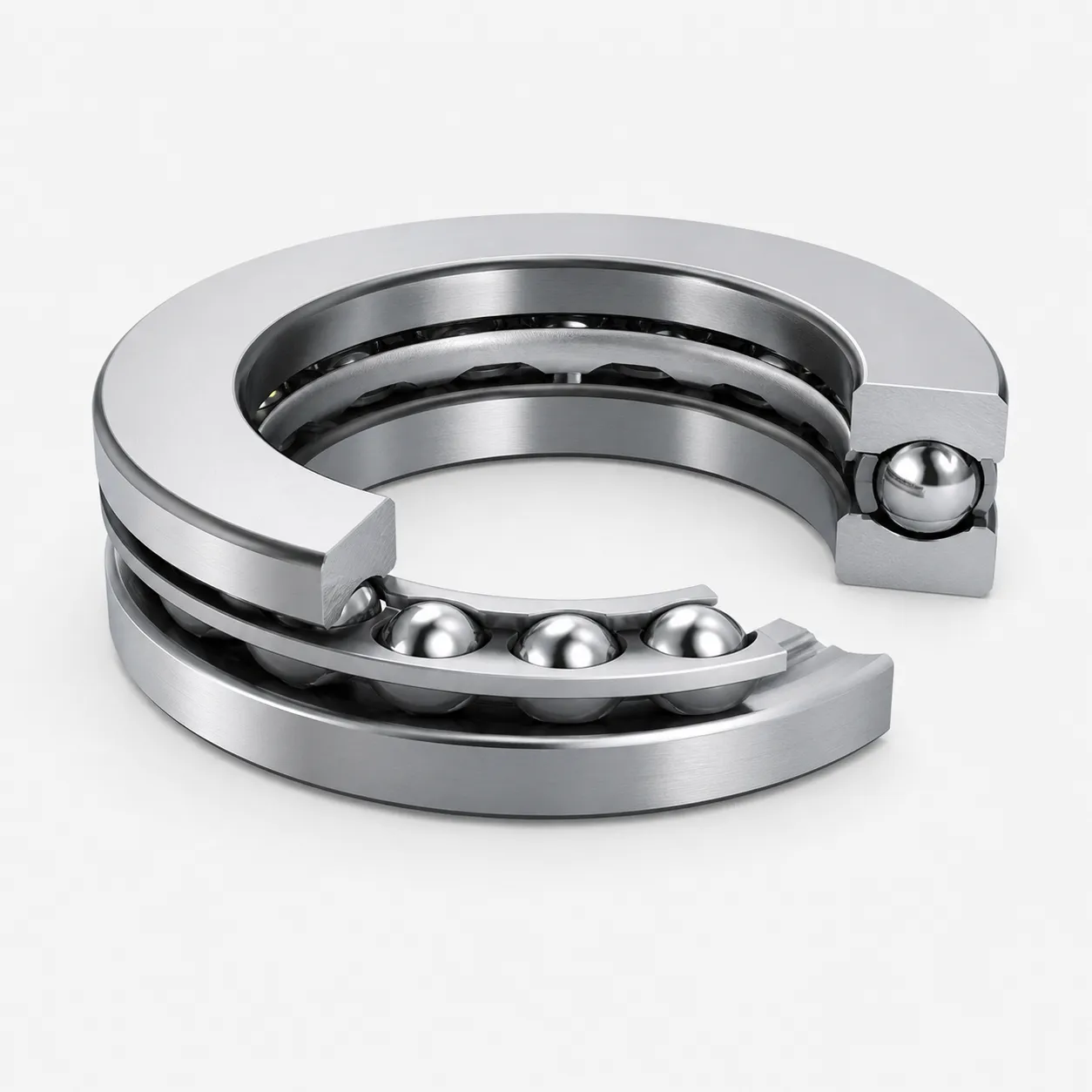
Thrust Ball Bearing
Bearings consisting of two bearing discs with raceways, developed solely for absorbing axial forces in one direction for precise shaft axial positioning.
- Bore Diameter
- 10 mm - 150 mm (standard range)
- Dynamic Load Rating
- 5 kN - 250 kN
- Precision Class
- P5 standard, P4 on request
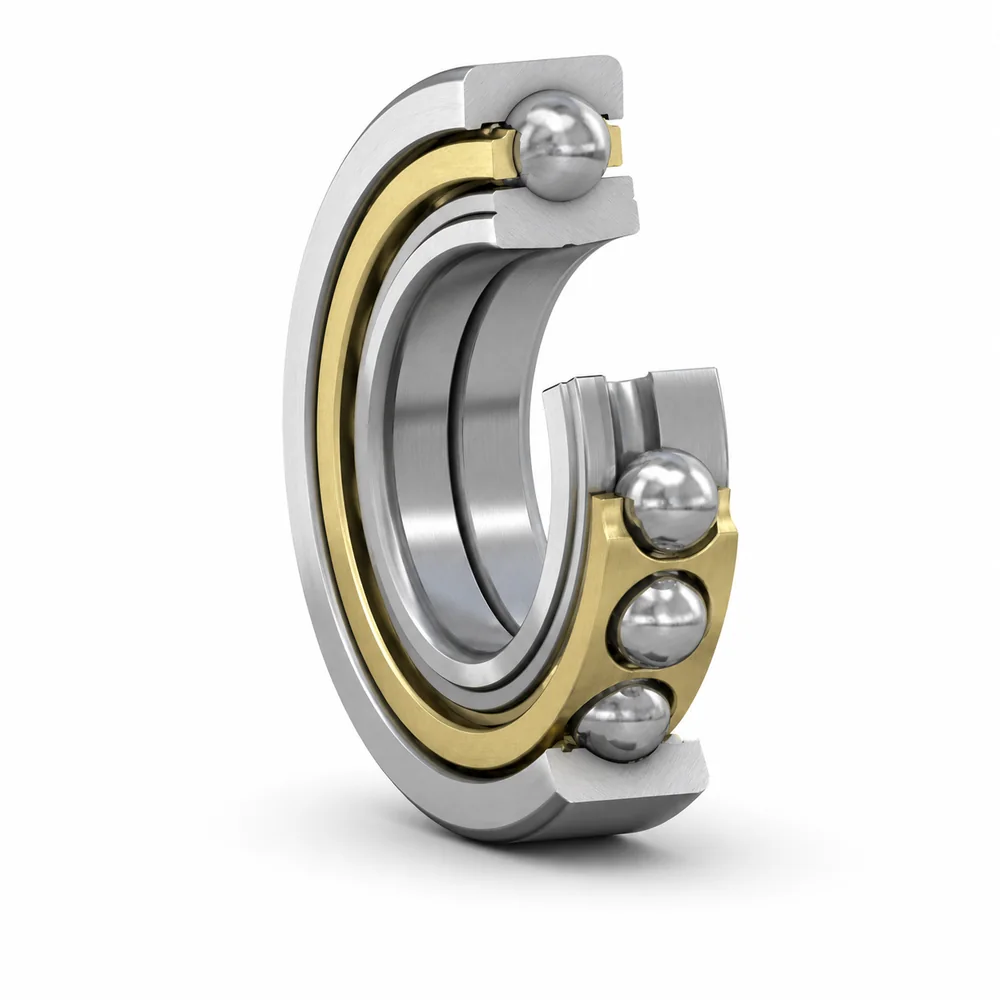
Four-Point Contact Ball Bearing
Single-row bearings capable of supporting axial loads in both directions, ideal for rolling mill and heavy machinery applications.
- Bore Diameter
- 30 mm - 500 mm
- Dynamic Load Rating
- 20 kN - 800 kN
- Precision Class
- P5 standard, P4/P2 on request
Key Takeaways
- Available in 5 types: deep groove, angular contact, self-aligning, thrust, and four-point contact
- Bore diameters from 3 mm to 200 mm with precision classes P5, P4, and P2
- Chrome steel (AISI 52100) and stainless steel (AISI 440C) options
- High-speed capability with low friction — ideal for motors, pumps, and conveyors
- ISO 15:2017 and ISO 492 certified quality
Technical Overview
Ball bearings use balls as rolling elements and are characterised by point contact between the balls and the raceways. As a rule, ball bearings can rotate at very high speeds but have lower load capacity compared to roller bearings of the same size. ANDE manufactures a comprehensive range of ball bearings suitable for applications from small electric motors and household appliances to large industrial pumps and conveyor systems. Our product line includes deep groove ball bearings for general-purpose use, angular contact ball bearings for combined loads, self-aligning ball bearings for misalignment compensation, thrust ball bearings for axial load support, and four-point contact ball bearings for bidirectional axial loads. All ball bearings are manufactured from premium chrome steel (AISI 52100) or stainless steel (AISI 440C), with precision-ground raceways and optimized internal geometry for smooth, quiet operation and extended service life. Available in open, shielded, and sealed configurations with various cage materials including pressed steel and polyamide. All ball bearings conform to ISO 15:2017 dimensional standards and are available in precision classes from P5 (standard) through P2 for demanding high-speed applications.
Key Features
- High-speed capability with low friction torque
- Available in bore diameters from 3mm to 200mm
- Multiple seal and shield configurations for contamination protection
- Chrome steel and stainless steel material options
- Precision classes: P5, P4, P2 to meet diverse application needs
- Conformance to ISO 15:2017 and ISO 492 standards
Frequently Asked Questions
What is the difference between deep groove and angular contact ball bearings?
Deep groove ball bearings are general-purpose bearings that handle moderate radial and axial loads. Angular contact ball bearings have a contact angle (typically 15°–40°) that allows them to support higher axial loads in one direction, making them ideal for spindle assemblies, pumps, and paired mounting configurations.
What precision classes are available for ANDE ball bearings?
ANDE ball bearings are available in precision classes P5 (standard), P4 (high precision), and P2 (ultra-high precision) according to ISO 492. Higher precision classes offer tighter dimensional and running accuracy tolerances for applications such as CNC machine tool spindles and high-speed electric motors.
How do I select the right ball bearing size for my application?
Selection depends on four factors: required load capacity (both radial and axial), operating speed, available mounting space, and environmental conditions. Start with the equivalent dynamic load rating (C) and required life expectancy (L10), then verify the limiting speed. ANDE offers bore diameters from 3 mm to 200 mm to cover most industrial applications.
Can ball bearings handle axial loads?
Yes. Thrust ball bearings are designed exclusively for axial loads. Angular contact and four-point contact ball bearings handle combined radial and axial loads. Deep groove ball bearings can support light axial loads (up to approximately 50% of the remaining radial load capacity). For heavy bidirectional axial loads, four-point contact bearings are recommended.
What materials are ANDE ball bearings made from?
Standard ANDE ball bearings are manufactured from high-carbon chromium steel (AISI 52100 / GCr15) for optimal hardness and fatigue life. Stainless steel options (AISI 440C) are available for corrosive environments. Cages are available in pressed steel, machined brass, or polyamide (PA66) depending on application speed and temperature requirements.
Related Articles
Automobile Ball Bearings: Types, Uses & Buying Guide (2026)
Where ball bearings sit in a modern car, the five categories you'll actually specify, why EV traction motors need ceramic hybrids, and how to spot a fake.
2026-05-19Dynamic Load vs Static Load in Bearings (C vs C₀)
Dynamic rating C governs L₁₀ fatigue life under rotation (ISO 281). Static rating C₀ bounds permanent deformation per ISO 76. Below 10 rpm, C₀ governs.
2026-05-13How Do You Measure a Bearing? A Step-by-Step Guide
Measure a bearing in three numbers: bore, outer diameter, and width. The last two digits of the bearing code × 5 give you the bore in mm per ISO 15.
2026-05-06What Are Ball Bearings Used For? Applications and Types
Where ball bearings are used and how to pick the right one. From dental handpieces at 400,000 rpm to EV traction motors, the 7 application areas that matter.
2026-05-02Different Kinds of Bearings: A Complete Guide
Eleven bearing categories explained, from deep-groove balls (the world's most-produced bearing type) to magnetic levitation. How each works and where it fits.
Send Drawing / Model / Operating Conditions → Quote Within 24 Hours
Our engineering team reviews your specifications and provides a detailed quotation with bearing selection recommendations.
Other Categories
Need this bearing for your application?
Our engineering team can help with bearing selection, custom specifications, and volume pricing.