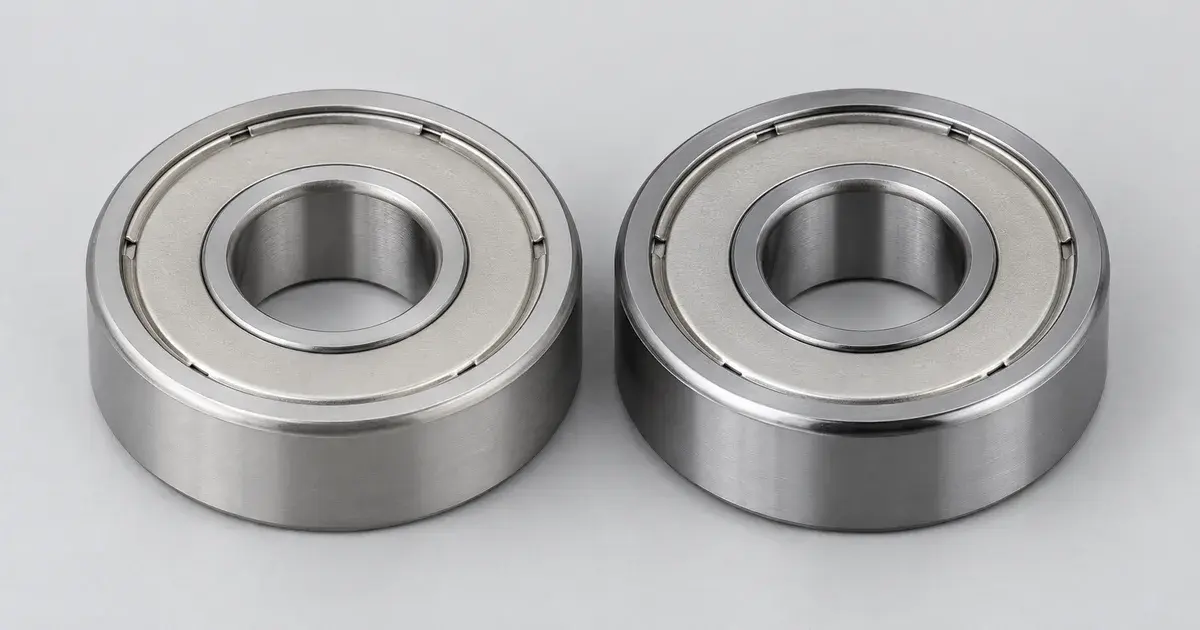
Put a stainless deep groove ball bearing next to its chrome steel twin and almost nothing on the data sheet changes. Same bore, same outside diameter, same width, same static rating, and no loss of speed. One column moves.
That column is the basic dynamic load rating, and it moves by 16 to 23 percent depending on size. That matters, because rating life goes as the cube of it. The questions engineers actually get stuck on have published answers that almost nobody quotes. Which grade sits in the rings rather than the balls. What the real temperature ceiling is. Whether stainless costs speed. Where a stainless bearing still rusts. This guide works through each of those from manufacturer catalogues and the standard that defines the steel. If you need the shape of a designation first, start with our guide to reading a bearing number.
Key Takeaways
- A "440C bearing" is usually three stainless steels. SKF produces the rings of its stainless deep groove ball bearings from X65Cr13, the balls from X105CrMo17 (AISI 440C), and the cages and shields from X5CrNi18-10, which is austenitic 304.
- Stainless costs you one column, and it is C. At three matched envelopes, open stainless against open chrome steel: C falls 16.4%, 20.9% and 22.8%, while C₀ falls by 0%, 1.9% and 7.4% and the fatigue load limit Pᵤ falls by 0%, 0% and 6.3%.
- It does not cost you speed. The seal does. Open
W 6000and open6000carry the same 67 000 r/min reference and 40 000 r/min limiting speed. At 40 mm bore the stainless bearing is rated higher, 12 000 against 11 000 r/min. Fit contact seals to either one and both land on 5 600 r/min.- Convert the rating cut into life before arguing about grades. Because L₁₀ scales as (C/P)³, a 16.4% to 22.8% cut in C is a 42% to 54% cut in rated life at the same applied load.
- Hardened 440C is the less corrosion resistant stainless. High carbon ties up chromium as carbides during hardening, leaving less dissolved chromium for the passive film. Schaeffler describes X105CrMo17 as "a compromise between corrosion resistance and overrolling resistance."
- 120 °C, not 300 °C. SKF states its stainless deep groove ball bearings are dimensionally stable up to at least 120 °C (250 °F). Ranges of 300 °C and above describe the steel, not the bearing.
- The standard changed in 2023 and added the grade that resolves the tradeoff. ISO 683-17:2023 is edition 4, published 22 September 2023, and its revision added X30CrMoN15-1, the high nitrogen martensitic grade.
What Is a Stainless Steel Bearing Made Of?
Three different stainless steels, in most cases. A martensitic grade in the rings, a harder martensitic grade in the balls, and an austenitic grade in the cage and shields. Each is chosen for a different property, and only one of the three is the grade the whole product usually gets named after.
SKF publishes the split precisely. The bearing rings are produced from X65Cr13 according to ISO 683-17, the balls from X105CrMo17, and the shields and cages from X5CrNi18-10 in accordance with EN 10088-1 (SKF). X105CrMo17 is the grade sold as AISI 440C, and X5CrNi18-10 is AISI 304. So the part most listings call a 440C bearing has 440C in the balls, a lower carbon martensitic grade in the raceways, and austenitic 304 in the cage.
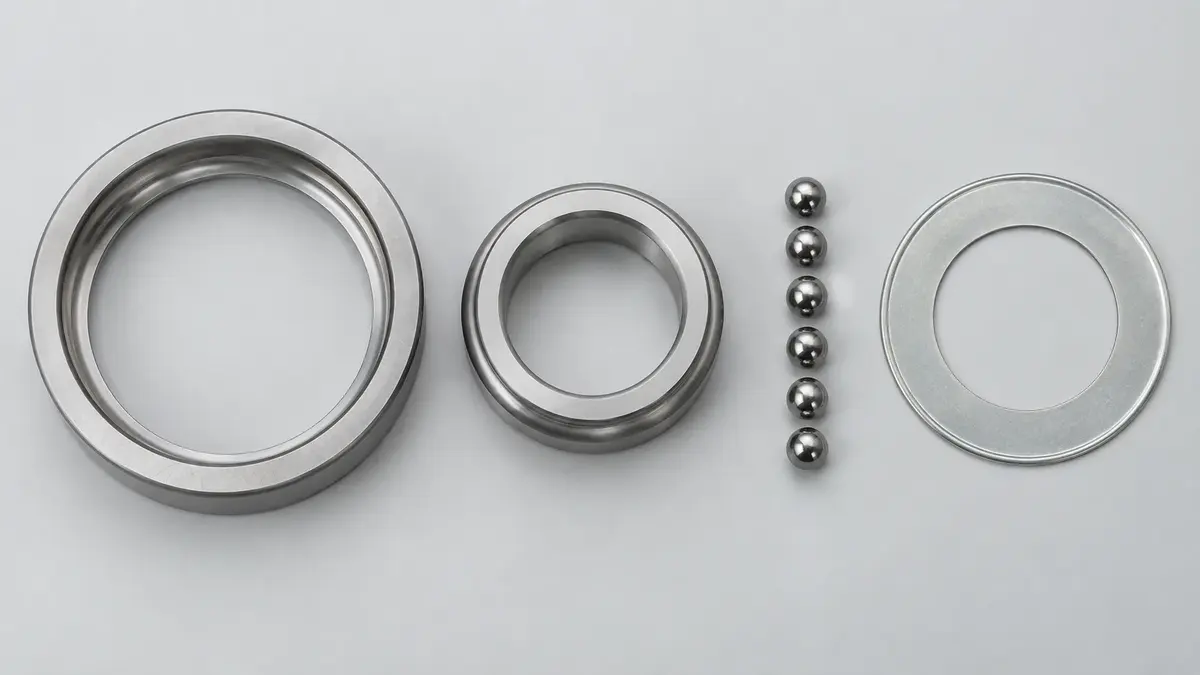
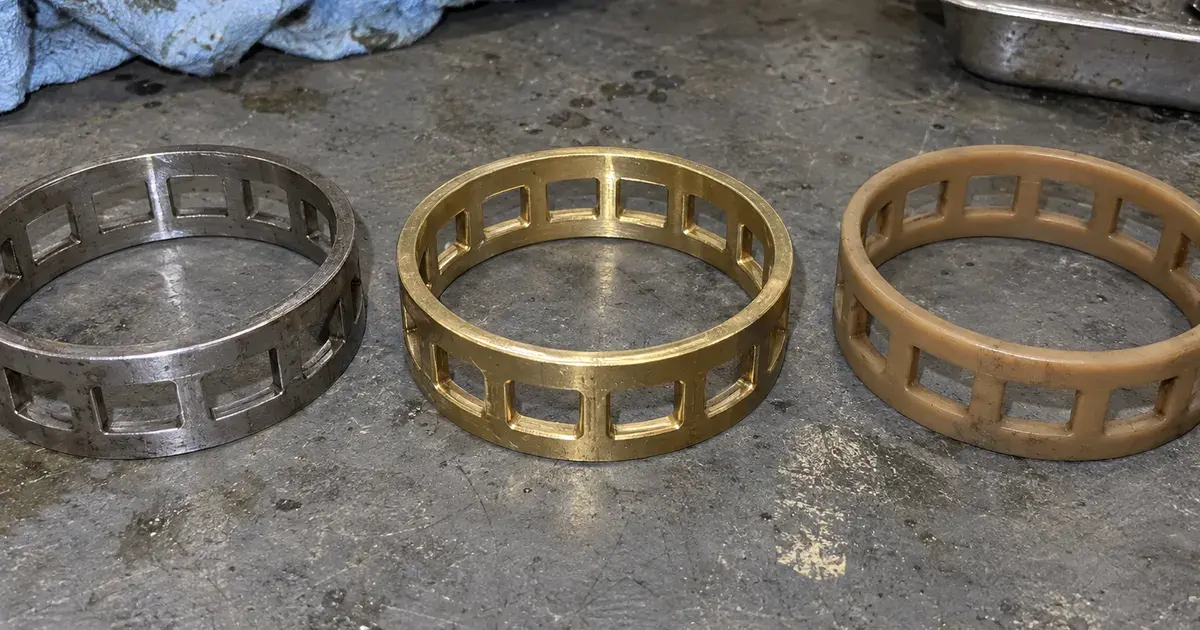
The reason for the split is that the three parts are being asked for three different things. Hardness where the rolling contact is. Corrosion resistance and formability where there is no rolling contact. The cage on a standard capped stainless bearing is a stamped stainless cage, supplied as a ribbon, riveted or snap type, all ball centred. Injection moulded glass fibre reinforced polyamide 66 is available on request (SKF). For what that choice costs at temperature, see our guide to bearing cage materials.
The practical consequence is a purchasing one. A request for quotation that says "stainless, 440C" has specified the balls. It has left the ring grade, the cage grade and type, the shield or seal material, and the grease undefined, and each of those decides something the buyer cares about.
Martensitic, Austenitic, and the Grade That Ends the Tradeoff
Martensitic grades can be hardened for rolling contact and austenitic grades cannot. That single fact explains why 316 is the better corrosion material and the worse raceway material, and why a third family exists to stop forcing the choice.
| Grade | Family | Where it belongs in a bearing |
|---|---|---|
| X65Cr13 | Martensitic | Rings. Finer structure than 440C, so quieter running |
| X105CrMo17 / AISI 440C | Martensitic | Balls, and rings in some sizes. Hardest of the common set |
| AISI 420 | Martensitic | Lower carbon, lower hardness, lower cost. General duty |
| X5CrNi18-10 / AISI 304 | Austenitic | Cages, shields, housings. Not a raceway material |
| AISI 316 and 316L | Austenitic | Chloride service. Raceway only in light load designs |
| X30CrMoN15-1 | High nitrogen martensitic | Rings and balls where corrosion and load both bind |
The ring grade deserves a word, because it is the choice that looks like a downgrade and is not. GRW records that makers of small and miniature bearings moved their rings off 440C at the end of the 1980s. The reason was structure rather than chemistry: 440C's corrosion resistance "is paid for with more-coarse grain structure and with significantly larger carbides", which drives the noise level at that size. X65Cr13's finer structure "combines the corrosion resistance of the 440C steel and the low-noise level of the 52100 chrome steel" (GRW, SV30 stainless steel for ball bearings, from a distributor-hosted copy). The ring grade is a noise decision.
The mechanism behind the tradeoff is chromium availability. Carbon in a hardened martensitic grade precipitates as chromium carbide, which means that chromium is no longer dissolved in the matrix and no longer available to build the passive film. Schaeffler states the requirement from the other direction. Corrosion resistance in the hardened state "is achieved by a high proportion of dissolved chromium in the structure". On that basis it positions X105CrMo17 as "a compromise between corrosion resistance and overrolling resistance" that "increasingly can no longer fulfil the current requirements" (Schaeffler).
Substituting nitrogen for part of the carbon hardens the steel without spending the chromium. That is the whole design logic of X30CrMoN15-1. Its composition runs about 15% Cr and 1% Mo, with 0.15 to 0.35% C and 0.20 to 0.40% N. Carbon plus nitrogen is tuned to 0.60 to 0.80% to reach a minimum of 58 HRC (Hucklenbroich et al., 1999). The metallurgical payoff is carbide size. Carbides in this grade are significantly smaller than in AISI 440C. Under rolling contact fatigue, 440C's larger carbides produce extensively interconnected cracks where the nitrogen grade branches them (Rejith et al., 2024).
It is worth knowing that this grade is now in the standard. ISO 683-17:2023 is edition 4, published on 22 September 2023, and it specifies technical delivery requirements for five groups of bearing steel, one of which is stainless bearing steels. The fourth edition cancels and replaces the 2014 edition, and among its changes it added X30CrMoN15-1. So the answer to "which stainless steels are bearing steels" is a published list, not a supplier preference.
Size changes which of these is the default. At miniature sizes stainless is the normal choice rather than the exception, because so little steel is used that the cost premium nearly vanishes. Our guide to miniature bearings covers that, along with the S, SR and SMR prefixes that mark it. For the wider three-way comparison against chrome steel and ceramic hybrids, see what ball bearings are used for.
One consequence worth stating plainly: an austenitic bearing is a light load bearing. If a design specifies 316 rings, it has accepted a raceway that cannot be hardened, and the load, speed and life figures have to come from a catalogue built for that. 316 earns its place in heavy industry in wet positions where corrosion rather than contact stress is the dominant threat. Our guide to rolling mill bearing materials covers that case for mill duty.
What Does Stainless Actually Cost You?
One column. At a matched envelope, specifying stainless moves the basic dynamic load rating and leaves the static rating, the fatigue load limit and the speed ratings alone or slightly better.
SKF states the general point itself: its stainless deep groove ball bearings "have a lower load carrying capacity than same-sized bearings made of high chromium steel" (SKF). What no comparison page publishes is the size of it. Here are three matched pairs, open against open, from SKF's own tables.
| Envelope | Chrome steel | Stainless | ΔC | ΔC₀ | ΔPᵤ | Δ limiting speed |
|---|---|---|---|---|---|---|
| 10 × 26 × 8 mm | 6000: C 4.75 kN, C₀ 1.96 kN, Pᵤ 0.083 kN, 40 000 r/min | W 6000: C 3.97 kN, C₀ 1.96 kN, Pᵤ 0.083 kN, 40 000 r/min | −16.4% | 0% | 0% | 0% |
| 25 × 52 × 15 mm | 6205: C 14.8 kN, C₀ 7.8 kN, Pᵤ 0.335 kN, 18 000 r/min | W 6205: C 11.7 kN, C₀ 7.65 kN, Pᵤ 0.335 kN, 19 000 r/min | −20.9% | −1.9% | 0% | +5.6% |
| 40 × 80 × 18 mm | 6208: C 32.5 kN, C₀ 19 kN, Pᵤ 0.8 kN, 11 000 r/min | W 6208: C 25.1 kN, C₀ 17.6 kN, Pᵤ 0.75 kN, 12 000 r/min | −22.8% | −7.4% | −6.3% | +9.1% |
Chrome steel figures from current SKF product pages; stainless figures from the SKF stainless catalogue (November 2015). Speeds are limiting speeds for the open bearing. Deltas computed from the two published values.
Two caveats belong with that table rather than in a footnote. First, every chrome steel bearing above is SKF Explorer performance class, which lifts C independently of material, so part of the C delta is performance class and not grade. Second, the two sides come from different publications, fifteen years and one catalogue revision apart. Both caveats bear on the C column. Neither touches C₀, Pᵤ or the speed ratings, which is why those three are the sturdier half of the finding.
Why the penalty lands on C and not on C₀
Because the two ratings are calculated from different things. The basic static load rating under ISO 76 is fixed by a specified contact stress at the most heavily loaded rolling element contact, which makes it a geometry calculation. Identical geometry gives an identical number, and the stainless bearing has identical geometry. The basic dynamic load rating under ISO 281 carries a factor for contemporary material and manufacturing quality on top of the geometry, and that factor is what the grade change moves.
One detail resists the tidy version of this story, and it should be said rather than smoothed. If material quality were the whole explanation, the fatigue load limit Pᵤ would be expected to fall alongside C. At 10 mm and 25 mm bore it does not move at all. Only at 40 mm does it drop, and then by less than the dynamic rating. Treat the mechanism above as the direction of the effect, not a complete account of it.
What a 23% cut in C does to rated life
It roughly halves it. Basic rating life for a ball bearing goes as L₁₀ = (C/P)³ under ISO 281, so multiplying C by 0.836 to 0.772 multiplies rated life by 0.58 to 0.46. In plain terms: at the same applied load, the stainless part reaches 42% to 54% less rated life. Read the other way, holding life constant means cutting the applied load by the same 16% to 23%.
That arithmetic, and not the grade table, is what settles most stainless decisions. If the position is lightly loaded, a 50% life reduction on a life measured in decades is irrelevant and the corrosion resistance is free. If the position is working near its rating, the same reduction is the whole design margin. Our guide to dynamic and static load ratings covers which rating governs which case.
Are Stainless Bearings Slower Than Chrome Steel?
No. In SKF's own tables the open stainless bearing matches or beats its chrome steel equivalent, and the component that actually halves the speed ceiling is the contact seal.
The three open pairs above give 40 000 against 40 000 r/min at 10 mm bore. At 25 mm it is 19 000 against 18 000, and at 40 mm 12 000 against 11 000. Reference speeds behave the same way on the two larger pairs. The stainless bearing is rated 30 000 and 20 000 r/min against 28 000 and 18 000 for the chrome steel part (SKF, read against SKF's product pages for 6205 and 6208). On this evidence the stainless bearing is very slightly the faster part, not the slower one.
The closure tells a different story, and it can be checked inside a single catalogue and a single designation family. W 6208 open is rated to 12 000 r/min. Shielded as W 6208-2Z it drops to 10 000. With contact seals as W 6208-2RS1 it drops to 5 600. Chrome steel 6208-2RS1 also sits at 5 600 (SKF). Same closure, same ceiling, either material.
This matters because the speed claim is where most published grade comparisons go wrong. Comparison tables that rank 440C well above 304 and 316 on speed are comparing product ranges rather than matched parts, and they rarely say which envelope or which closure each figure describes. Hold both constant and the ranking disappears. If speed is the binding constraint, the decision to examine is the closure, which our guide to sealed and shielded bearings treats as its own specification lever.
Where Does a Stainless Bearing Still Rust?
At the shield, at the seat, and in chlorides. Stainless resists corrosion rather than preventing it, and the corrosion that ends a stainless bearing's life often starts somewhere other than the raceway.
Start with the grade itself. Because hardening consumes chromium as carbide, hardened X105CrMo17 has less dissolved chromium available for the passive film than an annealed martensitic or an austenitic grade. In chloride service it therefore pits sooner than 316. Most star tables put 440C ahead of everything on quality and only slightly behind 316 on corrosion, which understates the gap under salt.
The measured comparisons are worth having, each attributed to the party that ran them. Schaeffler reports its Cronitect surface layer reaching about 900 hours in salt spray testing. That is "only slightly lower than that of Cronidur30" and "significantly higher than that of AISI440C or rolling bearing steels with a coating of thin dense chromium". The same paper reports raceway wear under dry running almost twelve times lower than 100Cr6. Rating life at 90% reliability under mixed friction came out higher by a factor of nine than bearings made from AISI 440C or 100Cr6 (Schaeffler). Those are manufacturer test results under stated conditions rather than general ratings, and they should be read that way.
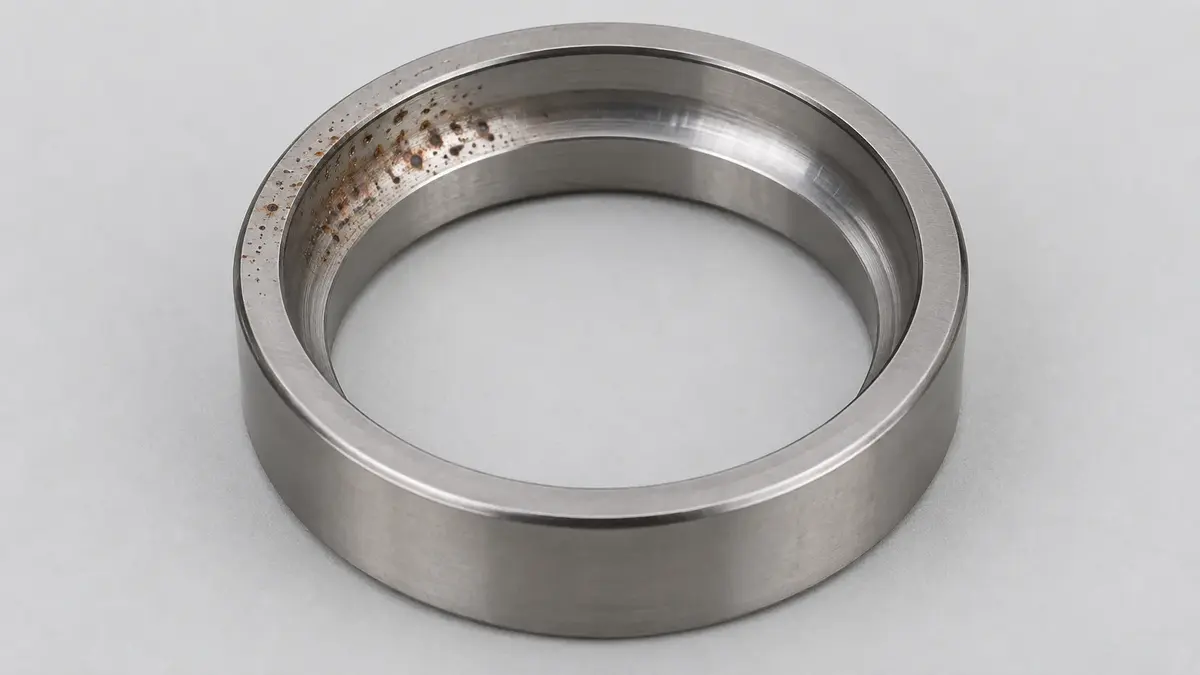
Then the parts that are not the ring. On a capped stainless bearing the shields and cage are austenitic 304, and the seals are nitrile rubber unless specified otherwise. The shaft, the housing and the fasteners are whatever the machine is made of. A stainless bearing pressed into a carbon steel housing still generates fretting corrosion at the seat under micromovement, and no ring grade prevents that. ISO 15243:2017 files it as clause 5.3.3.2, distinct from moisture corrosion at 5.3.2, and our guide to bearing failure modes covers how to tell one from the other on a returned part.
One more case matters for anyone integrating a bearing ring into a stressed structure. Under stress corrosion cracking exposure to the ESA standard, AISI 440C survived only to about 20% of its 0.2% proof stress, against 50 to 75% for Cronidur X30. Both grades are nonetheless graded class 3 for low resistance under ECSS-Q-70-36C (Merstallinger et al., 2023). A hardened stainless ring in tension is not the same proposition as the same ring in compression.
In cost order, the fixes are: closure rating and drainage first, then passivation, then grease selection, then a nitrogen grade, then a hybrid with ceramic balls, then a coating. The expensive options are last for a reason. On a washdown line the housing is part of the same decision, and our guide to flange bearing materials covers where a stainless or composite housing earns its cost.
What Temperature Can a Stainless Bearing Run At?
About 120 °C, and the limit is set by ring stabilisation, seal material and grease rather than by the tempering behaviour of the steel. SKF states that its stainless deep groove ball bearings "are dimensionally stable up to at least 120 °C (250 °F)" (SKF).
Ranges of 300 °C or 350 °C circulate widely for stainless bearings, and they are a category error rather than a disagreement. Those figures describe what the steel tolerates. The catalogue figure describes what the assembled, stabilised, sealed and greased bearing tolerates while holding its dimensions. Specify against the second one. The same confusion runs through the 800 °C claim attached to hybrid ceramics, which our guide to ceramic bearings unpicks.
The grease is where the temperature answer and the compliance answer meet. Standard capped stainless bearings ship filled with LHT23. It is a lithium soap grease on an ester base oil, NLGI consistency class 2 to 3, with a base oil viscosity of 27 mm²/s at 40 °C and 5.1 mm²/s at 100 °C. The food grade alternative VT378 is an aluminium complex soap grease on a PAO base oil, NLGI 2, 150 and 15.5 mm²/s, specified for −25 to +120 °C.
The Food Line execution VP311 pairs blue nitrile seals, coloured for optical detection if a fragment enters the food stream, with a lubricant registered by NSF as category H1. Its FDA approval is to 21 CFR section 177.2600, for rubber articles intended for repeated use in contact with aqueous and fatty foods. The EC approval is to the overall migration requirements of the German BfR recommendation XXI for category 3 materials (SKF).
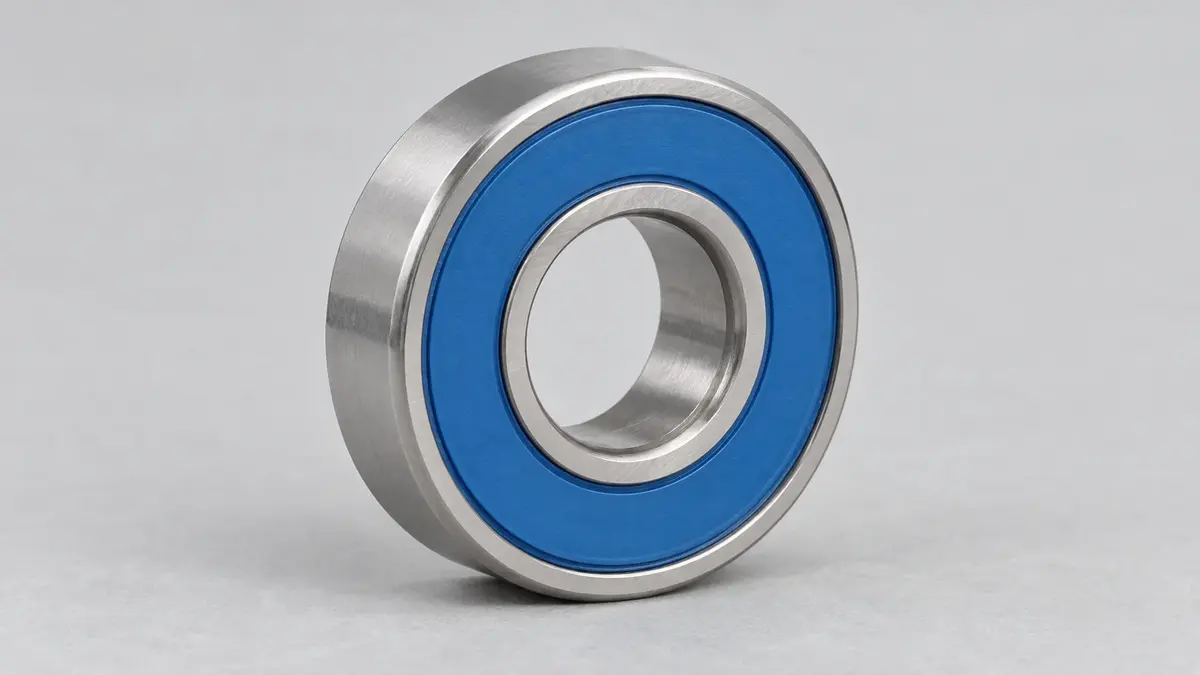
There is a published penalty attached to that compliance, and it is easy to miss. SKF's own note on calculating grease life for VT378 says to work from reference grease MT33 and then multiply the result by 20% (SKF). Since capped stainless bearings are considered maintenance-free for the life of the bearing, that grease life is effectively the bearing's life. Choosing a food grade fill is therefore a relubrication decision as much as a compliance one, a pattern our guide to bearing lubrication develops in general terms.
Which Standards Apply, and Which Editions Are Current?
The same ones that apply to chrome steel bearings, which is what makes a stainless bearing dimensionally interchangeable with a standard one. The catalogue that tells you so, though, cites editions from the 1990s and 2000s.
SKF's stainless catalogue is specific about all four. Metric boundary dimensions conform to ISO 15, except for bearings carrying a WBB1 prefix or an X suffix. Inch series bearings conform to ANSI/AFBMA Std 12.2. Every stainless deep groove ball bearing is manufactured as standard to Normal tolerances corresponding to ISO 492. Radial internal clearance is Normal to ISO 5753, except for bore diameters below 10 mm. Distributors often quote that tolerance class back as P0, which is the DIN 620 code for the same ladder rather than an ISO designation: ISO 492:2023 designates Normal, 6X, 6, 5, 4 and 2. The stainless range covers shaft diameters from 0.6 to 50 mm. The smallest catalogue part, W 618/0.6, is a 0.6 mm bore in a 2.5 mm outside diameter, 1 mm wide, rated C 34 N and C₀ 7 N, with a mass of 20 mg.
The editions cited are ISO 683-17:2000, ISO 15-1998, ISO 492-2002, ISO 5753-1991, EN 10088-1:1995 and ANSI/AFBMA Std 12.2-1992. Three of those have since been superseded: the current versions are ISO 683-17:2023 at edition 4, ISO 15:2017 at edition 4, and ISO 492:2023 at edition 6. Radial clearance moved from ISO 5753:1991 to ISO 5753-1:2009, which remains the published standard with a second edition under development. Read the catalogue's references as the manufacturer's citations at the time of publication, and check the edition yourself before quoting one in a specification.
The designation is the practical takeaway. SKF marks stainless with a prefix rather than a suffix. W is metric, D/W is inch, and WBB1 is a stainless metric bearing not in accordance with ISO dimension series (SKF). The suffixes that follow carry the closure and the compliance. 2Z and 2ZS are shields, 2RS1 a contact seal, 2TS a PTFE seal, and R a flanged outer ring. X marks one boundary dimension that deviates from the standard, and BB1 two or more. VT378 is the food grade fill and VP311 the Food Line execution.
Two of those void a dimensional cross reference outright. A WBB1 prefix and an X suffix both announce that the envelope is not the ISO envelope, so a chart lookup that assumes it will produce a part that does not fit. Our guide to cross referencing bearings across brands treats both codes as stop signs for exactly this reason.
One number surprises people who assume a small bearing is forgiving. Permissible angular misalignment between the inner and outer rings runs between 2 and 10 minutes of arc, depending on operating clearance, size, internal design and the forces acting (SKF). Any misalignment increases noise and reduces service life.
What to put on a stainless bearing enquiry
| Specify | Why it matters |
|---|---|
| Ring grade | Decides hardness, corrosion resistance and noise. "440C" on its own has specified only the balls |
| Ball grade | The hardest component in the bearing, and usually X105CrMo17 whatever the rings are |
| Cage material and type | Stamped stainless or moulded polyamide, and the choice caps operating temperature (cage materials) |
| Shield or seal type and material | Sets the limiting speed and decides whether the bearing survives washdown |
| Grease and its approvals | NSF H1, FDA and EC conformity where there is food contact, and it sets grease life |
| Tolerance class | Normal unless you state otherwise. The P-prefixed codes a distributor quotes are DIN 620, not ISO designations (tolerance classes) |
| Radial internal clearance class | Normal unless you state otherwise, and it changes with fit and operating temperature (clearance) |
| Passivation | A separate finishing step that restores the passive film after grinding, and it is not implied by the grade |
| Magnetic requirement | Martensitic grades are magnetic and austenitic grades are not, so say so if it matters |
How Much Axial Load Can a Stainless Bearing Take?
The same as its chrome steel equivalent by design, and still no more than 0.25 C₀ under pure axial load. SKF publishes both halves of that, and they read like a contradiction until you place them against the general guidance.
The stainless catalogue states that these bearings "have the same axial load carrying capacity as standard SKF deep groove ball bearings". It then says that under purely axial load "this load should generally not exceed the value of 0,25 C₀", with excessive axial load reducing service life. SKF's general deep groove ball bearing guidance puts the ceiling for a standard single row bearing at 0.5 C₀. Three categories are held to half of that: bearings with a bore of 12 mm or under, bearings in diameter series 8, 9, 0 and 1, and stainless steel bearings (SKF).
Read together, the two statements say something more useful than either alone. Stainless is not axially weaker in the sense of a reduced rating. It is grouped with the cases held to the tighter fraction of an identical rating. The governing mechanism is the same one that caps the small and light series. Under high pure axial load the contact ellipse rides up the raceway shoulder, so the failure is geometric rather than a static overload. Our guide to axial and radial load works the ceilings through by bearing type.
Minimum load is the other half of the same conversation, and it is easy to forget on a lightly loaded stainless position. A minimum radial load is always required, estimated from the minimum load factor, the lubricant viscosity at operating temperature, the speed and the bearing mean diameter. Greater loads are needed when starting up cold or with a highly viscous lubricant. Where an arrangement is purely axial, apply preload by adjusting the inner and outer rings against each other or with springs.
When Is Stainless the Wrong Answer?
When load, chlorides or temperature dominates. Corrosion resistance is one lever among several, and reaching for the grade first is what produces bearings that satisfy the material specification and fail anyway.
Load dominated. Run the life arithmetic before the grade comparison. On a position working near its rating, giving up 42% to 54% of rated life to gain corrosion resistance is a poor trade. Better closure, drainage and lubricant selection on a chrome steel bearing would have addressed the moisture directly.
Chloride dominated. Hardened 440C is the wrong tool for salt. The ordered alternatives are a high nitrogen grade, a hybrid with ceramic balls, a coating, or full ceramic. The choice among them depends on load, speed and media rather than on which is most corrosion resistant in the abstract. Note also that the nitrogen grades earn their advantage in specific regimes. X30CrMoN15-1 shows no reported failures by white etching cracks, the mode that ends conventional high carbon bearing steels at as little as 5 to 10% of L₁₀ (Yu, Li and Herbig, 2019).
Temperature dominated. Above roughly 120 °C the stabilisation, the seals and the grease bind before the steel does. Specify for temperature first and treat corrosion resistance as a constraint on the options that remain.
Magnetic requirements. Martensitic grades are magnetic and austenitic grades are not, so an imaging, sensor or instrument application can force an austenitic ring and therefore a light load design. That is the one situation where 316 in a raceway is a considered decision rather than a mistake. It also makes a magnet a reliable field check for which family a part belongs to.
For a stainless bearing on your drawing, send us the corrosion source, the load case, the speed, the temperature range and any food contact or magnetic requirement. Reach the engineering team through the contact page, or start from the deep groove ball bearing range. Verifying that an incoming batch actually meets the grade and tolerance claimed on the order is a separate discipline, covered in our guide to sourcing bearings overseas.
Frequently Asked Questions
What are stainless steel bearings made of?
Usually three grades. SKF produces the rings of its stainless deep groove ball bearings from X65Cr13, the balls from X105CrMo17 (AISI 440C), and the cages and shields from X5CrNi18-10, which is austenitic 304. The grade a listing names is normally the ball grade.
Is 440C or 316 better for bearings?
For a loaded raceway, 440C, because it can be hardened for rolling contact and 316 cannot. For chloride corrosion resistance, 316. If an application needs both, the answer is a high nitrogen martensitic grade such as X30CrMoN15-1 rather than either of them.
Do stainless steel bearings have a lower load rating?
The basic dynamic load rating, yes. At three matched envelopes SKF's open stainless bearings run 16.4%, 20.9% and 22.8% below their chrome steel equivalents. The basic static load rating and the fatigue load limit barely move, and at the smallest of the three they do not move at all.
Are stainless steel bearings slower than chrome steel?
No. Open stainless and open chrome steel bearings of the same size carry the same or slightly higher speed ratings. Contact seals roughly halve the limiting speed, and they do it equally to both materials.
Can stainless steel bearings rust?
Yes. Hardened martensitic grades pit in chlorides because hardening consumes chromium as carbide, and stainless does nothing at all about fretting corrosion at the shaft or housing seat.
What temperature can a stainless steel bearing run at?
SKF rates its stainless deep groove ball bearings as dimensionally stable up to at least 120 °C. Figures of 300 °C and above describe what the steel tolerates, not what the assembled and greased bearing holds.
Are stainless steel bearings magnetic?
Martensitic grades such as 440C and X65Cr13 are magnetic. Austenitic grades such as 304 and 316 are not. A magnet is a reliable way to tell which family a part in the stores belongs to.
The Short Version
- A stainless bearing is normally three stainless steels, and the grade in the listing is usually the one in the balls.
- Specifying stainless moves one catalogue column. C falls 16% to 23%, and the gap widens with size.
- That converts to 42% to 54% less rated life at the same applied load, or the same cut in permissible load.
- The static rating, the fatigue load limit and the speed ratings hold. Speed is set by the closure, not by the steel.
- The ceiling is about 120 °C, and food grade grease costs 80% of grease life.
- Hardening is what makes stainless less stainless, which is why the nitrogen grades exist and why ISO 683-17 added one in 2023.
Send the corrosion source, load, speed, temperature and compliance requirements to our engineering team and we will work the derating with you rather than around it.
About the Author
Jeff Li writes on bearing engineering and global sourcing for ANDE Bearing. He works directly with OEM and aftermarket buyers in automotive, heavy industry, and renewable energy. Connect on LinkedIn.