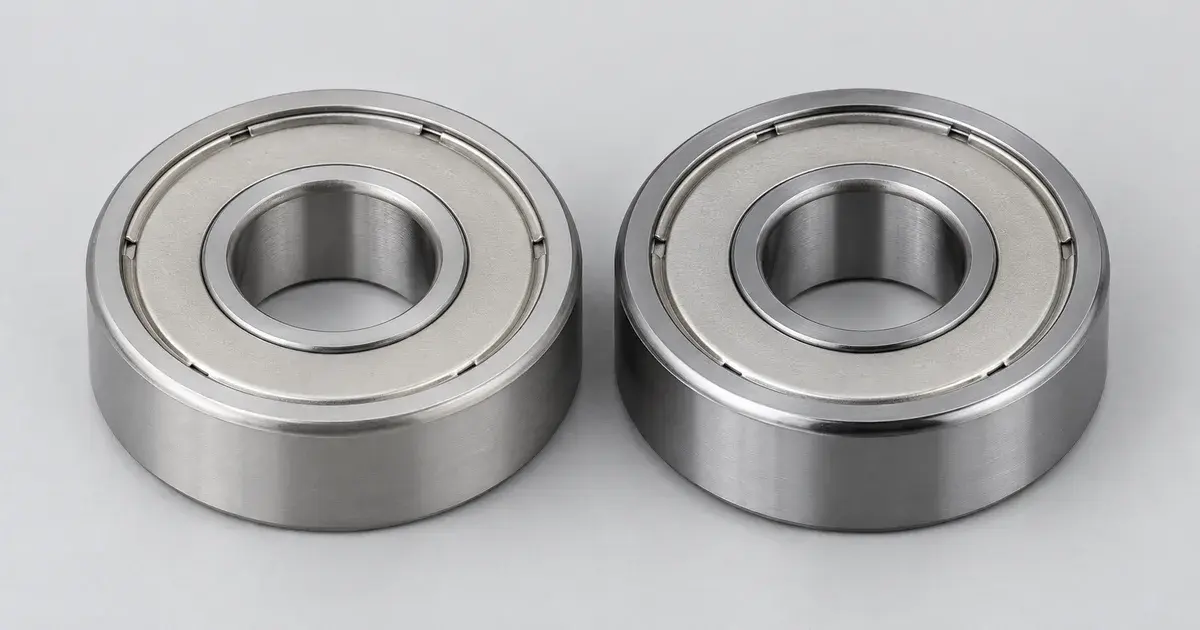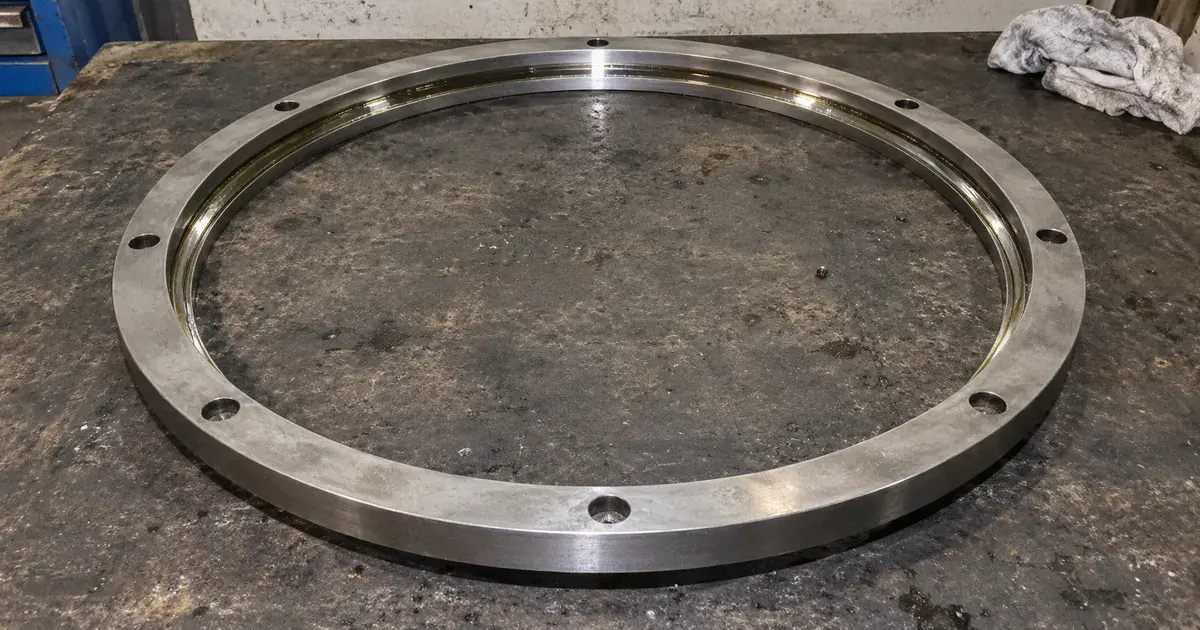
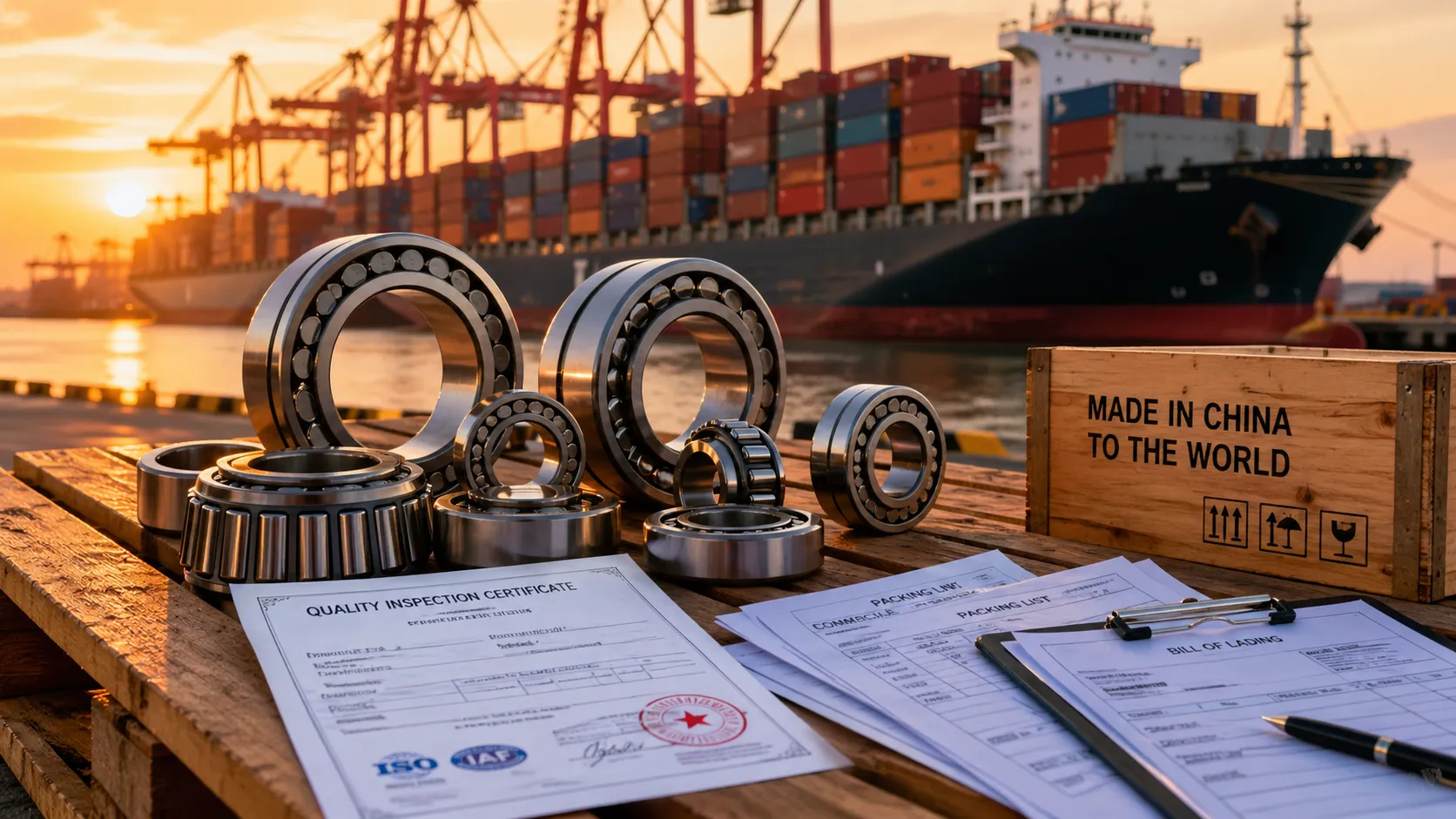
A bearing factory in Jiangsu can hold a bore tolerance of 0 to −8 µm on a 15 mm bore, or it can hold nothing in particular. The designation printed on the box tells you which one you got only if you specified the class in writing and inspected against it on arrival.
That is the real problem in sourcing bearings from China, and it has almost nothing to do with geography. Chinese manufacturers represent one-fourth of the global bearing market (SKF), and China's bearing industry booked ¥231.5 billion of revenue on 33.7 billion units in 2024 (CBIA via People's Daily). The supply base is deep and export-ready. What varies between suppliers is the gap between the tolerance a plant can actually hold and the tolerance your purchase order asked for.
This guide walks the transaction end to end. What belongs on the RFQ, which procurement structure fits your volume, and the five gates that qualify a supplier. Then how to set an acceptance sampling plan before the first container lands, and what the part actually costs once duty and inspection are counted. For rankings, revenue, and who the major Chinese producers are, see our guide to the top bearing manufacturers.
Key Takeaways
- Chinese manufacturers hold one-fourth of the global bearing market, and the top six international makers together hold more than half (SKF). Separately, China is the single largest consuming market at roughly 30% of global demand. Those are two different numbers, and conflating them is where most sourcing articles go wrong.
- Specify the class, not the country. A designation is only enforceable if the tolerance class (ISO 492), clearance group (ISO 5753-1), and boundary dimensions (ISO 15) appear on the purchase order.
- Verify the certificate, don't read the logo. ISO 9001 certificates are searchable by company name or certificate number through IAF CertSearch. One caveat on the accreditation side: IAF ceased operations on 1 January 2026, and Global ACI assumed its role.
- Agree the AQL before the first lot ships. ISO 2859-1:2026 turns a lot size into a sample size and an accept/reject number, so "quality problem" becomes an arithmetic question instead of an argument.
- Unit price is the smaller half of the decision. Freight, duty, customs entry, and inspection routinely add 20 to 30% on top of an FOB price, and the duty line is the one that moves most.
What Belongs on the RFQ Before You Ask for a Price?
A bearing RFQ needs six specifications, and a quote against fewer than six is not comparable to any other quote. Bearings interchange across makers because four ISO standards define the same geometry, capacity, and running accuracy for everyone. ISO 15 sets boundary dimensions and ISO 492 sets tolerance class. ISO 5753-1 sets radial internal clearance, and ISO 281 with ISO 76 set the dynamic and static load ratings.
Those standards are your leverage in a cross-border purchase. They give you a number a third party can measure, which is worth considerably more than a supplier's assurance.
| RFQ line | What to state | Governing standard | If you leave it out |
|---|---|---|---|
| Designation | Full code including suffixes, e.g. 6205-2RS C3 P6 | ISO 15 (boundary dimensions) | You get the maker's default execution, not yours |
| Tolerance class | Normal, 6, 5, 4 or 2 (DIN 620: P0 to P2) | ISO 492:2023 | Quotes arrive at Normal class and look cheap |
| Radial internal clearance | C2, CN, C3, C4 or C5 | ISO 5753-1 | CN is supplied; a press fit then eats the clearance |
| Load rating | Required C and C₀ for your duty cycle | ISO 281, ISO 76 | No basis to compare L₁₀ life between offers |
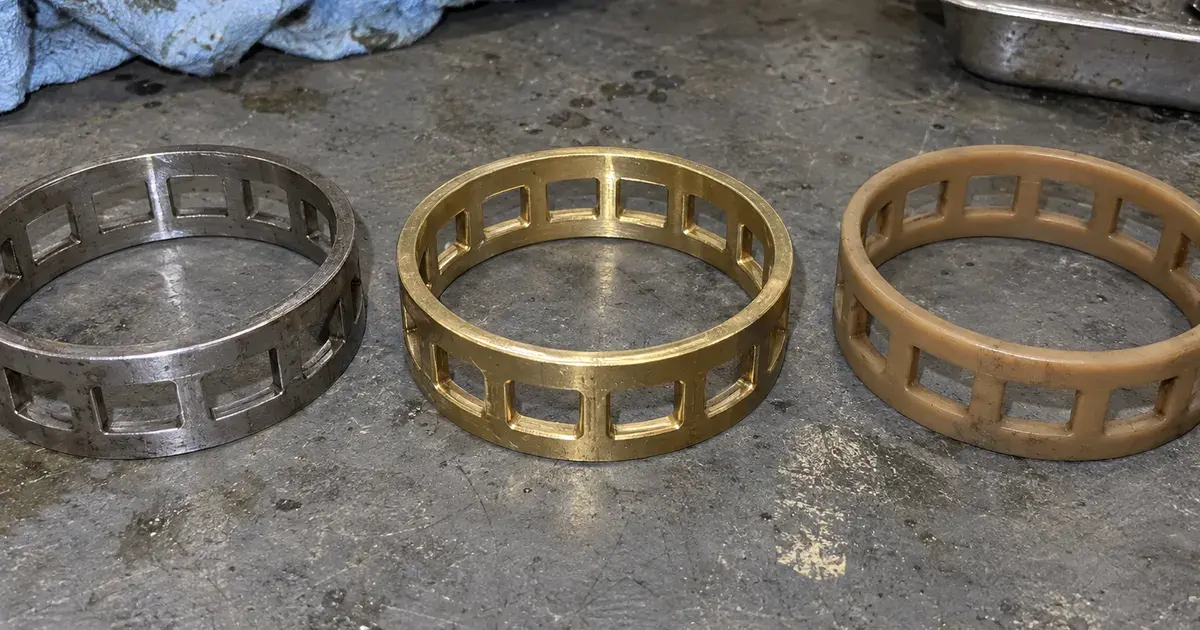
| Cage and seal execution | Material and type, e.g. steel, brass, polyamide; 2RS or ZZ | Maker's catalogue suffix | Speed and temperature limits shift silently |
| Acceptance criteria | AQL, inspection level, and required documents | ISO 2859-1 | Every rejection becomes a negotiation |
Tolerance class is the line buyers skip most often, and it's the one with the widest price consequence. The bore tolerance band tightens roughly fourfold from Normal to P2, and each step up means more grinding passes and tighter process control. Our guide to the ABEC bearing rating carries the class-by-class tolerance table with the ISO and JIS equivalents, and the bearing internal clearance guide gives the micrometer bands for each clearance group.
Most sourcing failures are RFQ failures, not factory failures. When a batch arrives and runs rough, the investigation usually ends at a purchase order that named a bearing number and a quantity, and nothing else. The factory supplied its standard execution, correctly, against an incomplete specification. Adding the tolerance class and clearance group to the RFQ line costs nothing and removes the most common cause of dispute before the first quote arrives.
If you're not sure how to read the suffixes on the part you're replacing, work through our guide to reading a bearing number first, then build the RFQ from the decoded designation.
Which Procurement Structure Fits Your Volume?
Volume and SKU spread decide the structure, not preference. Two models cover almost all cross-border bearing procurement, and the deciding variables are annual quantity per part number and how many part numbers you buy.
Buying factory-direct works when demand is high and stable on a small number of designations. You reach the real pricing tiers, you deal with the engineers who own the process, and batch traceability is a single hop. That same directness turns into friction when your demand is small, mixed, or irregular. You sit below the volume tier, tooling and setup get amortised across too few pieces, and a five-piece line item competes with a container order for attention.
Working through a distributor or a manufacturer's export desk trades a margin layer for consolidation. One order covers several series, stock absorbs demand spikes, and someone else carries the inventory risk.
| Factory direct | Distributor or export desk | |
|---|---|---|
| Best fit | High volume, few designations, stable schedule | Mixed baskets, irregular demand, many series |
| Typical MOQ | Full pricing tiers; setup amortised over volume | Breaks bulk; mixed-SKU orders accepted |
| Lead time | Fixed to the production slot | Buffered by stock on standard items |
| Technical response | Direct to process engineering | Depends on the partner's own engineering depth |
| Traceability | One hop to heat and batch records | Only as good as the records passed through |
| Reassess when | Demand fragments across many series | Volume on one designation justifies going direct |
What the MOQ and lead-time bands actually look like. From ANDE's own order desk: standard catalogue items run a typical MOQ of 50 to 100 pieces. Rolling mill bearings can go as low as 1 to 2 pieces, because the unit value carries a single-piece setup. Standard catalogue lead time is 2 to 4 weeks from order confirmation. Four-row tapered, four-row cylindrical, and backing bearings run 4 to 6 weeks in standard sizes, and 6 to 10 weeks for non-standard or large-bore work. Samples ship in 5 to 7 business days. Those are the bands to test a quotation against.
The practical mistake is locking a structure in and leaving it. Volume moves, and the layer that was economically justified at 200 pieces a year often isn't at 20,000. Revisit the question whenever annual demand on a single designation changes materially.
How Do You Qualify a Chinese Bearing Supplier?
Qualification is five gates, and each one produces a document you can hold up later. Run them in order. The sequence matters because each gate is cheap to fail and expensive to skip, and the cost of discovering a problem rises steeply once a production lot exists.
Step 1 — Verify the certificate, not the logo
Ask for the certificate number and the issuing certification body, then check it in a registry rather than accepting a PDF. A logo on a capability deck proves nothing; an accredited certificate carries a number that resolves to a live record.
ISO 9001:2015 is the baseline quality management system standard, and automotive work adds IATF 16949. Both are searchable by company name or certificate number through IAF CertSearch.
One thing changed recently that most sourcing checklists have not caught up with. The International Accreditation Forum ceased operations on 1 January 2026. Global ACI now holds the former roles of both IAF and ILAC, and runs a single Multilateral Recognition Arrangement in place of the old IAF MLA. The verification route still works. The body standing behind it has a different name, so treat any checklist that stops at "IAF MLA signatory" as out of date.
Step 2 — Send a spec pack, not a part number
Issue the six RFQ lines from the table above as a controlled document, with a drawing where the application is non-standard. Then ask two questions that separate a manufacturer from a reseller: which of these dimensions do you grind in-house, and what steel are you using?
The answer you want on steel is GCr15, the Chinese designation for the through-hardening bearing steel sold elsewhere as AISI 52100 and 100Cr6. Steel quality is the dominant variable in bearing fatigue life, and it is the first place a counterfeit or a corner-cutting supplier economises (NSK). If you're specifying for a mill or another high-load application, our guide to rolling mill bearing materials covers where 52100 stops being the right answer.
Step 3 — Approve samples against the standard
Order samples and inspect them against the specification you issued, not against a general impression of quality. Four checks cover most of the risk:
- Bore, outside diameter, and width measured with a micrometer, not a caliper. A Normal-class bore tolerance is only a few micrometers wide, well below caliper resolution. Our guide to measuring a bearing covers the three-reading method and which limit to check against.
- Hardness, expected at 60 to 64 HRC for through-hardened 52100 or GCr15.
- Residual radial clearance, confirmed against the group you ordered.
- Noise and vibration on a running test, which is where grinding and assembly quality show up even when every dimension passes.
Keep the samples. A retained, labelled sample with its inspection report is the reference you compare against when a later batch drifts.
Ask for the inspection report with the batch ID on it, not a generic certificate of conformity. In our export work the difference shows up immediately. A supplier that can produce the actual measured values for the lot you received, tied to a batch number, is running real in-process inspection. One that can only send a template certificate with your part number typed in is telling you something about its process control, whatever the document says. ANDE ships a certificate of conformity with every order alongside the packing list and commercial invoice. The batch-level measured data is the part that matters for your incoming check.
Step 4 — Set the acceptance sampling plan before the first container
Agree an AQL, an inspection level, and a sample size in writing at the purchase-order stage. ISO 2859-1:2026 does the arithmetic for you. It maps a lot size to a sample size and an accept/reject number, so a disagreement about quality resolves into a count rather than a debate.
A worked example, using general inspection level II and single sampling under normal inspection. For a lot of 501 to 1,200 pieces, the plan gives a sample of 80. At an AQL of 1.0%, you accept the lot on 2 or fewer defectives in that sample of 80 and reject it on 3. Tighten to AQL 0.65% and the same sample of 80 accepts on 1 and rejects on 2.
Two details are worth setting up front. Define what counts as a defective, because dimensional non-conformance, packaging damage, and rust are three different problems with three different owners. Second, note that the third edition of ISO 2859-1, published in 2026, adds skip-lot sampling procedures. That's the structured way to reduce inspection burden on a supplier with a proven record, rather than inspecting every lot forever.
Step 5 — Lock traceability and the corrective-action loop
Require batch or heat traceability on every shipment, and agree the language you'll use when something fails. ISO 15243 classifies rolling bearing damage into defined categories with named causes. That turns a warranty conversation from "your bearings are bad" into a specific claim about surface-initiated fatigue, or moisture corrosion, or whichever mode the evidence actually supports.
That distinction decides who pays. A subsurface fatigue failure at a fraction of calculated L₁₀ life points at the bearing. A wear pattern consistent with contamination or lubricant starvation points at the installation and the maintenance regime. Our bearing lubrication guide and the hot strip mill bearing failure analysis case study both work through how those modes are told apart in practice.
What Does a Chinese Bearing Cost Landed?
An FOB unit price is typically 75 to 80% of what the bearing actually costs you, and the gap is where sourcing decisions are won or lost. Four cost lines sit between the factory gate and your stores: international freight, import duty, customs entry, and inspection. Only one of them is negotiable with the supplier.
Start with classification, because duty follows the code. Ball and roller bearings fall under heading 8482 of the Harmonized System, and the subheading depends on the type (USITC):
- 8482.10 ball bearings
- 8482.20 tapered roller bearings, including cone and tapered roller assemblies
- 8482.30 spherical roller bearings
- 8482.40 needle roller bearings
- 8482.50 other cylindrical roller bearings, including cage and roller assemblies
- 8482.80 other, including combined ball and roller bearings
Get the subheading right before you model landed cost. Duty rates, and any trade-remedy measures layered on top, attach to a specific subheading and origin combination rather than to "bearings" generally. In the United States, Section 301 measures on Chinese-origin goods and their exclusion process are administered by USTR, and rates and exclusions have been modified repeatedly. In the EU, check the current TARIC entry for your CN code. Verify the live rate for your own code and entry date rather than trusting a figure quoted in any article, including this one.
Then fix the Incoterm, because it decides which of those lines you are even quoting. The ICC Incoterms 2020 rules are eleven three-letter terms that allocate tasks, costs, and risks between seller and buyer, in force since 1 January 2020. Three cover most bearing shipments.
| FOB | CIF | DDP | |
|---|---|---|---|
| Export clearance and loading | Seller | Seller | Seller |
| Ocean freight | Buyer | Seller | Seller |
| Marine insurance | Buyer | Seller | Seller |
| Import duty and taxes | Buyer | Buyer | Seller |
| Customs entry | Buyer | Buyer | Seller |
| Risk transfers | On board at origin | On board at origin | At named destination |
The trap in CIF is that risk transfers at origin even though the seller pays freight, so cost and risk part company mid-ocean. DDP puts the whole chain on the seller and produces the one number a procurement system can compare directly. Request it alongside FOB even if you don't intend to buy on it.
Packaging belongs in this conversation too, because a bearing that arrives corroded costs its full landed value and the freight to replace it. Ask what the anti-corrosion specification is: individual anti-rust paper and VCI film inside cartons or wooden cases for ocean freight, with moisture barriers and heavy-duty crating on large mill bearings. Ocean transit is a humid environment for months, and this is a cheap line item to get right.
How Do You Keep Quality Stable Across Batches?
Batch-to-batch consistency, not the first sample, is what determines whether a supplier relationship works. Bearings run for years, so real reliability evidence only accumulates over repeated lots and operating hours. A first article approved against specification proves the factory can hit the number once. The eleventh lot proves the process holds it.
Three practices turn incoming inspection into a drift detector rather than a gate:
- Trend the measured values, not just the accept/reject outcome. A lot that passes at AQL while the mean bore diameter walks steadily toward the tolerance limit is a warning, and it's invisible if you only record pass or fail.
- Define re-qualification triggers up front. A change of steel supplier, a new production line, a grinding equipment change, or a gap of more than a year between orders should all reopen sample approval.
- Use the standard's vocabulary in every claim. Classifying a failure under ISO 15243 forces the conversation onto mechanism and cause, which is where corrective action actually gets designed.
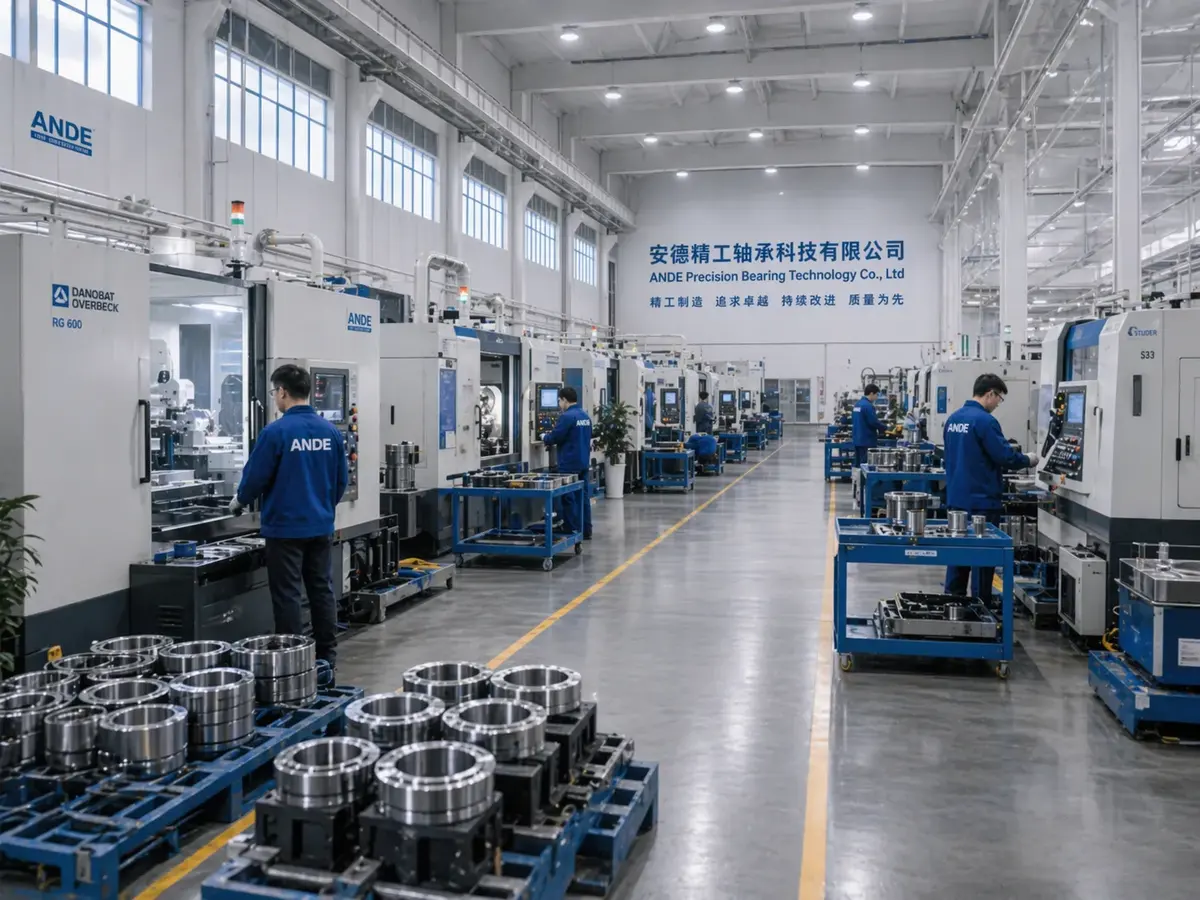
What continuity looks like from the supply side. ANDE ships to buyers in more than 50 countries from a 15,000 m² plant in Jiangyin, Jiangsu, with annual capacity above 200,000 units and precision classes to P5, P4 and P2. Roughly 85% of orders are repeat orders, and over 2,000 tonnes shipped in 2024. That repeat share matters to a buyer for a mechanical reason, not a reputational one. A plant whose volume is mostly repeat business runs the same processes on the same designations continuously, and that is the condition under which batch-to-batch variation stays small.
Switching suppliers repeatedly to chase small unit-price differences resets that clock every time. Each new supplier restarts qualification, restarts the sample library, and restarts the operating-hours evidence you were accumulating. Where a supplier is performing, the more productive move is usually to widen the basket with them and use the leverage on price rather than on the relationship.
Frequently Asked Questions
Are Chinese bearings as good as SKF or NSK?
A bearing that verifiably meets its stated ISO 492 tolerance class and ISO 5753-1 clearance group performs to that specification regardless of where it was made. The variable is verification, not origin. The top six international manufacturers hold more than half of the global market on the strength of consistency, brand assurance, and engineering depth (SKF). Premium branded product stays the right call where failure is expensive and validation budget is short. For standard designations where you can specify the class and inspect the lot, a qualified manufacturer delivers the same measured geometry at a different price. Specify the class, inspect against it, and let the numbers decide.
What MOQ should I expect from a Chinese bearing factory?
For standard catalogue items, expect a typical minimum around 50 to 100 pieces per designation. High-value parts invert this: rolling mill bearings such as four-row tapered and backing bearings can be bought in 1 to 2 pieces, because the unit value carries the setup. Non-standard sizes, special clearances, coatings, or private-label packaging raise the minimum, since each involves tooling or a dedicated run. If a quoted MOQ looks far above these bands for a standard part, it usually signals that you're talking to a trading layer rather than the plant.
How do I verify a Chinese supplier's ISO 9001 certificate?
Ask for the certificate number and the name of the issuing certification body, then look it up in IAF CertSearch, which searches accredited management-system certificates by company name or certificate number. Confirm three things: the certificate is current, the scope covers bearing manufacturing at the site you're actually buying from, and the certification body itself is accredited. One date matters here: on 1 January 2026, IAF ceased operations and Global ACI took over its role and its recognition arrangement.
What lead time should I plan for bearings from China?
Plan 2 to 4 weeks from order confirmation for standard catalogue bearings, and 4 to 6 weeks for standard-size rolling mill bearings. Non-standard or large-bore mill work runs 6 to 10 weeks. Add ocean transit on top, which is weeks rather than days depending on the lane, plus customs clearance at destination. For a first order, add the qualification sequence in front of all of it: certificate check, spec pack, and sample approval typically occupy four to five weeks before a production lot starts.
Do I need a third-party pre-shipment inspection?
For a first production lot from a new supplier, yes. It's the cheapest point at which a systematic problem can still be caught before freight and duty are spent on it. Instruct the inspector against your own AQL and sample size under ISO 2859-1 rather than a generic checklist, and name the dimensional checks that matter for your fit. Once a supplier has a record of lots accepted at your AQL, the standard's skip-lot procedures let you cut inspection frequency in a structured way instead of simply dropping it.
Sourcing bearings from China is a specification and verification exercise wearing the costume of a geography question. The supply base is a quarter of the world market and it is not going anywhere. Four things separate a stable programme from a recurring problem. Whether the tolerance class made it onto the purchase order. Whether the certificate was checked in a registry. Whether an AQL was agreed before the first container. And whether measured values get trended across lots instead of filed.
Get those right and origin stops being the interesting variable. For the parts of this that are engineering rather than procurement, see our guides to rolling mill bearings and bearing internal clearance. You can also browse the product catalogue or contact our engineering team with a specification to quote against.
About the Author
Jeff Li writes on bearing engineering and global sourcing for ANDE Bearing. He works directly with OEM and aftermarket buyers in automotive, heavy industry, and renewable energy. Connect on LinkedIn.