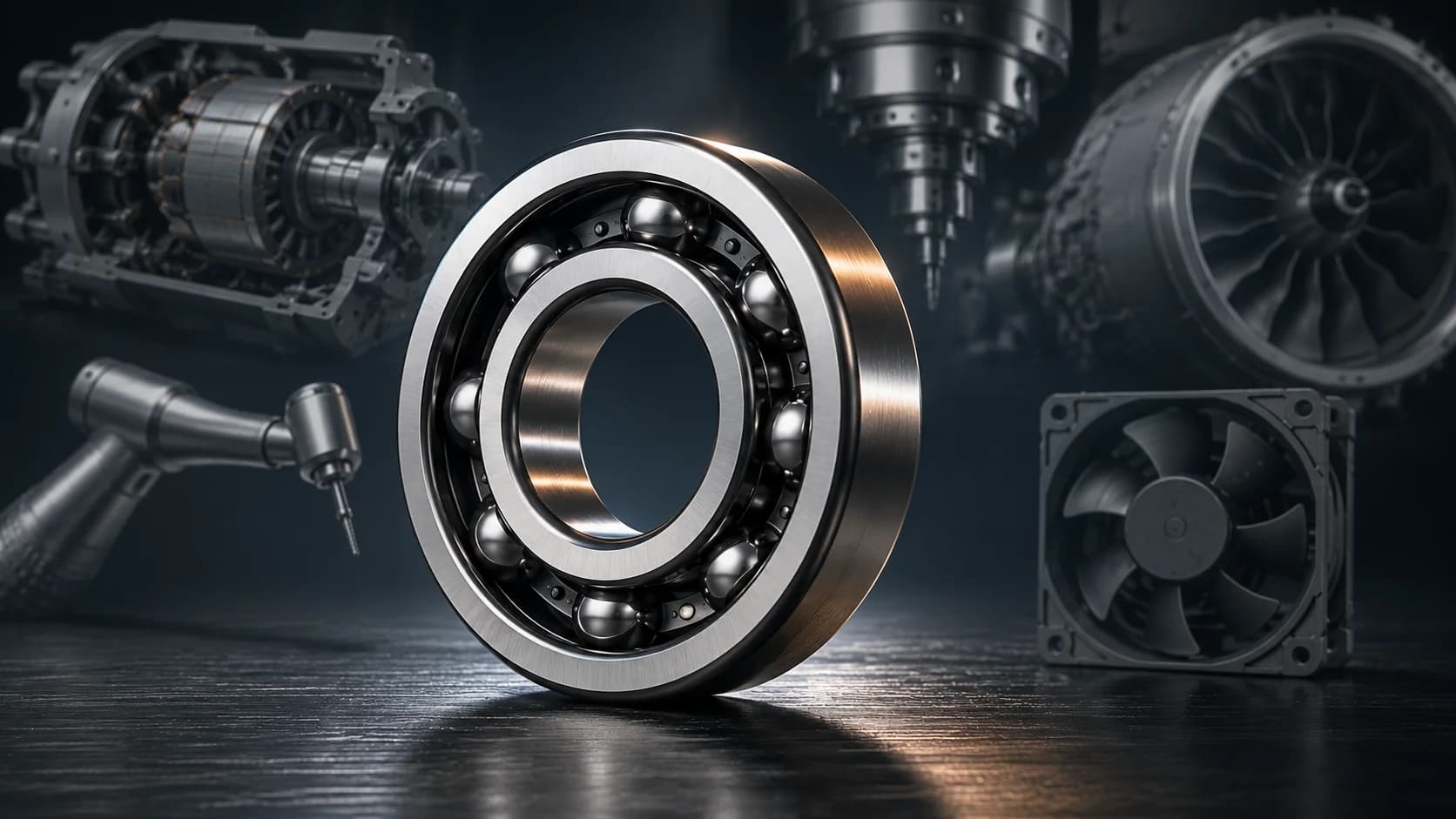
Ball bearings sit at the heart of nearly every rotating machine on earth. They carry the air-turbine dental handpiece that spins at up to 400,000 rpm (NSK), the traction motor in an electric vehicle, and the cooling fan in the laptop on your desk.
This article focuses on where ball bearings are used and how to pick the right one for a given job. For how ball bearings are built and where they sit alongside the roller, plain, and magnetic families, start with our pillar guide on the different kinds of bearings. That guide also carries the L10 life math behind selection. For who actually makes them, see bearing manufacturers.
Key Takeaways
- Ball bearings dominate any rotating application that combines moderate load, high speed, and a small package: motors, pumps, fans, automotive accessories, and most consumer electronics.
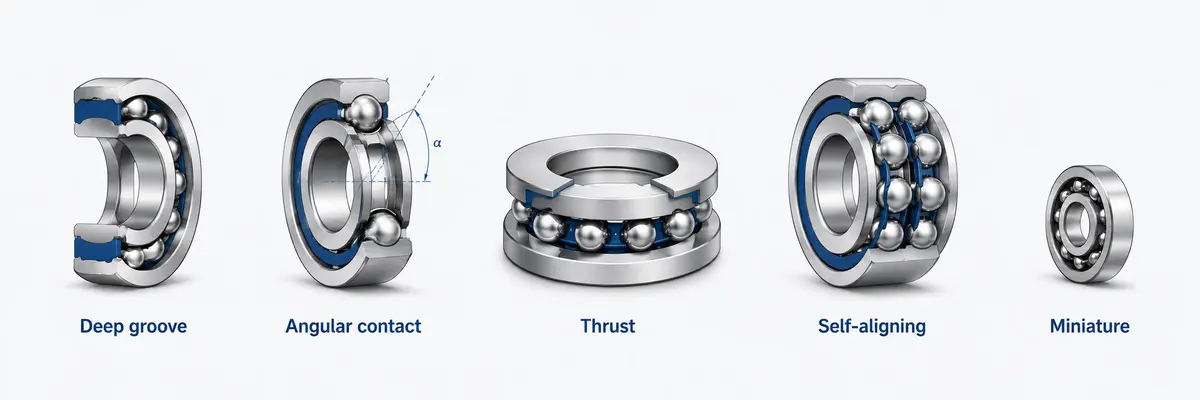
- Five geometries cover almost every commercial use case: deep groove, angular contact, thrust, self-aligning, and miniature.
- Material choice (chrome steel, stainless steel, ceramic hybrid) is driven by environment and speed, not by load alone.
- A ceramic hybrid is not a high-temperature bearing. Its steel rings set the temperature ceiling. The ceramic balls buy electrical insulation and speed.
- Selection reduces to five questions: what load, what speed, what environment, what precision class, and what maintenance plan.
- Lubrication and contamination, not pure fatigue, dominate premature failure (SKF).
What Are Ball Bearings Used For?
Ball bearings appear in every industry that involves rotating machinery, but their share is highest where the application combines moderate load with high rotational speed in a compact envelope. The seven sectors below cover the bulk of global ball bearing demand.
Automotive
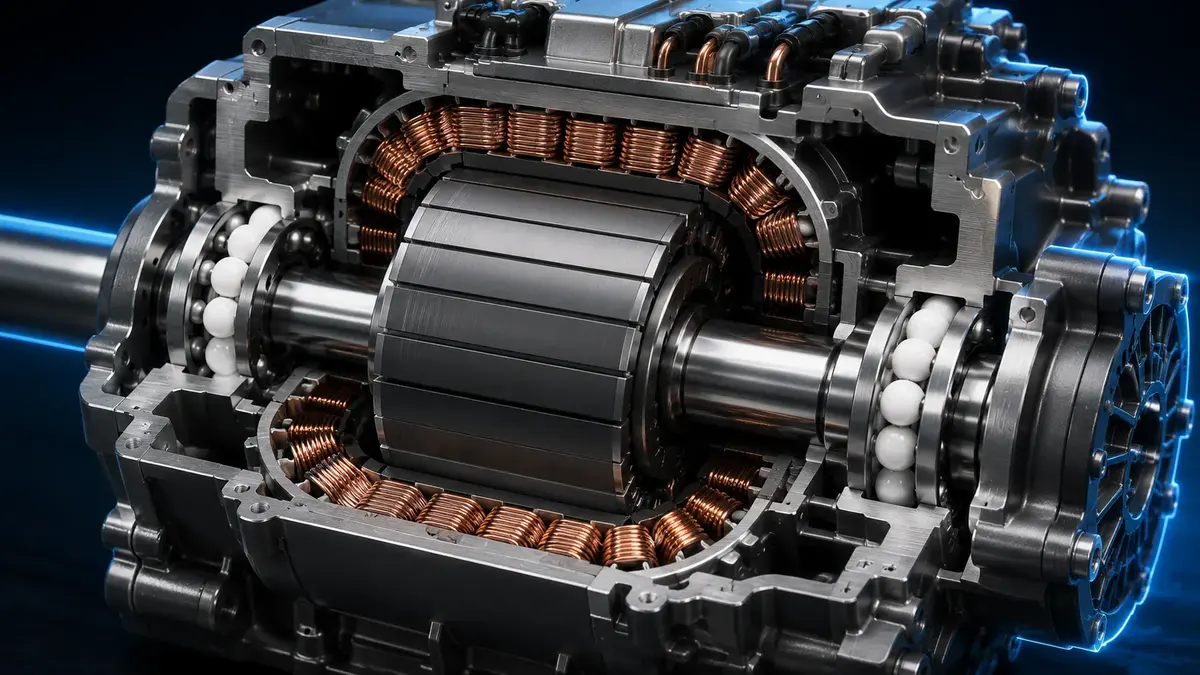
Every modern vehicle uses ball bearings at multiple points. Wheel hub units carry combined radial and axial wheel loads. Transmission and differential shafts run on deep groove bearings, often paired with tapered rollers. Alternators, water pumps, A/C compressors, and starter motors all contain ball bearings that endure vibration, temperature swings, and years of continuous duty. Electric vehicle traction motors are driving rapid adoption of ceramic hybrid bearings. The ceramic balls insulate against the inverter-induced shaft currents that erode conventional steel raceways (Schaeffler).
Industrial Machinery and Manufacturing
Electric motors, the backbone of industrial production, almost universally run on deep groove ball bearings. CNC machine tool spindles use precision angular contact bearings to maintain micron-level accuracy during high-speed cutting. Conveyors, packaging lines, and industrial fans all depend on reliable bearing performance for uptime. For heavy mill applications where ball bearings would be overloaded, see how four-row tapered or cylindrical roller bearings take over.
Aerospace and Defense
Bearings used in aircraft must be extraordinarily reliable. Mainshaft bearings in commercial turbofan engines run hot and fast, and high-end designs increasingly use silicon nitride ceramic balls. Silicon nitride's low density cuts weight and inertial forces, which is what allows the higher speeds (SKF). Gyroscopes and inertial navigation systems use ultra-precision miniature bearings.
Medical and Dental Devices
Air-turbine dental handpieces spin at up to 400,000 rpm (NSK). Miniature precision ball bearings make that possible, and the same bearing has to let the tool stop completely before it leaves the patient's mouth. Surgical robots, MRI and CT gantries, and lab centrifuges all rely on specialised bearings.
Consumer Electronics and Appliances
Hard-disk drives historically used ball bearings, then transitioned to fluid dynamic bearings for near-silent operation. Cooling fans in laptops, servers, and gaming PCs use miniature ball bearings rated for tens of thousands of hours. Washing machines, vacuum cleaners, blenders, and power tools are everyday examples.
Robotics and Automation
Modern robotic arms need precise, repeatable positioning across millions of cycles. Crossed roller bearings and precision angular contact ball bearings dominate joint designs. Crossed roller units are a roller type rather than a ball type, but they share the joint with angular contact balls often enough to be worth naming here.
Recreational and Sporting Equipment
Skateboard and inline-skate wheels use ABEC-rated ball bearings, typically ABEC-3 to ABEC-7 (ANSI/ABMA 20-2025). Bicycle hubs, bottom brackets, and headsets use cup-and-cone or cartridge bearings. Even fishing reels run on miniature corrosion-resistant bearings for smooth line retrieval.
The Five Ball Bearing Types You'll Actually Specify
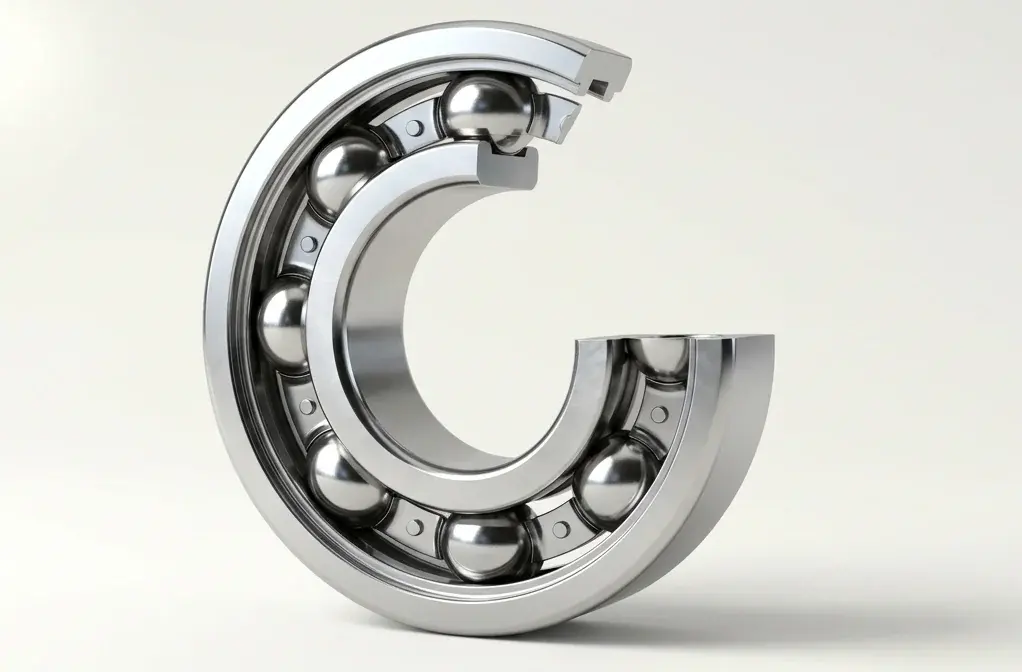
Five geometries cover the vast majority of industrial and commercial ball bearing applications. Each is built around a specific combination of load direction, speed, and misalignment tolerance. For a fuller breakdown of how each type works, see the ball bearing section in our pillar guide.
| Type | Load Direction | Max Speed | Misalignment Tolerance | Where You'll See It |
|---|---|---|---|---|
| Deep groove | Radial + moderate axial | Very high | Low | Motors, pumps, fans |
| Angular contact | Combined radial + axial | High | Low | Machine spindles, wheel hubs |
| Thrust | Axial only | Moderate | None | Steering columns, crane hooks |
| Self-aligning | Radial + light axial | Moderate | High (series dependent) | Conveyors, agriculture |
| Miniature | Radial + light axial | Very high | Low | Dental drills, drones, HDDs |
A few practical notes most catalog tables skip:
- Deep groove is usually the default starting point. If a deep groove bearing meets the load and speed requirement, the cost and availability advantage is hard to beat. Browse the full deep groove ball bearing range.
- Angular contact bearings are almost always installed in matched pairs (back-to-back, face-to-face, or tandem) so axial load can be carried in both directions and the assembly preload is controlled. See our angular contact product line.
- Thrust ball bearings are pure-axial only. Mounting them on a shaft that sees any meaningful radial load is one of the more common selection errors we see on returned bearings.
- Self-aligning ball bearings accommodate both static and dynamic misalignment (SKF). The permissible angle varies with the series and the sealing, so take it from the specific bearing's catalogue data rather than a blanket figure. The trade-off is lower load capacity than spherical roller bearings, which solve the same misalignment problem at higher load. Our self-aligning ball bearing series shows the operating envelope.
- Miniature bearings (down to 1 mm bore) are about precision and noise, not load. ABEC tolerance class matters here in a way it usually doesn't elsewhere.
Ball Bearing Materials: How Material Choice Drives Life
Material is driven by environment and speed first, then load. Three material families cover the commercial market. For a much deeper treatment of bearing steels, including how through-hardened 52100 compares with case-carburized M50NiL for extreme loads, see our companion guide on rolling mill bearing materials.
| Material | Hardness | Corrosion Resistance | Max Continuous Temp | Best For |
|---|---|---|---|---|
| Chrome steel (SAE 52100) | 60–64 HRC rings, 60–67 balls | Low | ~120°C at standard stabilisation | General industrial, automotive |
| Stainless steel (AISI 440C) | 58–62 HRC rings, 58–65 balls | High | ~120°C at standard stabilisation | Food, marine, medical, washdown |
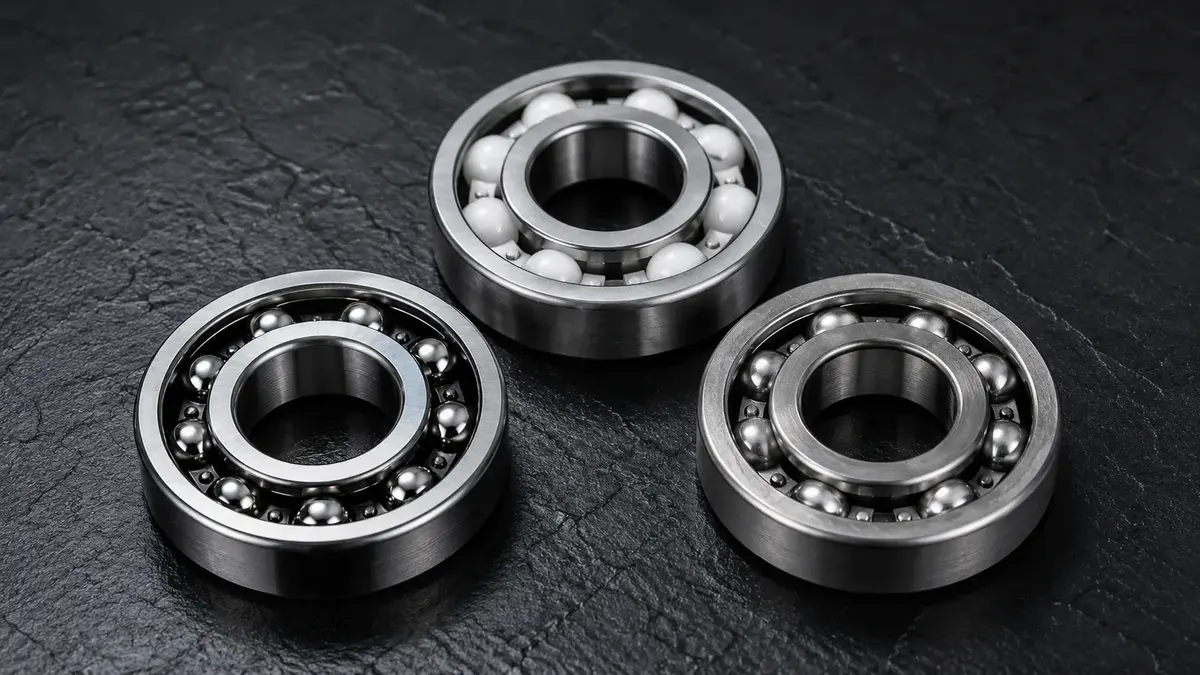
| Ceramic hybrid (Si3N4 balls, steel rings) | Balls 75–80 HRA | Balls immune, rings unchanged | Set by the steel rings, not the ceramic | EV traction motors, high-speed spindles |
Ring temperature limits come from how the steel was heat stabilised, not from the alloy alone, so read the permissible operating temperature off the specific bearing's catalogue data before committing.
Ceramic hybrid bearings put silicon nitride balls in rings made of bearing steel (SKF; Schaeffler). They are lighter, run cooler at speed, add stiffness, tolerate contamination better, and insulate electrically, which is what prevents inverter-induced bearing currents in EV traction motors.
Two things a hybrid is not. It is not corrosion-proof, because the steel rings still corrode and still need sealing or a stainless grade. And it is not a high-temperature bearing, because those same steel rings cap the operating range. Bearing-grade silicon nitride is good to roughly 800°C, but you only get that in a full ceramic bearing with ceramic rings as well as ceramic balls, covered in our pillar guide. Specifying a hybrid for a hot application on the strength of the ceramic's capability is a real and recurring mistake. The cost premium over chrome steel is real but shrinking.
How Do I Choose the Right Ball Bearing?
Choosing the wrong ball bearing isn't only a service-life problem. It can mean unplanned downtime, damaged equipment, and lost production. Selection comes down to five questions, asked in order:
- What's the load type and direction? Predominantly radial means deep groove. Combined radial-plus-axial means angular contact, mounted in DB, DF, or DT pairs to set preload and carry thrust in both directions. Pure axial means thrust.
- What's the speed? Higher speeds demand bearings with lower friction and better lubrication. Check the bearing's DN value (bore diameter in mm × rpm) against the manufacturer's grease or oil limit.
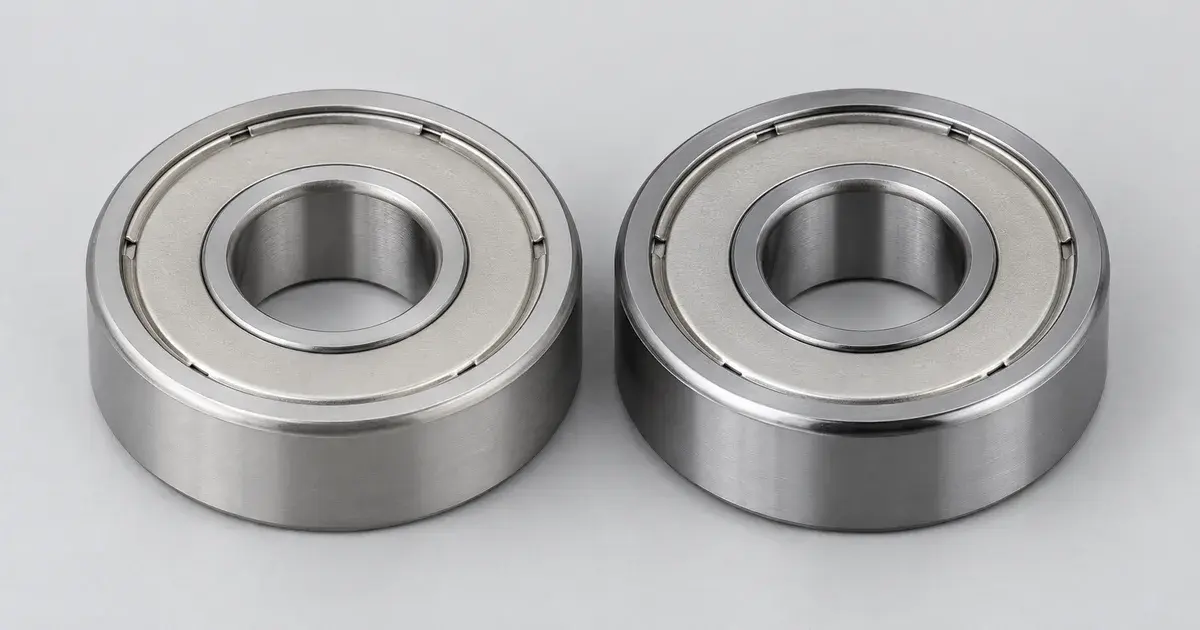
- What's the operating environment? Moisture, dust, chemicals, and extreme temperature drive material choice (52100, 440C, ceramic) and seal type (open, shielded, or sealed-for-life 2RS).
- What's the precision grade? Standard applications use ABEC-1 or ABEC-3 per ANSI/ABMA 20. Machine tools and aerospace may require ABEC-7 or ABEC-9.
- What's the maintenance plan? Sealed (2RS) bearings come pre-greased and are maintenance-free. Open or shielded (ZZ) bearings allow re-lubrication for long-service applications. Our sealed vs shielded bearings comparison has the speed, temperature, and service-life data behind this trade-off.
When in doubt, run the L10 life calculation per ISO 281 against the manufacturer's basic dynamic load rating (C). It's common practice to oversize C by 20–30% to extend service life beyond the design minimum.
FAQ
Q: What are ball bearings used for in everyday life?
Ball bearings appear in nearly every rotating product around you: car wheels and alternators, washing machine drums, vacuum motors, laptop and server cooling fans, refrigerator compressors, electric scooters, skateboards, fishing reels, dental drills, and drone motors. Anywhere a shaft spins under moderate load at moderate-to-high speed, a ball bearing is the most likely component carrying that motion.
Q: Are ball bearings the same as roller bearings?
No. Ball bearings use spherical rolling elements and contact the raceway at a point, which gives lower friction and higher allowable speed but lower load capacity. Roller bearings use cylindrical, tapered, or barrel-shaped elements and contact the raceway along a line. That line contact carries substantially more dynamic load than an equivalent ball bearing, but at lower speed. The pillar guide explains the trade-off in detail.
Q: Why do EV motors increasingly use ceramic hybrid ball bearings?
EV traction motors run at high speeds and are driven by variable-frequency inverters that can induce shaft currents capable of pitting the raceways of conventional steel bearings. Silicon nitride balls are electrically insulating, which breaks the current path and prevents that electrical erosion (SKF). Their low density also cuts inertial forces, so the bearing tolerates higher speed.
Q: Can a ceramic hybrid bearing run at high temperature?
Not on the strength of the ceramic alone. A hybrid has silicon nitride balls but rings made of bearing steel (Schaeffler), so the steel rings and the lubricant set the temperature ceiling, exactly as they would in an all-steel bearing. The roughly 800°C figure often quoted for bearing-grade silicon nitride applies to full ceramic bearings, which have ceramic rings too. Check the catalogue temperature rating for the specific hybrid part, not the material data sheet for Si3N4.
Q: Do ABEC ratings tell me how good a ball bearing is?
No. ABEC, defined in ANSI/ABMA 20, measures dimensional and rotational tolerances only, not load capacity, surface finish, internal clearance, lubricant, or noise. A high ABEC rating is meaningful for high-precision spindle applications but is not a quality marker for general-purpose bearings, where internal geometry and lubrication matter much more.
Q: How long should a ball bearing last in a typical industrial motor?
Bearing life is rated using the L10 concept from ISO 281, the operating hours at which 90% of identical bearings under identical conditions are still running. A properly selected and lubricated ball bearing in a standard industrial motor typically lasts 20,000 to 50,000 hours. Lubrication problems and contamination dominate premature failure, well ahead of pure fatigue (SKF). Our bearing failure guide breaks the causes down by ISO 15243 mode.
Q: When should I switch from a ball bearing to a roller bearing?
When sustained radial or combined load exceeds what a deep groove or angular contact ball bearing can carry within an acceptable envelope, or when shock loading is expected. Heavy industrial applications such as rolling mills, mining gearboxes, and large pumps almost always run on roller bearings. See our hot strip mill bearing failure analysis for a worked example of why ball bearings are not used in mill stands.
Match the Bearing to the Job
Ball bearings are one of the most consequential mechanical inventions of the industrial era: small, precise, and easy to overlook until they fail. Whether you're specifying bearings for a new machine, troubleshooting premature failure, or sourcing replacements for a maintenance overhaul, the answer starts with five variables. Load direction, speed, operating environment, precision class, and maintenance plan.
Ready to find the right bearing for your application? Browse our ball bearing product range, explore the broader ANDE Bearing catalog, or contact our engineering team for technical consultation.
About the Author
Jeff Li writes on bearing engineering and global sourcing for ANDE Bearing. He works directly with OEM and aftermarket buyers in automotive, heavy industry, and renewable energy. Connect on LinkedIn.