Most engineers searching "bearing flange" are actually looking for two different things, and confusing them is the fastest way to order the wrong part. One is a flanged housing unit: a ball bearing pre-fitted into a cast housing with a bolt-on flange. The other is a flange on the bearing itself: a flanged outer ring on a ball bearing or a sleeve bushing. This guide is mostly about the first. That's what 90% of the queries mean, and where the costly mistakes happen.
These units exist for one reason: to let you bolt a bearing to a surface that faces the shaft, where a pillow block simply won't fit. Two standards define what you are buying. The insert bearing follows ISO 9628, and the cast or pressed housing around it follows ISO 3228, which covers "plummer block housings, flanged housings and take-up housings" (ISO 3228:2013).
Key Takeaways
- A flange bearing mounts perpendicular to the shaft via a bolt-on housing face. Use it where there's no horizontal base to seat a pillow block (conveyor ends, fan housings, gearbox cheeks).
- Flange types are coded by flange shape: UCFL (oval 2-bolt), UCFB (round 3-bolt), UCF (square 4-bolt), and UCFC (round 4-bolt).
- Cast iron is the default housing material. Choose an alternative for the environment, not the load: only composite housings cap operating temperature (−20 to +80 °C), while cast iron, pressed steel and stainless housings do not limit it at all (SKF).
- Choose flange vs pillow block by mounting plane, not preference. The bolting face decides the housing, and the housing decides the unit.
What Is a Flange Bearing?
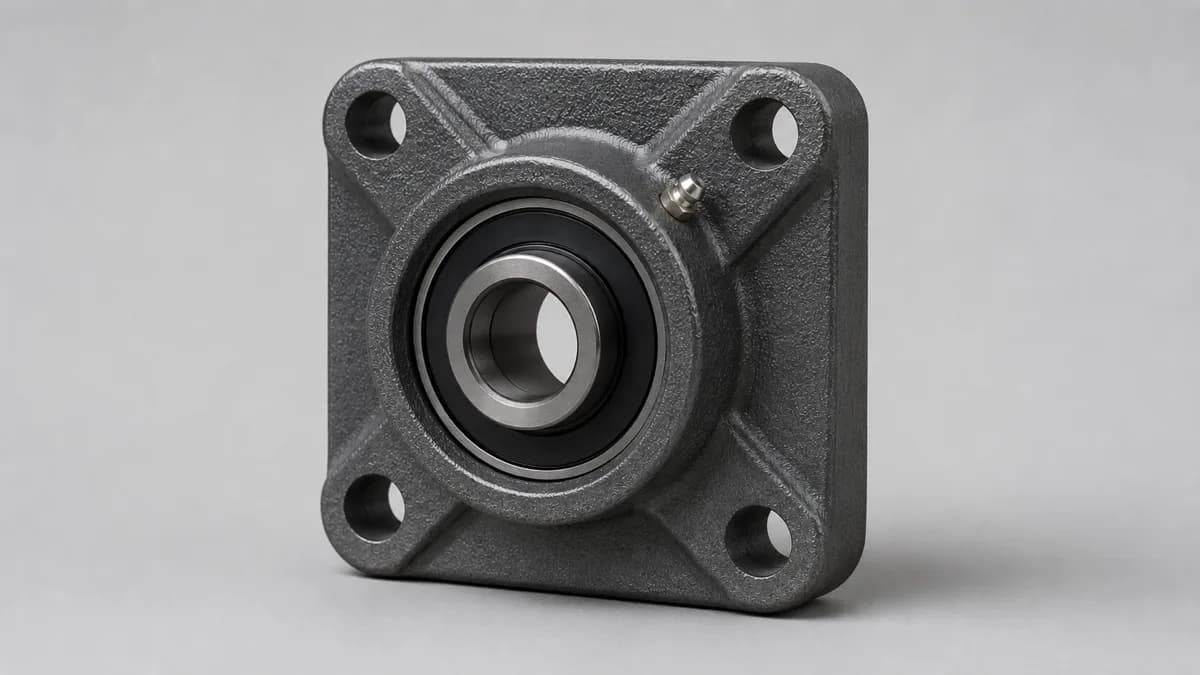
A flange bearing is an insert (ball) bearing seated in a housing whose mounting face sits perpendicular to the shaft axis, so you bolt it to a vertical or end wall rather than a horizontal base. That perpendicular mounting plane is the entire reason the part exists.
Think about where you'd use one. A conveyor's head and tail pulleys terminate at end plates that face the shaft. A fan or blower bolts its bearing to the scroll wall. In both cases there's no horizontal surface to sit a pillow block on. But there's a flat face square to the shaft, and that's exactly what a flange unit bolts to.
Structurally, a flange unit has four parts: the insert bearing (a deep-groove ball bearing with a spherical outer surface and an extended inner ring), the cast housing with its bolt-hole flange, an integral seal on each side, and a locking method that fixes the inner ring to the shaft. ANDE manufactures the deep-groove ball bearing inserts that sit at the heart of these units. The rolling element is doing the work; the flange just holds it in the right plane.
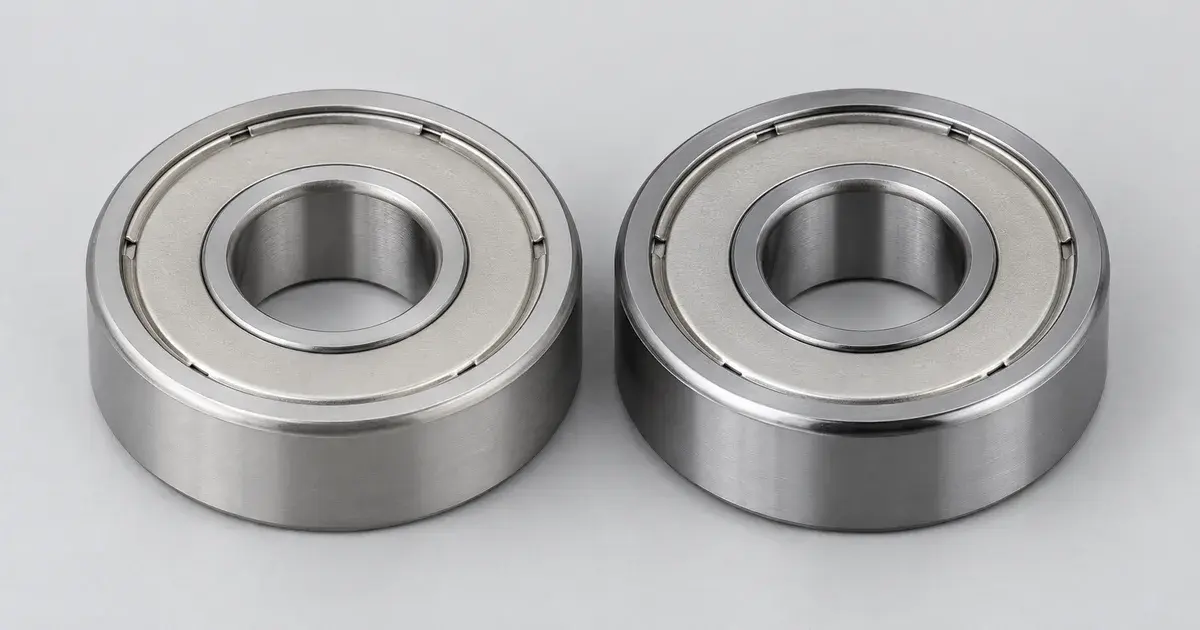
Here's the disambiguation that trips people up. A "flanged ball bearing" can also mean a small bearing with a flange machined onto its outer ring (common in miniature and instrument sizes, where the flange locates the bearing axially in a bore). And a "flanged bushing" is a plain sleeve bearing with an integral thrust collar and no rolling elements at all. Same word, three different parts. The rest of this guide covers the mounted housing unit unless stated otherwise.
What Are the Types of Flange Bearings?
Flange bearings are classified by the shape of the flange and the number of mounting bolts, and each shape carries a standard designation prefix. The four common types are oval 2-bolt (UCFL), round 3-bolt (UCFB), square 4-bolt (UCF), and round 4-bolt (UCFC). Flange units are the default whenever the mounting face turns to meet the shaft.
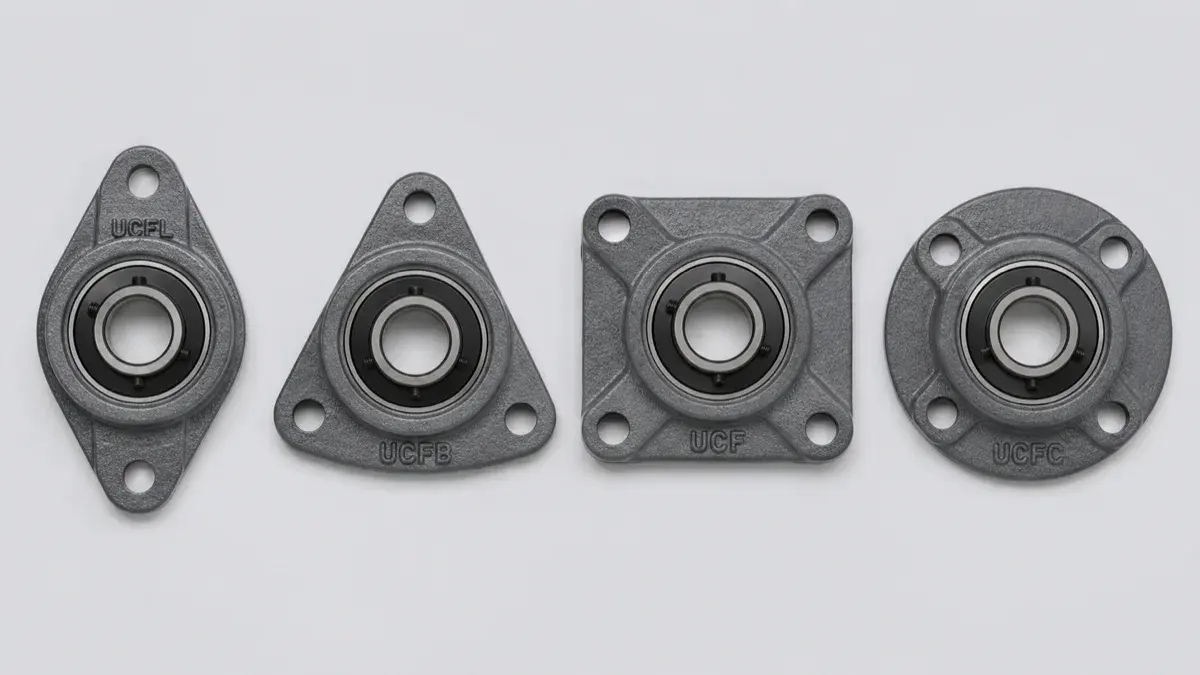
Why so many shapes? Each trades footprint against rigidity. A 2-bolt oval flange is compact and cheap but only resists load along the bolt axis well. A square 4-bolt flange is the rigid workhorse: four bolts in a square pattern resist moment loads from any direction. The 3-bolt triangular flange splits the difference: nearly the rigidity of four bolts in a smaller, lighter casting.
| Designation | Flange shape | Bolt holes | Best for |
|---|---|---|---|
| UCFL | Oval / diamond | 2 | Tight spaces, light-to-moderate loads, light frames |
| UCFB | Round (triangular bolt pattern) | 3 | Balanced rigidity in a compact, low-cost casting |
| UCF | Square | 4 | Maximum mounting rigidity; moment loads from any direction |
| UCFC | Round | 4 | Rigid mount where a round housing clears better than a square one |
There's one more distinction competitors rarely explain: piloted versus non-piloted flanges. A piloted flange has a raised circular boss (a pilot, or spigot) machined on the mounting face that drops into a matching counterbore in the mating surface. It locates the unit concentrically before the bolts are even snug. That's critical when two flange units share a shaft and must stay coaxial. A non-piloted flange has a flat face and relies entirely on the bolts and your alignment skill. If your application demands repeatable concentricity, specify piloted.
Worth knowing: the "UC" prefix means the insert, a deep-groove ball bearing with a wide inner ring and set-screw or collar locking. The letters after it describe the housing. So "UCF" reads as "UC insert + F flange (square)," and "UCFL" as "UC insert + FL flange (oval)." Decode the housing letters and you can identify almost any mounted unit on sight.
What Do UCF, UCFL & UCFC Codes Mean?
The designation system is a stack of letters where each position describes one feature, so you can read a unit's entire configuration from its code. Reading left to right: UC is the insert bearing type, the F family of letters describes the flange housing, and a trailing number gives the shaft size. The interchangeability comes from a three-part JIS family that most Asian and global manufacturers share: JIS B 1558 dimensions the insert bearing, JIS B 1559 the cast and pressed housing, and JIS B 1557 the combination of the two as a unit. That is why a UCF207 insert from one maker fits a UCF207 bore from another.
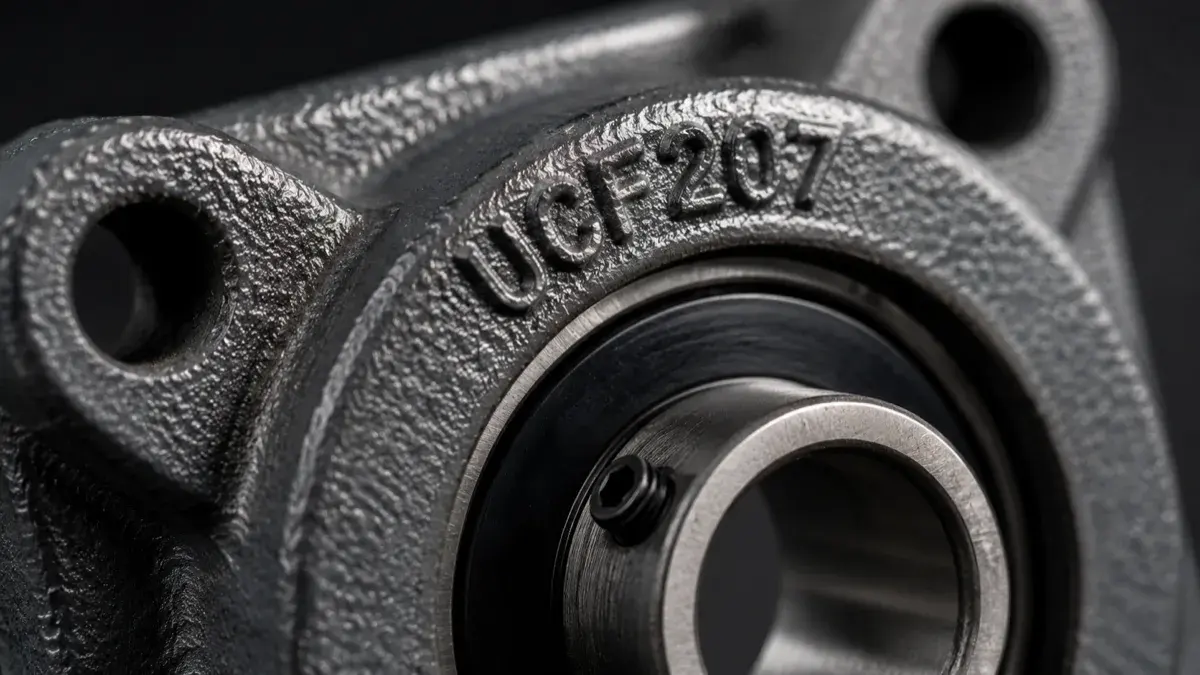
Break down a typical code like this:
- UC: insert ball bearing, wide inner ring, usually set-screw locking
- F: flange housing
- L: oval (2-bolt) flange; C: round (4-bolt); B: round 3-bolt; no extra letter means square (4-bolt)
- Number: bore size code (see the next section)
The locking method often shows up as a separate prefix or suffix, and it matters as much as the flange shape. Three methods dominate. A set screw uses two grub screws in the inner-ring extension: simple, cheap, and rated by SKF for both constant and alternating directions of rotation. An eccentric locking collar cams against the inner ring over a wider area. SKF intends it for a constant direction of rotation (SKF), while Timken claims its own reduced-offset design holds even in reversing service (Timken). An adapter sleeve is a tapered sleeve that grips the shaft over a wide area, the most secure option and the one used on larger units. Pick the locking method for your load reversals and vibration, not just the flange for your mounting face.
How Do You Read Flange Bearing Dimensions?
The single most-searched gap on this topic is dimensions. The good news is the bore size decodes directly from the designation number, a system standardized so tightly that the insert dimensions are interchangeable across makers. For the common 200-series inserts, the last two digits of the number, multiplied by five, give the shaft bore in millimeters. So a UCF205 takes a 25 mm shaft, a UCF207 takes 35 mm, and a UCF210 takes 50 mm. (If you need to confirm a shaft fit on a unit already in service, our guide on how to measure a bearing walks through the calipers-and-codes method.)
| Designation | Shaft bore | Flange type | Mounting bolts |
|---|---|---|---|
| UCF204 | 20 mm | Square | 4 |
| UCF205 | 25 mm | Square | 4 |
| UCF206 | 30 mm | Square | 4 |
| UCF207 | 35 mm | Square | 4 |
| UCF208 | 40 mm | Square | 4 |
| UCF210 | 50 mm | Square | 4 |
The bore is standardized, but here's the honest caveat: the housing castings are not fully interchangeable between manufacturers. Bolt-hole center distance, overall flange diameter, pilot diameter, and bolt size vary by maker even within the same UCF size, because the cast housing is a manufacturer's own design around a standardized insert. So when you spec a replacement, match four things to the drawing: bore code, flange shape, bolt-hole center distance, and pilot diameter (if piloted). Don't assume two "UCF207" housings share a bolt pattern. Measure or pull the manufacturer's drawing first.
From our experience: the most common field mismatch we see isn't the bore. It's the bolt-hole spacing. A maintenance team orders "the same UCF207," the insert fits the shaft perfectly, and then the mounting holes miss the existing tapped holes by a few millimeters. Confirm the bolt-hole center distance against the old housing before you order, every time.
Flange Bearing Materials: Cast Iron, Steel, Stainless & Polymer
Cast iron is the default housing material, and it earns that position with excellent vibration damping, dimensional stability, and the lowest cost per unit of stiffness, which is exactly what a rigid mounting plane wants. It also carries a grease fitting as standard, where composite and pressed steel housings are generally built for relubrication-free service (SKF). For the majority of conveyor, fan, and general-machinery duty, gray cast iron is the right answer.
But cast iron rusts and it's brittle under shock, so three alternatives have carved out their niches. Which one fits depends on the environment more than the load:
- Pressed (stamped) steel: light, low-cost, used in light-duty agricultural and light-conveyor units. SKF describes pressed steel housings as "suitable for simple applications with limited loads and speeds," so treat them as a light-duty choice, not a cost substitution.
- Thermoplastic / composite: corrosion-proof and light, typically glass-fibre-reinforced polyamide. Ideal for washdown, food, and chemical environments where steel would rust. This is the one material that caps the unit's temperature, so check the limit below before specifying it.
- Stainless steel: the premium hygienic choice for food, pharma, and marine duty, where both corrosion resistance and high strength are non-negotiable.
Material choice also decides whether the housing is what caps your operating temperature, and for metal housings it isn't. SKF puts composite housings at −20 to +80 °C, with 100 °C tolerated only for brief periods, and states plainly that "other housing materials do not limit the permissible operating temperature of the unit" (SKF). On a cast iron or stainless unit the real ceiling is the seal, with NBR rated −30 to +100 °C. So check the seal and the grease before you assume a hot application needs an exotic housing.
In the most aggressive washdown lines, the housing isn't the only thing that goes corrosion-resistant. The insert does too. For suitable operating conditions, manufacturers offer modern composite and self-lubricating inserts rated for maintenance-free operation over the unit's service life. That's why a polymer-housed stainless insert often wins on lifetime cost despite a higher sticker price. Use the manufacturer's service-life rating for the application rather than a class-wide figure.
Flange Bearing vs Pillow Block: When to Choose Which?
Choose by the mounting plane, not by preference: a flange unit bolts to a face perpendicular to the shaft, while a pillow block bolts to a base parallel to the shaft. Both are the same product class, dimensioned by the same standard. ISO 3228 covers plummer block, flanged, and take-up housings in one document, so neither is the higher-grade option. The geometry of your machine, not a quality ranking, decides which one you need.
The decision is almost mechanical once you look at the structure. Is there a horizontal surface beneath the shaft to bolt down to? Use a pillow block. Does the shaft terminate at or pass through a wall, end plate, or panel that faces it? Use a flange. When both surfaces exist, weigh serviceability (which is easier to reach for relubrication and replacement?) and load direction (where does the radial load point relative to the bolts?).
| If your application has… | Choose | Because |
|---|---|---|
| A horizontal base under the shaft | Pillow block | Bolts and load align with the base; easiest to align and service |
| An end plate or wall facing the shaft | Flange unit | The only housing that bolts to a shaft-perpendicular face |
| Two units that must stay coaxial | Piloted flange | The pilot register locates both housings concentrically |
| Tight radial clearance, light load | Oval 2-bolt flange (UCFL) | Smallest footprint of the flange family |
| Heavy or reversing moment loads | Square 4-bolt flange (UCF) | Four bolts resist tipping moments from any direction |
If you're still mapping out which bearing family suits your machine before you even reach the housing question, our overview of different kinds of bearings covers the full landscape, and the dynamic vs static load guide explains how to size the insert itself.
How Do You Install a Flange Bearing Correctly?
A disciplined mounting sequence prevents most premature failures, and contamination introduced during a sloppy install is no small risk. As little as 1% water in the oil can cut a journal bearing's life by up to 90%, and rolling-element bearings (the insert in every flange unit) fare even worse. On the upside, improving particle cleanliness by one ISO code adds 10–30% life (Machinery Lubrication). The unit arrives sealed and greased; your job is to mount it without letting dirt in or pulling it out of alignment.
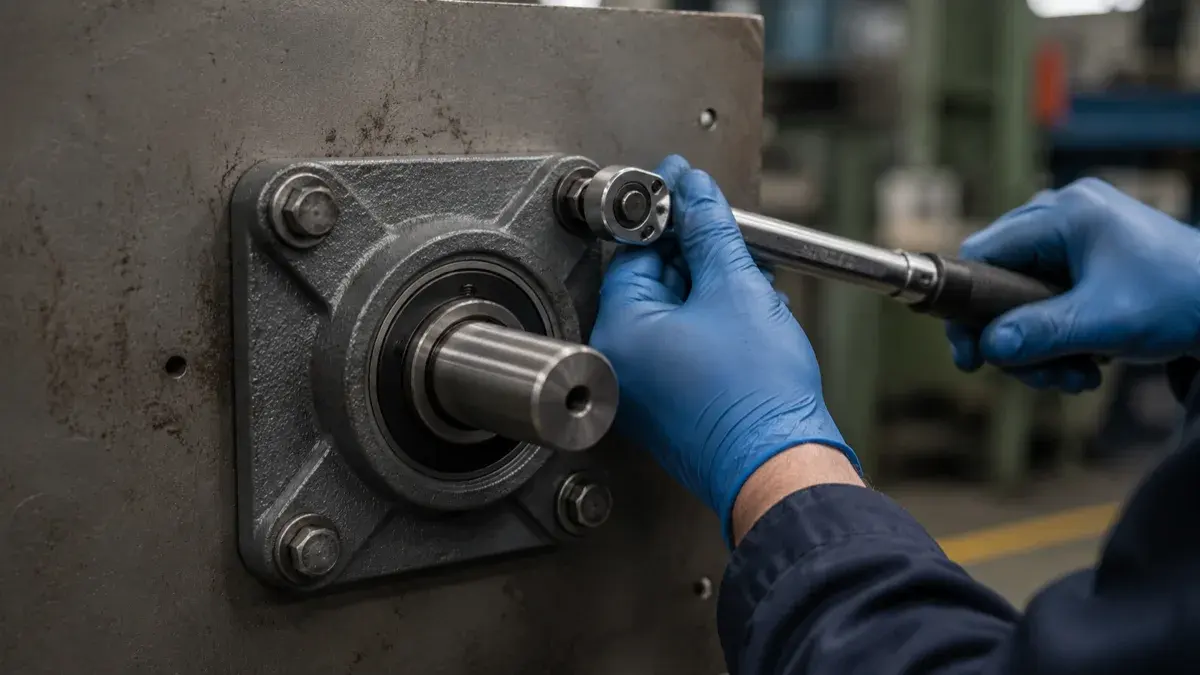
Work through it in order:
Step 1 — Prepare and check the mounting face
Clean the mating surface and confirm it's flat and square to the shaft. A burr or a high spot creates soft foot, which twists the housing and preloads the bearing the moment you torque the bolts.
Step 2 — Engage the pilot, then start the bolts
If the flange is piloted, seat the pilot boss into its counterbore before threading any bolt. That's what sets concentricity. Start all bolts by hand so the housing can still float into position.
Step 3 — Torque in a cross pattern
Tighten the bolts in a cross (star) sequence in two or three passes to final torque. Even tightening keeps the flange face flat against the mount and avoids distorting the housing.
Step 4 — Lock the inner ring to the shaft
Set the locking method last: torque both set screws evenly, cam the eccentric collar in the direction of shaft rotation, or draw up the adapter sleeve to spec. Then rotate the shaft by hand. It should turn freely with no binding.
A flange unit that turns freely after locking, with its seals seated and its bolts evenly torqued, is doing everything its geometry promised. Skip the alignment check and you'll be back at it in months, not years.
What Standards & Load Ratings Apply to Flange Bearings?
Flange units are governed by the same international standards as any rolling bearing, because the insert is a rolling bearing and the housing just holds it. Bearing life follows ISO 281, the international standard that defines the basic rating life L10 as the life that 90% of a group of identical bearings will reach or exceed (ISO 281:2007). The life equation is L10 = (C/P)ᵖ, where p = 3 for ball bearings and 3.33 for roller bearings. The "10" means 10% are expected to have failed by that point. It's a statistical floor, not a guarantee for any single unit.
A handful of standards do the heavy lifting, and knowing which is which keeps you from quoting the wrong one (a frequent competitor error is citing "ISO 9001," a quality-management certification that says nothing about the part):
- ISO 15: boundary dimensions and designation system for radial bearings
- ISO 9628:2019: the insert bearing itself, including its eccentric locking collar and radial internal clearance
- ISO 3228:2013: the cast or pressed housing, covering plummer block, flanged, and take-up types
- ISO 281: dynamic load ratings and rating life (the L10 calculation above)
- ISO 15243:2017: classification of bearing failure modes and their mechanisms
- ANSI/ABMA 9 and 11: the North American load-rating methodology, now aligned with the ISO 281 and ISO 76 calculations. The inch-dimension equivalents of the two ISO housing standards are ANSI/ABMA 14 (housing) and 15 (bearing)
- JIS B 1557 / 1558 / 1559: the Japanese trio for the unit, the insert bearing, and the housing respectively. JIS B 1559 covers housings, not inserts, which is a common miscitation
One precision note: the ABEC tolerance classes that matter so much for high-speed spindles are largely irrelevant for mounted flange units. These run at modest speeds in conveyors and fans, so a standard tolerance insert is correct. Paying for ABEC 5 on a conveyor flange unit is money spent on precision the application can't use. Precision classes matter far more in the smallest sizes — see miniature bearings.
Frequently Asked Questions
Q: What is a flange bearing used for?
A flange bearing supports a rotating shaft where the mounting surface faces the shaft rather than sitting beneath it: conveyor head and tail pulleys, fan and blower housings, agricultural machinery, and gearbox end plates. It belongs to the mounted bearing unit category, whose housings are dimensioned by ISO 3228:2013 and whose inserts follow ISO 9628.
Q: What is the difference between a flange bearing and a pillow block?
Mounting plane. A flange bearing bolts to a surface perpendicular to the shaft; a pillow block bolts to a base parallel to the shaft. Neither is the higher-grade part, and ISO 3228 dimensions both in the same document. Choose by which surface your machine offers.
Q: What do UCF, UCFL and UCFC mean?
They describe the flange housing around a "UC" insert bearing. UCF is a square 4-bolt flange, UCFL an oval 2-bolt flange, UCFC a round 4-bolt flange, and UCFB a round 3-bolt flange. The trailing number gives the bore: the last two digits times five equals the shaft size in millimeters for the 200 series.
Q: How many bolts does a flange bearing have?
Two, three, or four, depending on the flange shape. Oval flanges (UCFL) use 2 bolts, triangular round flanges (UCFB) use 3, and square (UCF) or round (UCFC) flanges use 4. More bolts means more rigidity against moment loads. Square 4-bolt units resist tipping from any direction, which is why they're the heavy-duty default.
Q: Is a flanged bearing the same as a flanged bushing?
No. A flanged bearing (housing unit) contains a rolling-element ball bearing and runs with very low friction. A flanged bushing is a plain sleeve with an integral thrust collar and no rolling elements. It slides rather than rolls, with a much higher friction coefficient. Same flange concept, fundamentally different mechanism and application.
Conclusion
Specifying a flange bearing comes down to four reads, in order:
- Mounting plane decides flange over pillow block: perpendicular face, flange unit.
- Flange shape and bolt count (UCFL, UCFB, UCF, UCFC) trade footprint against rigidity.
- Bore code gives the shaft size directly; bolt-hole spacing and pilot must still be matched to the drawing, because housings aren't interchangeable between makers.
- Material and locking method follow the environment and the load reversals, not the catalog price.
Get those four right and the unit will hit its rated life. Get the bolt pattern wrong, the most common field mistake, and the insert can be perfect while the housing won't bolt up. When in doubt, decode the housing letters, match the drawing, and check the alignment after locking.
ANDE manufactures the deep-groove ball bearing inserts at the core of mounted flange units across the full bore range. For help matching an insert, housing material, and locking method to your application, or to confirm a replacement against an existing bolt pattern, contact our engineering team.