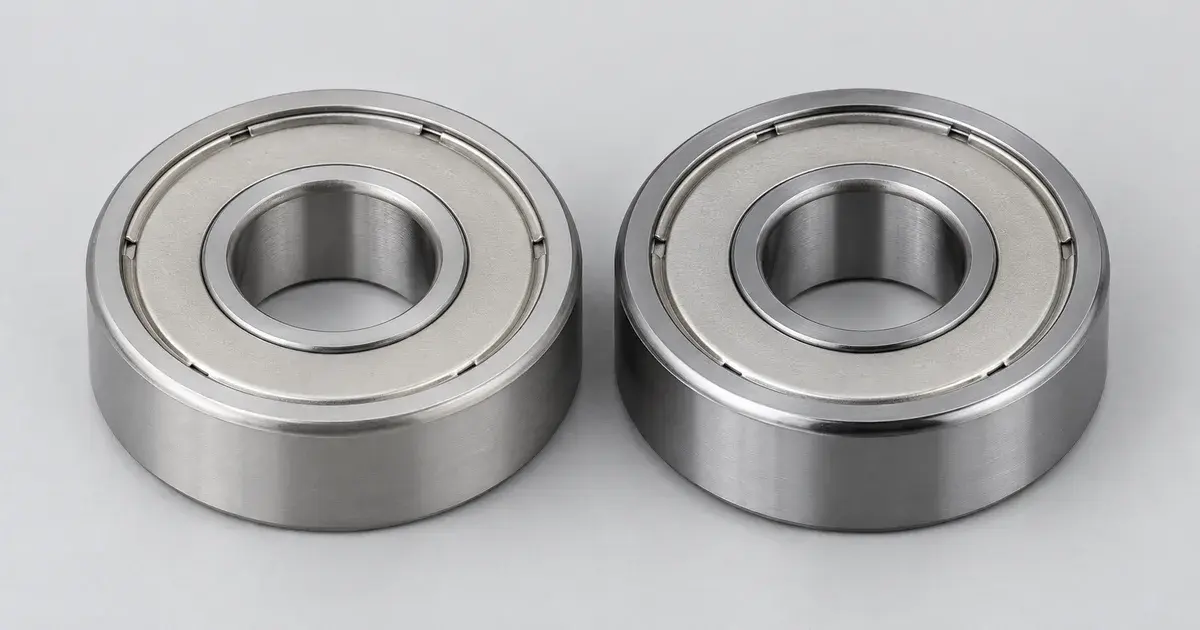
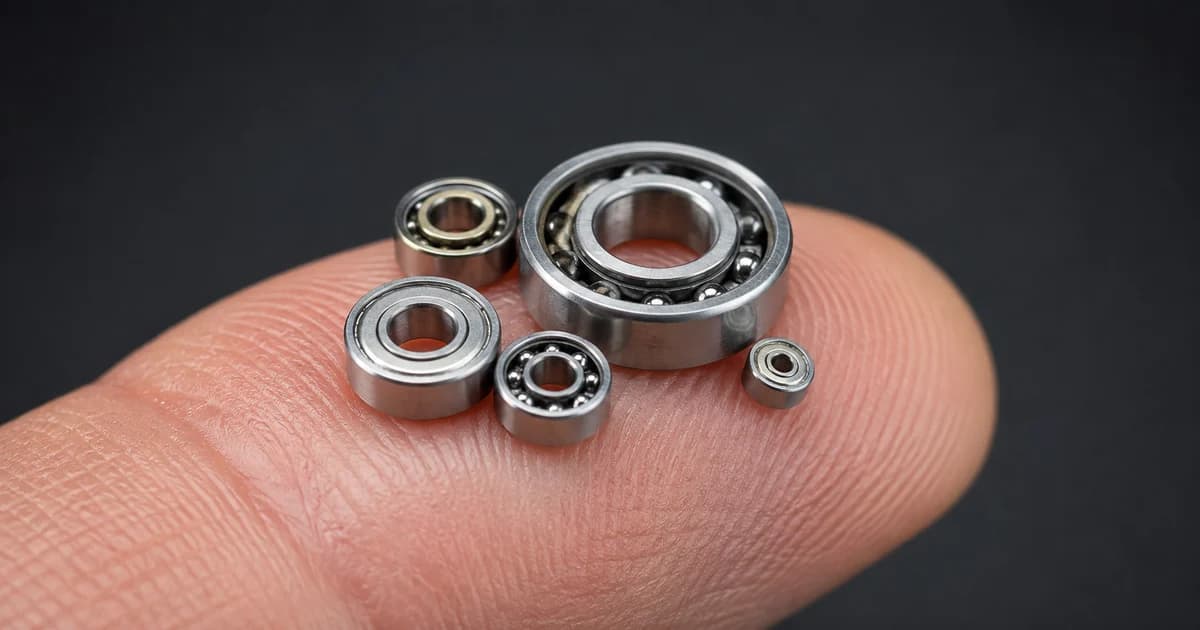
You pulled a bearing off a broken encoder and the ring reads R188. The replacement your colleague found is stamped MR104. Are they the same part? One number counts the bore in sixteenths of an inch. The other reads outer diameter first, then bore, in millimetres. They describe completely different bearings, and nothing on the part tells you which convention it follows.
That is the daily reality of miniature bearings. The parts are tiny, the tolerances are tight, and the numbering is a minefield. Search for "miniature bearing" and you land in a wall of product grids that quote a price and never explain how to read the size, pick the steel, or set the clearance.
This guide fixes that. It resolves where "miniature" actually starts and stops, decodes both numbering systems side by side, and walks through material, precision, clearance, and sourcing the way an OEM engineer specifies them.
Key Takeaways
- A bearing is generally miniature when its outside diameter is about 10 mm or smaller, running down to a 0.6 mm bore at the sub-miniature end (AST Bearings). There is no single universal cut, so verify the boundary before you argue about it.
- "Instrument bearing" is the high-precision end of the miniature range, formalised by ABMA Standards 12.1 and 12.2 with a "P" tolerance suffix.
- Two numbering systems collide here. Metric coded parts give the bore uncoded in millimetres below 10 mm (629 is a 9 mm bore). The MR series reads OD then bore (MR104 is 10 mm OD, 4 mm bore). The inch R number encodes bore in sixteenths of an inch (R4 is a 1/4 inch bore).
- 440C stainless is the miniature default, not chrome steel. At this size the cost penalty nearly vanishes, so corrosion resistance comes essentially free (SMB Bearings).
- Precision runs to ABEC 5 or 7 for instrument work, but ABEC rates tolerances only. Radial play, torque, and noise are separate specs you must call out (Boca Bearings).
- ANDE does not manufacture sub-10 mm miniature bearings. Our deep groove range begins at a 10 mm bore, where the miniature range ends and the thin-section series starts.
What Is a Miniature Bearing?
A miniature bearing is a rolling bearing with an outside diameter of about 10 mm or smaller (AST Bearings). You reach for one where envelope, mass, low noise, and precision matter more than load capacity. The range extends surprisingly far down: the smallest standard catalogue part has a 0.6 mm bore in a 2.5 mm outer diameter (SMB Bearings).
Be honest about the boundary, because the industry is not consistent. AST cuts at 10 mm outer diameter. Others define miniature by bore, with metric bores from 1 mm to 10 mm and inch bores from 0.040 inch upward. There is no single agreed number, so treat "around 10 mm OD, single-digit-millimetre bore" as a working definition, not a law.
Three overlapping terms cause most of the confusion:
- Miniature describes size, roughly the 10 mm outer-diameter band and below.
- Instrument describes the high-precision end of that band. ABMA formalises instrument ball bearings in Standards 12.1 and 12.2, marked with a "P" suffix (AST Bearings). Every instrument bearing is miniature, but not every miniature bearing meets instrument tolerances.
- Micro or sub-miniature describes the smallest tail, bores of roughly 0.6 mm to 3 mm.
The takeaway is that "miniature" is a statement about priorities, not a load rating. To find the three dimensions on a bearing you already have, see our guide to how to measure a bearing. For where these parts fit among the wider family, see what ball bearings are used for and the broader kinds of bearings.
How to Read Miniature Bearing Numbers: Metric vs Inch
Miniature parts use two incompatible numbering systems, and each encodes size differently. Read the system wrong and the "equivalent" you order will not fit the bore, the housing, or both. Here is how each one works.
Metric coded series (60x, 62x, 63x, 68x, 69x). The leading 6 marks a deep groove ball bearing. For bores under 10 mm, the bore is given uncoded, directly in millimetres (SKF). So 625 is a 5 mm bore, 629 is a 9 mm bore, and 608 is an 8 mm bore. Above 10 mm the familiar "size code times five" rule takes over, which our bearing number guide covers in full.
Metric MR and MF series. These NMB and NSK "special metric" codes read outer diameter first, then bore. MR104 is a 10 mm outer diameter on a 4 mm bore. MR126 is a 12 mm outer diameter on a 6 mm bore. NMB's primary system uses a four-digit dimension code on the same OD-then-bore logic, with prefixes such as R for the thick type, L for thin, and LF or RF for flanged (MinebeaMitsumi).
Inch R series, and the myth to unlearn. The classic R number gives the bore in sixteenths of an inch, not the outer diameter in eighths as is often assumed. R4 is a 4/16 inch bore, which is 1/4 inch. R8 is a 1/2 inch bore. R16 is a 1 inch bore (Schatz Bearing). The three-digit inch codes are different again. R144, R156, and R188 are compressed chart-lookup codes, read from a table rather than calculated. R144 is a 1/8 inch bore in a 1/4 inch outer diameter, and R188 is a 1/4 inch bore in a 1/2 inch outer diameter.
Put the systems in one place and the incompatibility is obvious:
| Designation | System | Bore | Outer diameter | How the number encodes size |
|---|---|---|---|---|
| 625 | Metric, coded | 5 mm | 16 mm | Last digit is the bore in mm (uncoded below 10 mm) |
| 629 | Metric, coded | 9 mm | 26 mm | Last digit 9 gives a 9 mm bore |
| MR104 | Metric, MR | 4 mm | 10 mm | Reads OD (10) then bore (4) |
| MR126 | Metric, MR | 6 mm | 12 mm | Reads OD (12) then bore (6) |
| R144 | Inch, 3-digit | 1/8 in (3.175 mm) | 1/4 in (6.35 mm) | Chart-lookup code, not a fraction |
| R188 | Inch, 3-digit | 1/4 in (6.35 mm) | 1/2 in (12.7 mm) | Chart-lookup code, not a fraction |
A stainless part carries an S, SR, or SMR prefix, where S marks 440C stainless and no prefix marks SUJ2 chrome steel (Boca Bearings). One symbol worth care is NMB's DD, which appears both as a stainless material code and as a double-contact-seal code on different tables. Confirm its meaning against the specific catalogue.
What the flange adds
A flanged miniature bearing carries an integral lip on its outer ring, marked with an MF, FR, RIF, or LF prefix. The flange lets the bearing seat against a flat face without a machined housing shoulder. That simplifies thin-walled housings and locates the bearing axially in a through-hole, so it cannot migrate under vibration (AST Bearings).
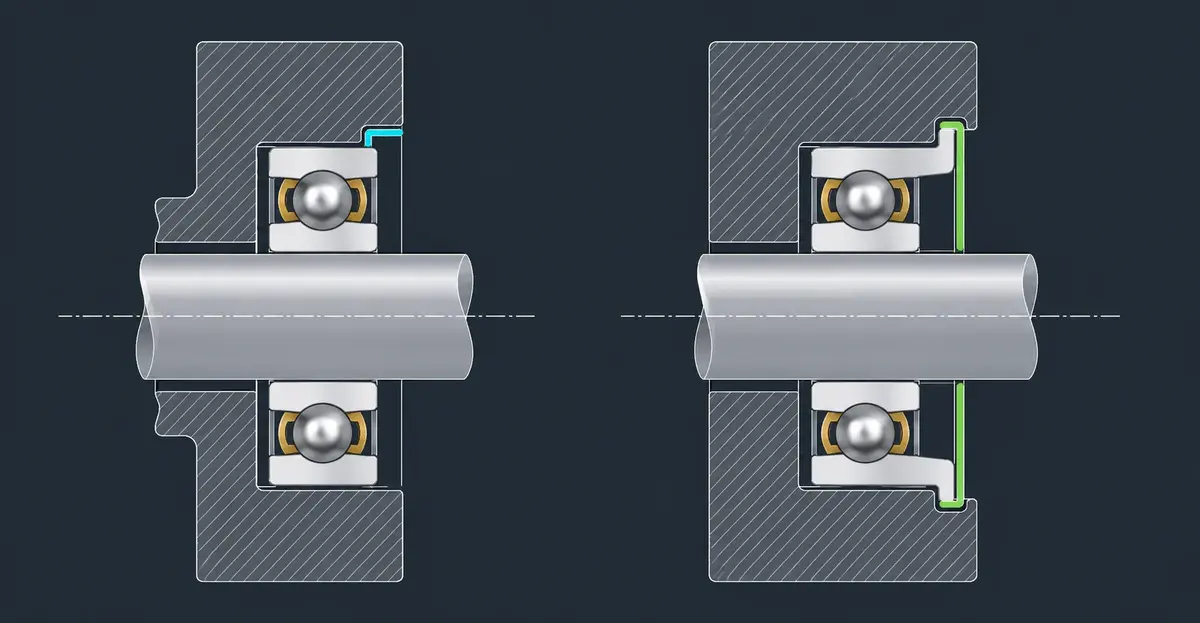
The same word covers a different part at larger sizes, where a "flange bearing" means a bolt-on housing unit. Our flange bearing guide untangles that.
What Are Miniature Bearings Made Of?
440C stainless steel is the default miniature material, not the 52100 chrome steel that dominates standard-series bearings. The reason is economic as much as technical: at miniature size so little steel is used that the cost premium for stainless is often negligible, so corrosion resistance comes essentially free (SMB Bearings).
The hardness numbers explain the rest of the trade. Chrome steel is slightly harder and carries more load, but it has no inherent corrosion resistance, which is disqualifying in a dental handpiece, a medical device, or anything exposed to washdown or humidity.
The material menu in practice:
- 440C stainless (AISI 440C, SUS440C) runs 58 to 65 HRC on the balls and 58 to 62 HRC on the rings. It is the standard choice for corrosion resistance and the best-stocked option (NHBB).
- 52100 chrome steel (SUJ2) runs 60 to 67 HRC on the balls and 60 to 64 HRC on the rings, with higher load capacity and low noise, but no corrosion resistance.
- Hybrid ceramic pairs silicon nitride balls with steel rings. Silicon nitride has a density of about 3.21 g/cm³, roughly 40% that of bearing steel at about 7.8 g/cm³, so the balls weigh around 60% less (CeramTec). Barden reports its hybrids running 40% to 50% faster, with 2 to 7 times lower vibration and up to 5 times longer life. Treat those as the manufacturer's figures (Barden).
- Premium dental alloys such as SV30 and ACD34 have a finer grain than 440C for the highest-speed handpieces, covered in the applications section below.
For a deeper material comparison across bearing families, see our guide to rolling mill bearing materials.
Precision: ABEC 5 and 7, and the Limits of the Standard
Instrument-grade miniature bearings are commonly specified ABEC 5 or ABEC 7. That gets you the running accuracy an encoder or a gyro needs. But there is a catch every product page skips: ABEC rates tolerances only. It says nothing about the radial play, torque, or noise that often decide whether the bearing actually works in your application (Boca Bearings).
The ABEC scale maps cleanly onto the international standards, so a European or Japanese datasheet is not a translation problem:
| ANSI/ABMA Std 20 | ISO 492 | DIN 620 |
|---|---|---|
| ABEC 1 | Class Normal | P0 |
| ABEC 3 | Class 6 | P6 |
| ABEC 5 | Class 5 | P5 |
| ABEC 7 | Class 4 | P4 |
| ABEC 9 | Class 2 | P2 |
That equivalence comes from AST, citing ANSI/ABMA Standard 20, and is corroborated by Boca and by Koyo. The governing documents are ISO 492:2023, ANSI/ABMA 20-2025, and ABMA 12.1 and 12.2 for instrument ball bearings.
Here is the nuance competitors omit. Boca states plainly that ABEC and ISO classes do not cover radial play, raceway curvature, surface finish, material, ball complement, retainer type, lubrication, torque, or cleanliness. A higher ABEC number is not a better bearing for your job. It is a tighter dimensional tolerance, nothing more.
So specify by duty. ABEC 1 or 3 suits general small-motor work. ABEC 5 or 7 belongs on encoders, gyroscopes, dental and surgical tools, and metrology. Then call out the play, torque, and noise separately. Our ABEC rating guide covers the full scale and what each class controls, and our guide to bearing noise covers the vibration group and measuring standard that noise is actually specified with.
Radial Play, Clearance and Preload at Miniature Scale
At miniature scale the internal radial clearance governs running accuracy, noise, and torque, and it is a spec ABEC does not touch. It must be called out explicitly on the order, because the default may not be what your application wants.
The clearance codes run MC1 through MC6, in micrometres:
Standard clearance is MC3, at 5 to 10 µm, and the measuring load for a miniature bearing is just 2.5 N (Boca Bearings). NMB's parallel codes run P13 at 2.5 to 7.5 µm, P24 at 5 to 10 µm, and P58 at 12.5 to 20 µm.
When you tighten and when you open up:
- Tighten to MC1 or MC2 for rotary encoders and optical gimbals, or use a light-preload duplex pair. Excess play shows up directly as signal noise and positioning error.
- Open up to MC5 or MC6 for high axial load, heavy interference fits, or a large thermal gradient across the bearing.
Preload deserves respect at this scale. Boca notes that maximum life sits at a very slight preload, but even a small increase past that point has a "considerably detrimental" effect on life. Preload is a scalpel, not a lever. The duplex pairing logic is the same as for an angular contact bearing.
Shields, Seals, Cages and Low-Torque Lubrication
For miniature bearings, the closure and the lubricant are chosen around torque and speed, not just contamination. A contact seal that is right for a wheel hub can stall a low-torque instrument, so the logic is different from a standard bearing.
Shields versus seals. Metal shields, marked ZZ or Z, do not contact the inner ring, so they add almost no torque. NHBB calls the metal shield its most popular closure, good to around 600 °F. Contact rubber seals, marked 2RS or DD, exclude contamination better but add drag. Non-contact rubber, marked VV or SR, sits between them. In torque-sensitive work, prefer shields over contact seals, since there is no rubbing surface to create drag (NHBB). Our sealed versus shielded guide has the full speed and life comparison.
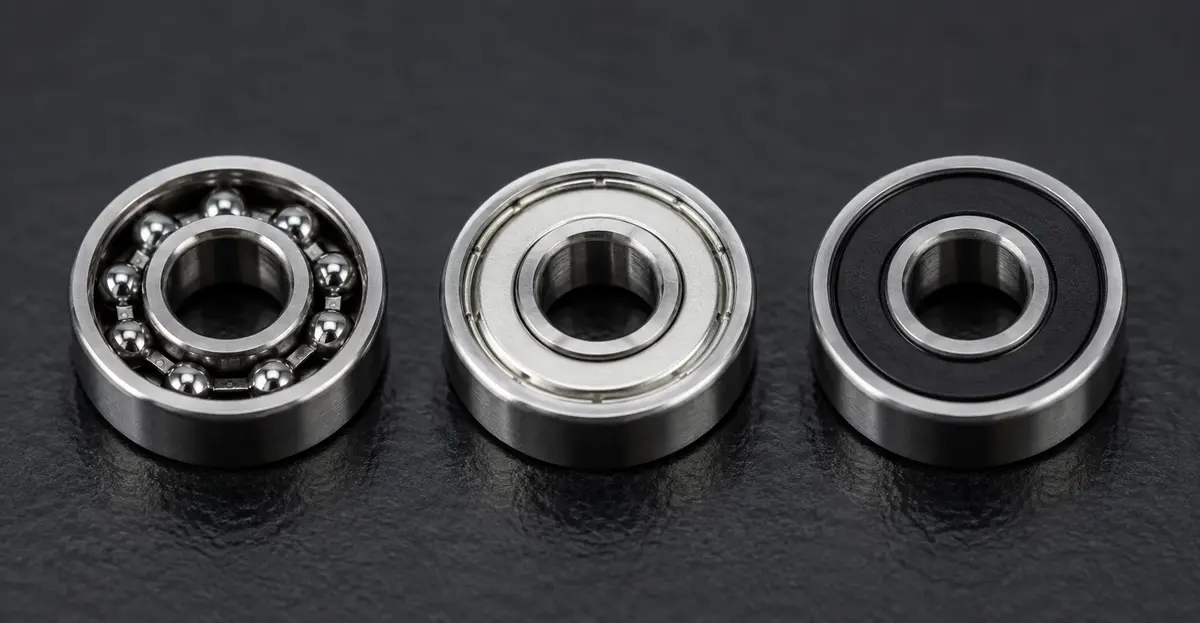
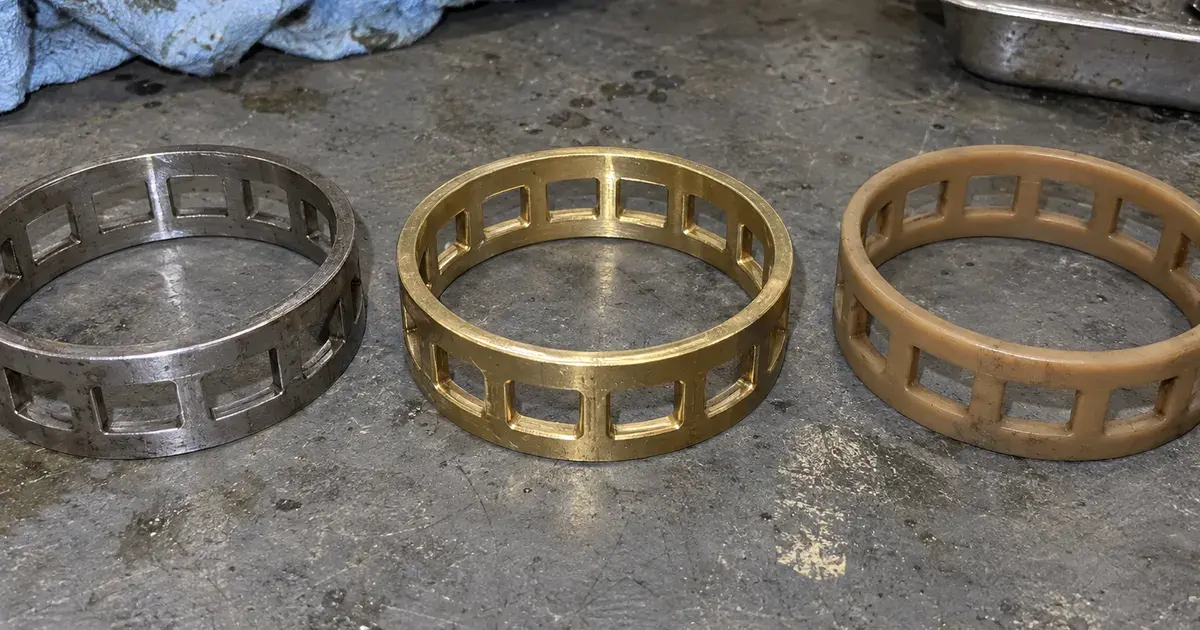
Cages. The smallest sizes use a one-piece steel crown for space and low torque. Two-piece steel ribbon cages handle higher load and vibration. A molded nylon crown suits high speed and low mass, kept below 120 °C. A full-complement design, with no cage at all, maximises radial load at low speed.
Lubrication. Grease fill is deliberately low, at 25% to 35% of the bearing's internal free volume. Oil is dosed by the drop, roughly 3 to 6 mg up to R-2 size (NHBB). Grease raises both starting and running torque and caps speed compared with oil, which is why instrument bearings often ship with a light oil rather than a working grease. Our bearing lubrication guide covers fill percentage and grease-versus-oil selection in depth.
Where Miniature Bearings Are Used (and How Fast They Spin)
Miniature bearings dominate where the binding constraint is space, precision, or speed rather than load. The headline application is speed, and the numbers are genuinely extreme.
Dental handpieces set the pace. Air-turbine handpieces run at up to about 500,000 rpm, while the slower contra-angle handpieces reach around 200,000 rpm (Barden; GRW). Those turbine speeds are what drive the SV30 and ACD34 alloys and the ceramic-ball options. Surgical robots and tools, plus implantology, add a second selection driver beyond speed: the bearing must survive repeated autoclave sterilisation without corroding.
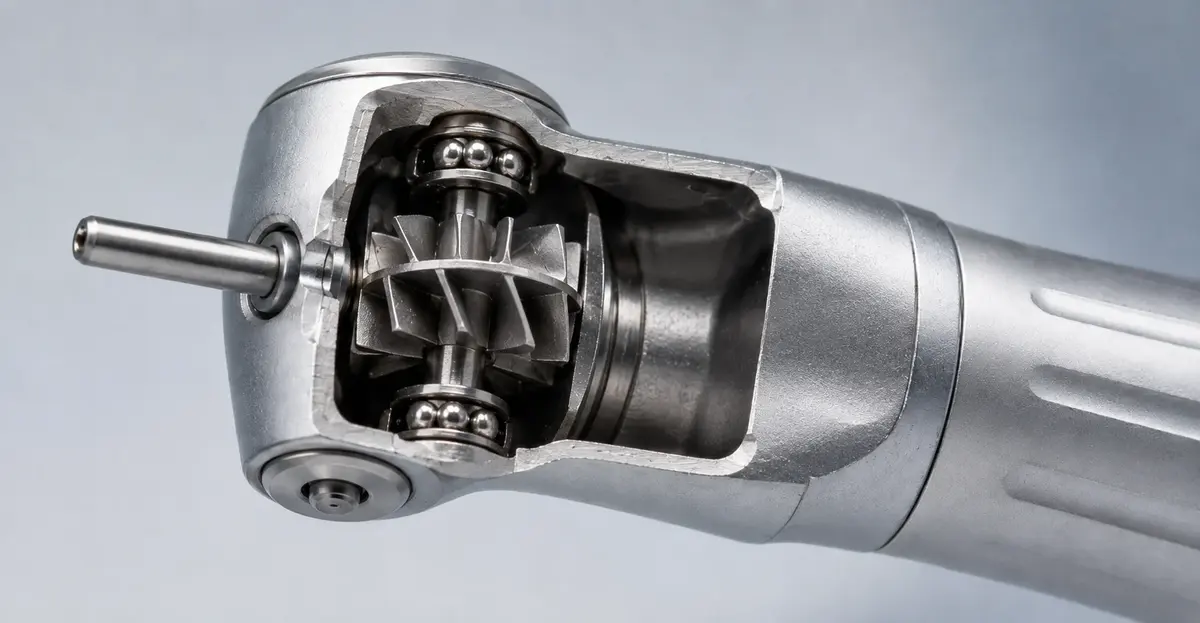
Beyond medicine, the list is long: rotary encoders and optical gimbals, where radial play sets signal quality; gyroscopes, anemometers, and flow meters; small electric motors and miniature gearboxes; drone and UAV sensors; robotic tools; and RC hobby gear.
Limiting speed is real and size-dependent, and oil consistently beats grease for outright speed:
A 1 mm bore R09 tops out near 150,000 rpm on oil, while a larger R188 is limited to about 50,000 rpm. Smaller parts spin faster, and oil lifts the ceiling at every size. The dental precision classes are covered in the ABEC rating guide.
How to Specify and Source Miniature Bearings
Specify a miniature bearing by the full stack, not just the part number, because the number alone hides most of what matters. A clean RFQ names all of these:
- Numbering system and designation, stating metric or inch explicitly
- Bore, outer diameter, and width
- Material: 440C, 52100, hybrid ceramic, or a dental alloy
- Closure: open, shielded (ZZ), or sealed (2RS)
- Cage type
- Precision class in ABEC or ISO
- Radial clearance code in the MC or P system
- Preload, if the bearing is duplexed
- Lubricant and fill percentage
- Any RoHS or autoclave requirement
The world's miniature makers are a specialist group. MinebeaMitsumi and its NHBB unit lead globally, with NSK, GRW, and Barden supplying much of the precision volume, and the Cixi and Ningbo export belt supplying much of the commodity volume. Our bearing manufacturers guide ranks the field.
Here is the honest part. ANDE does not manufacture sub-10 mm miniature or instrument bearings. Our deep groove range begins at a 10 mm bore, in the 6800 and 6900 series, which is where the miniature range ends and the thin-section series begins. If your part is smaller than that, we are not your maker, and we will say so.
What we can help with is the boundary and the verification. For the 10 mm and up small-bore range, ANDE's deep groove ball bearing series is a direct fit. And for any supplier, including us, the ANDE position holds: specify the number, do not assume the origin. Verify the material, the precision class, the clearance, and the method behind a published rating against the standard, whoever stamps the ring. Sourcing overseas for the first time? Our guide to sourcing Chinese bearings covers the QC questions worth asking.
Frequently Asked Questions
What size is a miniature bearing?
A miniature bearing generally has an outside diameter of about 10 mm or smaller, with bores from 0.6 mm up to around 9 mm. There is no single universal cut. Some makers define it by outer diameter and others by bore, so confirm the boundary against the specific catalogue.
What is the difference between a miniature bearing and an instrument bearing?
"Instrument" is the high-precision end of the miniature range, formalised by ABMA Standards 12.1 and 12.2 with a "P" tolerance suffix. Every instrument bearing is miniature, but not every miniature bearing meets instrument tolerances.
What does the "R" mean in a miniature bearing number?
In the classic inch series, the R number gives the bore in sixteenths of an inch, so R4 is a 1/4 inch bore. The three-digit codes like R188 are chart-lookup codes rather than simple fractions, where R188 is a 1/4 inch bore in a 1/2 inch outer diameter.
What are miniature bearings made of?
Most are 440C stainless steel, because at this size the cost penalty over 52100 chrome steel is negligible and corrosion resistance comes essentially free. Chrome steel, hybrid ceramic with silicon nitride balls, and premium dental alloys serve specific duties.
What ABEC class do miniature bearings need?
Instrument and high-speed work commonly uses ABEC 5 or 7, which map to ISO 492 Class 5 and Class 4. But ABEC rates tolerances only. Radial clearance, torque, and noise are separate specifications you must call out on the order.
Specify the System, Not the Guess
Miniature bearings reward engineers who read the part number correctly and specify the whole stack. A few things carry most of the value:
- The boundary is about 10 mm outer diameter and below, down to a 0.6 mm bore, with no universal cut.
- Two numbering systems encode size differently: metric coded bores read in millimetres, MR reads OD then bore, and the inch R number reads bore in sixteenths.
- 440C stainless is the default, because corrosion resistance is nearly free at this size.
- ABEC 5 or 7 covers precision, but rates tolerances only, so clearance, torque, and noise are separate specs.
- Clearance and preload are the real design levers, with MC3 the standard and tighter grades for precision motion.
Get the numbering system right, match the material and clearance to the duty, and a bearing smaller than a shirt button will hold a surgical tool true at half a million rpm.
For the 10 mm and up small-bore range, browse ANDE's deep groove ball bearing series, or send our engineering team your part number for interchange and selection help.
About the Author
Jeff Li writes on bearing engineering and global sourcing for ANDE Bearing. He works directly with OEM and aftermarket buyers in automotive, heavy industry, and renewable energy. Connect on LinkedIn.