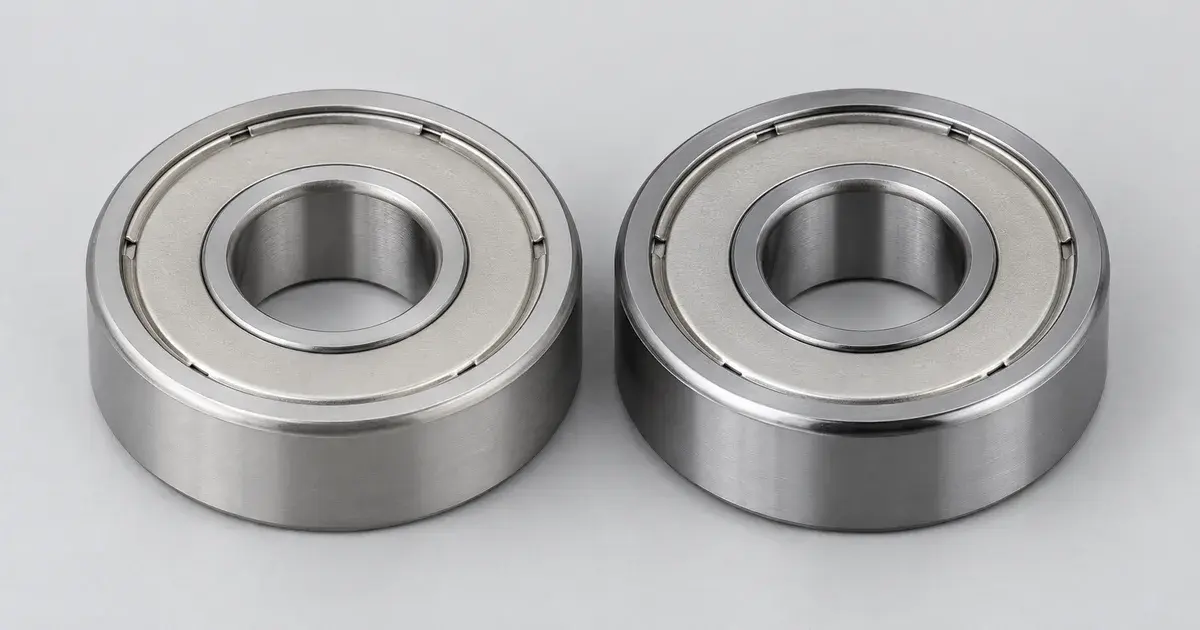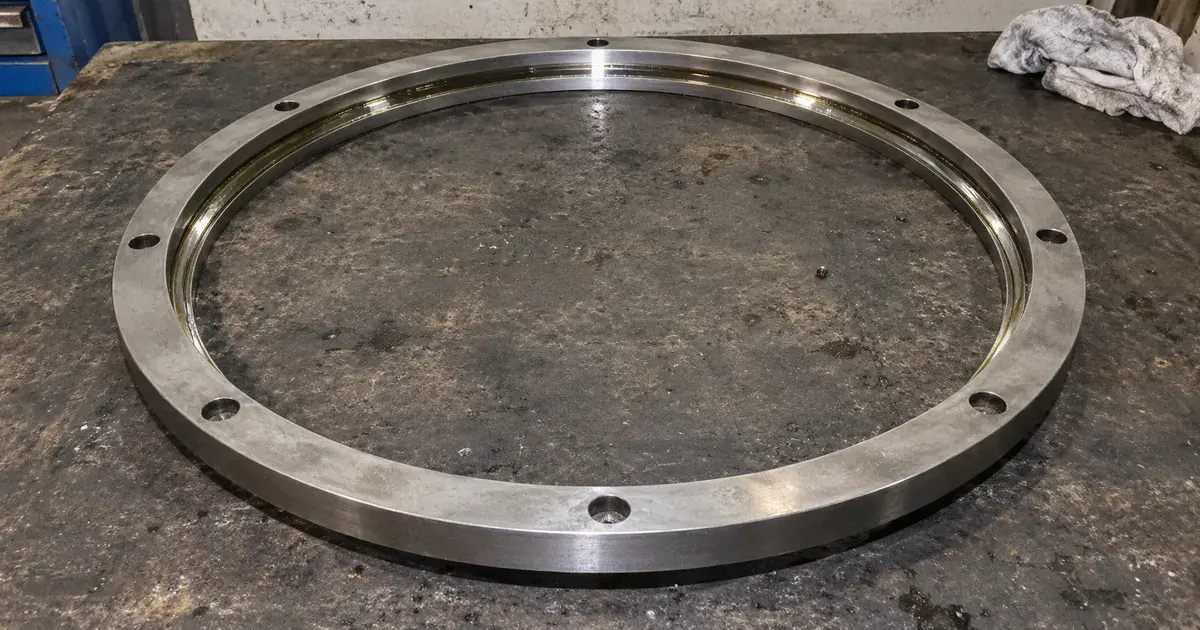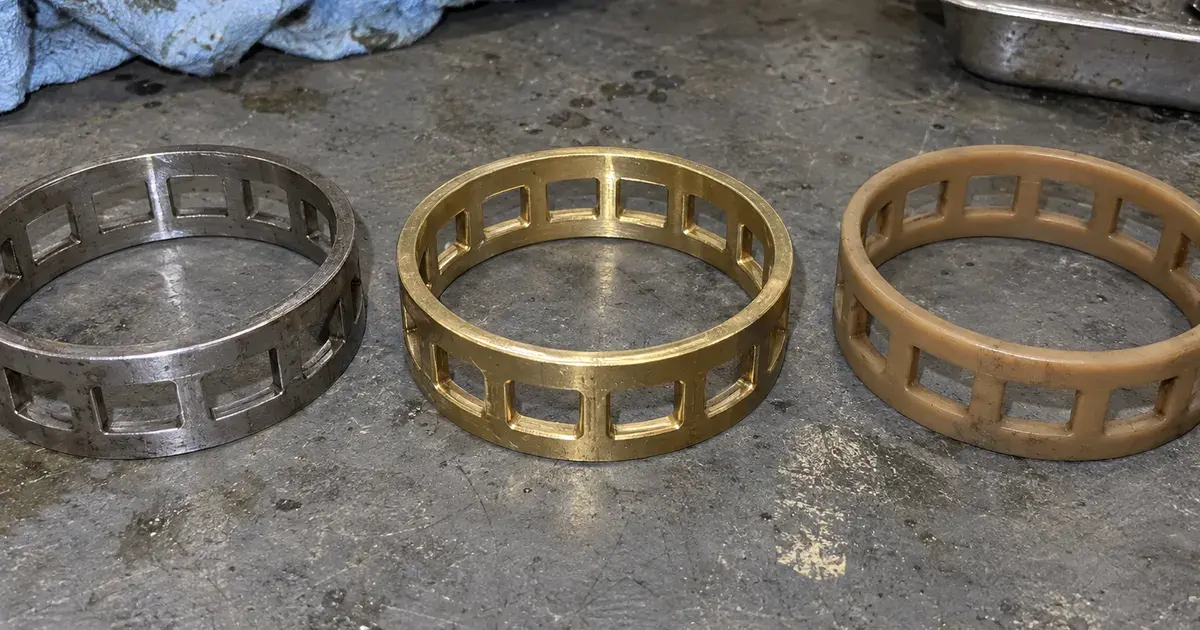
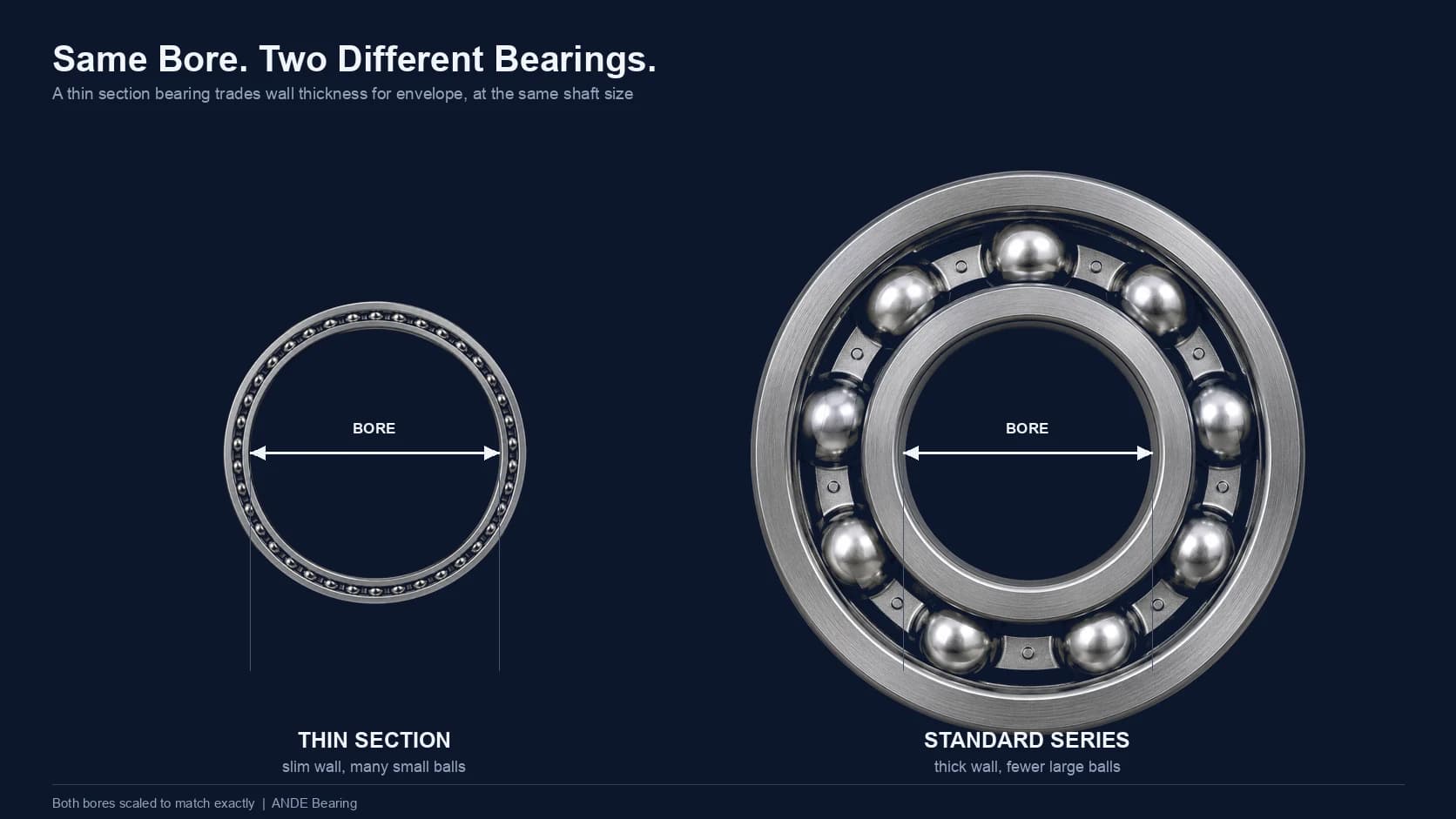
You have a 50 mm shaft, a housing that will not grow, and a bearing that does not fit. The reflex is to drop to a smaller bore and hope the shaft holds. There is usually a better move: keep the bore and take a thinner section.
The numbers are worth the detour. A 6810 and a 6010 both take a 50 mm shaft, but the 6810 occupies about 80% less envelope volume. That is the promise of a thin section bearing, and it is real.
There is a catch that costs engineers real money, though. Two different bearing families are sold under the name "thin section," and they are not interchangeable. Cross-shop them and you will order a part that cannot fit the space you designed for it.
Key Takeaways
- A bearing is generally thin section when its radial cross section is under one fourth of the bore diameter and under twice the ball diameter (Kaydon). It is a ratio test, not a width.
- Two families share the name. The ISO metric 61800/61900 series (68xx/69xx) are a thin dimension series whose section still grows with bore. The inch constant-cross-section family (Kaydon Reali-Slim, RBC, Silverthin) holds one section from roughly 3/4" to 40" bore.
- Constant-cross-section bearings come in three geometries: type C radial, type A angular contact, and type X four-point contact. Type X carries radial, thrust and moment load in one row through Gothic-arch raceways, so one bearing can replace two (Kaydon).
- Kaydon reports 85% space and 83% weight savings against a 6010 at the same bore. Treat that as a manufacturer claim at one size.
- Mounting decides the outcome. A thin ring takes the shape of its seat, so shaft roundness must match the ring's radial runout and seat flatness must match its axial runout (Kaydon).
- Do not compare load ratings across suppliers. The ISO 281 rating assumptions do not hold for thin sections, and published capacity for one part ranges from 150 lb to 558 lb depending on who calculated it.
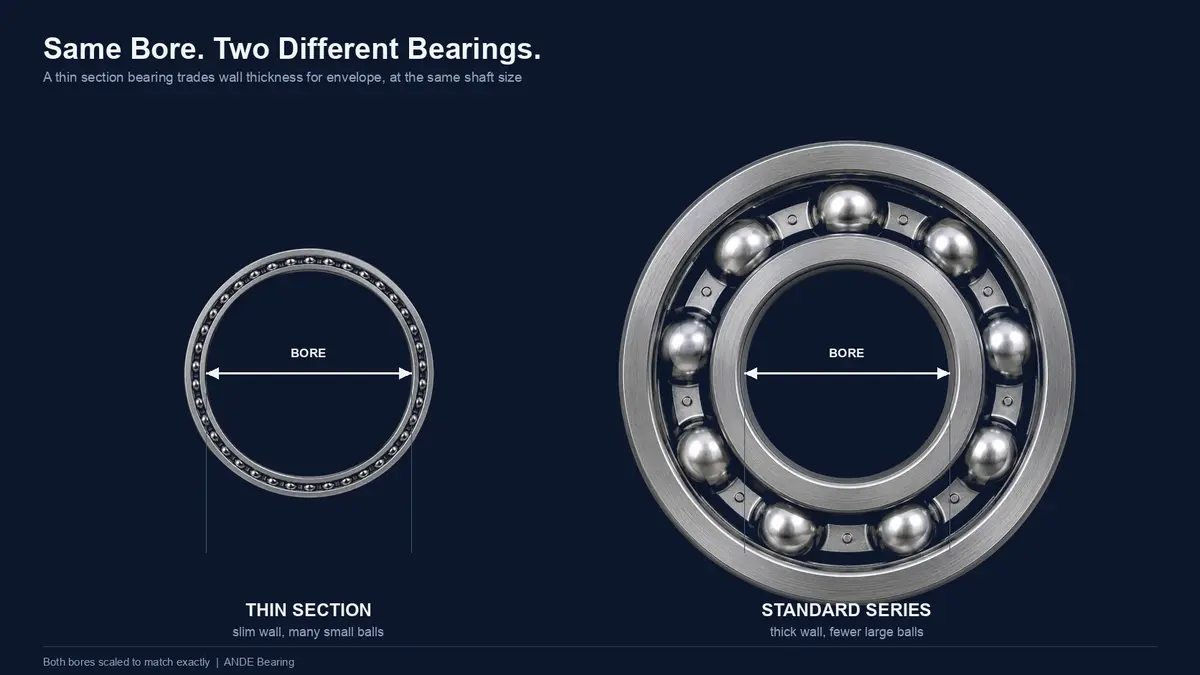
What Is a Thin Section Bearing?
A thin section bearing is one whose radial cross section is disproportionately small for its bore. The working test is quantitative: the radial section is less than one fourth of the bore diameter, and less than twice the rolling-element diameter (Kaydon).
Notice that the definition is a ratio rather than a measurement. A 6 mm section is thin at a 50 mm bore and unremarkable at a 10 mm bore. "Thin" only means anything relative to the shaft the bearing has to surround.
The reason the ratio matters is how conventional bearings scale. In a standard series, both the radial section and the ball diameter grow with bore, so mass climbs steeply as the shaft gets larger. A thin section bearing breaks that relationship by holding a small section and using smaller, more numerous balls spread over a larger pitch diameter.
You are making a deliberate trade. You buy envelope and mass, and you pay in load capacity and mounting tolerance. Both halves of that bargain are covered below.
Applying the ratio test to real catalogue parts is clarifying. At a common 50 mm bore, ANDE's own boundary dimensions give these sections:
| Bearing | Bore × OD × width | Radial section | Section ÷ bore | Thin section? |
|---|---|---|---|---|
| 6810 | 50 × 65 × 7 mm | 7.5 mm | 0.15 | Yes |
| 6910 | 50 × 72 × 12 mm | 11.0 mm | 0.22 | Yes |
| 6010 | 50 × 80 × 16 mm | 15.0 mm | 0.30 | No |
| 6210 | 50 × 90 × 20 mm | 20.0 mm | 0.40 | No |
| 6310 | 50 × 110 × 27 mm | 30.0 mm | 0.60 | No |
The 68xx and 69xx series pass the test. The 60xx, 62xx and 63xx series do not. If you want to confirm a candidate yourself, the arithmetic is just (OD − bore) ÷ 2, divided by bore. To measure an unmarked bearing first, see our guide to how to measure a bearing.
Two Bearing Families Share This Name
Here is the distinction that prevents wasted purchase orders. Both families are marketed as thin section, but only one holds a constant cross section as the bore grows.
Family one: ISO metric dimension series 68xx and 69xx
These are standard metric bearings in a thin dimension series, with boundary dimensions set by ISO 15. Timken lists the 61800 and 61900 series in its catalogue under the literal heading "Thin Section Ball Bearings" (Timken). They are widely stocked, catalogue-priced, and available from most manufacturers, ANDE included.
Their section is thin relative to bore, and it still grows as bore increases, just more slowly than a 60xx or 63xx. ANDE's catalogue shows the progression clearly:
| Series | 10 mm bore | 50 mm bore | 100 mm bore |
|---|---|---|---|
| 68xx section | 4.5 mm (6800) | 7.5 mm (6810) | 12.5 mm (6820) |
| 69xx section | 6.0 mm (6900) | 11.0 mm (6910) | 20.0 mm (6920) |
This is worth stating plainly because it is often described incorrectly. The 68xx and 69xx series are a thin series, not a constant-section series. Their section nearly triples between a 10 mm and a 100 mm bore.
Family two: inch constant cross section
This is the family that holds one section across an enormous bore range. Kaydon's Reali-Slim, along with equivalents from RBC and Silverthin, is built from a limited set of cross sections that stay fixed as the bore grows, spanning roughly 3/4" to 40" (Kaydon).
Kaydon's open series illustrates the idea. Section AA is 0.187" × 0.187" and section G is 1.000" × 1.000", and either one can be ordered across many bores (Kaydon part number codes). Silverthin describes its family as 12 primary cross sections starting at 3/16", with bores from 1" to over 40" (Silverthin). At the extreme, SKF's Ultra-Slim bearings are just 2.5 mm wide at large bore (SKF).
That property is what makes a gimbal or a scanner designer's life easier. You can grow the aperture of an assembly without the bearing envelope growing with it.
| ISO metric 68xx / 69xx | Inch constant cross section | |
|---|---|---|
| Dimension standard | ISO 15 boundary dimensions | ABMA 26.2, inch design |
| Section behavior | Grows with bore | Constant across bore range |
| Typical bore range | 10 mm to 100 mm and up | 3/4" to 40" |
| Tolerance standard | ISO 492 classes | ABEC 1F to 7F |
| Best for | Catalogue availability, cost, moderate bore | Large bore, extreme envelope limits, moment load |
The practical consequence: a 6810 is not a drop-in substitute for a Kaydon KA020CP0, and cross-referencing between these families means checking bore, section and contact type. If you are decoding an unfamiliar designation, start with how to read a bearing number.
Types C, A and X: Which Raceway Geometry?
Within the constant-cross-section family, three raceway geometries carry different loads. Choose by the load you actually have, not by what is in stock.
Type C, radial contact. Deep grooves, much like a standard deep groove bearing. Excellent under radial load, good under axial load, and acceptable under light to moderate moment load. This is the default for predominantly radial duty.
Type A, angular contact. Excellent under axial load in one direction and good radially. A single type A should never be used alone for moment or reversing axial load (RBC). It works in matched pairs, arranged back-to-back, face-to-face or tandem, which is the same logic covered in our guide to the angular contact bearing.
Type X, four-point contact. This is the geometry with no real equivalent in conventional proportions. Each raceway groove is formed from two intersecting arcs of equal radius that meet at a peak in the plane of the ball centres. Kaydon describes the profile as a Gothic arch, and it produces four contact points around every ball (Kaydon).
Because there is contact on all four sides of the groove, a single row of type X balls resists radial, thrust and moment load at once. That is why one type X bearing can often replace two bearings, whether the pair being replaced is angular contact, tapered roller, or a thrust and radial combination. Kaydon's king-post example reports about a 50% improvement in moment load stiffness from making that substitution.
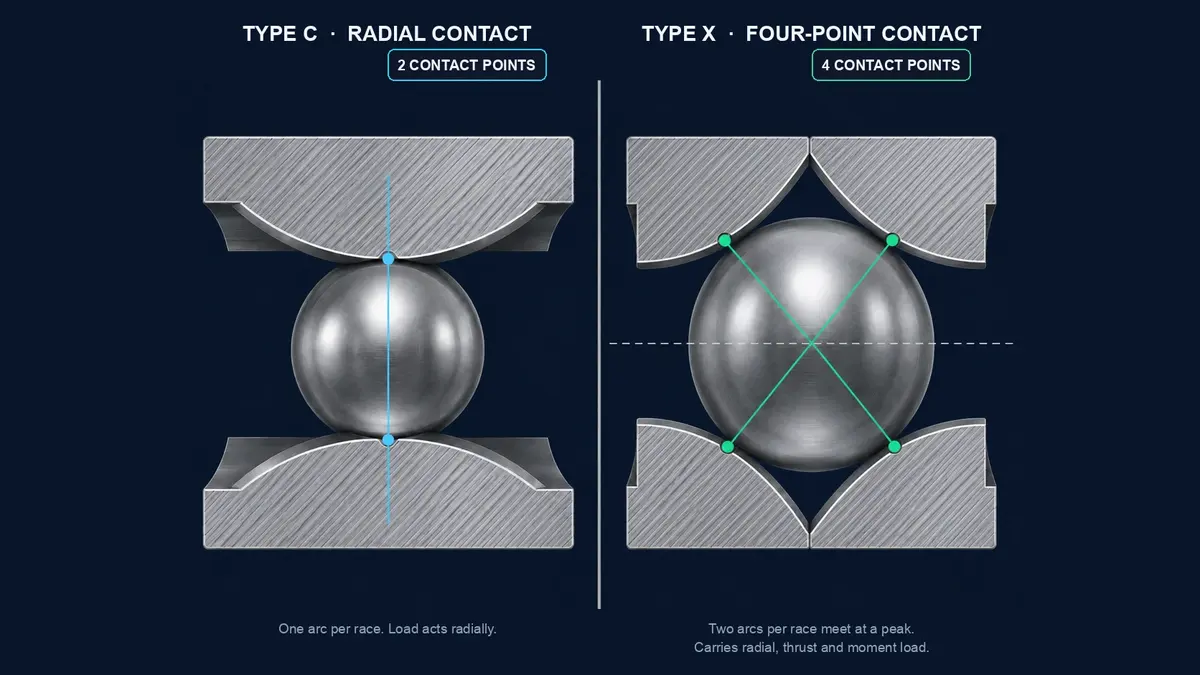
The trade-off is friction and radial capacity. A type X has higher friction than a type C or type A of the same size, and it is a poor choice for pure radial load.
| Type | Radial | Axial | Moment | Reversing axial | Combined |
|---|---|---|---|---|---|
| C radial | Excellent | Good | Good | Good | Good |
| A angular | Good | Excellent | Do not use | Do not use | Good |
| X 4-point | Poor | Good | Excellent | Excellent | Poor |
Load competence by thin-section bearing type. Source: RBC Bearings, corroborated by Silverthin.
One caveat on the letters. C, A and X are a convention shared by Kaydon, RBC and Silverthin, not an ISO code. Silverthin extends the set with B, F and T for back-to-back, face-to-face and tandem pairs, plus M and W for its UltraDuplex arrangements (Silverthin). Always confirm a letter against the maker's own catalogue.
How Much Space and Weight Do You Actually Save?
The savings are large, and they belong mostly to the constant-cross-section family. They also only materialise if you redesign the shaft and housing around the thinner ring rather than dropping it into the old envelope.
Kaydon's published example is the most-cited figure in this category. Against a 6010 standard bearing at the same 2.0" bore, a thin section bearing delivers 85% space savings and 83% weight savings. The bearing in that comparison is 0.25" wide with 27 balls of 0.125" diameter, and it still carries 1,700 lb static axial load. Kaydon's ultra-thin bearings push further, to as much as 99.9% weight and 97% volume reduction (Kaydon).
Those are the manufacturer's own numbers at one bore size, so it is fair to ask whether they survive an independent check. They do. Using ANDE's catalogue dimensions and treating each bearing as an annulus of volume π/4 × (OD² − bore²) × width, at a 50 mm bore:
A 6810 comes out 80.6% smaller than a 6010 and 95.3% smaller than a 6310, carrying the same 50 mm shaft in every case. That is close enough to Kaydon's 85% to treat the vendor claim as credible, and it is arithmetic you can reproduce from any catalogue in an afternoon.
Two honest qualifications. This is an envelope calculation, not bearing mass, since ball count and internal geometry do not enter the formula. And the envelope you save is only useful if the surrounding design can use it.
Why does the load capacity hold up at all? Because the load is distributed across smaller and more numerous balls spread over a larger pitch diameter, rather than a few large balls. Kaydon notes that good shaft and housing support distributes load onto many balls while still respecting the industry static limit of 609,000 psi Hertz stress at the most heavily loaded ball. The second-order win is that thinner rings often let you shrink the shaft and housing too, compounding the saving.
Why Do Load Ratings Disagree Between Suppliers?
Here is the part that belongs in every procurement conversation and appears in almost none of them. Published dynamic load ratings for the same thin-section part can differ by more than three times between suppliers.
Kaydon publishes the comparison. For part KAA10CL0, the catalogue values are:
| Source | Published dynamic radial rating |
|---|---|
| Kaydon catalogue | 150 lb |
| ISO/ABMA 1990 fc tables | 558 lb |
| INA | 558 lb |
| NSK | 558 lb |
| SKF | 555 lb |
| RBC | 300 lb |
Published dynamic radial load rating for one thin-section part, by source. Source: Kaydon, 2014.
Nobody is being dishonest. The suppliers are answering the question differently, because the standard equations were never written for these bearings.
ABMA Standard 9 and ISO 281 both derive the basic dynamic radial load rating from a factor called fc, and that factor rests on a set of assumptions. Kaydon lists eight, and several fail outright for thin sections (Kaydon):
- Raceway cross-sectional radii of about 52% and 53% of ball diameter
- Inner and outer races rigidly supported and properly aligned — the assumption a thin flexible ring most obviously violates
- Nominal internal clearance after mounting, where nominal means zero
- Bearings made to ABEC 1 or better per ANSI/ABMA Standard 20, when thin sections are made to Standard 26.2
Kaydon's own ratings come from a contact-stress method calibrated against roughly five years of fatigue testing, which is why its published numbers sit far below the table-derived ones. Suppliers that take fc straight from the tables, without adjusting for curvature ratio or clearance, arrive at the higher figures.
There is a further gap worth knowing. Four-point contact bearings are not covered by Standard 9 or ISO 281 at all, so any dynamic rating you see for a type X bearing comes from a proprietary method.
So what do you actually do with this?
- Never compare ratings across suppliers as though they were the same quantity. Compare within one maker's method.
- Ask which standard and revision produced the number. A supplier who cannot answer is quoting a table, not a test.
- Size against L₁₀ for your real load case, not a headline capacity. Our guide to dynamic load versus static load ratings covers that calculation.
This applies to us as much as anyone. Ask ANDE which method produced a rating, and expect a straight answer. Verifying the number beats trusting the badge, whoever the badge belongs to.
Tolerances: Why Thin Sections Use ABEC 1F to 7F
Thin section bearings are toleranced under ANSI/ABMA Standard 26.2, in ABEC classes written 1F, 3F, 5F and 7F. That is a different standard from the ABEC 1 through 9 scale most engineers know, which comes from Standard 20 (NHBB).
The separate standard exists for a physical reason. Thin section standards are set up to allow for very large diameters and for the flexible nature of the inner and outer rings prior to final customer mounting (Kaydon). A large thin ring is not fully round until it is clamped, so holding it to a rigid-ring tolerance in free state would be meaningless.
Kaydon's part numbers encode the class directly in position 8, and the mapping is explicit (Kaydon):
| Kaydon code | Precision class |
|---|---|
| 0 | Kaydon class 1, per ABEC 1F |
| 3 | Kaydon class 3, per ABEC 3F |
| 4 | Kaydon class 4, per ABEC 5F |
| 6 | Kaydon class 6, per ABEC 7F |
ANDE's metric 68xx and 69xx bearings are toleranced to ISO 492 classes instead, since they are ISO dimension-series parts rather than inch thin sections. If you are working with the ABEC scale generally, our guide to the ABEC bearing rating covers the Standard 20 classes and what they do and do not control.
One practical note for anyone doing incoming inspection. A free-state roundness reading on a large thin ring is not a defect report. The ring is designed to conform when mounted, so measure what matters after installation, not on the bench.
Mounting: The Part That Decides Whether It Survives
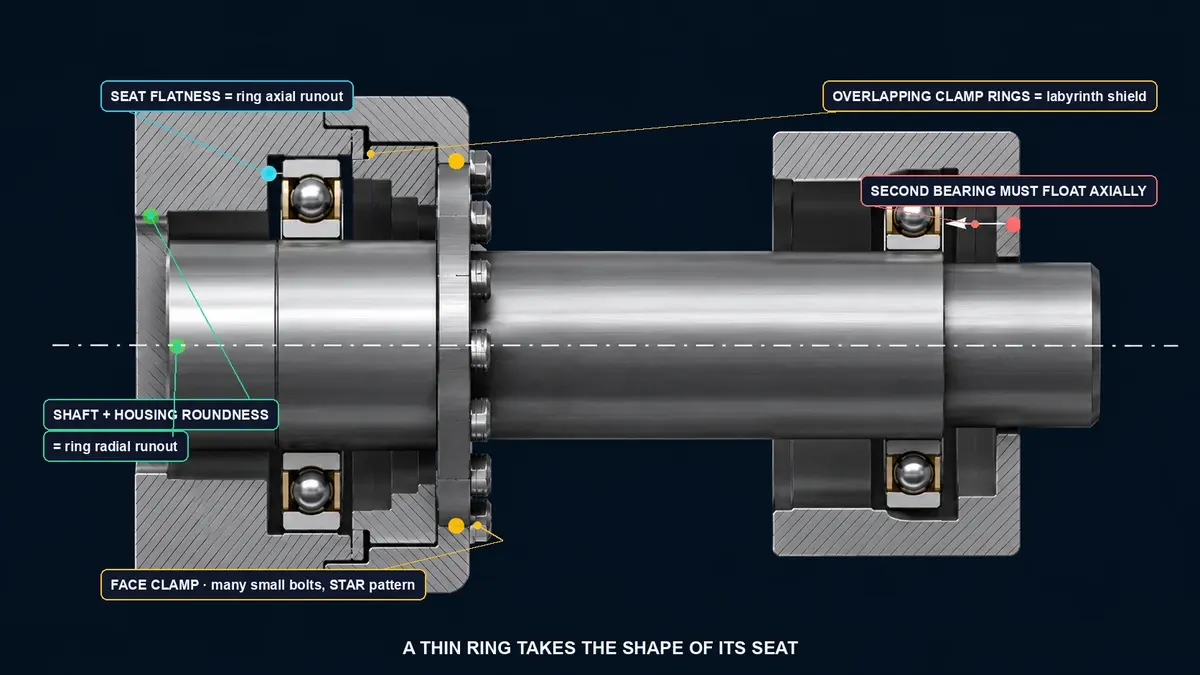
A thin ring takes the shape of the shaft and housing it is clamped to. That single fact drives every mounting rule that follows, and it is why the seat geometry, not the bearing, sets the running accuracy and torque you end up with (Kaydon).
The seat geometry rule
Kaydon states the tolerance requirement as a direct equivalence, which makes it easy to put on a drawing:
- Flatness of the bearing seats should equal the axial runout of the mating bearing ring.
- Roundness of the shaft and housing should equal the radial runout of the mating bearing ring.
Press an out-of-round housing onto a thin outer ring and the ring becomes out-of-round with it. The result is tight spots, higher friction, and early failure that no amount of bearing quality will prevent.
Arrangement rules by type
Each geometry has its own mounting logic, and two of these rules are easy to get wrong:
- Two type C bearings on a long shaft: allow one to float axially, so thermal expansion of the shaft or housing does not force thrust into a radial bearing.
- A type X bearing paired at the far end of a long shaft: make the second bearing a type C and let it float. Two type X bearings on one shaft is not recommended.
- Type A bearings: use in preloaded pairs, back-to-back or face-to-face. Two back-to-back pairs on the same shaft is not standard practice. If a third bearing supports the far end, make it a single radial or a face-to-face pair, free to float.
Orientation marks are load-bearing information
The markings on a thin section bearing are instructions, not decoration:
- Radial and four-point bearings with snap-over separators mount solid side up, pocket openings down when the shaft is within 45° of vertical. These carry an "UP" arrow. Horizontal shafts have no preferred orientation.
- A single type A bearing is marked "THRUST" with an arrow showing the direction of thrust the outer ring can take. In a back-to-back pair the arrows point away from each other; face-to-face, they point toward each other.
- Matched duplex sets carry a "V" mark across the outside and inside diameters. Align the two "V" marks with each other. They sit at the high point of radial runout, so setting them against the low point of the shaft and housing reduces assembled runout.
Fits, clamping and lubrication
Published fits assume standard clearance, steel components, and room temperature. Change any of those and the fit changes with them. Dissimilar metals shift fits with temperature, which can make a bearing radially tight in service and drive friction torque up. Where a bearing is supplied with diametral preload, allow slight clearance on both the shaft and the housing.
For clamping, use face clamps rather than relying on a press fit alone. A large number of small fasteners gives more uniform clamping than a few large ones, and they should be tightened in a star pattern. Overlapping the clamp rings to form a labyrinth shield helps keep lubricant in and contamination out.
If a press fit is unavoidable, apply uniform pressure across the whole bearing face and press only on the ring carrying the interference. Never press across the races. Where interference is significant, use heat or cold to gain clearance and let the assembly return to room temperature before torquing anything.
One detail that catches people out: open bearings ship with preservative oil, not a working lubricant. Clean them and apply a lubricant suited to the load, speed, temperature and environment before installation. Sealed bearings arrive factory-filled with general-purpose grease. Our bearing lubrication guide covers the selection, and sealed versus shielded bearings covers the closure choice.
Applications, Alternatives and How to Specify
Choose a thin section bearing when envelope or mass is the binding constraint and loads are moderate. Choose a standard series when load capacity dominates. Choose a slewing ring when moment load and diameter outgrow what a thin ring can carry.
Thin sections earn their place in robot joints and harmonic-drive outputs, medical imaging and surgical robotics, optical and radar gimbals, semiconductor handling, aerospace actuation, and antenna and camera positioners. The common thread is a large aperture, a tight envelope, and moderate load.
The most demanding published example is off-world. Kaydon Reali-Slim bearings are used on NASA's Perseverance Mars rover, in the main robotic arm, the sample-collecting turret, the tool-bit carousel and the sample handling assembly (SKF). They survived a months-long transit and now work in the Martian environment.
Where not to use one:
- Heavy radial load in a flexible or thin-walled housing, where the ring cannot be supported properly
- High speed on a type X, where four-point friction generates heat
- Pure radial load on a type X, which is what a type C is for
Thin section or slewing ring?
Both come up when moment load is the problem, and the boundary is practical rather than sharp. Reach for a slewing ring when you need integral gear teeth, a bolt-hole mounting pattern, or moment capacity beyond what a thin ring provides, and when speeds are low. Stay with a thin section when the assembly rotates continuously at moderate speed, torque must stay low, and you can machine a properly round and flat seat. Our guide to slewing bearings covers the types, the static limiting load diagram that sizes them, and the support-surface tolerances they impose.
What to put on the RFQ
Thin section bearings are ordered on more attributes than a standard bearing. Specify all of these to avoid a requote:
- Bore and section series
- Contact type: C, A or X, and the pair arrangement if applicable
- Open, sealed or shielded
- Separator material and style
- Precision class: an F class for inch thin sections, or an ISO 492 class for metric
- Internal fit or preload
- Material: 52100 chrome steel or 440C stainless, plus any plating
- Lubricant, or a note that you will lubricate on installation
- Which method produced the published load rating
ANDE's deep groove ball bearing range covers the metric thin-section series, 6800 through 6820 and 6900 through 6920, in open, shielded and sealed forms. One clarification on the four-point geometry described above. Our four-point contact ball bearings run from 30 mm to 500 mm bore as a heavy series for rolling mills and large gearboxes, so they are not a thin-section part. If you need help matching a section, a type, or an interchange, talk to our engineering team. Sourcing overseas for the first time? Our guide to sourcing Chinese bearings covers the QC questions worth asking.
Frequently Asked Questions
What is a thin section bearing?
A thin section bearing is one whose radial cross section is less than about a quarter of its bore diameter, and less than twice its ball diameter. It trades load capacity and mounting tolerance for a much smaller envelope and lower mass at the same shaft size.
Are 6800 and 6900 series bearings thin section bearings?
Yes. Both are ISO metric thin dimension series. At a 50 mm bore, a 6810's section is 0.15 times bore and a 6910's is 0.22, both under the 0.25 threshold, while a 6010 is 0.30. Their section still grows with bore, though, so they are not interchangeable with inch constant-cross-section bearings such as Kaydon Reali-Slim.
What is the difference between type C, A and X thin section bearings?
Type C is radial contact and best under radial load. Type A is angular contact, excellent for thrust in one direction, and used in matched pairs. Type X is four-point contact with Gothic-arch raceways, excellent under moment and reversing axial load but poor under pure radial load.
Why do thin section bearing load ratings differ between suppliers?
Because the ISO 281 and ABMA Standard 9 rating equations assume rigidly supported races and zero mounted clearance, which thin sections violate. Suppliers using the standard tables publish much higher numbers than those using test-based methods. One part, KAA10CL0, is rated at 150 lb by Kaydon and 558 lb by INA and NSK.
How tight do the shaft and housing need to be?
Seat flatness should match the mating ring's axial runout, and shaft and housing roundness should match its radial runout. The ring conforms to whatever it is clamped against, so an out-of-round seat produces an out-of-round bearing.
Specify the Section, Not the Reputation
Thin section bearings reward engineers who treat the geometry as a design variable rather than a catalogue lookup. Six things carry most of the value:
- The definition is a ratio, not a width: section under a quarter of bore.
- Two families share the name, and only the inch family holds a constant section.
- C, A and X map to loads, with type X the moment specialist that can replace two bearings.
- Verify the rating method before trusting any published capacity.
- Inch thin sections use F-class tolerances under ABMA 26.2, not the familiar Standard 20 scale.
- The seat geometry is the design. A thin ring is only as round as what you bolt it to.
Get the section and the type right, machine a seat worthy of them, and a bearing that fits in your palm will hold a robot joint to arc-seconds.
Browse ANDE's deep groove ball bearing range for the 68xx and 69xx thin-section series. Or send our engineering team your envelope, load case and speed, and we will work the selection with you.
About the Author
Jeff Li writes on bearing engineering and global sourcing for ANDE Bearing. He works directly with OEM and aftermarket buyers in automotive, heavy industry, and renewable energy. Connect on LinkedIn.