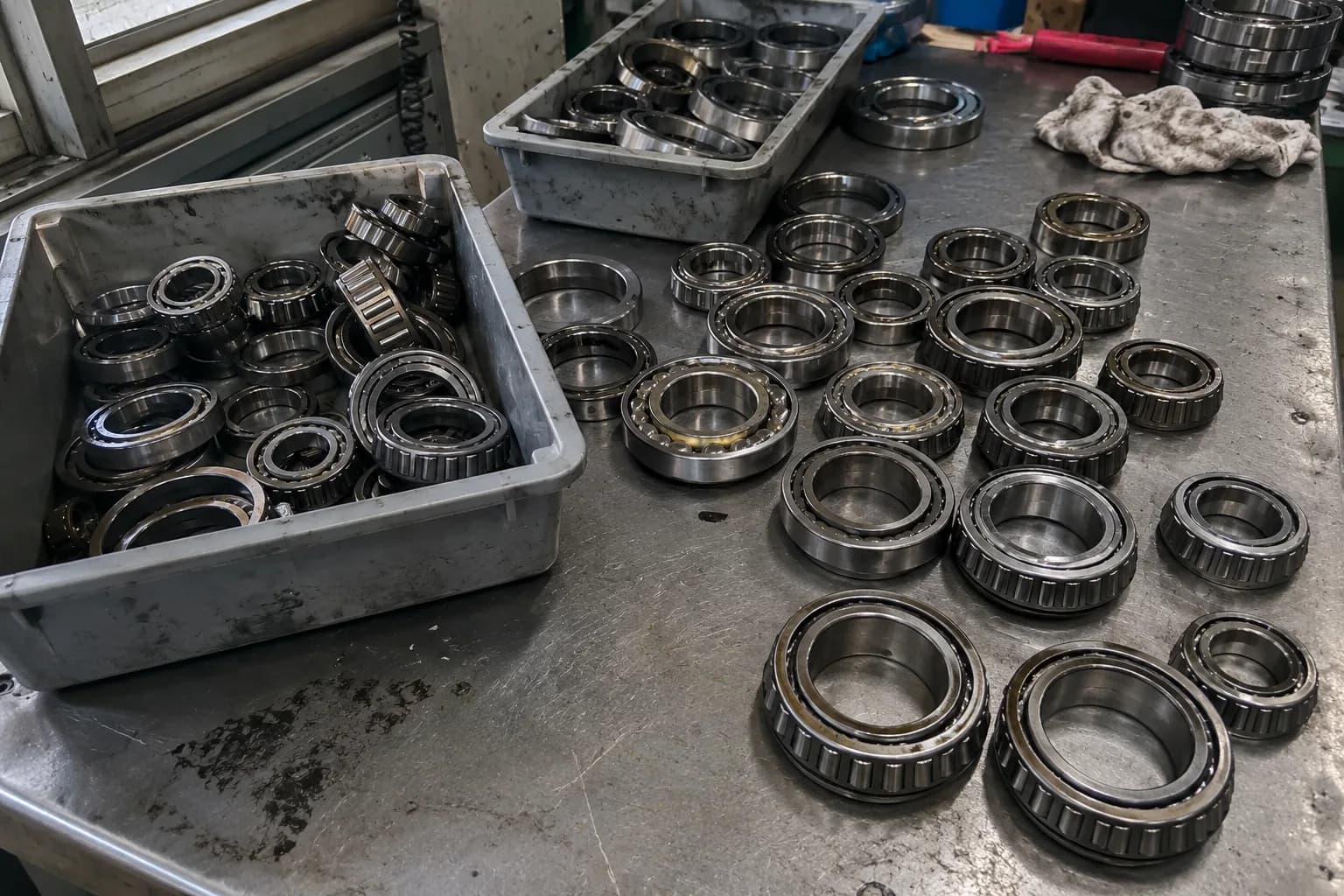
A handful of companies most people have never named move nearly every wheel, spindle, gearbox and turbine on Earth. SKF, the market leader, estimates that a small group of large manufacturers holds roughly half the global rolling-bearing market, with Chinese producers accounting for around a quarter more (SKF Investor Relations). Yet most "top bearing manufacturer" lists you'll find are undated, unsourced, and quietly leave out those Chinese firms.
This guide fixes that. It ranks the real players by sourced revenue, tells the honest China story, and — because most people searching this are here to buy — ends with how to actually choose and qualify a supplier.
Key Takeaways
- The premium tier is a "Big 8": SKF (Sweden), Schaeffler/FAG/INA (Germany), Japan's NSK, NTN, JTEKT/Koyo and MinebeaMitsumi, and Timken and RBC in the USA. SKF is the largest pure-play maker at SEK 98.7B (~USD 9.3B) in FY2024 (SKF Year-End Report 2024).
- Naïve lists rank JTEKT and MinebeaMitsumi above SKF using group revenue — but those totals are mostly steering, motors and electronics, not bearings. Rank by comparable bearing scale and SKF sits at #1.
- Chinese manufacturers hold roughly a quarter of the global bearing market (SKF, 2025), yet most lists omit them. China's bearing industry booked ≈¥231.5B (~USD 32B) and 33.7B units in 2024 (CBIA via People's Daily).
- The major Chinese players are ZWZ/Wafangdian (China's oldest, 1938), HRB/Harbin, LYC/Luoyang, and C&U Group — inside a base of nearly 3,000 manufacturers.
- "Biggest" isn't "best for you." Match quality tier to application: premium branded for critical high-speed/precision duty, a certified OEM for cost-performance on standard parts — provided you qualify the supplier and avoid the counterfeit channel (~USD 467B in fake goods traded in 2021, OECD/EUIPO).
Who Are the Largest Bearing Manufacturers?
The world's largest bearing manufacturers are SKF (Sweden), the Schaeffler Group (Germany), Japan's NSK, NTN, JTEKT and MinebeaMitsumi, and Timken and RBC in the USA. SKF leads the pure-play field with SEK 98.7B (~USD 9.3B) in net sales for FY2024 (SKF Year-End Report 2024). Together, a small group of majors holds roughly half the market.
Call them the "Big 8." They define the premium, branded tier — the names an engineer reaches for when failure is expensive. But there's a ranking trap that almost every competing list falls into, and it's worth understanding before you read the numbers.
The trap is group revenue versus bearing revenue. JTEKT reports around ¥1.9 trillion and MinebeaMitsumi around ¥1.5 trillion, which looks like they dwarf SKF. They don't — as bearing makers. JTEKT's total is mostly automotive steering and machine tools; MinebeaMitsumi's is mostly motors and electronic devices. Rank by comparable bearing scale and SKF is #1, followed by the Japanese pure-plays and Timken.
Bearing makers ranked by comparable revenue (FY2024, USD):
| Manufacturer | HQ | Comparable bearing revenue | Basis |
|---|---|---|---|
| SKF | Sweden | ~$9.3B | Pure-play (group net sales) |
| NTN | Japan | ~$5.5B | Bearing-led (group revenue) |
| NSK | Japan | ~$5.3B | Bearing-led (group revenue) |
| Timken | USA | ~$4.6B | Bearing + power transmission |
| RBC | USA | ~$1.87B | Precision bearings |
Excluded because group totals are mostly non-bearing: Schaeffler €18.2B (incl. Vitesco), JTEKT ≈¥1.9T (steering/machine tools), MinebeaMitsumi ≈¥1.5T (motors/electronics). Sources: SKF Year-End Report 2024; NSK, NTN, Timken and RBC filings via stockanalysis.com. RBC figure is the fiscal year ended March 2026.
That table is the thing no competitor shows: the actual numbers, each one traceable to a filing. What these companies make — the different kinds of bearings — is largely the same catalogue of deep-groove ball, tapered roller, spherical roller and specialty types. What separates them is scale, precision capability, and price.
The "Big 8" Global Bearing Manufacturers, Profiled
The Big 8 are the eight companies that define the branded, premium tier — the ones whose datasheets set the benchmark. Here they are with founding year, headquarters, latest revenue, and specialty. As of FY2024, SKF alone booked more revenue in pure bearings than any single competitor (SKF Year-End Report 2024).
SKF (Sweden, founded 1907). The world's #1 pure-play bearing maker. Rolling bearings plus seals, lubrication and condition monitoring. FY2024 net sales SEK 98.7B (~USD 9.3B), down about 5% from a record 2023, split roughly SEK 69.5B industrial and SEK 29.3B automotive.
Schaeffler Group (Germany; the FAG bearing line traces to Friedrich Fischer's 1883 ball-grinding invention in Schweinfurt). Automotive and industrial, under the FAG and INA brands. FY2024 revenue €18.2B — but note the Vitesco merger closed in October 2024, so that figure now folds in a large non-bearing electronics business. Treat it as group revenue, not bearing revenue.
NSK (Japan, founded 1916). Japan's oldest bearing maker. Precision and automotive bearings plus steering systems. FY2024 (year ended March 2025) revenue ≈¥796.7B (~USD 5.3B).
NTN (Japan, founded 1918). Bearings and constant-velocity joints. FY2024 (year ended March 2025) revenue ≈¥825.6B (~USD 5.5B), narrowly the largest of the Japanese bearing-led firms by top line.
JTEKT / Koyo (Japan; Koyo Seiko founded 1921, JTEKT formed by a 2006 merger). A conglomerate: steering systems, machine tools and driveline dominate the ≈¥1.9T group revenue. Koyo is the bearings arm — a fraction of that total, not the whole.
MinebeaMitsumi / NMB (Japan, founded 1951). The world leader in miniature and instrument ball bearings, the tiny precision bearings inside hard drives, dental drills and aerospace instruments. But motors and electronic devices make up most of the ≈¥1.5T group revenue.
Timken (USA, founded 1899). The tapered-roller specialist, plus a large power-transmission business. FY2024 revenue ≈USD 4.6B. If your application uses tapered roller bearings, Timken effectively invented the modern version.
RBC Bearings (USA). Aerospace, defense and industrial precision bearings, heavy on roller and plain types for demanding duty. Revenue ≈USD 1.87B (fiscal year ended March 2026).
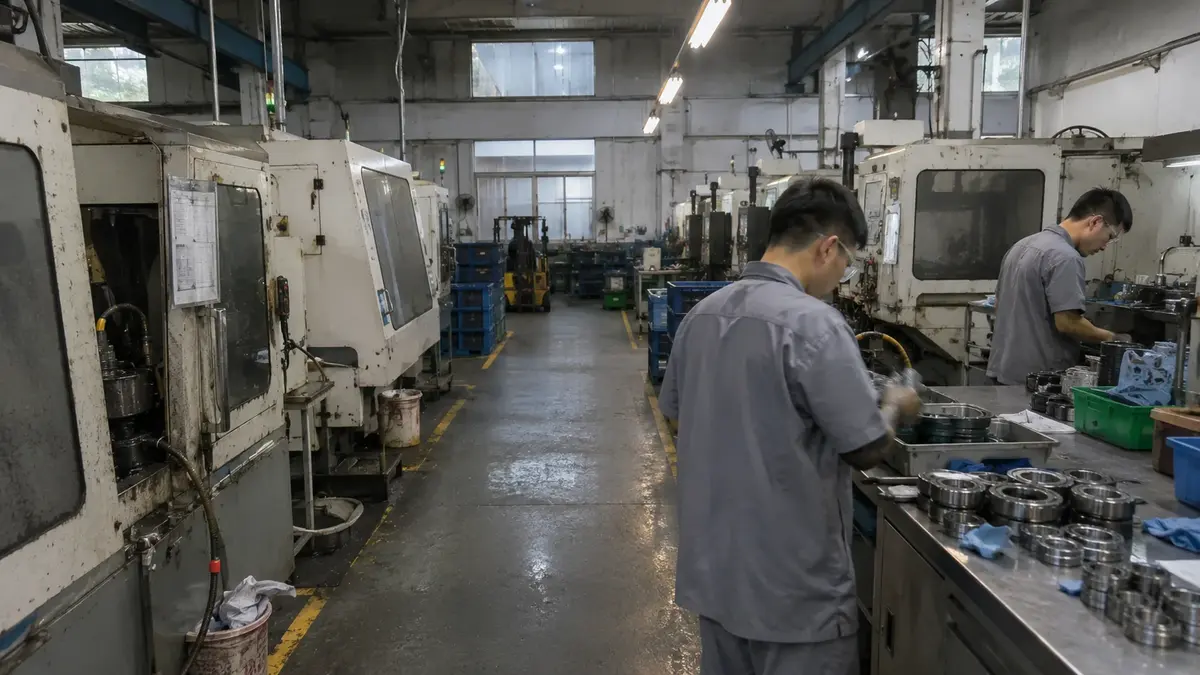
Notice the pattern: the truly enormous "bearing" numbers you'll see quoted usually belong to conglomerates where bearings are one division among several. That's not a knock on JTEKT or MinebeaMitsumi — they're superb engineering companies. It's just a reason to read revenue tables carefully. When a buyer needs the value alternative to this branded tier, that's where certified Chinese OEMs enter — and a step-by-step sourcing process matters more than the badge.
Chinese Bearing Manufacturers — The Quarter of the Market Nobody Ranks
Chinese manufacturers hold roughly a quarter of the global bearing market (SKF), yet most "top" lists omit them or bury them at #9–10 without context. In 2024, China's bearing industry generated ≈¥231.5B (~USD 32B) in revenue on 33.7B units — output up 17.3% year on year (CBIA via People's Daily). The majors are ZWZ, HRB, LYC and C&U.
Who are they, really?
ZWZ / Wafangdian Bearing Group (Liaoning, founded 1938). The birthplace of China's bearing industry and its oldest maker. Strong in large and extra-large bearings for wind, rail and heavy machinery. Only its listed subsidiary reports verifiable revenue, so treat any "whole-group" figure with care.
HRB / Harbin Bearing (Heilongjiang). One of the historic "big three" state makers alongside ZWZ and LYC. Consistently regarded as top-tier domestically. No reliable consolidated public revenue in English, so it's best described qualitatively — by standing and specialty, not a number.
LYC / Luoyang Bearing (Henan, founded 1954). The broadest range in China, from roughly 10 mm to 13,500 mm in diameter, including slewing rings and precision bearings. Home to the country's deepest bearing-engineering talent pipeline.
C&U Group (Zhejiang, founded 1991). Widely described as China's largest bearing maker by volume, built around the huge Cixi–Ningbo export cluster. Its revenue figures circulate on low-authority sources, so treat them as "reportedly," not confirmed.
The geography tells the real story. Wafangdian in the northeast owns large, wind and rail bearings; Luoyang owns precision and slewing; the Cixi–Ningbo belt in Zhejiang is the world's biggest export base for miniature deep-groove bearings; and Shandong's Liaocheng cluster supplies cages and trading. Nearly 3,000 manufacturers operate across these hubs (IBISWorld).
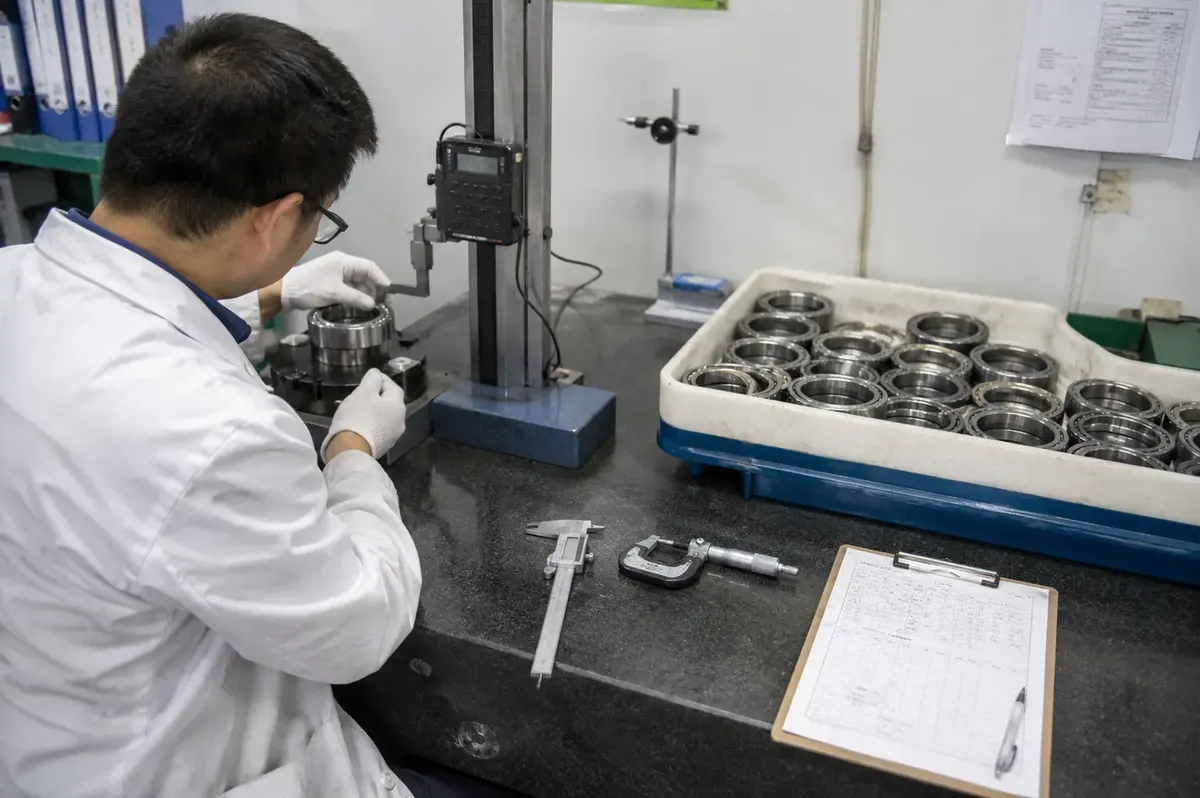
Here's the honest positioning, from inside it: ANDE is part of this credible, large manufacturing base — the "other quarter" of the market — offering certified quality at strong cost-performance. That's not an outlier claim. It's a quarter of global supply. The real question for a buyer isn't whether Chinese makers are legitimate; it's how to separate the qualified ones from the traders, which is exactly what a disciplined step-by-step sourcing process is for. The counterfeit risk is real too, and we cover how to dodge counterfeit bearings further down.
Bearing Manufacturers by Country and Region
Bearing manufacturing concentrates in four regions: Japan (home to the most global-scale makers by count — NSK, NTN, JTEKT, MinebeaMitsumi, plus Nachi and IKO), Europe (SKF and Schaeffler), the USA (Timken and RBC), and China (the volume base). Asia-Pacific is the largest market too, at about 41% of global demand in 2025 (Precedence Research).
Why does Japan hold so many of the Big 8? A century of precision-manufacturing culture, plus a domestic automotive and machine-tool industry that demanded high-volume, high-quality bearings early. Europe's two majors sit at the premium engineering end. The US pair occupy defensible niches — Timken in tapered rollers and power transmission, RBC in aerospace and defense precision. China supplies the volume and, increasingly, the quality.
Global bearing market by region (2025):
| Region | Share of global market | Leading makers |
|---|---|---|
| Asia-Pacific | ~41% | NSK, NTN, JTEKT, MinebeaMitsumi, Chinese majors |
| Europe | part of ~59% | SKF, Schaeffler |
| North America | part of ~59% | Timken, RBC |
Source: Precedence Research, Bearing Market, 2026. Asia-Pacific is the single largest regional market; Europe and North America together make up most of the balance.
There's a heritage angle worth noting: the oldest names carry the deepest process knowledge. Timken (1899), SKF (1907) and NSK (1916) had decades to refine heat-treatment and grinding before C&U (1991) even existed. That head start is real — but it narrows every year as Chinese makers invest in the same German and Swiss grinding lines the incumbents use.
How Big Is the Global Bearing Market?
Independent research firms put the global bearing market at roughly USD 130–175 billion for 2024–25, with 2030–2035 forecasts spanning about USD 93B to USD 356B. The spread reflects scope, not error — "all bearings" versus "industrial-only" versus rolling-only. Precedence Research pegs the all-bearings market at USD 145B in 2025, growing to USD 356B by 2035 at a 9.4% CAGR (Precedence Research).
Read any single "global bearing market size" number with suspicion. Publishers diverge by roughly 3× because they measure different things. Mordor Intelligence tracks industrial bearings only and lands near USD 55B for 2025, rising to ~USD 93B by 2031 (Mordor Intelligence) — far below the all-bearings figure because it excludes automotive and a lot else. Neither is wrong; they answer different questions.
What's consistent across sources: automotive is the largest single application segment, roller bearings are the largest product category, and the supplier side is highly concentrated. That concentration is the number that matters most to a buyer.
Who holds the rolling-bearing market (SKF's market-structure estimate):
| Supplier group | Approx. share | Who's in it |
|---|---|---|
| Western + Japanese majors | ~50% | The Big 8 branded tier |
| Chinese makers | ~25% | ZWZ, HRB, LYC, C&U + export OEMs |
| All others | ~25% | Regional and specialty makers |
Source: SKF Investor Relations market estimate, 2025. Shares are approximate and illustrative of market structure — a quarter of global rolling-bearing supply is Chinese, a structural share, not a fringe.
For readers cross-referencing segment sizes, our guides on thrust bearings and what ball bearings are used for cite the application-level markets that roll up into these totals.
Premium Branded vs. Value OEM: How to Choose a Manufacturer
The right manufacturer isn't automatically the biggest — it's the one whose quality tier matches your application. Pay for premium branded (SKF, Schaeffler, NSK) where failure is expensive or speed and precision are extreme. A certified OEM is the smart call for standard industrial parts where cost-performance wins. Chinese makers already supply roughly a quarter of the world's bearings (SKF) — the value tier isn't fringe.
When does premium branded win? When the cost of failure dwarfs the cost of the bearing: high-speed machine-tool spindles, aerospace and safety-critical duty, or applications needing extreme precision. If you're specifying tight precision classes, the branded tier's process consistency and global service network justify the premium.
When does a certified OEM win? Standard deep-groove and roller bearings in general industrial duty, price-sensitive volume, and private-label or OEM programs where you want your own brand on a well-made part. The honest caveat: "cheap" is not the same as "value." An unqualified supplier or a grey-market channel is exactly where quality collapses — which is the whole point of the qualification step in the next section.
From our production floor: what separates a real OEM from a trader isn't the price on the quote — it's what happens upstream of it. In-house heat treatment and grinding, traceable bearing steel (52100) with mill certificates, and inspection gates between operations. A trader can quote any SKU; only a manufacturer can show you the process behind it.
Match tier to application:
| Application profile | Premium branded | Certified OEM |
|---|---|---|
| Safety-critical / aerospace | ✓ | — |
| High speed (>10,000 rpm) or tight precision | ✓ | — |
| Standard industrial duty, general speed | Optional | ✓ |
| High volume, cost-sensitive | — | ✓ |
| Private-label / OEM program | — | ✓ |
Most industrial buyers live in the bottom three rows. That's not a compromise — it's matching spend to the actual failure risk. Choosing between a deep-groove and an angular-contact bearing, or sealed versus shielded, affects service life far more than the badge on the box.
How to Qualify and Source From a Bearing Manufacturer
Whichever tier you choose, qualify the manufacturer the same way: verify certifications (ISO 9001, and IATF 16949 for automotive), approve samples before volume, confirm MOQ and lead time, and buy through a traceable channel. That last point isn't paperwork — the OECD and EUIPO put global counterfeit trade at about USD 467B in 2021, roughly 2.3% of world trade (OECD/EUIPO).
The supplier-qualification checklist that actually protects you:
- Certifications, verified — not claimed. Ask for the ISO 9001 / IATF 16949 certificate number and the issuing body, then check it. A logo on a PDF is not a certification.
- Sample and PPAP approval. Dimensional inspection, hardness, noise and runout on real samples before you commit volume. Spec the bearing before you RFQ so you're comparing like for like.
- Capacity and lead time. Confirm the factory can hold your schedule, not just your first order.
- OEM / private-label capability. If you need your own brand or packaging, confirm it upfront — it changes tooling and MOQ.
- Traceability and after-sales. Lot traceability back to the steel heat, and a named contact when something goes wrong. China accounts for a large share of counterfeit seizures, so buying direct from a verifiable manufacturer — not an anonymous marketplace listing — is the single best defense.
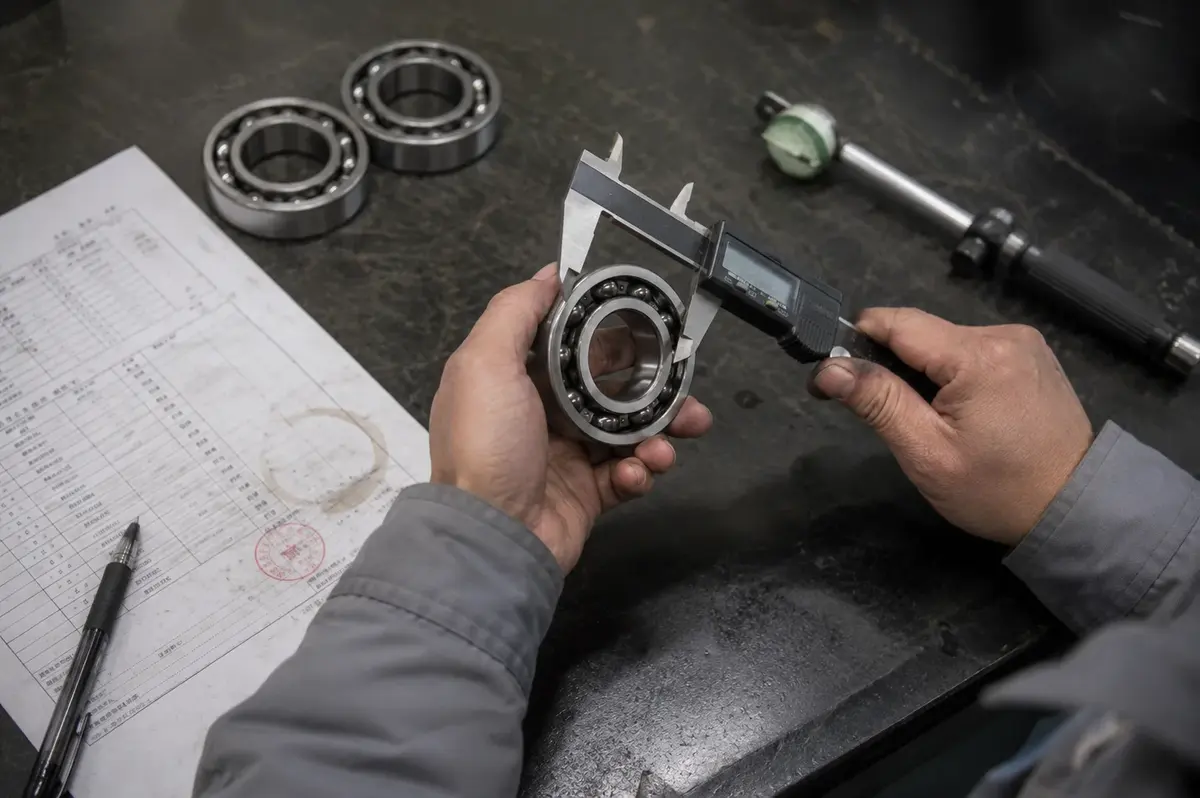
How overseas buyers actually vet us: the serious ones don't lead with price. They ask for the IATF certificate and audit history, request samples for their own lab, ask who owns the tooling, and want to know lead time under load — not best case. The buyers who only ask "what's your cheapest 6205?" are the ones who end up in the grey market. A good manufacturer welcomes the hard questions.
Everything above is the short version of a full step-by-step sourcing process — the structured workflow for shortlisting, qualifying and running a Chinese bearing supplier from overseas.
The Verdict — Who Should You Actually Buy From?
For most overseas industrial buyers, the answer isn't "the #1 name on the list." It's the qualified manufacturer whose tier, certifications and lead time fit your part. Premium branded for critical duty; a vetted, certified OEM for cost-performance at scale. With Chinese makers holding around a quarter of global supply (SKF), the value tier is a mainstream choice, not a gamble — if you qualify the supplier.
So use the list the right way. The Big 8 tell you who sets the engineering benchmark. The revenue table tells you who's genuinely largest, once you strip out conglomerate padding. The China section tells you where the value tier really is. And the qualification checklist turns all of that into a decision you can defend to your own engineering team.
ANDE is a certified Chinese manufacturer serving overseas buyers with OEM and private-label programs, in-house heat treatment and grinding, and structured QC. If that's the tier your application needs, browse ANDE's bearing range and contact our team for a quote or OEM program — or read the full overseas sourcing guide first.
Frequently Asked Questions
Q: Who is the largest bearing manufacturer in the world?
By pure-play bearing revenue, SKF of Sweden is the largest, with SEK 98.7B (~USD 9.3B) in FY2024 net sales. Schaeffler, JTEKT and MinebeaMitsumi report larger group totals, but those include big non-bearing businesses — steering, motors, electronics — so they aren't apples-to-apples bearing revenue. Rank by comparable bearing scale and SKF sits at #1.
Q: What are the top 10 bearing brands?
The premium tier is SKF, Schaeffler (FAG/INA), NSK, NTN, JTEKT (Koyo), Timken, MinebeaMitsumi (NMB) and RBC. Add China's ZWZ (Wafangdian) and LYC (Luoyang) and you have a defensible top 10 that reflects the ~25% of the market Chinese makers hold — which most lists leave out entirely.
Q: Which bearing brand is best — SKF, FAG or NSK?
All three are premium-tier makers, and "best" depends on the application, not the badge. FAG (Schaeffler) is strong in automotive and industrial; NSK in precision and steering; SKF across the broadest range plus seals and monitoring. Match the precision class and bearing type to your duty rather than picking on brand loyalty.
Q: What are the biggest bearing manufacturers in China?
The majors are ZWZ (Wafangdian, China's oldest, founded 1938), HRB (Harbin), LYC (Luoyang, founded 1954) and C&U Group (founded 1991), within a base of nearly 3,000 manufacturers. China's bearing industry generated ≈¥231.5B (~USD 32B) in 2024 and holds roughly a quarter of the global market.
Q: How do I choose a bearing supplier?
Match the quality tier to your application, then qualify the manufacturer the same way regardless of tier: verify ISO 9001 / IATF 16949 certifications, approve samples before volume, confirm MOQ and lead time, and buy through a traceable channel to avoid the counterfeit market. A step-by-step sourcing process turns that into a repeatable workflow.