Every machine that moves has something in common: it depends on bearings to do it smoothly. From the wheel on a skateboard to the turbine shaft of a jet engine, bearings are what allow one component to rotate or slide against another with minimal friction and controlled load distribution. SKF lists deep-groove ball bearings alone as "the most widely used bearing type" (SKF), and they are only one of eleven distinct categories you'll meet below.
Yet most people couldn't name more than one or two types, and even engineers sometimes rely on rules of thumb rather than a deep understanding of the options available. This guide cuts through that. If you're more interested in who manufactures these bearings — the companies, their revenue and the market structure — start there. Whether you're a curious reader, a student, or a professional brushing up on fundamentals, you'll come away with a clear, working knowledge of the different kinds of bearings, how each one functions, and why each exists.
Key Takeaways
- Bearings reduce friction by either rolling contact (balls or rollers) or sliding contact (a lubricated film).
- Deep-groove ball bearings are the most widely produced rolling bearing in the world.
- Roller bearings carry significantly higher loads than ball bearings of the same size because line contact replaces point contact.
- Bearing service life follows the L10 formula in ISO 281:2007: inversely proportional to the cube of the load for ball bearings, and the 10/3 power for roller bearings.
What Is a Bearing?
A bearing is a machine element that constrains relative motion between two parts to a single desired direction, typically rotation or linear translation, while reducing friction and supporting mechanical loads. The first patented ball bearing dates to 1869 (Jules Suriray's velocipede hub patent), and modern bearing terminology is standardized in ISO 5593 (Rolling bearings — Vocabulary).
Every bearing achieves this through one of two fundamental mechanisms:
- Rolling contact: balls or rollers interpose between the moving surfaces, replacing sliding friction with much lower rolling friction.
- Sliding contact: a lubricated surface layer separates the moving parts, letting them glide rather than grind.
Every bearing in existence is a variation or combination of these two principles.
What Are the Main Types of Bearings?
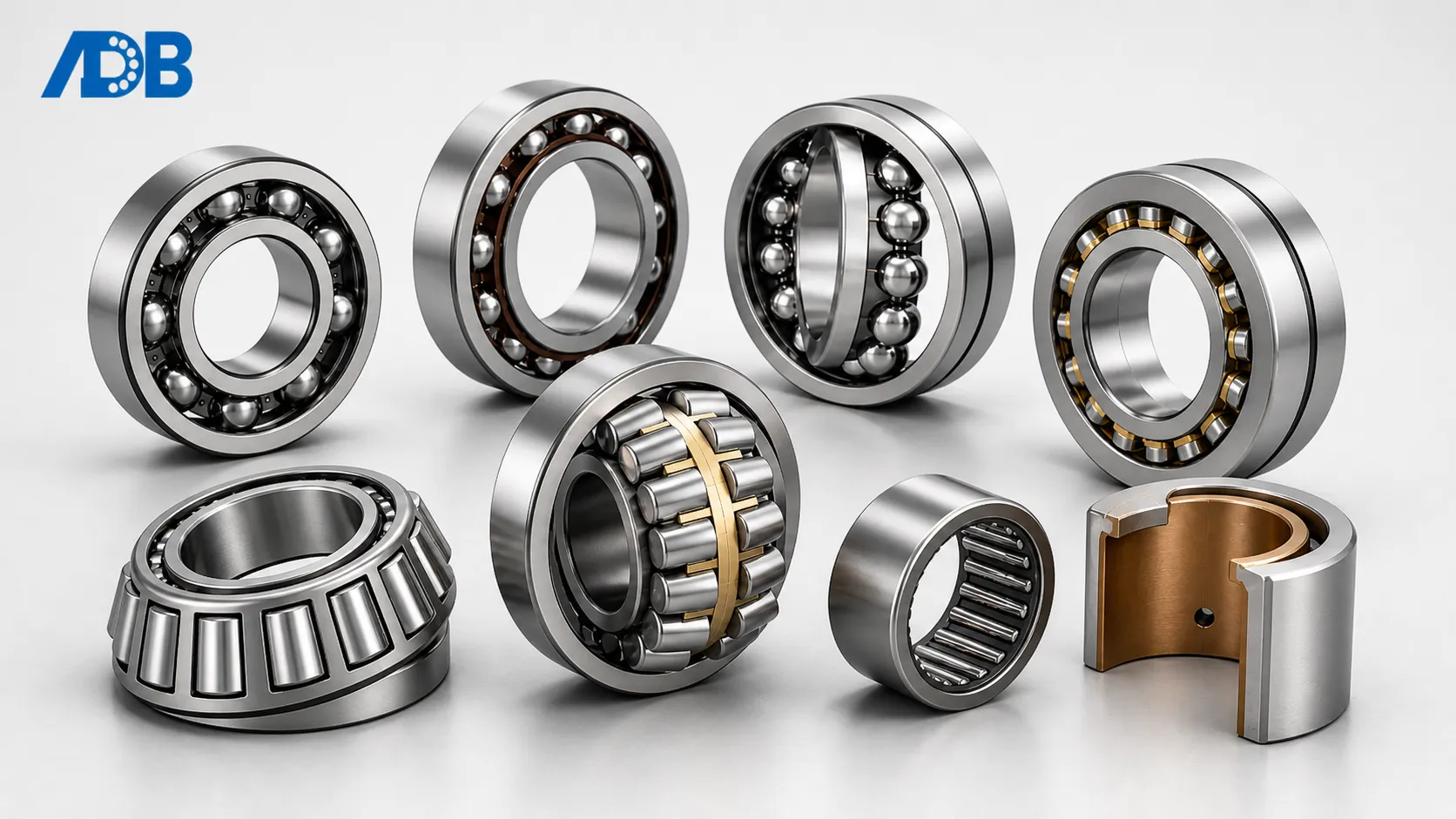
Industry handbooks classify bearings along three axes: contact mechanism (rolling or sliding), load orientation (radial, axial, or combined), and rolling-element geometry (ball, cylinder, taper, sphere, or needle). Per ISO 5593, the eleven functional categories below cover essentially every bearing in industrial use today.
1. Ball Bearings
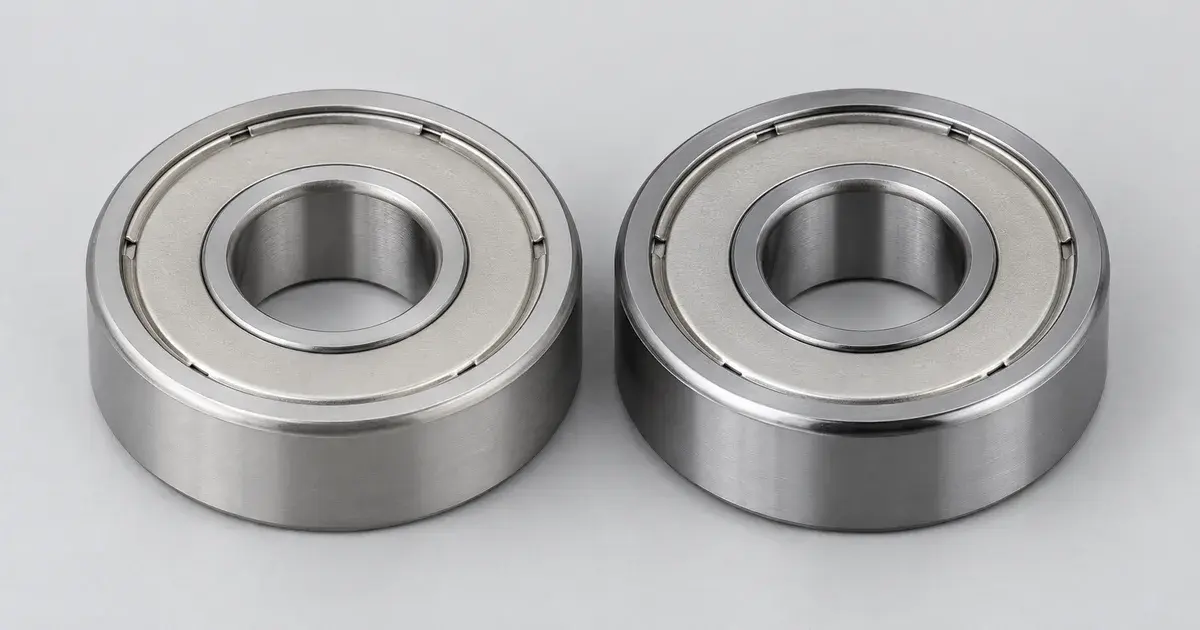
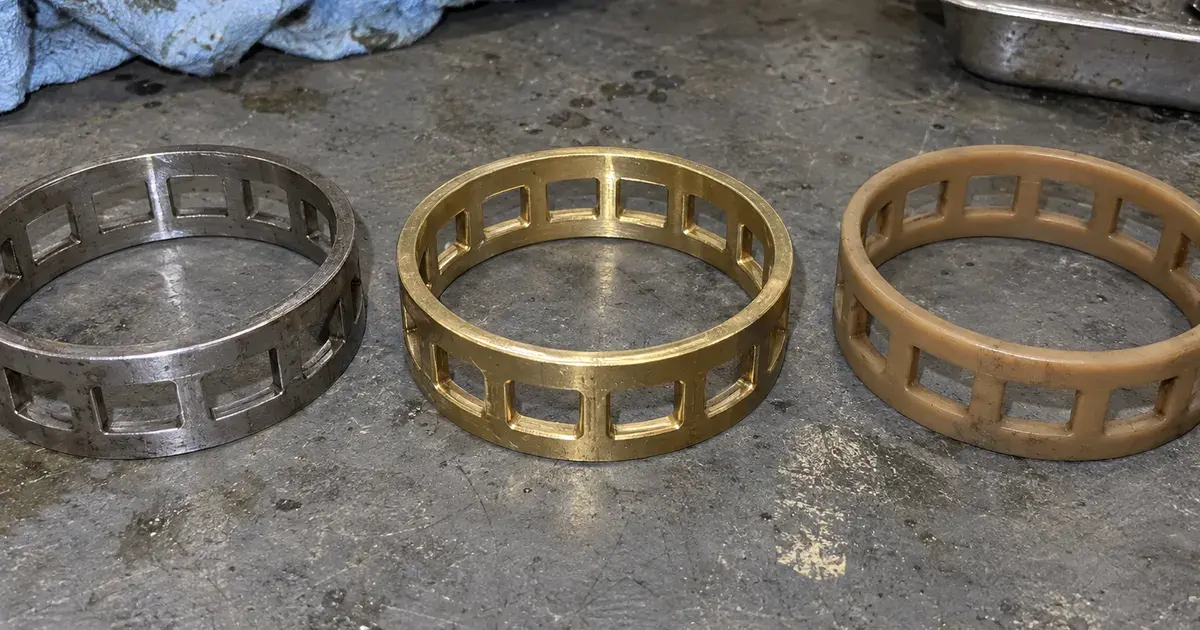
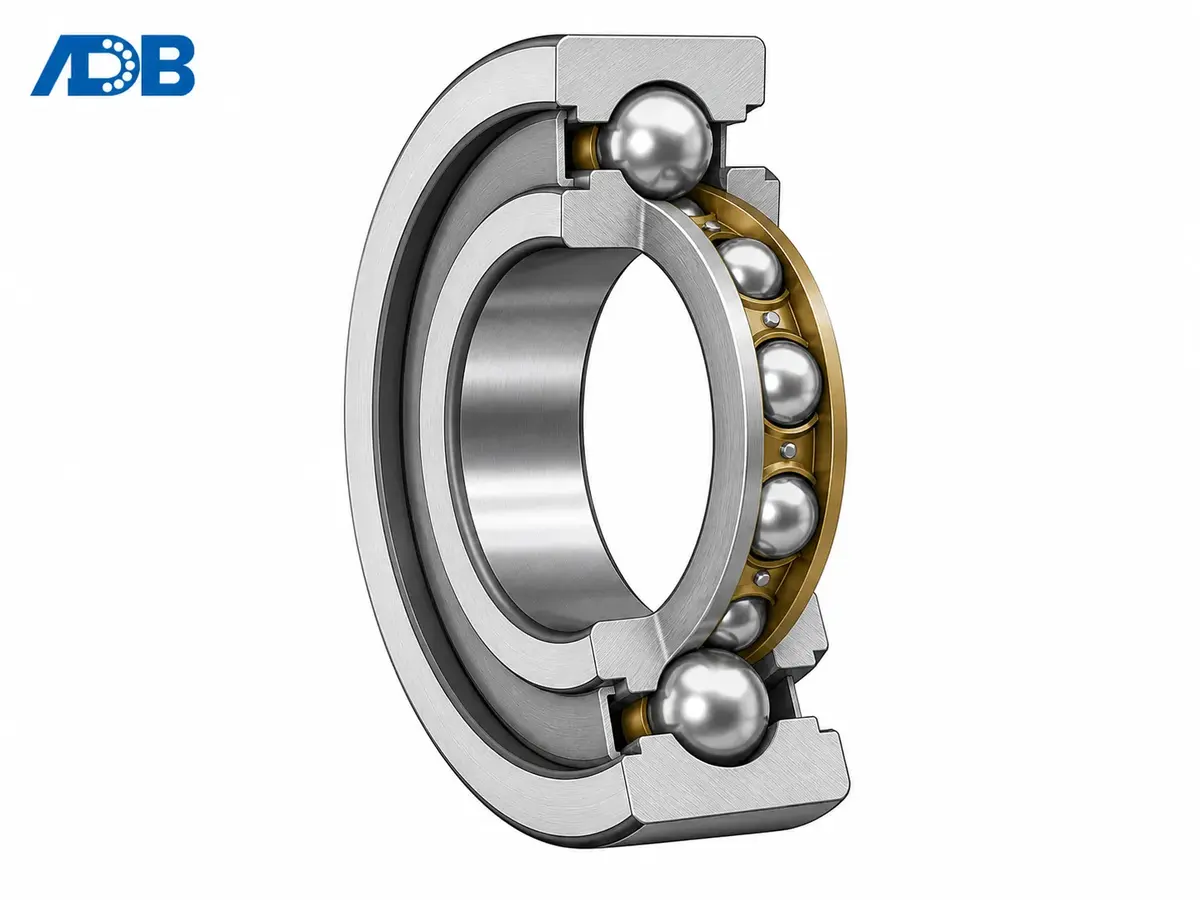
Ball bearings are the most widely produced rolling bearing in the world. Per ISO 15 (Rolling bearings — Radial bearings, boundary dimensions), the standard deep-groove design uses an inner ring, an outer ring, a set of hardened steel balls, and a cage that keeps the balls evenly spaced. When a load is applied, the balls roll between the rings and transmit force through point contact.
How they work: because contact between a sphere and a flat surface is theoretically a single point, rolling resistance is extremely low. That makes ball bearings excellent for applications where speed is critical and loads are moderate.
Key subtypes:
- Deep groove ball bearings: the most common bearing in existence. The raceway grooves are deep relative to the ball diameter, enabling them to carry both radial loads (perpendicular to the shaft) and modest axial (thrust) loads simultaneously. Found in electric motors, gearboxes, pumps, and household appliances.
- Angular contact ball bearings: the inner and outer rings are offset so the load is transmitted at a defined contact angle. Per major manufacturer catalogs (SKF, NSK, Schaeffler), standard angles are 15°, 25°, and 40°. The geometry handles combined radial and axial loads efficiently. Used in machine-tool spindles, high-speed pumps, and automotive wheel hubs (often as double-row angular-contact bearing units). To choose a contact angle and decode DB, DF, or DT pair mounting and preload, see our angular contact bearing selection guide.
- Self-aligning ball bearings: feature a spherical outer raceway that lets the inner ring tilt relative to the outer, compensating for shaft deflection or misalignment. Common in agricultural machinery, conveyors, and textile equipment.
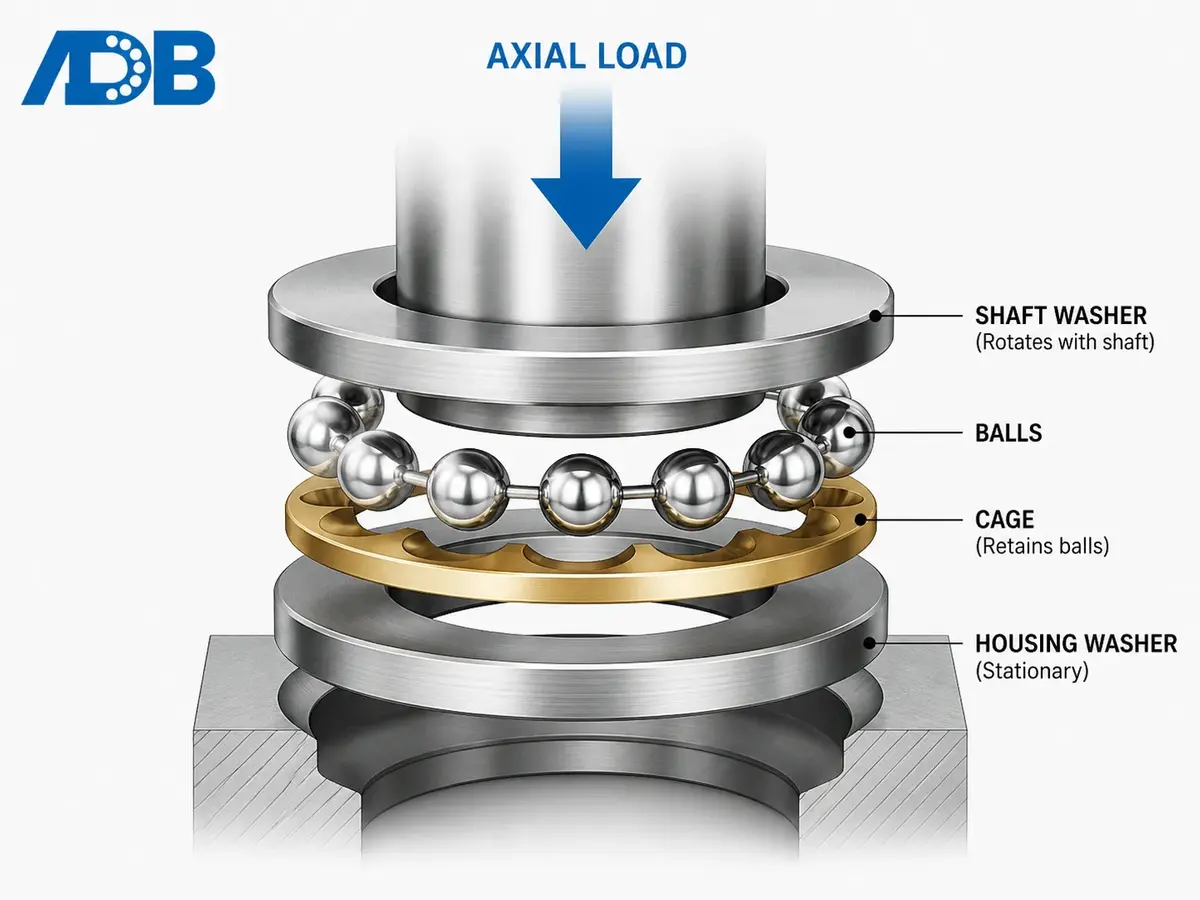
- Thrust ball bearings: designed exclusively for axial loads; they cannot support radial loads. Used in automotive clutch release mechanisms and vertical pump thrust applications.
- Thin section ball bearings: any of the above geometries built with a radial cross section under about a quarter of the bore, trading load capacity for a much smaller envelope at the same shaft size. The metric 6800 and 6900 series are the common catalogue form. Used in robot joints, gimbals, medical imaging, and anywhere envelope or mass is the binding constraint.
Limitations: ball bearings have relatively limited load capacity because of their point contact. Under heavy loads, the contact stress can cause premature raceway fatigue.
2. Roller Bearings
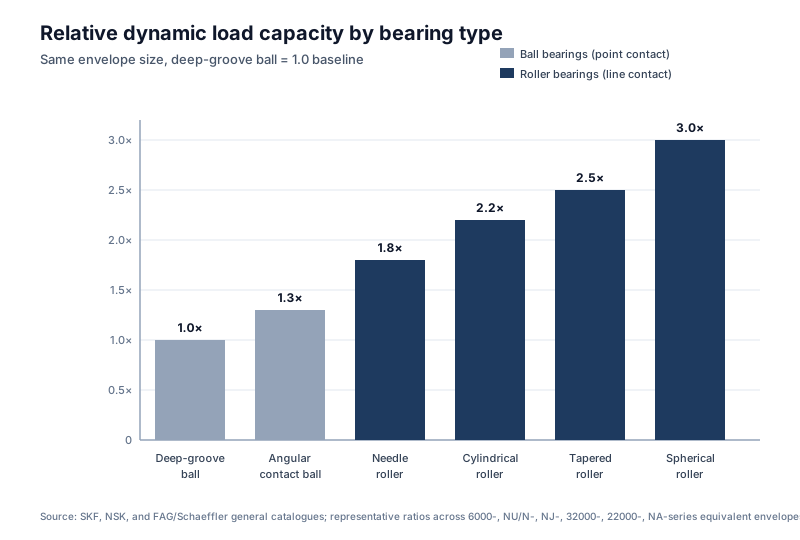
Where ball bearings use spheres, roller bearings use cylindrical, tapered, or barrel-shaped rolling elements. The critical difference is contact geometry: a roller contacts its raceway along a line rather than a point. Line contact distributes load over a larger area, which is why a roller bearing typically carries 1.5 to 3 times the dynamic load of a ball bearing of the same envelope size (per published basic load ratings in SKF, NSK, and FAG/Schaeffler catalogs).
Key subtypes:
- Cylindrical roller bearings: rolling elements are parallel cylinders. They carry very high radial loads but typically cannot handle axial loads (unless flanges are added). Used in large electric motors, rolling mills, and railway axles.
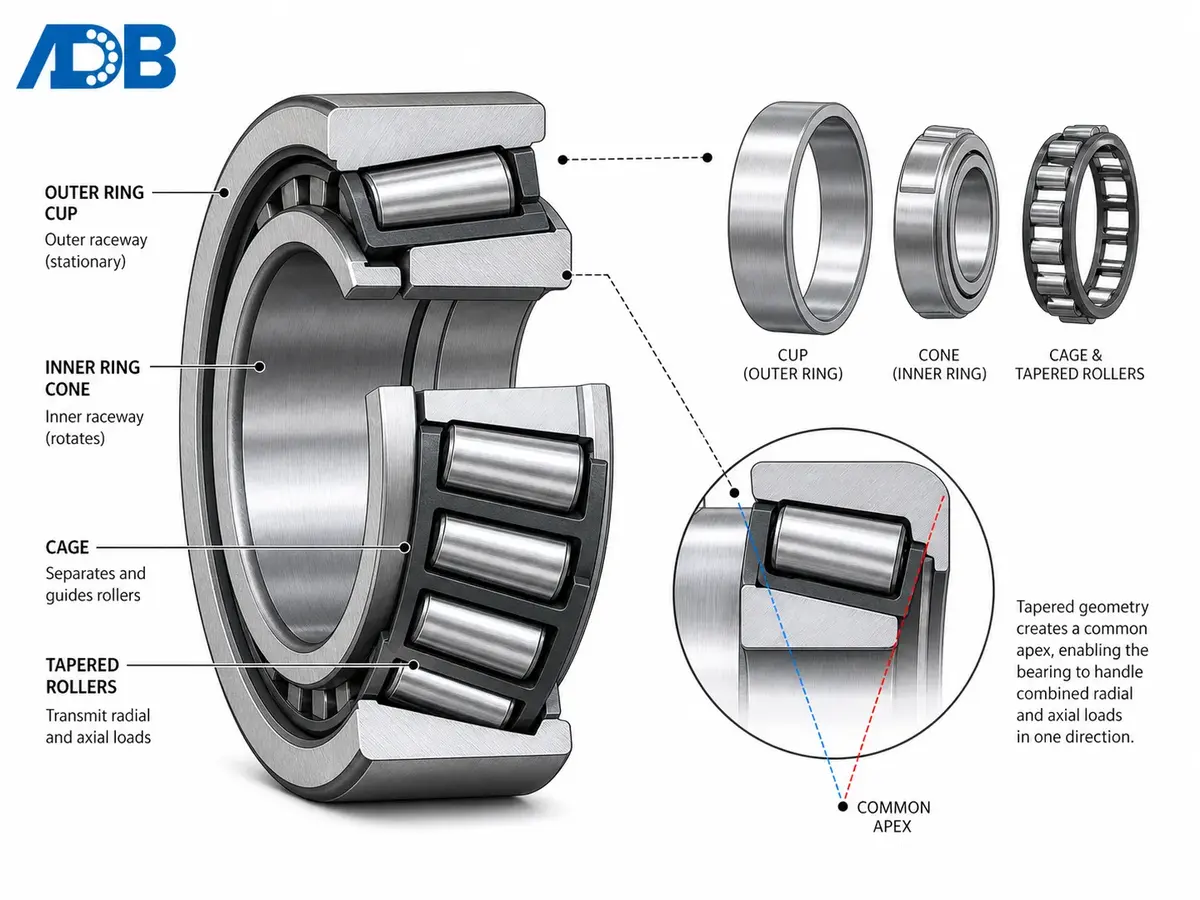
- Tapered roller bearings: both the rollers and the raceways are conical. This geometry allows the bearing to carry large radial loads and substantial one-directional axial loads simultaneously. They are one of the most important bearing types in automotive engineering, used in vehicle wheel hubs, differential housings, and transmissions. Tapered roller bearings must be installed in opposing pairs to manage bidirectional thrust; common arrangements include back-to-back (O-arrangement) and face-to-face (X-arrangement), each suited to different moment-load and alignment conditions.
- Spherical roller bearings: barrel-shaped rollers sit in a spherical outer raceway. Like self-aligning ball bearings, this design accommodates significant shaft misalignment or deflection, but with far higher load capacity. Found in mining equipment, paper mills, and heavy industrial gearboxes.
- Needle roller bearings: extremely slender rollers. Per ISO 5593, a needle roller's length is generally between three and ten times its diameter, with the diameter itself usually no greater than 5 mm. Their small cross-section makes them ideal where radial space is limited. Common in automotive rocker arms, two-stroke engine connecting rods, and universal joints. Our complete guide to needle roller bearings covers the four structural families, designations, and selection in detail.
- Toroidal roller bearings: a modern development combining the misalignment tolerance of spherical roller bearings with the ability to accommodate axial displacement without generating axial force. Used in paper machines and certain industrial drivetrains.
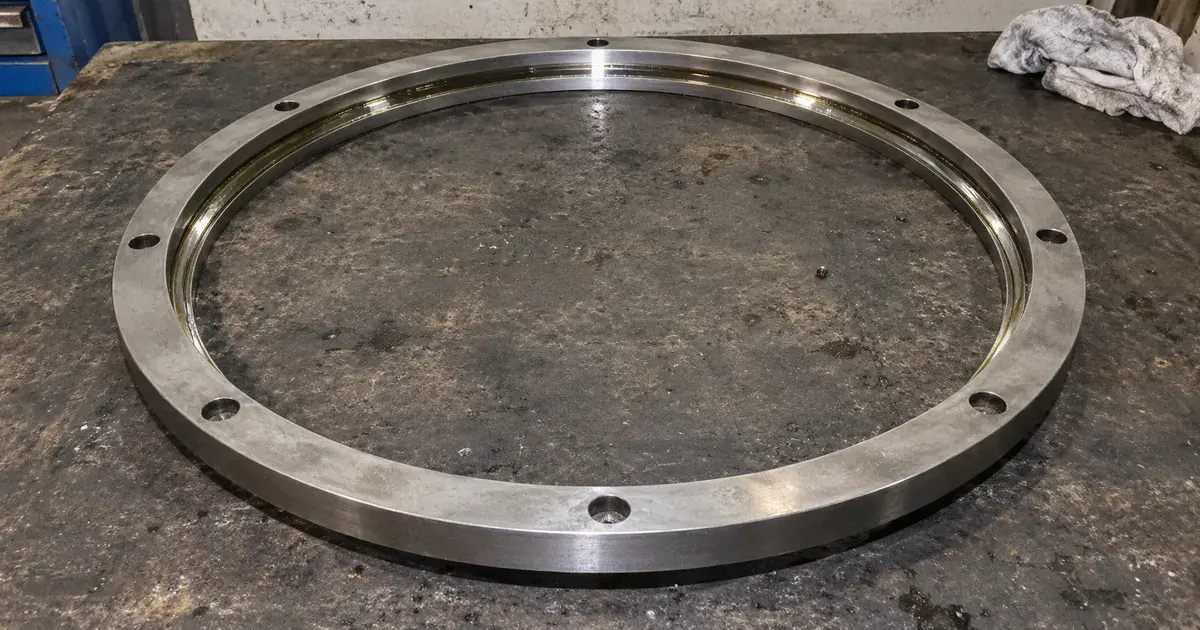
- Slewing bearings (slewing rings): large-diameter rings, from 50 mm to 14,000 mm outside diameter, that carry axial load, radial load and tilting moment together while turning slowly, usually with an integral gear and a bolt circle in each ring. Built in ball and roller forms, and used for crane and excavator superstructures, wind-turbine yaw, and rotary platforms. Our guide to slewing bearings covers the six types and how they are sized.
3. Linear Bearings
Linear bearings support and guide shafts in precise, directional reciprocating motion along their axis, extending the rolling or sliding principles from rotary to linear movement. In automation equipment and precision instruments, they are an indispensable foundation.
Key subtypes:
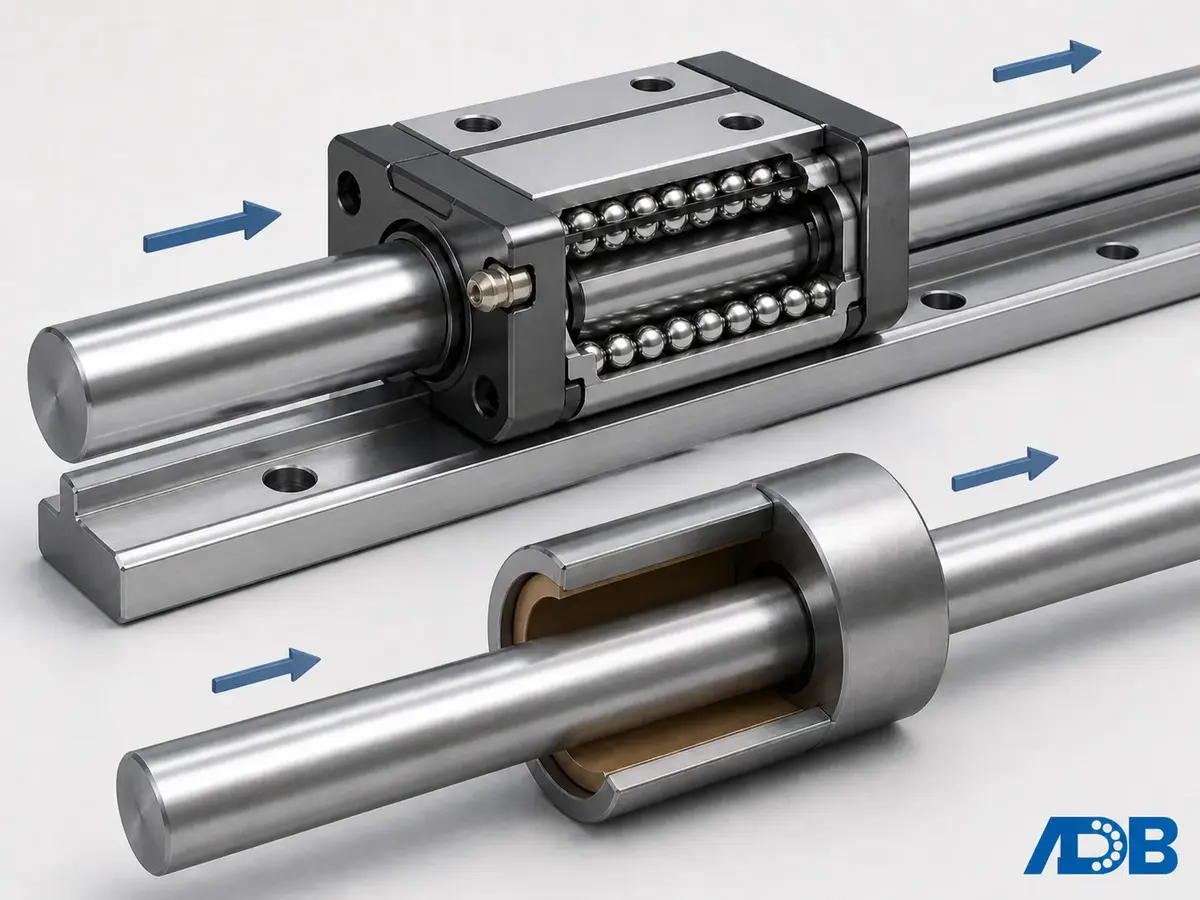
- Ball-type linear bearings: use a recirculating ball circuit so steel balls roll inside a closed track. Per the THK General Catalogue, the resulting coefficient of friction is roughly 0.002 to 0.003, comparable to that of a rolling-element bearing under similar load. Widely used in 3D printers, CNC machines, semiconductor packaging equipment, and general automation slides.
- Plain linear bearings: employ self-lubricating bushings (such as sintered bronze or PTFE composites) in direct contact with the shaft. More compact, with no rolling elements, they run quietly and resist contamination well. Suitable for moderate-load, moderate-precision reciprocating mechanisms like packaging machinery and medical device guides.
The key distinction between linear and rotary bearings is the form of motion: linear bearings carry radial loads perpendicular to the direction of travel while allowing free axial sliding. Selection must consider stroke length, guidance accuracy, and moment-load capacity.
4. Plain Bearings (Sleeve or Journal Bearings)
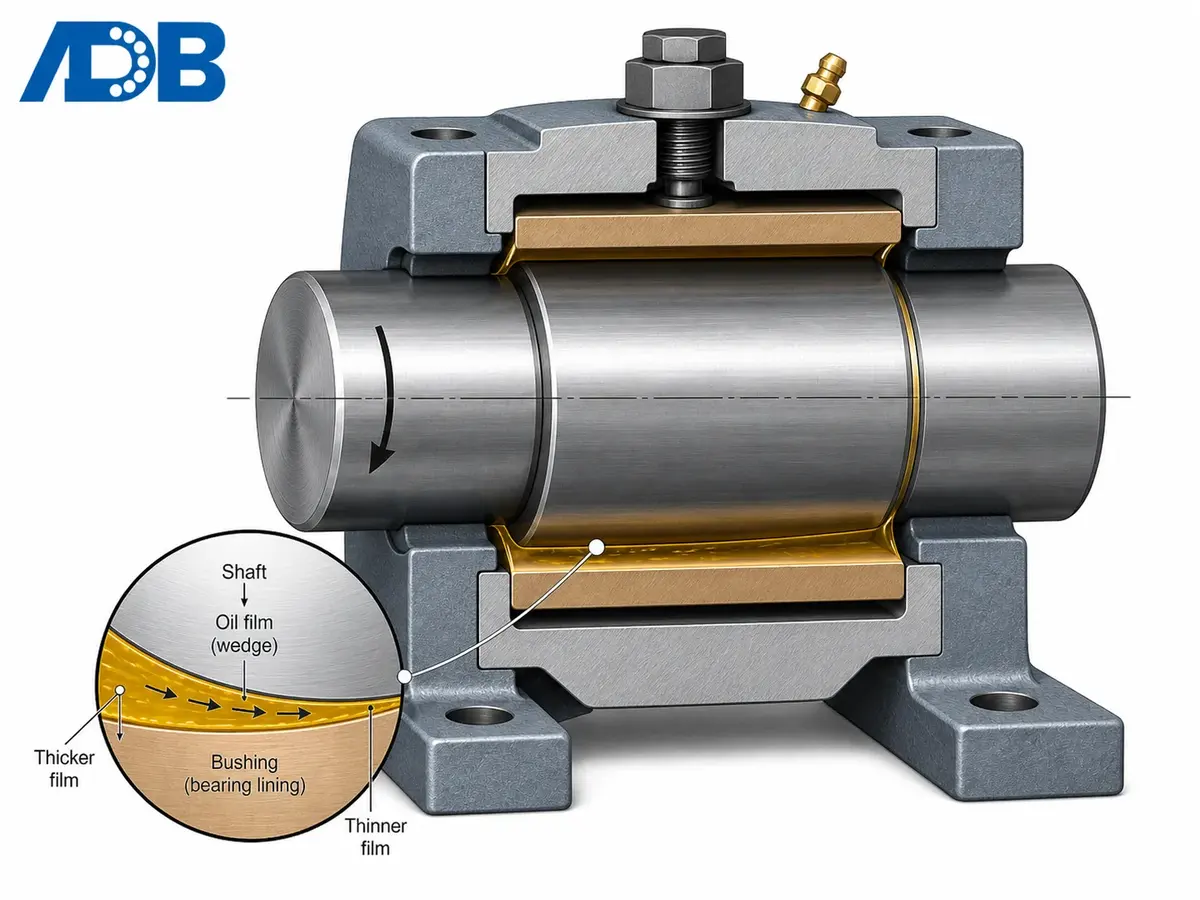
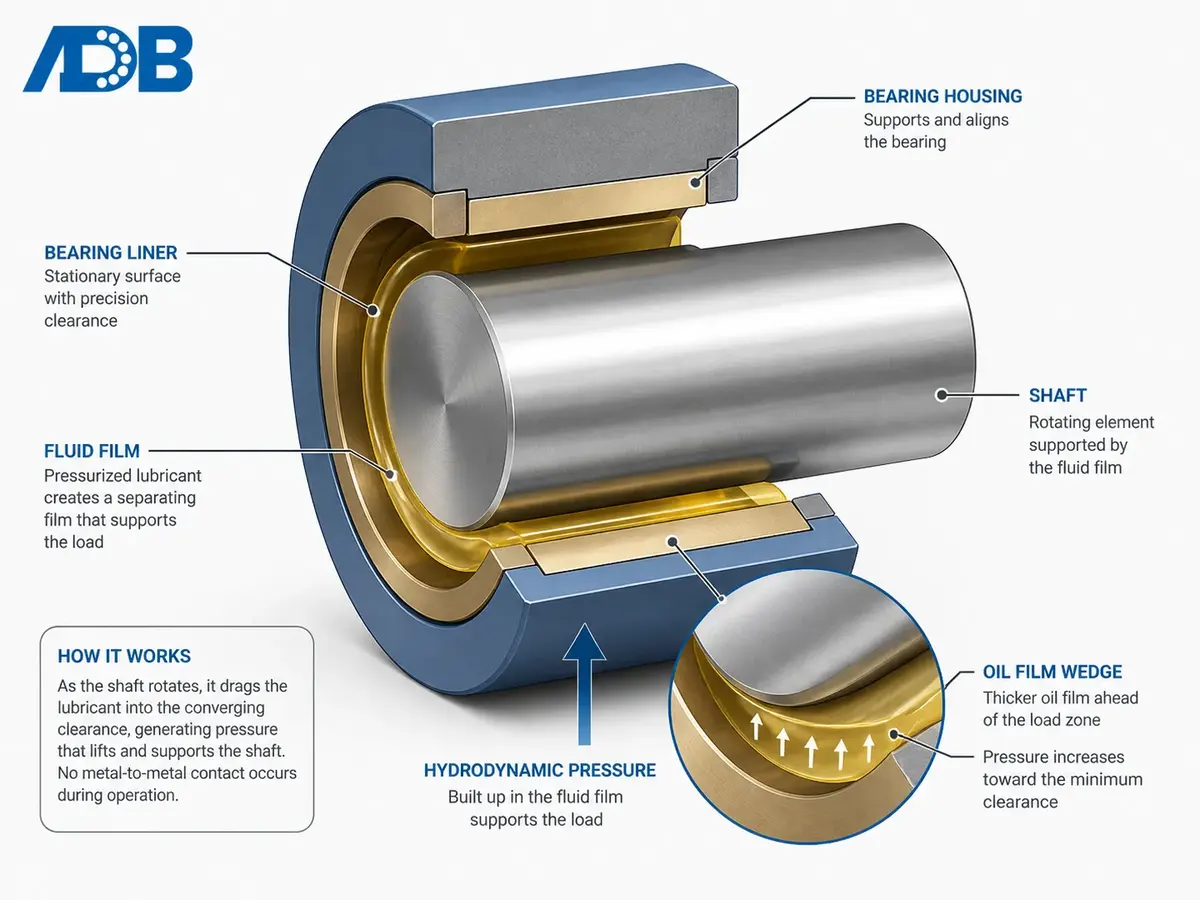
Plain bearings have no rolling elements at all. They work through sliding contact between two surfaces, typically a shaft rotating inside a bushing or sleeve. The separation between shaft and bearing is maintained by a lubricant film, which may be:
- Hydrodynamic: the rotating shaft itself generates a wedge of pressurized oil that lifts and supports it within the bore. At sufficient speed, no metal-to-metal contact occurs. This is the principle behind large engine crankshaft bearings and industrial turbine bearings.
- Hydrostatic: pressurized fluid is supplied externally to the bearing gap, achieving full-film separation even at zero speed. Used in precision machine tools and large telescope mounts.
- Boundary / mixed film: the lubricant film is thin or incomplete. Metal-to-metal contact occurs intermittently. Relies on high-viscosity lubricants and surface hardness.
Advantages: plain bearings are mechanically simple, compact, quiet, and capable of carrying enormous loads when properly lubricated. A diesel engine's crankshaft runs in plain bearings because no rolling-element bearing could survive the shock loads involved.
Limitations: plain bearings require careful lubrication management. If the lubricant film breaks down, whether from starvation, contamination, or excessive temperature, wear accelerates rapidly. Hydrodynamic plain bearings depend on a minimum shaft speed to generate a full separating film; at very low speeds or under frequent start/stop cycling, boundary contact occurs and wear is highest during those transitional phases. This limitation applies specifically to hydrodynamic operation. Hydrostatic bearings, by contrast, achieve full-film separation at zero speed and are the remedy when frequent start/stop duty is unavoidable.
Common materials: tin-based white metal (Babbitt), bronze, sintered bronze (self-lubricating), PTFE composites, and engineered polymers.
5. Thrust Bearings (Bearings Designed Primarily for Axial Load)
Thrust bearings are defined not by their contact mechanism but by their load orientation: they are designed to carry axial (thrust) loads, forces acting along the shaft axis. Structurally, thrust bearings are variants of ball, roller, or plain bearings that have evolved to handle purely or predominantly axial loads.
- Thrust ball bearings: for light axial loads and moderate speeds. Used in bar stools, lazy Susans, and automotive steering columns.
- Tapered roller thrust bearings: higher capacity, used in heavy-duty transmissions and axles.
- Tilting pad thrust bearings: a sophisticated plain bearing variant. Segmented pads tilt dynamically under load to generate hydrodynamic films. Used in ship propulsion systems, large compressors, and hydroelectric turbines, where axial loads can reach millions of newtons (a single Kingsbury-style thrust bearing in a hydroelectric generator routinely supports 100 to 500 tonnes of rotating mass, equivalent to roughly 1 to 5 MN of static thrust).
Most radial bearings can handle modest thrust, but dedicated thrust bearings become essential when axial force dominates or becomes very large.
6. Spherical Plain Bearings (Joint Bearings)
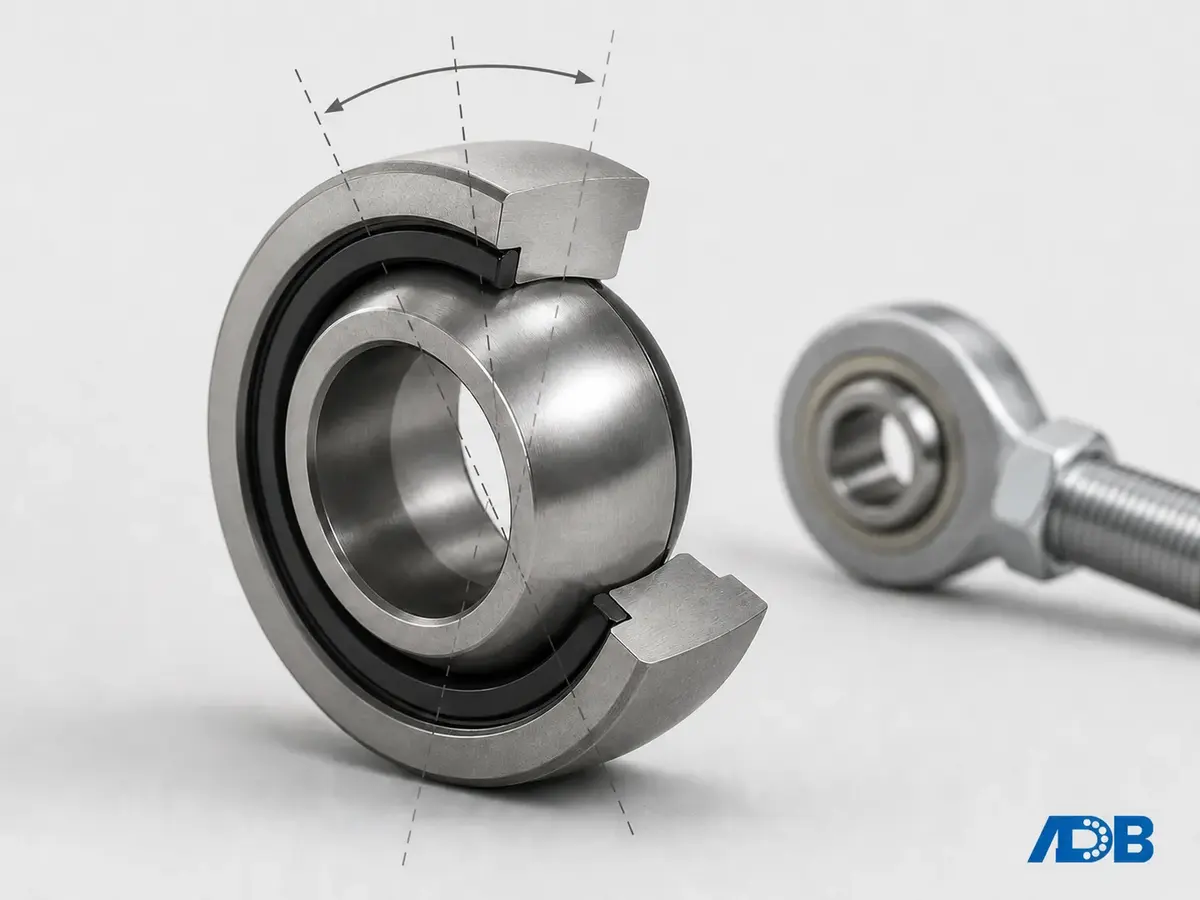
Spherical plain bearings are a specialized type of sliding bearing engineered to accommodate oscillating motion and angular misalignment. At their core, they feature an inner ring with a spherical outer surface that sits inside an outer ring, allowing tilting in any direction to compensate for mounting errors, shaft deflection, or structural deformation.
How they work: the inner ring's spherical surface slides against the outer ring, permitting angular alignment but not continuous high-speed rotation. Most spherical plain bearings use a self-lubricating liner (such as PTFE fabric) or require periodic grease replenishment.
Typical applications: hydraulic cylinder rod ends, linkage joints in construction machinery, hinge points on aircraft flight-control surfaces, and any situation demanding low-frequency oscillation combined with angular compensation. They serve as the critical interface between structural members and moving linkages.
7. Specialty Material Bearings
When operating conditions exceed the capabilities of standard bearing steels (such as GCr15), advanced ceramics and hybrid materials come into play.
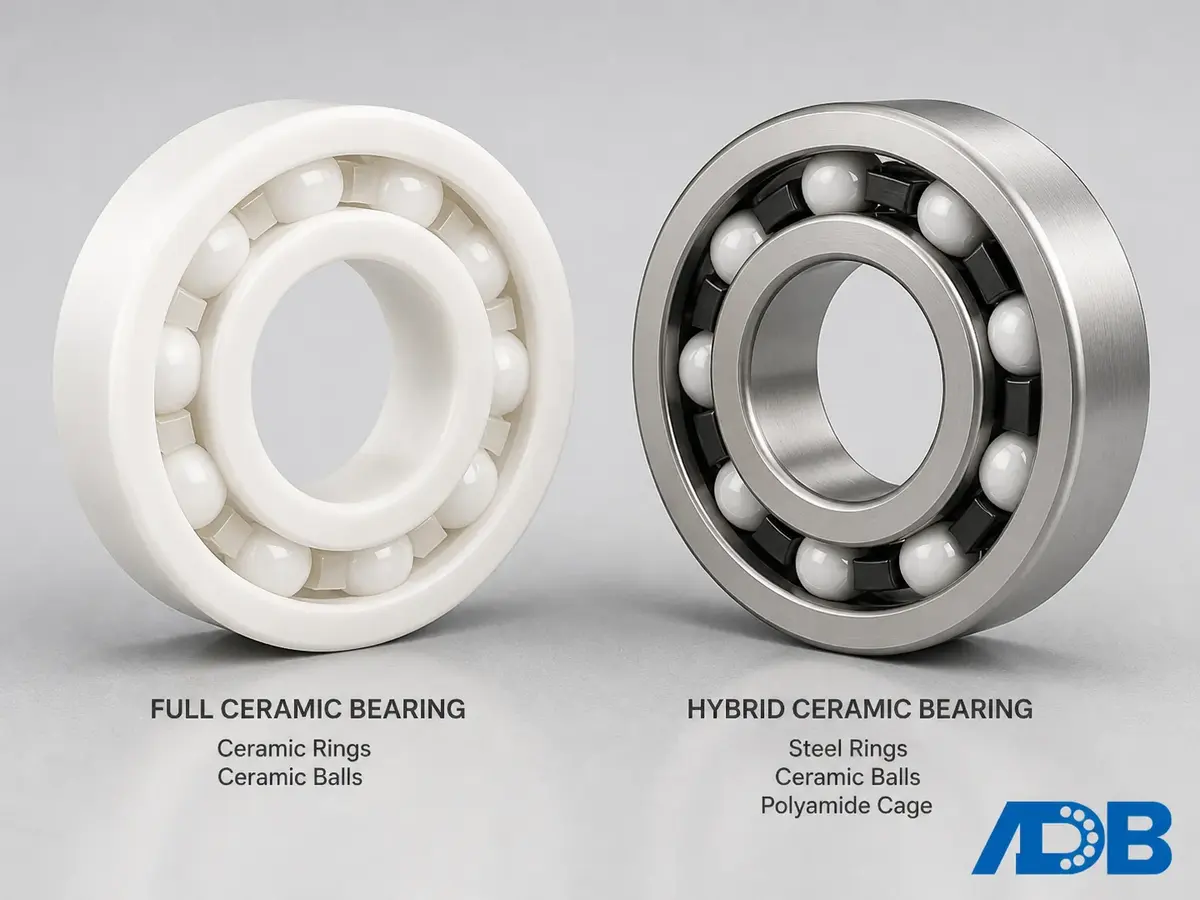
- Full ceramic bearings: inner rings, outer rings, and rolling elements all made from silicon nitride (Si₃N₄) or zirconia (ZrO₂). They offer absolute corrosion resistance, complete electrical insulation, high-temperature capability (continuous service to roughly 800°C for bearing-grade Si₃N₄, per CeramTec material data), and potential for self-lubrication. Used in semiconductor manufacturing equipment, ultra-high-speed spindles, and strong magnetic-field environments.
- Hybrid ceramic bearings: steel rings paired with silicon nitride balls. Si₃N₄ has a density of about 3.2 g/cm³, roughly 40% that of bearing steel (~7.85 g/cm³), so the lighter ceramic balls dramatically reduce centrifugal force and rolling-element skidding at high speeds, while providing inherent electrical insulation. They are common in high-performance motorized spindles and electric vehicle drive motors.
- Stainless-steel bearings: usually pair X65Cr13 rings with hardened 440C balls to balance corrosion resistance with rolling-contact hardness. Austenitic 304 and 316 resist corrosion better but are generally too soft for conventional raceways.
Ceramic bearings have moved beyond the laboratory and are now a standard solution for many extreme-duty applications.
8. Magnetic Bearings
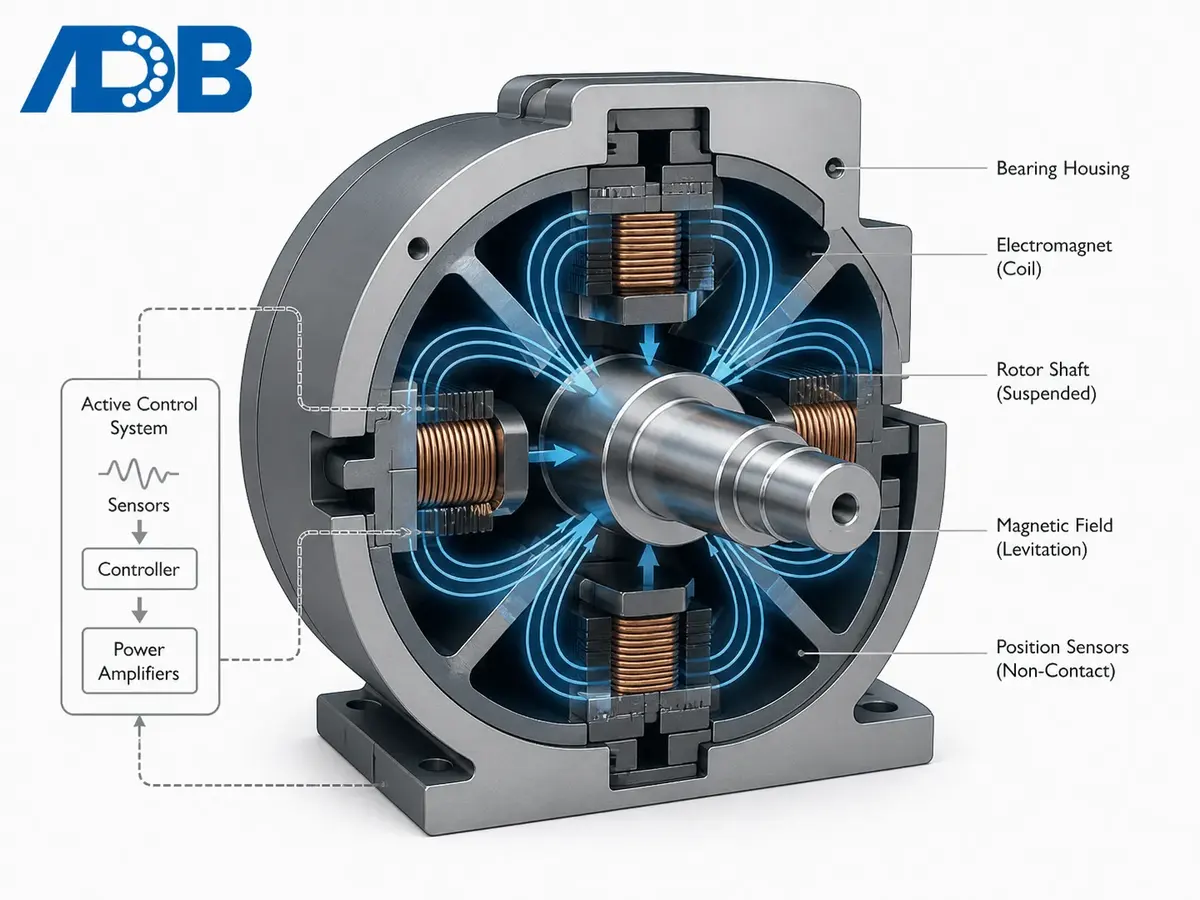
Magnetic bearings use controlled electromagnetic or permanent magnetic fields to levitate a rotating shaft with zero mechanical contact. Active magnetic bearings (AMBs) use sensors and feedback controllers to adjust electromagnet currents in real time, holding shaft position with micron-level precision.
Advantages: no friction, no lubrication, extremely high speeds possible, suitable for vacuum and clean environments.
Limitations: high cost, complex control systems, and the requirement for a backup (touchdown) bearing in case of power failure.
Applications: high-speed turbomachinery, flywheel energy-storage systems, semiconductor manufacturing equipment, and medical centrifuges.
9. Fluid Film Bearings (Gas Bearings)
A specialized subset of plain bearings where the fluid separating the surfaces is a gas (typically air or nitrogen) rather than oil. This eliminates contamination risks entirely and allows operation at extremely high speeds. See also foil bearings for a closely related self-acting gas variant used in aircraft air-cycle machines.
Used in precision machine-tool spindles, dental drills, and high-speed turbomolecular pumps, anywhere oil contamination is unacceptable and speeds are very high.
10. Jewel Bearings
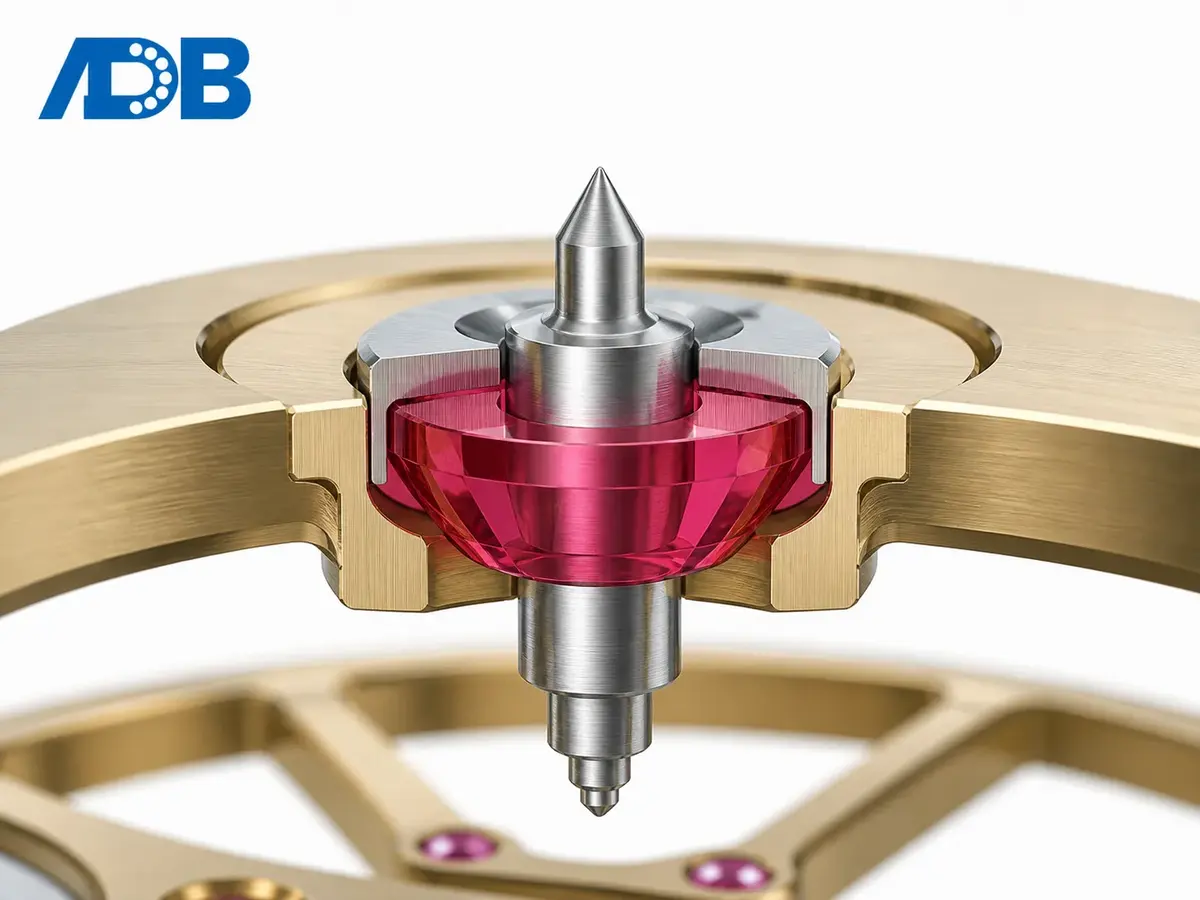
In precision instruments such as mechanical watches, measuring instruments, and scientific equipment, jewel bearings made from synthetic sapphire or ruby are used. These materials have extremely low and consistent friction coefficients, excellent hardness, and dimensional stability.
The pivot of a watch balance wheel runs in jewel bearings measured in fractions of a millimeter. The jewels are not for luxury; they are a functional precision-engineering choice.
11. Mounted Bearings (Bearing Units)
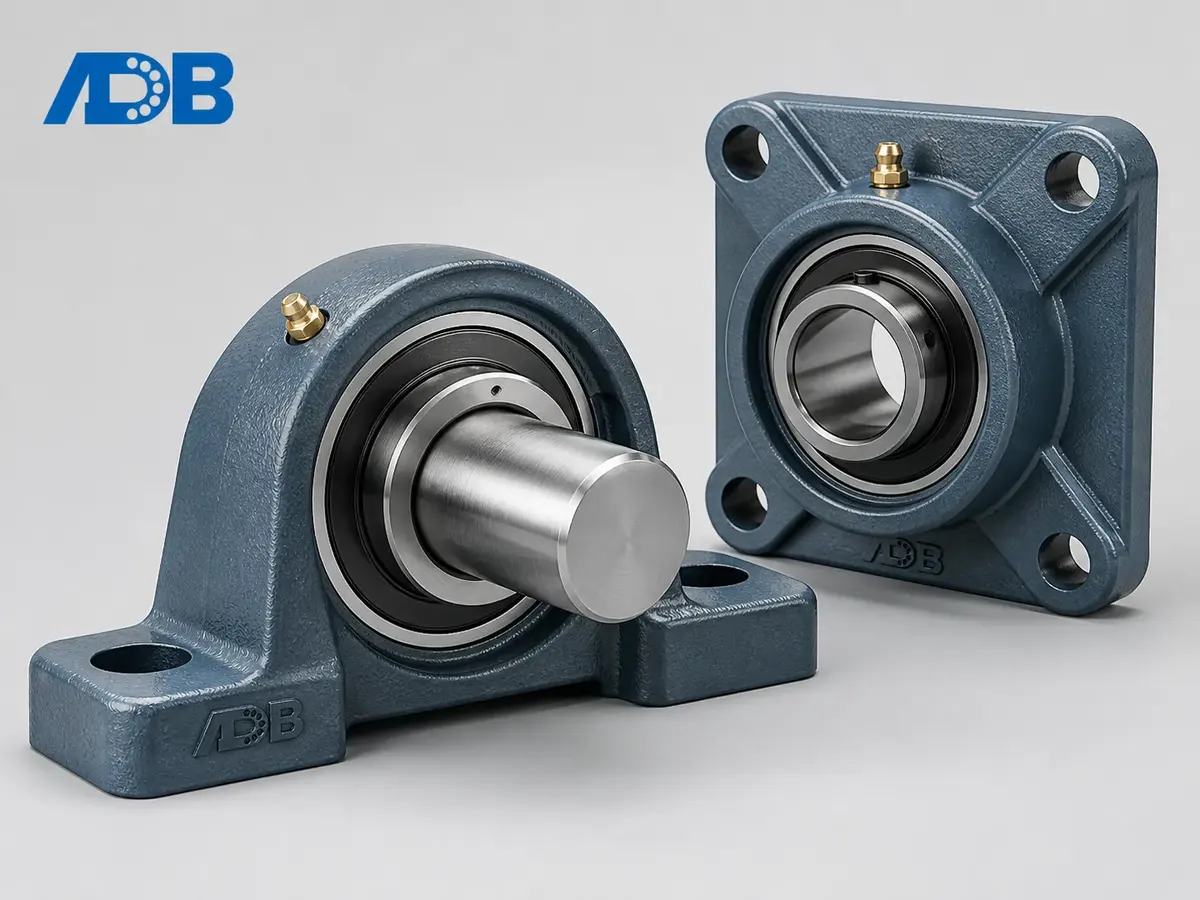
Mounted bearings are not a new contact mechanism but rather modular units in which a rolling-element bearing (often a deep groove ball bearing or a self-aligning ball/spherical roller bearing) is pre-assembled inside a housing of cast iron, pressed steel, or stainless steel. The unit bolts directly to a machine frame, eliminating the need for a separately machined housing bore.
Common configurations: pillow blocks (P-type), diamond-shaped flange units, square flange units, and more. To choose between the flange styles and decode their designations, see our guide to flange bearing types and codes. They are heavily used in agricultural conveyors, food processing equipment, and general industrial drive systems. Their defining advantage is "ready to install" simplicity and straightforward maintenance.
Bearing Types at a Glance
Across the eleven categories, dynamic load capacity spans roughly a 3× range at the same envelope size: a spherical roller bearing typically carries about three times the dynamic load of a deep-groove ball bearing of comparable bore and outer diameter, with cylindrical and tapered rollers landing between (basic load ratings, SKF, NSK, and FAG/Schaeffler general catalogues). The chart below visualizes that spread; the table that follows summarizes the four selection axes that matter most: load direction, load magnitude, speed range, and misalignment tolerance.
| Bearing Type | Load Direction | Max Load | Speed Range | Misalignment Tolerance |
|---|---|---|---|---|
| Deep groove ball | Radial + light axial | Moderate | High | Low |
| Angular contact ball | Combined radial + axial | Moderate to high | High | Low |
| Self-aligning ball | Radial + light axial | Moderate | High | High |
| Cylindrical roller | Radial only | High | High | Low |
| Tapered roller | Combined radial + axial | High | Moderate | Low |
| Spherical roller | Radial + axial | Very high | Moderate | High |
| Needle roller | Radial only | Moderate | Moderate | Very low |
| Plain (hydrodynamic) | Radial or axial | Very high | High (continuous) | Low |
| Spherical plain | Radial + oscillating | High | Oscillation only | Very high |
| Magnetic | Radial or axial | Low to moderate | Very high | Active control |
| Jewel | Radial (very light) | Very low | Moderate | Low |
How to Choose the Right Bearing Type
Bearing selection is a structured engineering decision driven by the L10 life formula in ISO 281:2007: predicted service life is inversely proportional to the cube of the equivalent dynamic load for ball bearings, and to the 10/3 power for roller bearings. Eight design parameters jointly determine which bearing fits.
| Parameter | Questions to Answer |
|---|---|
| Load direction | Radial only? Axial only? Combined? Or linear reciprocation? See axial vs radial load for the conversion and the per-type axial ceilings. |
| Load magnitude | Light, moderate, or heavy? Shock loads? |
| Speed | Low, medium, or high RPM? Or only intermittent oscillation? |
| Misalignment | Is shaft deflection, mounting error, or structural deformation likely? |
| Lubrication | What lubricant type and supply method is feasible? |
| Space | Are there radial or axial dimensional constraints? |
| Environment | Temperature, chemical attack, electrical insulation, vacuum, or clean room requirements? |
| Service life | How many hours of operation are required? At what reliability level? |
As a general rule of thumb:
- High speed, light to moderate load → ball bearings
- High load, moderate speed → cylindrical or spherical roller bearings
- Combined radial + axial load → tapered roller or angular contact ball bearings
- Precision linear motion → linear bearings (ball-type or plain)
- Low-frequency oscillation and angular compensation → spherical plain bearings
- Very heavy radial load, sufficient continuous speed → hydrodynamic plain journal bearings (for frequent start/stop, add hydrostatic assist)
- Extreme cleanliness, very high speed, or vacuum → gas or magnetic bearings
- High temperature, corrosive environment, or electrical insulation required → ceramic or hybrid ceramic bearings
- Precision instruments → jewel bearings
- Simplified installation and maintenance → mounted bearing units
Bearing Life and Internal Clearance
Two parameters often left out of casual specifications matter as much as type selection: bearing life and internal clearance / preload.
Rolling bearing life is conventionally expressed as the L10 basic rating life, the life that 90% of an identical bearing population will reach or exceed before fatigue failure, defined in ISO 281:2007 (ISO). L10 is inversely proportional to the cube of the equivalent dynamic load for ball bearings, and to the 10/3 power for roller bearings.
Why the exponent matters in practice. That 3-versus-10/3 difference is the fundamental reason heavy loads demand a shift from balls to rollers: doubling the load cuts a ball bearing's L10 life to one-eighth of its original value (½³ = 1/8), but only to roughly one-tenth for a roller bearing (½^(10/3) ≈ 1/10.1). Triple the load and the gap widens further: balls drop to 1/27 of rated life, rollers to about 1/39. In a borderline application sitting near a ball bearing's basic dynamic load rating, a 25% load increase you didn't plan for can halve service life. The exponent, not the catalogue capacity, is usually what surprises a design team in service.
Internal clearance and preload directly determine stiffness, running accuracy, and heat generation. For high-precision applications such as machine-tool spindles, getting these right is essential. Too little clearance, and the bearing seizes from thermal expansion; too much, and runout destroys precision.
FAQ
Q: What is the most common type of bearing?
The deep-groove ball bearing is by far the most widely produced bearing type in the world. It handles both radial and modest axial loads at high speeds, costs little to manufacture, and fits in a compact envelope, which is why it shows up in everything from small electric motors to laptop cooling fans. Boundary dimensions are standardized in ISO 15.
Q: What is the difference between a ball bearing and a roller bearing?
The fundamental difference is contact geometry. Ball bearings contact their raceways at a point, which means very low friction and good speed capability but limited load capacity. Roller bearings contact along a line, which distributes load over a larger area and dramatically increases load-carrying ability, at the cost of somewhat higher friction and generally lower speed limits.
Q: Can a bearing handle both radial and axial loads at the same time?
Yes, many bearing types are designed for combined loading. Angular contact ball bearings, tapered roller bearings, and deep-groove ball bearings can all carry simultaneous radial and axial loads, though their relative capacities differ. Pure radial bearings (such as some cylindrical roller bearings) and pure thrust bearings should not be subjected to significant loads in directions they were not designed for.
Q: Do all bearings need lubrication?
Most do, but there are exceptions. Self-lubricating plain and spherical plain bearings made from sintered bronze or PTFE composites carry their own lubricant within the material. Magnetic and gas bearings need none at all. For the vast majority of rolling-element bearings, however, adequate lubrication, whether grease or oil, is essential to achieve the L10 rated service life.
Conclusion
Across the eleven categories above, every bearing encodes a specific engineering trade-off between load capacity, speed, friction, misalignment tolerance, and service environment. Choose the wrong combination and a machine fails, typically at 10% of its rated life by definition of the L10 standard. Choose the right one and the machine quietly outlasts everything else around it.
Each bearing type encodes decades of refinement, and the differences between them are rarely arbitrary. Understanding those differences (contact geometry, load direction, motion type, lubrication regime, material science, and speed limits) puts you in a much stronger position to analyze, specify, or simply appreciate the mechanisms that keep the world turning.
About the Author
Jeff Li writes on bearing engineering and applications for ANDE Bearing. Connect on LinkedIn.