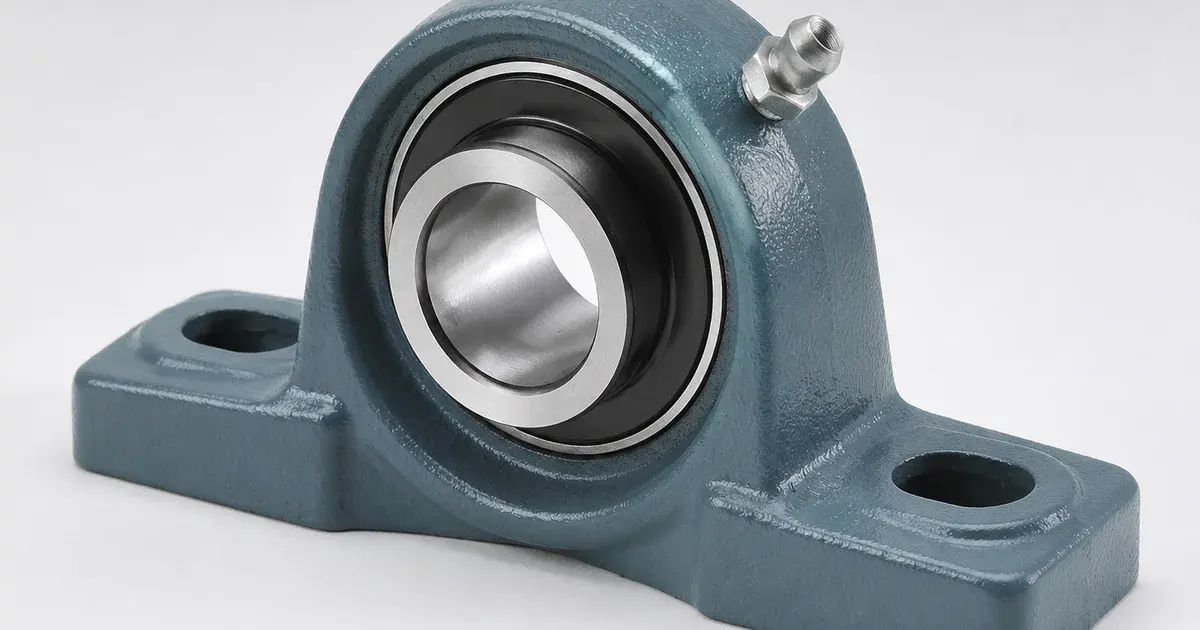
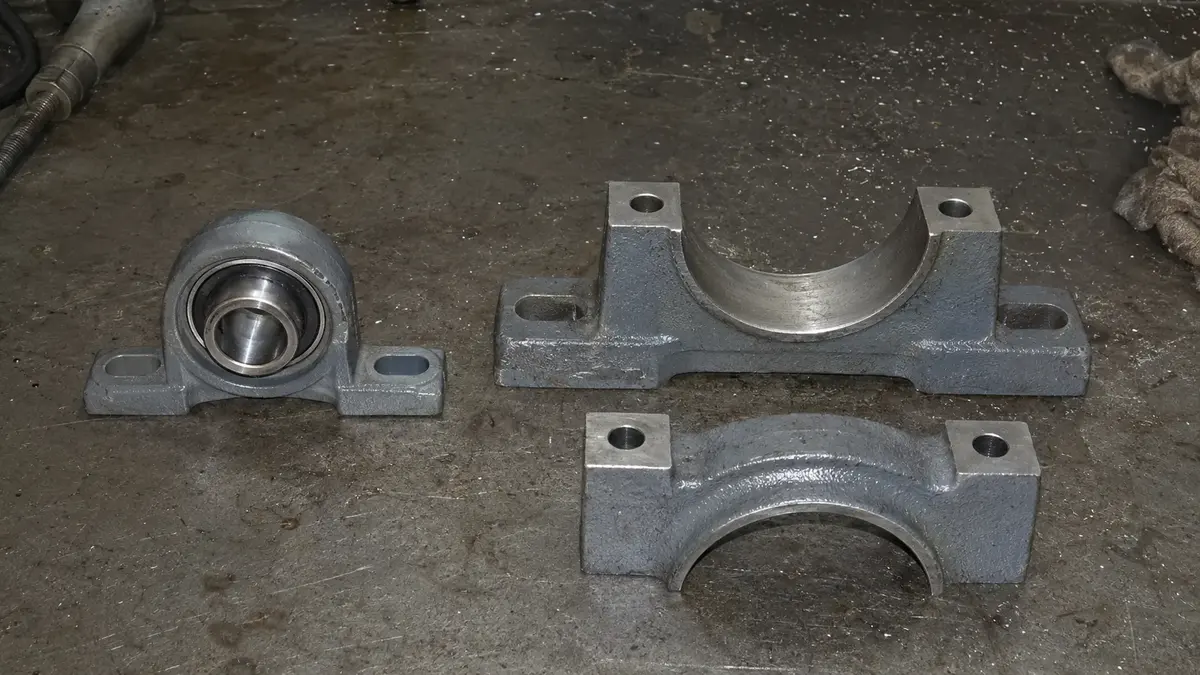
Two parts on the same purchase order can both be called a pillow block bearing and differ by an order of magnitude in what they can carry. One is a stamped or cast housing holding a wide-inner-ring ball insert, locked to the shaft with two grub screws. The other is a split cast housing carrying a spherical roller bearing on an adapter sleeve, rebuildable in place. They follow different dimensional standards, and the name tells you nothing about which one you are looking at.
This guide separates the two families by the standard that dimensions each, then decodes both designation systems. From there it works through the four decisions that actually determine service life: the locking method, the real misalignment capability, the load and speed ceiling, and the fixed and expansion pair.
Key Takeaways
- "Pillow block" covers two families. Insert-bearing units (UCP, SY, P2B) pair a wide-inner-ring ball insert per ISO 9628:2019 with a cast or pressed housing per ISO 3228:2013. Split plummer blocks (SNL, SAF) take a self-aligning ball or spherical roller bearing in a housing whose boundary dimensions follow ISO 113:2010.
- You are specifying the insert bearing, not the housing. The housing fixes the mounting geometry; the bearing inside it fixes load rating, speed, clearance and life.
- Self-alignment is static only, and conditional. SKF permits 5° where no relubrication is needed, 2° where it is, and 1° with a back seal, while stating that ball bearing units cannot accommodate dynamic misalignment at all.
- The locking method decides whether the unit survives reversing service. It does not set the speed limit: the seal design does.
- Two units on one shaft need a fixed and expansion pair, or thermal growth in the shaft turns into axial load on bearings chosen for radial duty. On insert units there is no expansion part number to order, so it becomes a shaft-spacing or shaft-machining decision.
- Housing material sets the load ceiling. Cast iron and stainless housings carry at least what the insert carries dynamically and statically, composite matches the static rating only, and pressed steel is the derated case, with axial load limited to 20% of the permissible radial load.
What Is a Pillow Block Bearing?
A pillow block is a bolt-on housing that supports a shaft from a base parallel to it, and the term covers two product families built on different standards. Both consist of a housing plus a bearing, and in both the bearing does the work while the housing only holds it in the right place.
The naming confusion is worth settling early because it reaches into the standards themselves. British and ISO usage calls this component a plummer block, which is why ISO 3228:2013 states that it "applies to plummer block housings, flanged housings and take-up housings." North American catalogues call the same thing a pillow block. The two words are synonyms, so a page presenting them as different products is describing a distinction no standard makes.
The distinction that does matter is structural. An insert-bearing unit is a sealed, pre-greased, throwaway assembly. A split plummer block is a serviceable housing whose bearing, seals and grease you replace without pulling the shaft. Choosing between them is a decision about load, speed and maintenance strategy.
If your mounting surface faces the shaft rather than sitting beneath it, you need the perpendicular equivalent. Our guide to flange bearing types and codes covers the UCF and UCFL family, which shares the same insert and the same governing standards. Our overview of mounted bearing types places both inside the wider bearing landscape.
Insert-Bearing Units vs Split Plummer Blocks
The two families split on three things: the standard that dimensions them, the bearing type inside, and whether you can service them. Get the family right first, because every later decision follows from it.
| Insert-bearing unit | Split plummer block | |
|---|---|---|
| Typical designations | UCP, UKP, SY, SYJ, P, P2B | SNL, SAF, SAW, SDAF |
| Bearing standard | ISO 9628:2019, ANSI/ABMA 15 (metric and inch), JIS B 1558 | the bearing's own standard |
| Housing standard | ISO 3228:2013, ANSI/ABMA 14, JIS B 1559 | ISO 113:2010 boundary dimensions, JIS B 1551 |
| Bearing type | wide-inner-ring ball insert, spherical outer surface | self-aligning ball or spherical roller, often on an adapter sleeve |
| Serviceable | no, replace the unit | yes, split the cap and change bearing, seals and grease |
| Shaft locking | set screws, eccentric or concentric collar, adapter sleeve | adapter sleeve or cylindrical bore with a locknut |
The standards mapping is the part almost no competing page supplies, and it is the fastest way to confirm you are comparing like with like. ISO 9628:2019 specifies the dimensional and geometrical characteristics of insert bearings and eccentric locking collars. It also covers their radial internal clearance, so the insert's clearance class is a standardized property rather than a vendor choice. ISO 3228:2013 then dimensions the housing that receives it.
Split housings work the other way round. ISO 113:2010 gives boundary dimensions for two-bolt plummer block housings, intended for bearings in ISO 15 diameter series 0 through 3. Four-bolt housings cover series 0, 1 and 2. Note what the standard does not do: it says nothing about split construction, housing material or seals. So the defensible claim is that SKF's split SNL housings conform to ISO 113 for two-bolt plummer block housings. SKF adds that they are "dimensionally interchangeable with the earlier SE, SN, SNA and SNH series" (SKF). Writing that "ISO 113 standardizes split housings" overstates it.
In the North American system the pair is ANSI/ABMA 14 for the housing and ANSI/ABMA 15 for the bearing. ABMA 14 covers "boundary dimensions and tolerances for ball bearings with spherical outside surfaces and extended inner ring width" and explicitly includes "pillow block, flanged and take-up unit housings" (ANSI/ABMA 14). Two things about that document get misreported. Its scope line is loosely worded in the source itself: all seven of ABMA 14's tables dimension housings, and the bearings sit in ABMA 15. And it is not an inch-only standard, despite the way it is usually described. Those seven tables are metric; the inch dimensions and tolerances sit in Annex A. The Japanese system splits the same territory three ways. JIS B 1558 covers the insert bearing, JIS B 1559 the housing, and JIS B 1557 the two combined as a unit (JISC). One miscitation to watch for hands B 1559 the insert bearing when it actually covers housings.
How Do You Decode a Pillow Block Designation?
Read a designation in three passes: the letters give the housing style and locking method, the digits give the bore, and any suffix gives the seal, material or inch conversion. Once you know the order, most mounted units in circulation decode on sight.
The bore arithmetic is the part worth committing to memory. In the 200 and 300 series, the last two digits multiplied by five give the shaft bore in millimetres. A UCP208 therefore takes a 40 mm shaft and a UCP210 takes 50 mm. An inch-dimension unit carries a trailing suffix in sixteenths that replaces the metric bore. UCP208-24 uses the same 208 housing on a 24/16 in shaft, which is 1 1/2 in or 38.1 mm. Confusing the two is how a unit arrives that bolts up correctly and will not slide onto the shaft.
SKF's own system is positional rather than prefix-based, and one detail in it is widely misreported. Housing material sits in position 2, where a dash means grey cast iron, K a black composite and SS stainless steel. The codes that look like material codes sit in position 5, which SKF labels the inserted bearing, and that field carries both the locking method and the seal arrangement. TF is set screws on a YAR 2-2F insert, FM an eccentric locking collar on a YET 2 insert, and LF is SKF ConCentra locking (SKF). Reading FM as a housing material gets both the housing and the locking method wrong at once.
Applying the ×5 rule across the common 200-series pillow blocks gives the following. Bore codes 04 and above follow the multiplication; the smaller codes do not, which is why the table starts at 204.
| Designation | Bore code | Metric shaft bore | Nearest inch suffix, if offered |
|---|---|---|---|
| UCP204 | 04 | 20 mm | -12, meaning 12/16 in = 3/4 in |
| UCP205 | 05 | 25 mm | -16, meaning 1 in |
| UCP206 | 06 | 30 mm | -18, meaning 1 1/8 in |
| UCP207 | 07 | 35 mm | -20, meaning 1 1/4 in |
| UCP208 | 08 | 40 mm | -24, meaning 1 1/2 in |
| UCP210 | 10 | 50 mm | -32, meaning 2 in |
| UCP212 | 12 | 60 mm | -36, meaning 2 1/4 in |
The metric column follows directly from the bore code. The inch column is only the sixteenths arithmetic applied to the suffix, so treat it as how to read a suffix rather than a promise that a given maker stocks that combination. Confirm the pairing against the manufacturer's own table before ordering.
The prefix is where care is needed. JIS B 1557 and B 1558 dimension the unit and its insert bearing, but their titles are dimensional: the letter codes come from maker convention rather than from standard text you can look up. UC is a set-screw insert, UK an insert bored to take an adapter sleeve, and P a pillow block housing. Beyond that, the variants in distributor listings for tapped bases, raised centre heights, pressed steel bases and stainless assemblies are trade conventions specific to each maker, and the makers do not agree with each other. SKF's positional system above is the clearest illustration: its P means a pressed steel unit, not the same P a UCP listing uses. Decode UC, UK and the bore digits with confidence, then look the remaining letters up in the catalogue of the maker you are actually buying from.
Split housings use a different grammar again. In an SNL designation the bolt-hole arrangement sits in the prefix and the housing material follows the series letters. The first size digit then says whether the bearing has a cylindrical bore or sits on an adapter sleeve (SKF). Catalogue entries also carry a second size number, as in SKF's own SNL 518-615 example, identifying the alternative bearing diameter series the same housing accepts. Search on the bare SNL 518 and you may miss the entry entirely.
For the wider logic behind bore codes, series numbers and suffixes across every bearing type, see our guide on how to read a bearing number.
How Do You Lock the Bearing to the Shaft?
Five methods dominate, and the choice decides how the unit behaves under load reversal: set screws, an eccentric locking collar, concentric locking, an adapter sleeve, and a plain interference fit. Match it to the duty cycle rather than to whatever the last unit used.
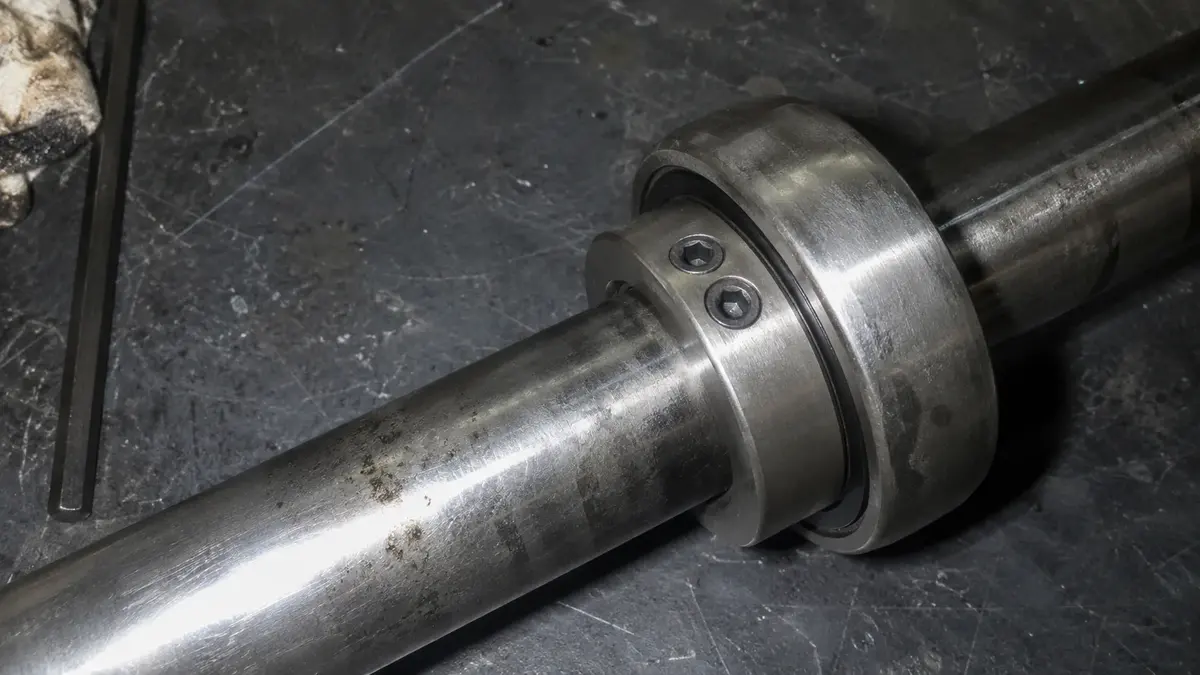
Set screws are the default on UCP-series units. Two grub screws in the extended inner ring bite into the shaft, which is cheap, compact and re-usable. Their limitation is the contact patch: the grip is essentially two points, so the screws mark the shaft and can make dismounting destructive. An eccentric locking collar instead cams against a matching eccentric step on the extended inner ring, and is locked by turning it in the direction of rotation, with a single set screw then securing the collar to the shaft (SKF).
Vendor guidance on reversing service diverges, and it is worth reporting rather than flattening. SKF rates set-screw insert bearings as "suitable for applications for both constant and alternating directions of rotation." It restricts eccentric-collar bearings to "applications where the direction of rotation is constant" (SKF). Timken claims the opposite for its own reduced-offset design, saying the EC series "should not release from a properly prepared shaft even in reversing applications." It also quantifies its set-screw arrangement as "two set screws positioned at 60 degrees," with a double-collared insert giving "double the holding power" of a single (Timken). Treat reversing capability as a property of the specific product, not of the locking category.
One correction to a claim that circulates widely: the locking method does not set the unit's speed limit. SKF is explicit that for ball bearing units the limiting speed "is set by the seal design." It groups set screws and eccentric collars together, noting only that both are additionally influenced by shaft tolerance (SKF). The catalogue numbers bear this out. Across the SY series, set-screw and eccentric-collar variants of the same bore carry identical limiting speeds at every size from 15 to 60 mm. Meanwhile an SY 40 TF runs to 4,800 r/min and an SY 40 TR to 2,800 r/min. That is a gap approaching a factor of two at the same bore and load rating. The catalogue's suffix table defines both as grub-screw inserts, differing only in seal series (SKF). So the spread is the seal, not the lock.
Where locking method does govern high-speed behaviour is vibration and running quality. SKF recommends a concentric method for applications "approaching but still below the limiting speed" or "where low vibration or quiet running is required." The options it names are ConCentra, an adapter sleeve, or a standard inner ring.
How Much Misalignment Can a Pillow Block Actually Take?
Less than the category's reputation suggests, and only at installation. The spherical seat between insert and housing lets the unit tilt to take up initial misalignment as you bolt it down. It does not track a shaft that deflects in service.
For ball bearing units, SKF's permitted values step down with how well the unit is sealed and serviced. They are 5° where relubrication is not required, 2° where it is, and 1° for units with a DFH back seal. The same page states flatly that "ball bearing units cannot accommodate dynamic misalignment." It also notes that a pressed steel housing cannot take up misalignment at all once its bolts are fully tightened, unless a rubber seating ring is fitted (SKF).
Step up to a mounted spherical roller unit and the figure is 1.5° of static misalignment at light to normal load. SKF warns that dynamic misalignment "can cause additional sliding, reducing permissible misalignment to a few tenths of a degree" (SKF).
Timken arrives at the same 1.5° and then diverges from SKF on exactly the point that matters. It does not split the figure into static and dynamic at all: the number applies "under static, oscillatory or dynamic load conditions," and "the life performance of our mounted bearing is not reduced while under misalignment conditions within these guidelines" (Timken). So on mounted spherical roller units the static-only rule is a vendor position rather than a property of the bearing type, and the same caution applies as with reversing service: take the qualification from the product you are buying, not from the category.
Split housings introduce a limit that catches people out: the seal, not the bearing, usually runs out first. SKF's SNL misalignment page carries no bearing figure at all, only the instruction that misalignment "may be limited by the housing seals" and to check both (SKF). The numbers live with the seals instead. A four-lip TSN..L design allows approximately 1° for shafts up to 100 mm and approximately 0.5° above that. A V-ring TSN..A runs from about 1.5° at 50 mm down to 1° at 150 mm and larger (SKF). Specify a generous bearing and a tight seal and you have bought alignment capability you cannot use.
There is also a cost to the mechanism that nobody advertises. The spherical seat that provides alignment is a sliding steel-on-cast-iron interface rather than a rolling one, so treat it as a wear and fretting path, and note that every figure published for it is installation take-up rather than a duty rating. For genuine continuous misalignment under heavy load, the answer is a bearing designed for it rather than a housing that tilts. Our guide to spherical roller bearings for shaft deflection covers where that line falls.
What Load and Speed Can You Actually Specify?
Rate the insert with ISO 281, then check the housing separately, because on the lighter housing materials the housing is what fails first. Load rating and speed also move in opposite directions as bore increases, which makes the trade explicit.
The insert is an ordinary rolling bearing, so its life follows ISO 281:2007, which ISO lists as due for replacement by ISO/DIS 281. ISO 281 calls L10 the basic rating life, the life associated with 90% reliability, meaning the life 90% of a group of identical bearings is expected to reach or exceed. The relation is L10 = (C/P)³ for a ball insert. Take the C value from the unit's own table rather than from a loose bearing of similar bore, because the extended inner ring and the housing seat change the assembly. Across the SY..TF range, C climbs from 12.7 kN at a 20 mm shaft to 52.7 kN at 60 mm, while limiting speed falls from 8,500 to 3,400 r/min (SKF).
There is a shaft condition behind those speeds, and it answers a question this category usually leaves vague. SKF treats h6 as the baseline shaft tolerance. For anything other than h6 it directs you to a correction table and tells you to compare: "The lower value is the permissible speed" (SKF). So a commercial-tolerance bar rather than a ground fit can cost you speed the catalogue appears to promise.
The housing is a separate calculation, and this is where the "low-torque, light-loading" framing that follows this product class around turns out to be half right. SKF states that pillow block housings in cast iron or stainless steel "accommodate at least the same dynamic and static loads as the incorporated insert bearings," and that those two can also endure peak loads or varying axial loads. The lighter materials are qualified. A composite housing matches "at least the same static loads" as the insert, with no dynamic parity claimed. Pressed steel is derated outright: it has "a lower load carrying capacity than the suitable insert bearings," and on those housings "the axial load should not exceed 20% of the permissible radial load" (SKF). So the derating tracks the housing material rather than the product category, and two of the three ISO-standard materials carry a qualification, not just the cheapest one.
One more constraint from the same page is easy to miss and expensive to get wrong. Where the load angle on the housing falls between 55° and 120°, the load is no longer pushing the housing into its base. SKF then requires either stops fitted in the load direction or, for cast iron, dowelling the housing to the support surface. For help separating the load components before you size anything, see our guide to axial versus radial load, and dynamic versus static load ratings for what C and C₀ each govern.
Housing Material, Seals, and Temperature Limits
For every housing material except composite, the housing is not what limits operating temperature. The seal, the cage or the grease is. That single fact redirects most material decisions away from temperature and towards corrosion, load and serviceability.
| Housing material | Choose it for | Watch out for |
|---|---|---|
| Grey cast iron | the default: stiffness and damping at low cost, and the only material with a grease fitting as standard | brittle under shock, corrodes in washdown |
| Composite (glass-fibre PA6) | light weight and corrosion resistance in food and washdown lines | the only material that caps unit temperature; static-only load parity; usually relubrication-free |
| Pressed steel | simple applications at limited load and speed, lowest cost | derated capacity, 20% axial limit, no misalignment take-up once bolted |
| Stainless steel | hygienic duty needing both corrosion resistance and strength | cost, and no grease fitting, so it cannot be relubricated |
| Cast steel or ductile iron | split housings needing extra strength | no published numeric strength delta over grey iron |
SKF puts composite housings at −20 to +80 °C, tolerating 100 °C only for brief periods. It states plainly that "other housing materials do not limit the permissible operating temperature of the unit." On a metal-housed unit the ceiling moves to the bearing's own parts: NBR seals are rated −30 to +100 °C, and the glass-fibre PA66 cage fitted to most insert bearings has its own limit, with steel cages the exception that does not constrain the unit (SKF).
Relubrication splits the materials differently again, and not the way the temperature answer does. Only cast iron ships with a grease fitting as standard. Composite and stainless steel housings are supplied without one and so cannot be relubricated, and pressed steel is likewise built with no relubrication feature (SKF, SKF). A relubricable composite execution exists as a designated variant, but it is the exception you have to ask for. That is a maintenance decision disguised as a material decision, and it is the reason a stainless unit specified for washdown corrosion resistance can turn out to be a sealed-for-life part.
Worth stating plainly: there is no Tier 1 published number for how much stronger a cast steel housing is than a grey iron one of the same size. Manufacturers describe cast steel as the choice where extra strength is needed and leave it qualitative. Anyone quoting a specific ratio is inventing it.
Because the seal governs both speed and temperature on these units, seal selection deserves the attention usually given to the bearing. Our guide to sealed versus shielded bearings covers the contact-lip and non-contacting options and what each costs in friction.
Mounting, Relubrication, and the Fixed and Expansion Pair
Two pillow blocks on one shaft need one end fixed and one end free to grow, or thermal expansion of the shaft turns into axial load until something fails. How you get that free end differs by family, and on insert units it is not something you order. Across the top six organic results for "pillow block bearing" on 2026-08-30 (distributor category pages, a marketplace listing and an encyclopaedia entry), none covered the pairing in body copy, which made it the largest gap across that set.
The mechanism is simple. A shaft running warmer than its frame grows along its length. If both housings clamp the shaft axially, that growth has nowhere to go and turns into axial load on two bearings chosen for radial duty. On split housings the fix is conventional: fix the unit nearest the drive or the thrust load, and give the other end a bearing free to move in its seat, a choice that shows up in the designation and the seal arrangement.
Insert units are the case that catches people out, because there is no expansion variant to order. SKF states that its ball bearing units "are designed to serve as locating supports" and "are not intended to accommodate axial displacement of the shaft relative to the housing," with internal clearance absorbing only minimal movement. It offers three remedies, and none of them is a different part number. Keep the distance between bearing positions short, "to avoid inducing excessive axial loads as a result of thermal expansion of the shaft." Support the units on resilient surrounding structures for small displacements. Or, at low speed and light load only, machine one or two grooves in the shaft at the non-locating position, 120° or 62° apart, and engage them with a dog-point set screw to ISO 4028 secured by a nut and lock washer (SKF). That last option is a shaft modification, so it belongs in the drawing rather than in the purchase order.
Shaft fit deserves a decision rather than an assumption, and this is where the published guidance is contradictory. The one tolerance class you can anchor to is the h6 that SKF attaches to its limiting speeds, which tells you what fit the catalogue's own performance figures assume. It is not, however, a seating specification for a set-screw insert. Take that from the manufacturer's mounting table for the specific unit, and treat any single blanket interference figure you find online as unsourced until you can name the table it came from.
Relubrication is the other place to resist a simple answer, because no manufacturer publishes a universal interval. Any "grease every N hours" figure is unsupported. What exists is a method. SKF defines the relubrication interval tf as the time at which there is a 1% probability of failure from grease degradation, which is the L1 grease life. It adds that "the L10 grease life can also be estimated by multiplying the relubrication interval (L1 grease life) by a factor of 2.7." The reference condition is a rotating inner ring on a horizontal shaft at 70 °C under clean conditions. Read the interval off the manufacturer's diagram for your load, speed and temperature, then halve it for a vertical shaft, and halve it again for every 15 °C the unit runs above that 70 °C reference (SKF).
A separate and lower threshold decides whether to relubricate at all. SKF lists the conditions under which relubrication extends the service life of a mounted unit: high humidity or severe contamination, normal or heavy loads, high vibration, or extended periods at high speed or "at temperatures above 55 °C" (SKF). Note the two numbers do different jobs. The 55 °C is the trigger for putting the unit on a schedule; the 70 °C is the datum the interval itself is measured from.
Quantity is easier to pin down than interval, at least on split housings. SKF sets the initial grease fill by the relubrication route you intend to use: 40% of the housing's free space where you will relubricate from the side of the bearing, or 20% where you will feed through the annular groove and the outer-ring holes. In either case the bearing's own free space is filled completely (SKF). These are not per-service top-up quantities, which SKF puts in its General Catalogue instead, so do not read the 40% as how much to pump at the next interval. Packing any housing solid drives the operating temperature up rather than down.
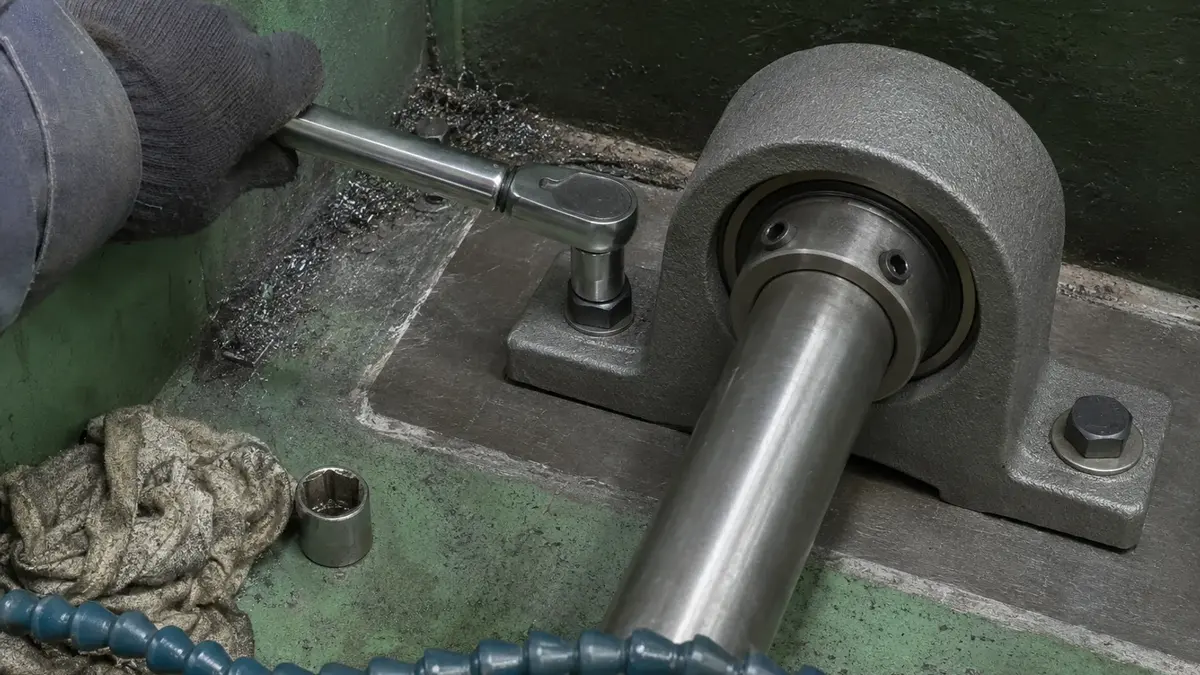
The mounting order itself is short. Check the surface for flatness so torquing the bolts cannot twist the housing, bring the bolts up evenly in a cross pattern, then set the shaft locking last. Cam an eccentric collar in the direction of rotation, torque set screws evenly, and turn the shaft by hand to confirm it runs free before it sees a motor. When something does fail later, the appearance classifies the cause. ISO 15243:2017 names the service failure modes, and our guides to bearing failure analysis and bearing lubrication work through the diagnosis.
One last specifiable property is easy to forget. ISO 9628 covers the radial internal clearance of insert bearings alongside their dimensions, so clearance in a mounted unit is a choice rather than whatever arrives. It matters most when the unit runs hot. Our guide to radial internal clearance classes explains how to choose.
Frequently Asked Questions
What is the difference between a pillow block and a plummer block?
Nothing, as terms. They are the same component under British or ISO usage versus North American usage. That is why ISO 3228 and ISO 113 both say "plummer block housings" for what a US catalogue lists as a pillow block. The distinction that carries engineering weight is between an insert-bearing unit and a split housing.
How much load can a pillow block bearing hold?
Take the basic dynamic load rating C from the specific unit's table and compute L10 = (C/P)³ for a ball insert, per ISO 281. As an anchor, SKF's SY..TF cast iron units run from 12.7 kN at a 20 mm shaft to 52.7 kN at 60 mm. Then check the housing separately: cast iron and stainless housings carry at least what the insert carries, composite matches its static rating only, and pressed steel is derated outright with axial load limited to 20% of permissible radial load.
What does UCP mean, and how is it different from UCF?
Both share the "UC" insert, a wide-inner-ring ball bearing with set screws. The following letters describe the housing: P is a pillow block that bolts to a base parallel to the shaft, F a square flange that bolts to a face perpendicular to it. The digits give the bore, with the last two multiplied by five giving millimetres, so UCP208 takes a 40 mm shaft. A trailing suffix in sixteenths replaces that with an inch bore.
Can I use a pillow block bearing in a reversing application?
Yes, with the right lock, but check the specific product rather than the category. SKF rates set-screw inserts for both constant and alternating rotation and restricts eccentric collars to constant direction, while Timken states its reduced-offset EC series holds in reversing service. Where the duty is genuinely severe, or where quiet running matters, SKF points to a concentric method instead: ConCentra, an adapter sleeve, or a standard inner ring.
How often should pillow block bearings be greased?
There is no universal interval, and any single hours figure is unsupported. Use the manufacturer's relubrication interval tf, which is the grease life at 1% failure probability, referenced to a horizontal shaft at 70 °C. Halve it for a vertical shaft, and halve it again for every 15 °C above 70 °C. Whether to relubricate at all is a separate question: SKF says it pays off under severe contamination or high humidity, normal to heavy loads, high vibration, or sustained running above 55 °C. Only cast iron housings come with a grease fitting; composite, stainless and pressed steel units are supplied without one.
Conclusion
Specifying a pillow block comes down to five reads, in order:
- Identify the family by its standard. ISO 9628 plus ISO 3228 means an insert-bearing unit; ISO 113 boundary dimensions mean a split plummer block.
- Decode the letters before the digits. The prefix gives housing style and locking method, the digits give the bore, and an inch suffix overrides the metric bore rather than adding to it.
- Choose the lock for the rotation direction, and read the specific manufacturer's reversing guidance instead of the category's.
- Treat alignment as static unless the vendor says otherwise. SKF's 5°, 2° and 1° are installation take-up, Timken applies its 1.5° dynamically too, and on a split housing the seal may cap you at 0.5°.
- Check the housing as well as the insert. Composite matches only the static rating and pressed steel is derated outright, and a load angle between 55° and 120° needs stops or dowels.
ANDE manufactures the bearing inside the unit rather than the housing, which is where load rating, clearance and life are actually decided. That covers insert-grade deep-groove ball bearings, self-aligning ball bearings for genuine misalignment, and spherical roller bearings where a split housing has to carry heavy shock. Send your load, speed and shaft tolerance to our engineering team and we will size it to the standard.
About the Author
Jeff Li writes on bearing engineering and global sourcing for ANDE Bearing. He works directly with OEM and aftermarket buyers in automotive, heavy industry, and renewable energy. Connect on LinkedIn.