A rolling-element bearing runs with roughly 10× less friction than a sliding bushing of the same size, but the bushing can cost a tenth as much. So why does any engineer ever specify the more expensive part? Because friction is only one variable in the decision. Shock loading, contamination, duty cycle, speed, and total cost of ownership all push the answer in different directions, and the part that wins on a spec sheet often loses on a real machine.
This guide compares bearings and bushings the way an engineer actually has to choose between them: with friction data, ISO standards, lifespan math, and a clear decision rule.
Key Takeaways
- A bushing is a type of plain bearing — the comparison is really rolling-element vs plain. Both classes are bearings, but they're governed by separate ISO standards because they fail by different physics.
- Rolling-element bearings deliver ~10–100× lower friction (deep-groove ball μ ≈ 0.0010–0.0015 vs plain linear bushing μ ≈ 0.05–0.10) (Koyo/JTEKT; Linear Motion Tips).
- Bushings die from heat (PV-limit exceedance); bearings die from fatigue (L₁₀ spalling per ISO 281). Different failure regimes, different design math.
- Bushings beat bearings on cost, shock tolerance, and contamination resistance. Pick by environment and duty cycle, not by reputation.
Is a Bushing Actually a Bearing?
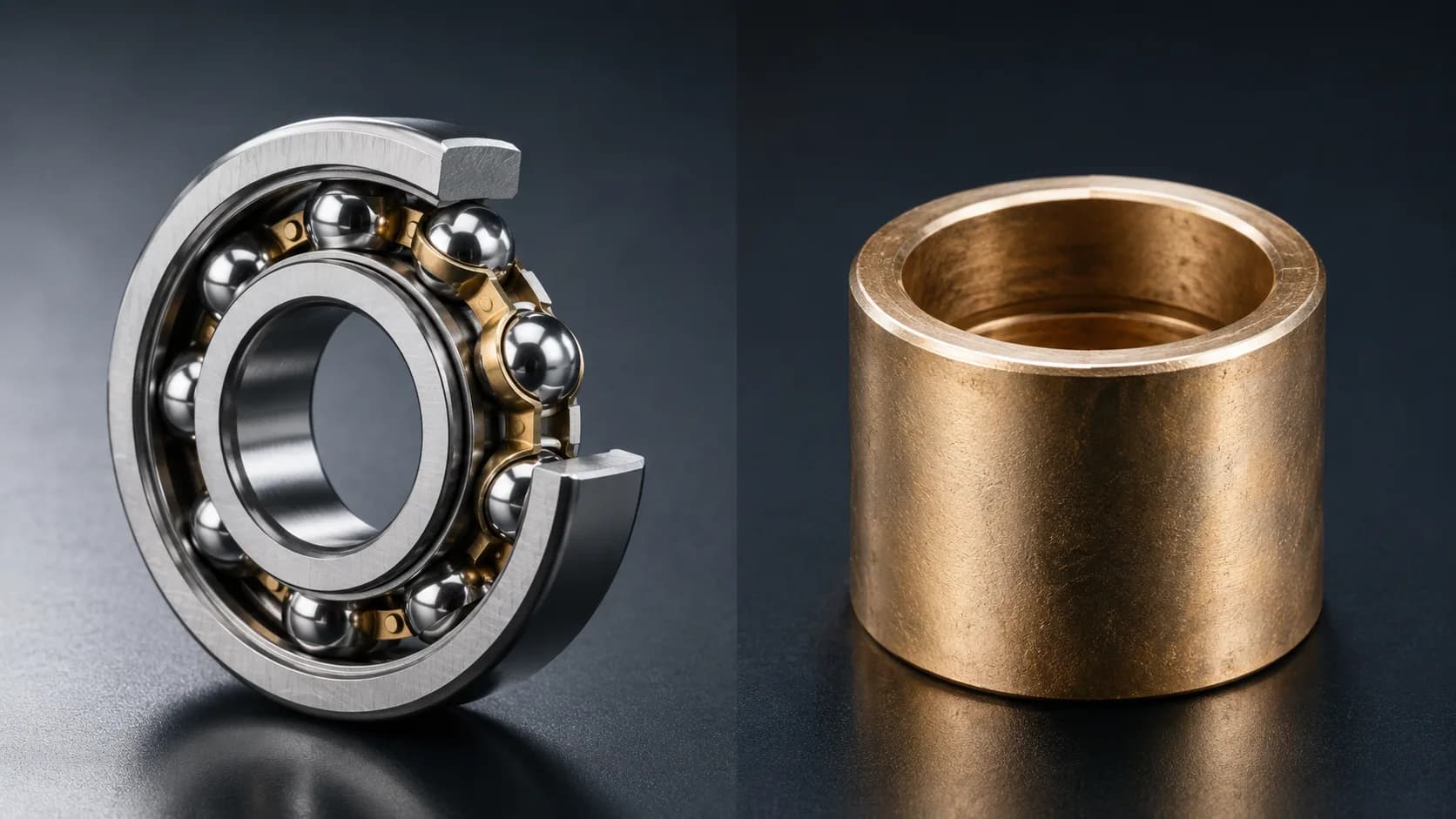
Yes — a bushing is one type of bearing. The bearing family splits into two top-level classes: rolling-element bearings (balls or rollers between hardened races) and plain bearings (sliding contact on a lubricated film). Bushings are the most common form of plain bearing, which is why "bearing vs bushing" is really shorthand for "rolling vs plain."
The two classes are governed by separate ISO standards because they fail by different physics. Rolling-element bearings answer to ISO 281:2007 (dynamic load rating and L₁₀ fatigue life) and ISO 76:2006 (static load rating). Plain bearings answer to a different series — ISO 4378-1:2024 for vocabulary and classification, and ISO 7146-1:2019 for appearance and characterization of damage. The standards don't overlap, and neither does the design math.
That's why supplier catalogs put them in different sections, why the words "bushing" and "sleeve bearing" are interchangeable, and why a part labeled "rod bearing" inside an engine block is technically a plain bearing. The naming is messy. The physics is not.
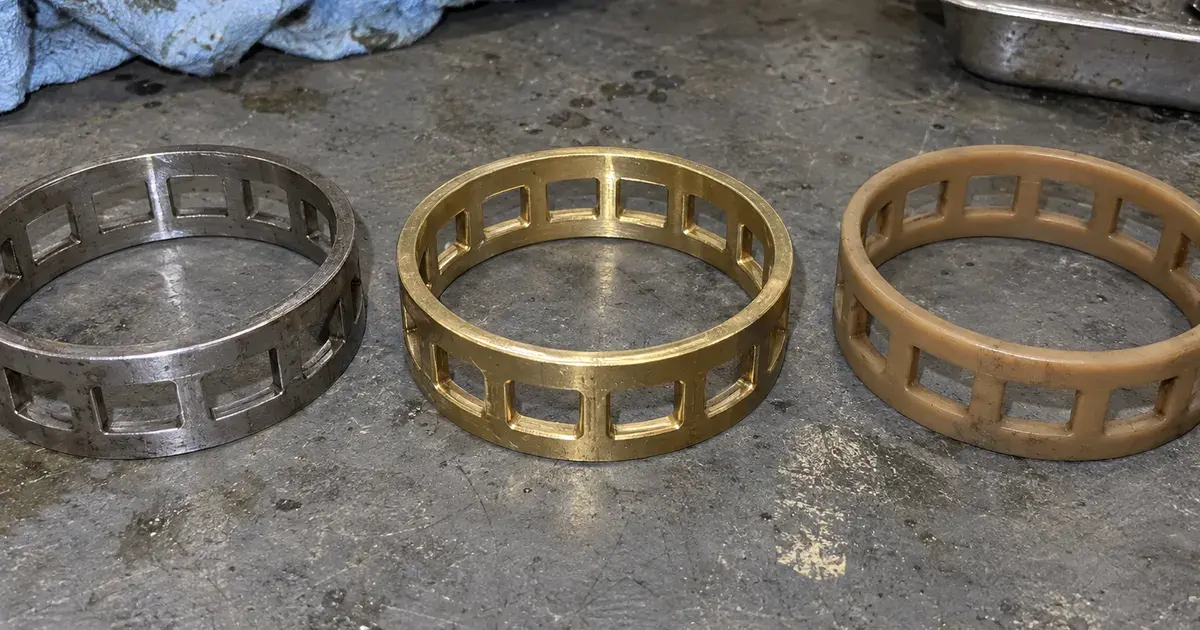
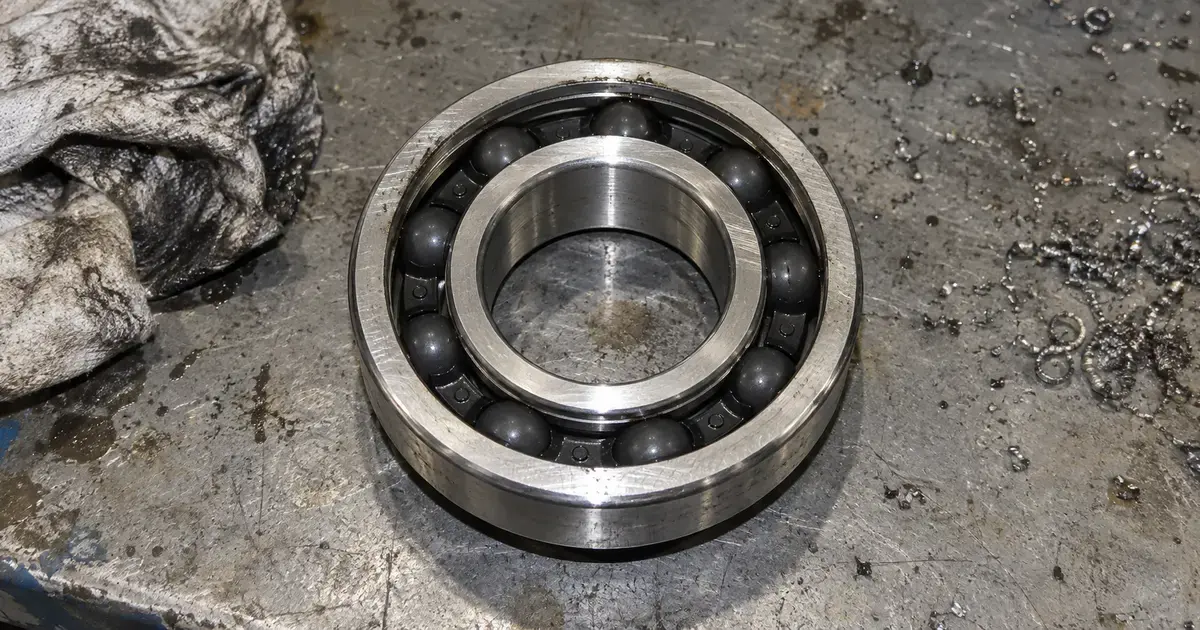
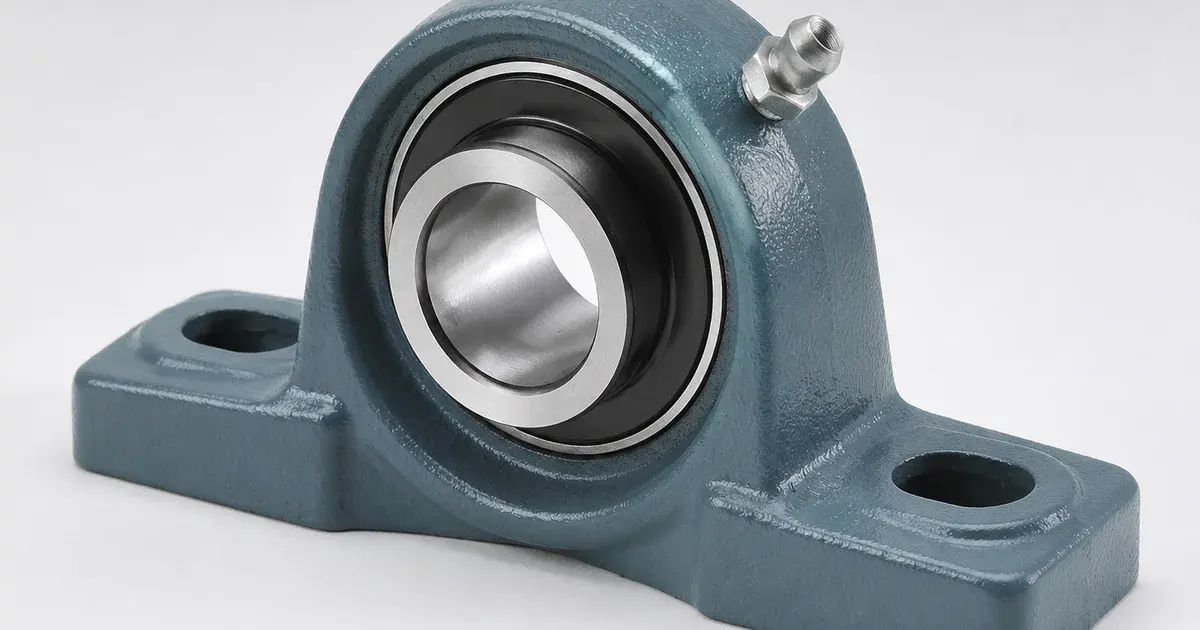
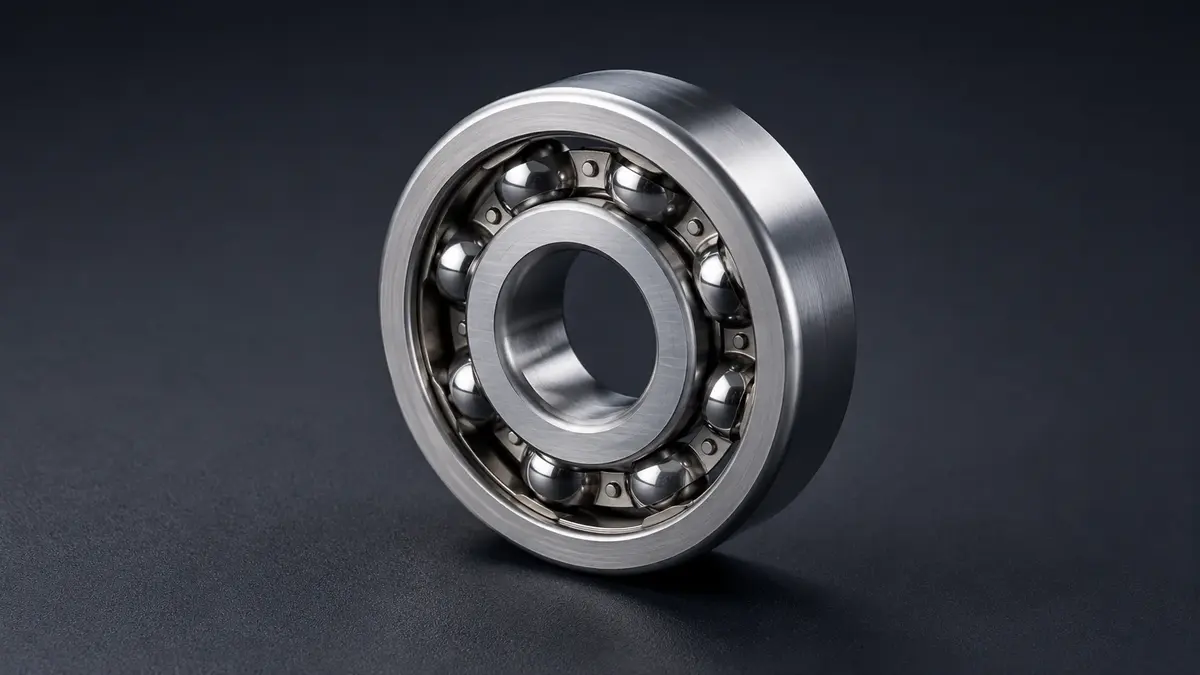
A bushing is a single piece — typically a press-fit cylindrical sleeve of bronze, steel-backed bimetal, sintered material, plastic, or a polymer composite. A rolling bearing is an assembly with three or four parts: an outer ring, an inner ring, a set of rolling elements, and (usually) a cage. That structural difference is where every other difference begins.
How Do Bearings and Bushings Differ?
Seven differences drive the engineering decision: friction coefficient, speed limit, load profile, lubrication strategy, cost, install method, and failure mode. The table below summarizes them, and the rest of this guide unpacks the ones that matter most.
| Factor | Bushing (plain bearing) | Rolling-element bearing |
|---|---|---|
| Friction coefficient (μ) | 0.05–0.20 typical (plain linear and sleeve) | 0.0010–0.0030 (≈10–100× lower) |
| Speed limit | PV-limit governed; heat fails it first | High DN values; fatigue fails it first |
| Load sweet spot | Heavy radial loads with shock or oscillation | Continuous radial (and axial, depending on type) |
| Lubrication | Boundary or hydrodynamic oil film, sometimes self-lubricating | Grease or circulating oil |
| Unit cost | Low — often a fraction of an equivalent rolling bearing | Higher; precision-ground raceway pricing |
| Install method | Press-fit / shrink-fit; sometimes self-installing | Slip-fit or mild interference; precision tooling |
| Failure mode | Surface wear, heat, PV exceedance | Sub-surface fatigue (raceway spalling) |
| Governing ISO standard | ISO 4378-1, ISO 7146-1 | ISO 281, ISO 76 |
Friction is the most quoted difference and also the most misunderstood. The Koyo/JTEKT engineering reference lists the friction coefficient for deep-groove ball bearings at 0.0010–0.0015, cylindrical roller bearings at 0.0008–0.0012, tapered roller bearings at 0.0017–0.0025, and spherical roller bearings at 0.0020–0.0025 (Koyo/JTEKT, Bearing Engineering Data, Section 8). Plain (sleeve) bearings sit at 0.01–0.20 depending on operating regime. Plain linear bushings run μ ≈ 0.05–0.10, while rolling-element linear guides come in around 0.005–0.010 — about ten times lower friction in matched conditions (Linear Motion Tips).
That order-of-magnitude separation is why electric motors, pumps, gearboxes, and wheel hubs default to rolling bearings. It's also why mistakenly substituting one class for the other — in either direction — usually fails.
The friction-coefficient spread inside the rolling-bearing family is small enough that swapping ball for roller for tapered rarely changes operating power loss in any meaningful way. The spread between rolling and plain is so large it changes the energy budget of an entire machine. That's the practical reason most production equipment defaults to rolling bearings, and most slow-rotation suspension and pivot points default to bushings.
When Are Bushings the Right Choice?
Choose a bushing when shock loading dominates, the duty cycle is intermittent or oscillating, contamination is unavoidable, or unit cost matters more than cycle cost. In those regimes, a properly sized bushing routinely outlasts a sealed bearing. No seal survives long-term mud, salt, or process dust, and no bearing race tolerates the impact loading that a compliant bushing absorbs.
A few applications where bushings consistently win:
- Suspension control arms and sway-bar links. Rubber and polyurethane bushings tune NVH (noise, vibration, harshness) by deflecting under load — a job a rigid rolling bearing can't do. Suspension-bushing service life is environment-driven, not mileage-driven. Heat, road salt, and moisture degrade rubber far faster than rotation count, which is why service intervals follow inspection rather than fixed mileage in the SAE chassis-engineering body of work (SAE J670 and related vehicle-dynamics references).
- Engine connecting-rod bearings. Despite the name, these are plain bearings — precision-machined steel-backed inserts riding on a hydrodynamic oil film. Peak combustion loads exceed what any rolling bearing of equivalent size could survive at engine RPM, and the oil film carries the load.
- Kiln cart wheels, agricultural pivot pins, and dry-pile machinery. Sintered bronze sleeves and self-lubricating composite bushings shrug off the dust and shock that destroys sealed rolling bearings.
- Quiet, low-load mechanisms. PTFE-composite bushings in medical guides and packaging machinery run dry, run quiet, and never need re-greasing.
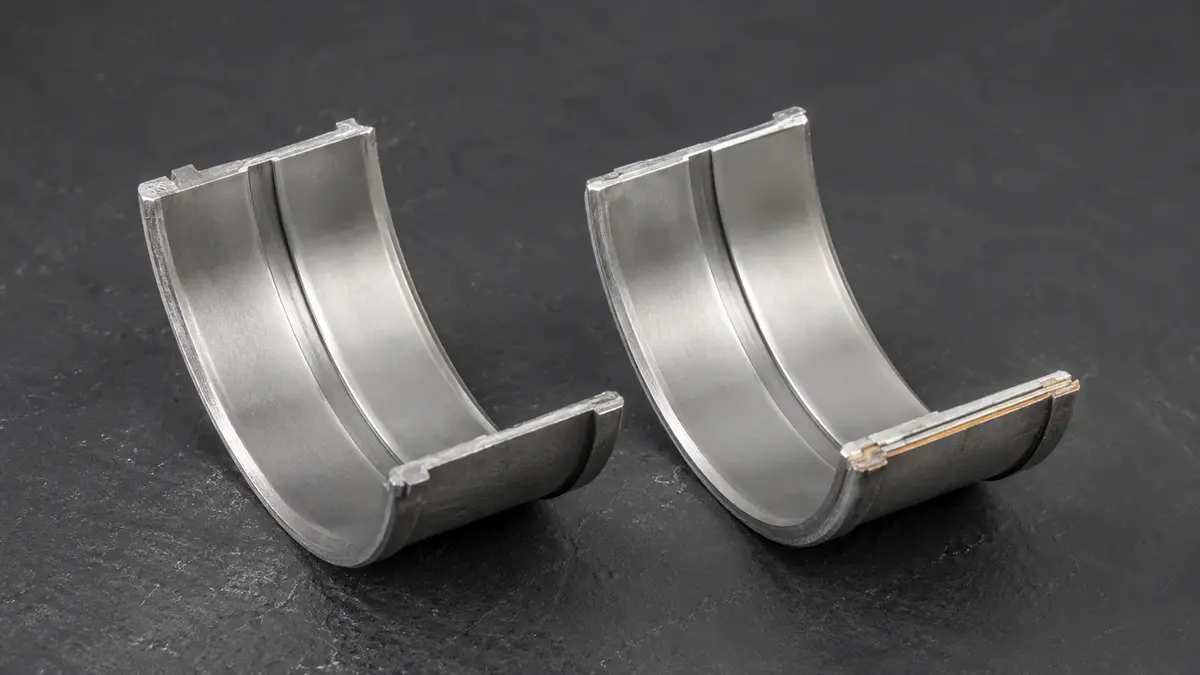
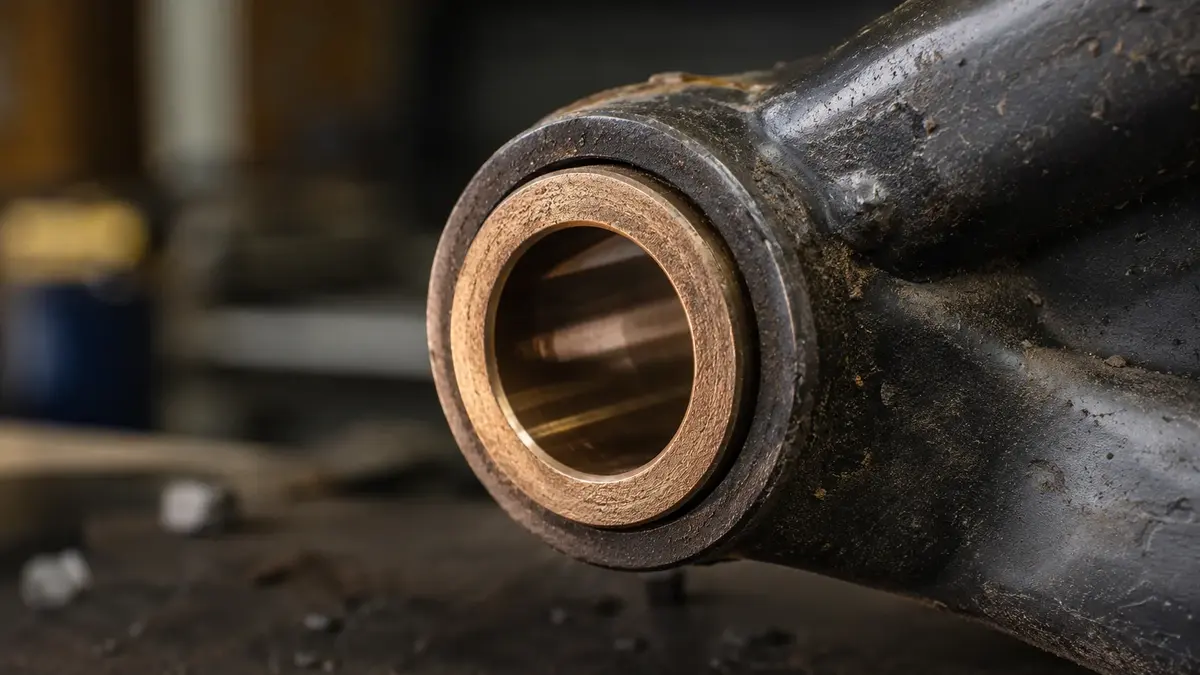
We don't sell bushings, but we do tell customers to use them when the application calls for one. The most common mistake we see in the field is over-engineering — specifying a sealed precision bearing for a slow-rotation, dirty pivot point that a $4 sintered bronze bushing would handle for years. The seal fails first, contamination gets in, and the bearing destroys itself trying to do a bushing's job.
If your application is dominated by shock, dirt, or oscillation, a bushing is probably the right answer. The next two sections explain why.
When Are Rolling-Element Bearings the Right Choice?
Specify a rolling-element bearing when continuous high-speed rotation, low friction, predictable rated life, or controlled tolerances are non-negotiable. That covers most production machinery: motors, gearboxes, pumps, vehicle wheel hubs, machine-tool spindles, and rolling-mill roll necks.
The case for rolling bearings rests on three structural advantages: friction is roughly two orders of magnitude lower than plain bearings (Koyo Table 8-1 above), service life is calculable to a 90% reliability via the L₁₀ formula in ISO 281:2007, and tolerance-grade specification (P0 through P2) lets designers control runout and play to micron precision. None of that is available from a bushing.
A few applications where rolling bearings dominate:
- Vehicle wheel hubs. Tapered roller bearing pairs handle combined radial and axial loads with predictable L₁₀ life. The architecture has been the automotive default since the 1920s.
- Centrifugal pumps. SKF's application handbook documents bearing-type selection by DN-value envelopes — different bearing types own different speed bands across the pump portfolio (SKF).
- Electric motors. Deep-groove ball bearings at the drive end and non-drive end give the lowest practical friction loss across the entire RPM range. That's directly an energy-efficiency argument: lower μ at the bearing translates to less waste heat over the motor's service life.
- Rolling-mill roll necks. Four-row tapered and four-row cylindrical bearings carry hundreds of tons across thousands of cycles per hour. ANDE's full rolling mill bearings catalog covers all three roll-neck architectures; for the architecture-by-stand decision, see our tapered vs cylindrical roller bearing guide and the definitive guide to rolling mill bearings.
According to Koyo's published reference data, deep-groove ball bearings operate at μ ≈ 0.0010–0.0015 (Koyo/JTEKT, Bearing Engineering Data, Section 8). Compared with the 0.05–0.10 typical of plain linear bushings, that's two orders of magnitude — the difference between rolling a wheeled cart and dragging a sled.
The radar plot makes the trade-off concrete. Rolling bearings dominate the friction-speed-life axes; bushings dominate the cost-shock-dirt axes. There's almost no overlap, which is why the parts coexist instead of substituting.
How Long Does Each Last? PV Limit vs L₁₀ Fatigue Life
Bushings die from heat exceeding their PV limit; bearings die from sub-surface fatigue after a calculable number of revolutions (L₁₀). The two regimes don't translate, which is why service-life numbers don't carry across between the parts. A claim that "bearings last longer than bushings" is true in some applications and false in others — and the math tells you which.
For a bushing, the operating duty is expressed as PV = P × V, where P is the projected unit load and V is the surface velocity (V = 0.262 × rpm × D in inch units). Each bushing material has a rated PV ceiling, published per material per geometry in the tribology literature (ASM International, ASM Handbook, Volume 18: Friction, Lubrication, and Wear Technology). Stay below it and the lubricant film holds; cross above it and surface temperature climbs to wear-out. Bushings don't fatigue — they overheat.
For a rolling bearing, life follows the L₁₀ formula in ISO 281:2007: L₁₀ = (C/P)ᵖ million revolutions, where C is the dynamic load rating, P is the equivalent load, and p equals 3 for ball bearings or 10/3 for roller bearings. Ninety percent of an identical-population sample survives at least L₁₀ revolutions before raceway spalling. The standard is the basis of every catalog life calculation and is widely adopted in federal-government and aerospace procurement (STLE Tribology & Lubrication Technology). Rolling bearings don't overheat (in their design envelope) — they fatigue.
For a deeper read on how the dynamic and static ratings interact in bearing sizing, see our guide to dynamic load vs static load in bearings.
The implication is the one most "bearings vs bushings" articles miss: there's a regime where a bushing routinely outlasts a bearing — slow rotation, heavy or shock loading, contamination — and a regime where a bearing routinely outlasts a bushing. Each part owns its zone. Trying to extend one part across the other's zone is where service life collapses.
What Does Each Cost — and How Do You Calculate Total Cost of Ownership?
A bushing can cost a small fraction of an equivalent rolling-element bearing on unit price, but installed cost depends on housing complexity, downtime, and replacement frequency. The right cost metric is dollars per operating hour, not dollars per part. Get that math wrong and the cheaper part is often the more expensive one.
The unit-price gap is real. A bronze sleeve bushing of moderate size sells for a small fraction of a precision rolling bearing of equivalent shaft diameter. Rolling bearings carry hardened-steel raceway, precision-ground roller, and cage cost that bushings don't.
But total cost of ownership has to factor in:
- Replacement frequency. Bushings replaced more often in regimes where a bearing would last longer; bearings replaced once where a bushing would have lasted decades.
- Energy cost. The 10-100× friction gap shows up directly as motor and pump power consumption. In continuous-duty applications, the energy delta over a year often exceeds the per-unit price difference.
- Downtime. Whichever part fails first dictates the maintenance cadence. In production machinery, an hour of unplanned downtime usually swamps multiple bearing replacements.
- Procurement complexity. Most large mills and OEMs dual-source — they need bushings and bearings across the same machine. (For procurement-side mechanics in our industry, see our guide on sourcing Chinese bearings overseas)
Globally, the rolling-bearing market is large and growing — Grand View Research sized it at USD 143.21 billion in 2025, projected to reach USD 301.33 billion by 2033 at a 9.8% CAGR (Grand View Research). Automotive bushings are tracked in a separate report. The two product families don't compete commercially — they coexist because they solve different problems.
The procurement question isn't "which part is cheaper" but "which part owns lower total cost of ownership in this application, at this duty cycle." Run the friction × hours × kWh math on a continuous-duty motor and rolling bearings usually win. Run the replacement-frequency × seal-life × downtime math on a dirty, slow-rotation pivot and bushings usually win.
How Do You Pick One for Your Application?
Use a three-step decision rule: (1) calculate operating PV for a candidate bushing — if it's below the bushing's rated PV, the bushing is viable; (2) estimate L₁₀ life for a candidate bearing — if it meets the application's required service interval, the bearing is viable; (3) when both are viable, pick by environment. Dirty, shock-loaded, intermittent → bushing. Clean, continuous, high-speed → bearing.
A worked example. Imagine a slow-rotation pivot pin on a bulk-handling conveyor — say 30 rpm, heavy radial load, exposed to dust and grit. Run a candidate bronze bushing's PV against the operating duty and it sits comfortably below the bushing's PV ceiling. Run an L₁₀ calculation on a candidate sealed deep-groove ball bearing of equivalent bore and the rated life is plenty. Both parts are mathematically viable, but the bearing's seal will fail under the contamination long before the raceway fatigues. Specify the bushing.
Now flip the scenario. A 1,800-rpm electric-motor shaft, clean lubrication, rated for 20,000 hours of continuous operation. Run the L₁₀ calc on a deep-groove ball bearing and the math comes out comfortably above 20,000 hours. Run a PV calc on a sleeve bushing of the same bore and the PV ceiling is exceeded at less than half the rated speed. Specify the bearing.
The procedure works because PV and L₁₀ are governed by different physics and bound different envelopes. When neither part satisfies, that's a signal the application needs something else entirely — a hydrodynamic oil-film bearing (the MORGOIL® class used in heavy mill backup rolls), a magnetic bearing, or a hybrid ceramic. Most of the time, though, one of the two viable answers is clearly superior and the math will show it.
ISO Standards Cheat Sheet — Bushings vs Bearings
Bearings and bushings are governed by separate ISO standards series because they fail by different physics. The crosswalk below maps the standards an engineer is most likely to cite when specifying or auditing either part.
| Topic | Rolling-element bearings | Plain bearings (bushings) |
|---|---|---|
| Vocabulary / classification | ISO 5593:2023 | ISO 4378-1:2024 |
| Dynamic rating / life | ISO 281:2007 (L₁₀) | (PV-limit per material data; no direct equivalent) |
| Load rating / operating limits | ISO 76:2006 | ISO 7902-3 (permissible operating parameters) |
| Failure modes / damage | ISO 15243 | ISO 7146-1:2019 |
When an audit or quality certification asks for a standard, it matters which family the part belongs to. ISO 281 doesn't apply to a sleeve bushing, and ISO 4378 doesn't apply to a deep-groove ball bearing. The crosswalk above is the map.
Frequently Asked Questions
Q: Is a bushing the same as a bearing?
A bushing is one type of bearing — specifically a plain (sliding-contact) bearing. Both classes carry a load while letting a shaft rotate or slide, but they do it through different physics. Plain bearings carry load on a sliding film; rolling-element bearings carry it on balls or rollers between hardened races (ISO 5593:2023; ISO 4378-1:2024).
Q: Which lasts longer — a bushing or a bearing?
Neither universally. A correctly sized rolling bearing in a clean, continuous-duty application outlasts a bushing by an order of magnitude (L₁₀ fatigue life per ISO 281:2007). A correctly sized bushing in a dirty, shock-loaded, slow-rotation application outlasts a sealed bearing because no seal survives long-term contamination. Pick by environment, not by reputation.
Q: Can you replace a bushing with a bearing (or vice versa)?
Sometimes — but not as a drop-in. The housing bore, fit tolerance, lubrication strategy, and failure mode all change. Replacing a control-arm bushing with a rolling bearing changes NVH characteristics. Replacing a wheel-hub bearing with a bushing exceeds the bushing's PV limit on day one (ASM Handbook Vol. 18). Re-engineer the housing, lubrication, and tolerance fit when crossing classes.
Q: When should you use a bushing instead of a bearing?
Pick a bushing when shock loading dominates, contamination is unavoidable, the duty cycle is intermittent or oscillating, or unit cost matters more than cycle cost. Common examples: suspension control-arm and sway-bar bushings, kiln cart wheels, agricultural pivot pins, engine connecting-rod bearings, and quiet low-load mechanisms in medical or packaging machinery.
Q: Why are rod bearings called bearings and not bushings?
Engine connecting-rod bearings are plain bearings that ride on a hydrodynamic oil film at very high pressures and shaft speeds. The "bearing" nomenclature stuck for historical reasons — they're precision-machined inserts (not press-fit sleeves) and they're designed around rated film thickness and PV envelopes, not raceway fatigue. Functionally they're plain bearings; the industry calls them rod bearings because that's what's stamped on the part number.
Q: Does the global bearing market include bushings?
Generally no. Grand View Research sized the global bearing market at USD 143.21 billion in 2025, projected to reach USD 301.33 billion by 2033 at a 9.8% CAGR (Grand View Research). The methodology is rolling-bearing-centric. Automotive bushings are tracked in a separate market report by the same firm.
Key Takeaways
- A bushing is a type of plain bearing; the real comparison is rolling-element vs plain.
- Rolling bearings deliver ~10–100× lower friction at speed; bushings give better shock and contamination tolerance.
- Failure regimes differ: PV-limit (bushing) vs L₁₀ fatigue (bearing). The two parts don't substitute one-for-one.
- Pick by environment + duty cycle, not by reputation.
- When in doubt, run the math both ways — PV for the bushing, L₁₀ for the bearing — and the application usually points clearly to one answer.
For a broader tour of the bearing family, see our guide to the different kinds of bearings. For the rating-life math behind bearing selection, see dynamic load vs static load in bearings. For ANDE's full rolling-element catalog — ball, roller, and rolling-mill — browse our products or contact our engineering team for a sizing review on your specific application.