
Choosing the wrong bearing for a rolling mill position doesn't just shorten bearing life — it causes unplanned downtime, damages rolls and housings, and degrades product quality. Yet bearing selection in rolling mills is often treated as a catalog exercise when it should be an engineering decision.
This guide walks through the practical steps of selecting the right bearing for each mill position and maintaining it for maximum service life. For a comprehensive overview of bearing types and technical characteristics, see our companion article: Rolling Mill Bearings: The Definitive Guide.
Step 1: Identify the Mill Position and Load Profile
The first decision is driven by where the bearing sits in the mill:
Work Roll Bearings
Work rolls contact the material directly. Their bearings experience:
- Very high radial loads from rolling pressure
- Moderate to high speeds (especially in finishing stands)
- Frequent roll changes — bearings must be easy to install and remove
- Thermal cycling from hot material contact
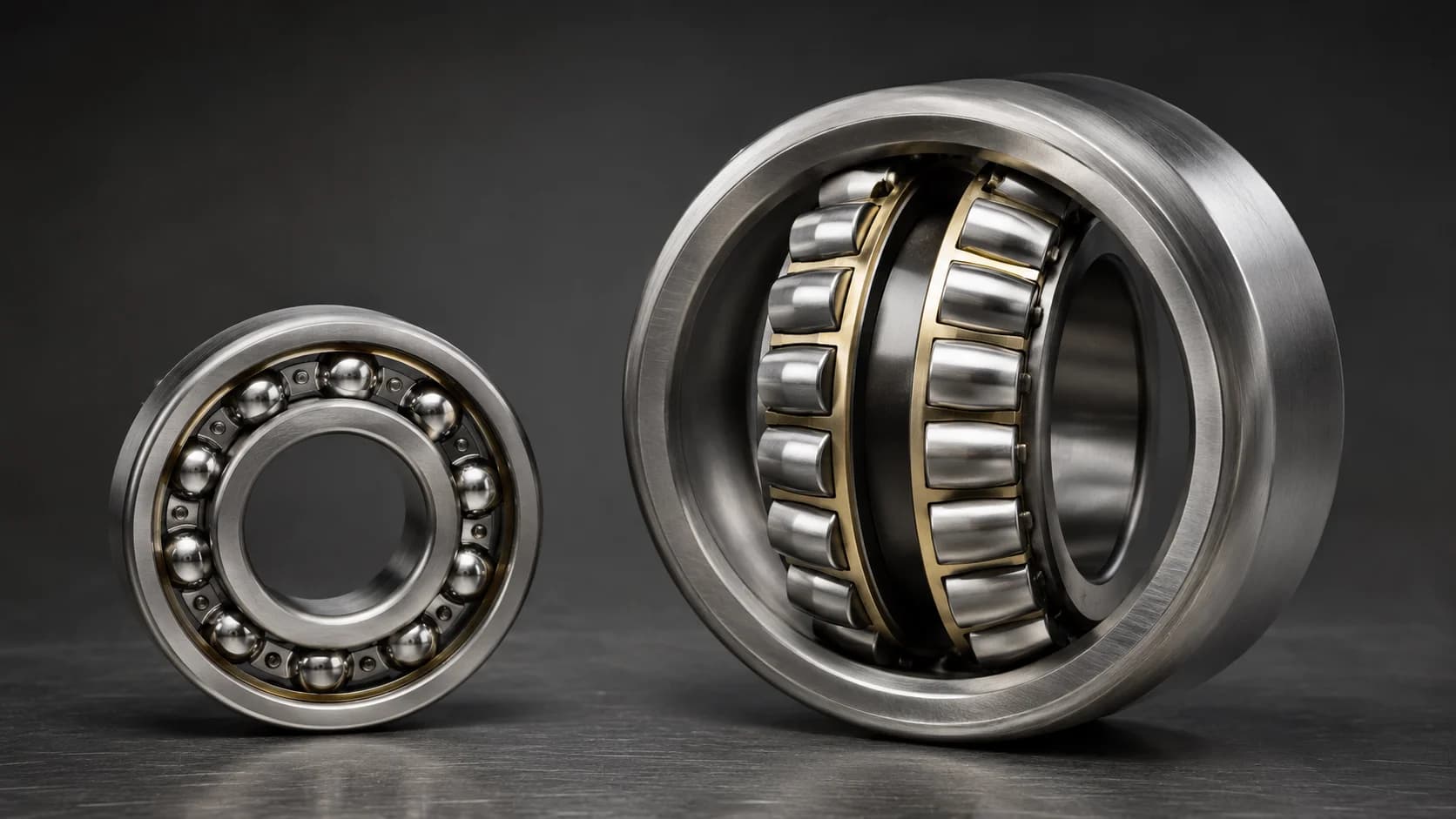
Best choice: Four-row cylindrical roller bearings for most work roll positions. Their separable construction allows roll changes without disturbing the bearing, and their compact cross-section fits the limited chock space.
Exception: When significant axial loads are present (common in heavy plate mills and non-ferrous rolling), four-row tapered roller bearings eliminate the need for separate thrust bearings.
Backup Roll Bearings
Backup rolls support the work rolls and carry the full rolling force. Their bearings see:
- The highest radial loads in the mill
- Lower speeds than work rolls
- Less frequent changes — longer service life is expected
- Axial forces from roll crossing or shifting systems
Best choice: Four-row tapered roller bearings for most backup roll positions, or hydrodynamic oil film bearings in high-production flat rolling mills where maximum accuracy and load capacity are required.
Intermediate and Cluster Roll Bearings
In Sendzimir (20-high) and other cluster mills:
- Extremely high contact pressures in a very small envelope
- Precision geometry is critical for strip thickness uniformity
Best choice: Backing bearings — purpose-built multi-row bearings designed specifically for cluster mill geometry.
Step 2: Match Clearance to Operating Temperature
One of the most common selection mistakes is specifying the wrong internal clearance.
| Mill Type | Typical Roll Neck Temperature | Recommended Clearance |
|---|---|---|
| Hot strip mill | 60–90°C during operation | C3 or C4 |
| Cold rolling mill | 30–50°C | CN (normal) or C3 |
| Plate mill | 50–80°C | C3 |
| Wire rod mill | 40–70°C | C3 |
Why it matters: Insufficient clearance at operating temperature causes excessive preload, overheating, and premature failure. Excessive clearance reduces load distribution uniformity and rolling accuracy.
For hot rolling mills, always calculate the expected thermal expansion of the roll neck and housing, then select clearance accordingly. When in doubt, err toward the larger clearance class — a slightly loose bearing runs cooler and lasts longer than a tight one.
Step 3: Select the Right Precision Class
Precision class directly affects strip thickness tolerance and surface quality:
| Precision Class | Typical Application | Thickness Tolerance |
|---|---|---|
| P2 | Ultra-precision cold rolling, foil mills | ±1–2 μm |
| P4 | High-precision cold rolling, aluminum foil | ±3–5 μm |
| P5 | Standard hot rolling, plate mills | ±10–20 μm |
Cost consideration: P4 bearings typically cost 30–50% more than P5. Only specify higher precision when the mill and product actually require it. A hot strip mill running P4 bearings gains nothing — the mill frame deflection and thermal crown already exceed the bearing's precision advantage.
Step 4: Choose the Right Lubrication System
The lubrication system must match the bearing type and operating conditions:
Oil-Air Lubrication (Recommended for Most Applications)
Delivers precise, metered oil quantities carried by a continuous airstream. Best for:
- High-speed finishing stands
- High-temperature hot rolling positions
- Applications requiring precise temperature control
Advantages: Superior cooling, minimal oil consumption, clean operation, extended bearing life.
Oil Mist Lubrication
Distributes a fine oil mist to multiple bearing points simultaneously. Best for:
- Rod and bar mills with many bearing positions
- Medium-speed applications
Advantages: Simple distribution system, low oil consumption, adequate cooling for moderate conditions.
Grease Lubrication
Simplest to implement but limited in performance. Best for:
- Low-speed roughing stands
- Auxiliary equipment (roller tables, guides)
- Positions where oil systems are impractical
Limitation: Poor cooling performance. Not suitable for high-speed or high-temperature positions.
Key Lubrication Rules
- Never mix lubricant brands or types — incompatible additives cause thickener breakdown and bearing failure
- Match viscosity to operating temperature: higher viscosity for hot rolling, lower for cold rolling
- Monitor oil condition regularly; contaminated lubricant is the leading cause of premature bearing failure
Step 5: Install Correctly
Poor installation causes more early bearing failures than poor bearing quality. Follow these standards:
Mounting
- Use induction heating or oil bath heating (80–90°C) to expand the inner ring for interference fit mounting. Flame heating is prohibited — it creates localized hot spots that damage the bearing steel microstructure.
- Ensure the installation environment is clean. A single particle of mill scale trapped between the inner ring and roll neck creates a stress concentration that leads to raceway spalling.
- Tighten fastening bolts in a cross pattern to prevent bearing eccentricity.
Alignment
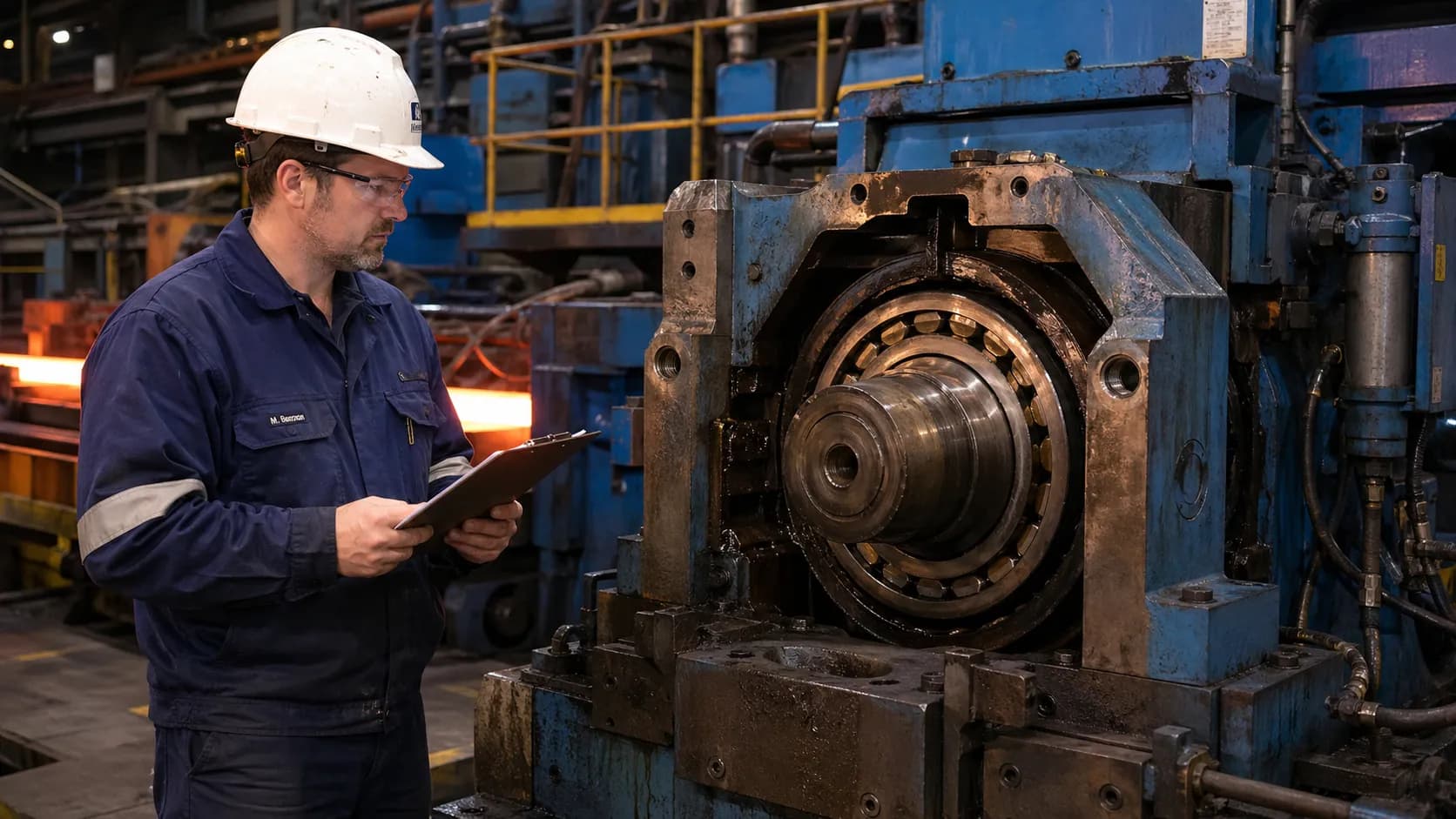
- Verify chock bore alignment before installation. Misaligned chocks impose bending loads on the bearing that dramatically reduce service life.
- For four-row cylindrical roller bearings, confirm that axial float is within specification — too little float prevents thermal expansion; too much allows the roll to shift during rolling.
Documentation
- Record the bearing serial number, installation date, and initial clearance measurement. This data is essential for tracking service life and identifying patterns in premature failures.
Step 6: Monitor and Maintain
Routine Monitoring Checklist
| Parameter | Normal Range | Action if Exceeded |
|---|---|---|
| Bearing temperature | ≤70°C | Shut down and inspect if >80°C or if temperature rises suddenly |
| Vibration level | Baseline ±20% | Investigate cause; schedule bearing inspection |
| Lubricant condition | Clean, correct viscosity | Replace if contaminated, discolored, or degraded |
| Seal integrity | No visible damage | Replace immediately if cracks or deformation found |
Predictive Maintenance Strategy
The most cost-effective approach is "predict first, replace second":
- Baseline: Record vibration and temperature data for each bearing position when new bearings are installed
- Trend: Monitor deviations from baseline over time. Gradual increases indicate normal wear; sudden changes indicate damage
- Plan: Schedule bearing replacement during planned mill shutdowns based on trend data — not on fixed calendar intervals
- Analyze: After removal, inspect bearings for failure patterns (spalling, pitting, cage damage, contamination) and feed findings back into selection and maintenance practices
This approach typically extends bearing service life by 20–40% compared to fixed-interval replacement, while reducing unplanned downtime.
Common Failure Modes and Prevention
| Failure Mode | Typical Cause | Prevention |
|---|---|---|
| Raceway spalling | Overload, fatigue, contamination | Correct load calculation, clean lubricant, proper sealing |
| Cage damage | Insufficient lubrication, misalignment | Adequate lubricant flow, proper installation alignment |
| Corrosion pitting | Water ingress through damaged seals | Regular seal inspection, prompt replacement |
| Fretting wear | Micro-movement under vibration | Correct interference fit, proper mounting |
| Overheating | Wrong clearance, lubricant failure | Correct clearance selection, lubricant monitoring |
Quick Reference: Bearing Selection by Mill Type
| Mill Type | Work Roll Bearing | Backup Roll Bearing | Thrust Bearing |
|---|---|---|---|
| Hot strip mill | Four-row cylindrical (C3/C4) | Four-row tapered or oil film | Tapered roller thrust |
| Cold strip mill | Four-row cylindrical (CN/C3) | Four-row tapered or oil film | Tapered roller thrust |
| Plate mill | Four-row cylindrical (C3) | Four-row tapered | Double-row tapered |
| Wire rod mill | Four-row cylindrical (C3) | Four-row cylindrical | Angular contact ball |
| Section mill | Spherical roller | Spherical roller | Tapered roller thrust |
| Sendzimir (20-high) | Backing bearings | Backing bearings | Integrated |
| Aluminum foil mill | Four-row tapered (P4) | Oil film | Integrated |
Conclusion
Bearing selection for rolling mills is an engineering decision, not a catalog exercise. The right bearing in the right position, installed correctly and maintained proactively, delivers years of reliable service. The wrong choice — or neglected maintenance — leads to costly failures that far exceed the price difference between bearing options.
Browse our rolling mill bearing products for detailed specifications, or contact our engineering team for selection support tailored to your specific mill configuration.